


The reporting that sparked this guide
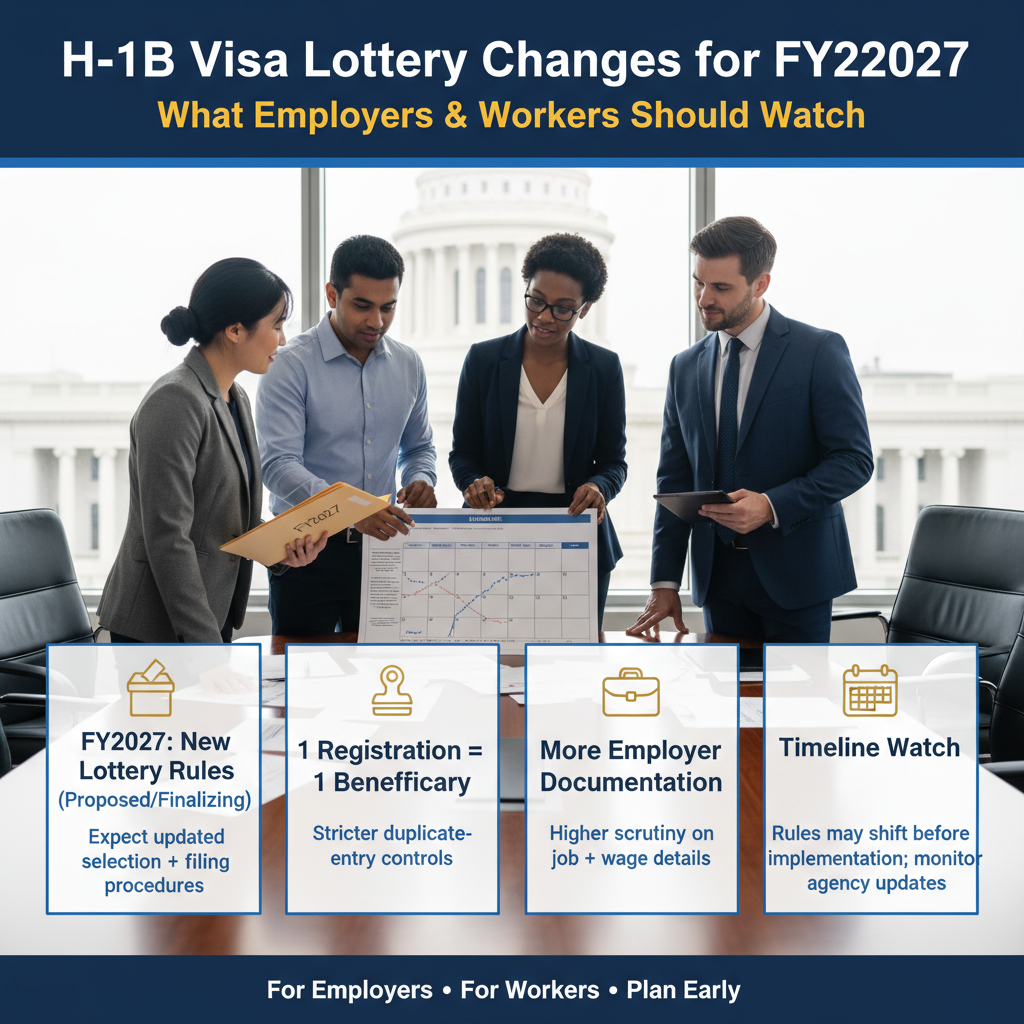
This article is based on trending coverage and discussion in legal and immigration news feeds, including: H-1B Visa Lottery Changes for FY2027 (Legal News).
Important: News coverage often summarizes proposed or newly finalized rules before agencies publish full implementation details. In this guide, we explain the H-1B “lottery” system, what changes are being discussed for FY2027, what is already in effect today, and how to prepare in a way that stays compliant regardless of final rollout dates.
Need Help? Our Orlando immigration team is ready to assist. Call +1 786-791-3106 for a free consultation, or message us online. Se Habla Español.
What This News Means for Immigrants in Orlando and Across Florida
Why this news is showing up now
The H-1B program remains one of the most competitive U.S. employment-based pathways. Each year, demand significantly exceeds the statutory cap (generally 65,000 regular cap slots plus 20,000 U.S. master’s or higher cap slots). Because of that mismatch, USCIS uses an electronic registration process and a random selection (“lottery”) to decide which employers can file full H-1B petitions.
Legal and business outlets are focusing on FY2027 because DHS/USCIS have been modernizing the H-1B process to address recurring problems—especially duplicate registrations, gaming of the system, and compliance concerns around job offers, third-party worksites, and wage levels. When agencies announce rulemaking, fee adjustments, or enforcement priorities, it can meaningfully change how employers and workers plan.
Reminder: “FY2027” refers to the federal fiscal year that begins October 1, 2026. The registration and selection typically happen months earlier (often in the spring). That means planning often starts the prior year.
How it can affect Florida residents
For Central Florida residents—especially along the I-4 corridor (Orlando, Lake Mary, Sanford, Kissimmee, and surrounding Orange County areas)—H-1B strategy affects:
- International students on F-1 OPT/STEM OPT working for Florida employers
- Professionals in tech, healthcare, engineering, finance, hospitality analytics, and higher education
- Families planning long-term stability, including eventual Adjustment of Status through employment-based green cards
- Employers trying to recruit and retain talent while staying compliant with wage, LCA, and worksite rules
If your case is in Orlando, the timing of selections and petition filings can also affect travel plans, driver’s license renewals, and downstream filings—like a change or extension of status, or later filings that depend on a stable underlying status.
What H-1B Visa Lottery Changes for FY2027 Is (and Why It Matters)
A plain-English definition
“H-1B lottery changes for FY2027” refers to anticipated updates to the rules and procedures USCIS uses to:
- Collect H-1B cap registrations (the short electronic registration)
- Select registrations for the limited number of cap-subject H-1B slots
- Decide who may file the full H-1B petition after selection
- Enforce compliance and deter manipulation (e.g., duplicate registrations)
These changes matter because a small procedural shift can change who gets selected, what evidence must be submitted, what timelines apply, and what risks an employer or worker faces if USCIS believes the registration or job offer is not legitimate.
Key terms you need to know
- H-1B cap: The annual numerical limit on new H-1B approvals for most employers.
- Electronic registration: The pre-filing step where employers register beneficiaries and pay a registration fee before filing the full petition.
- Beneficiary-centric selection: A selection approach intended to reduce the impact of multiple registrations for the same person by different employers (or related entities). In recent years, USCIS has moved toward selecting by beneficiary rather than by registration count.
- Cap-subject vs. cap-exempt: Many private employers are cap-subject; certain employers (e.g., qualifying universities and nonprofit research entities) can be cap-exempt.
- Specialty occupation: A role that normally requires at least a bachelor’s degree (or equivalent) in a specific specialty.
- LCA (Labor Condition Application): The Department of Labor filing (Form ETA-9035/9035E) that sets wage and working condition attestations.
- RFE: Request for Evidence—USCIS asks for more documents before deciding.
- Consular processing: Applying for the visa stamp abroad after an approval, versus changing status inside the U.S.
- Priority Date: A key date in many green card processes; it can become important when planning long-term immigration strategy.
Warning: Confusing the H-1B cap registration with the full H-1B petition is a common and costly mistake. Registration selection does not grant status; it only allows the employer to submit the full filing package to USCIS within the designated filing window.
Current Immigration Law: The Foundation
Even when procedures change, the H-1B program is grounded in federal statute and longstanding regulations. Understanding the foundation helps you spot what is truly “new” versus what is a repackaged enforcement focus.
Federal requirements
The H-1B classification is authorized by the Immigration and Nationality Act (INA), primarily INA § 101(a)(15)(H)(i)(b), with numerical limits under INA § 214(g). Implementing regulations are largely found in 8 C.F.R. § 214.2(h). Wage and labor condition rules are administered by the U.S. Department of Labor under 20 C.F.R. Part 655, Subparts H and I.
In practice, most cap-subject H-1B petitions include:
- Form I-129 (Petition for a Nonimmigrant Worker) with H Classification Supplement
- A certified LCA (ETA-9035/9035E)
- Evidence of a specialty occupation and the worker’s qualifications
- Employer-employee relationship evidence, especially for third-party placement scenarios
For downstream planning, many H-1B workers later pursue permanent residence through employment-based categories. While not H-1B-specific, families commonly ask about: Form I-130, Form I-485, Adjustment of Status, and the Priority Date concept (often tied to PERM and I-140 in employment cases).
Official references: USCIS official website, USCIS Forms, USCIS Processing Times, U.S. Department of State, Executive Office for Immigration Review.
Florida-specific considerations
Immigration law is federal, so Florida does not create separate H-1B visa eligibility rules. However, Florida-specific realities can affect how cases are prepared:
- Industry mix: Central Florida employers often hire in hospitality tech, simulation, aerospace/defense-adjacent engineering, healthcare systems, and higher education.
- Worksite geography: Commuting patterns along the I-4 corridor can mean multiple worksites (client sites, campuses, hospitals). That can trigger LCA posting and amendment considerations if the work location changes.
- The Orlando USCIS Field Office: While many H-1B filings are adjudicated at USCIS service centers, local field offices may become relevant for related filings (e.g., family Adjustment of Status interviews, certain compliance checks, or other case types). Planning should account for local scheduling realities.
- State licensing: Certain roles (e.g., healthcare) may involve Florida licensing timelines that should align with H-1B start dates and petition evidence.
Important: If your job duties or worksite will change after filing, talk to counsel early. Some changes may require an amended petition before the move—especially when the new location falls outside the area of intended employment covered by the LCA.
Need Help? Our Orlando immigration team is ready to assist. Call +1 786-791-3106 for a free consultation, or message us online. Se Habla Español.
How to Prepare for the FY2027 H-1B Lottery: A Complete Step-by-Step Guide
The best response to “new rules” is a compliant, well-documented case that can withstand scrutiny—whether USCIS tightens definitions, increases audits, or adjusts selection mechanics.
1) Confirm you actually need the cap lottery (cap-subject vs. cap-exempt)
Start by determining whether the employer is cap-subject. Some roles may qualify for cap-exempt H-1B (e.g., certain nonprofit entities affiliated with institutions of higher education, universities, nonprofit research, and governmental research organizations). If cap-exempt, you may be able to file without the lottery.
Documents to gather:
- Employer corporate documents (articles of incorporation, FEIN verification)
- Organizational chart and business description
- If claiming cap-exempt: evidence of qualifying status/affiliation (contracts, affiliation agreements, IRS letters)
- Proposed offer letter detailing role, salary, and worksite(s)
2) Vet the position as a “specialty occupation” and align the degree field
One of the most common RFE issues is whether the role truly requires a specific bachelor’s degree (or higher) in a particular specialty. For FY2027 planning, assume USCIS will continue scrutinizing:
- Generic job titles with vague duties
- Entry-level wages that appear inconsistent with complex duties
- Third-party placement without strong end-client documentation
Documents to gather:
- Detailed job description (daily/weekly duties, tools, technologies, reporting structure)
- Minimum requirements (degree level, specific major(s), experience)
- Evidence of industry standard (job postings, O*NET references, internal job ladders)
- Beneficiary diploma(s), transcripts, credential evaluation (if foreign degree)
- Resume, experience letters, certifications
3) Plan wage strategy and complete the LCA pathway early
The LCA is central. Employers must pay at least the required wage and comply with notice/posting rules. Wage strategy should match the duties, location, and experience level.
For Central Florida residents, wages may vary significantly between Orange County, Seminole County, and Tampa/Daytona markets along I-4. A multi-worksite role can complicate prevailing wage determinations.
Documents to gather:
- Worksite addresses (including remote work arrangements)
- Proposed salary and benefits summary
- Internal wage documentation (pay bands, compensation policy)
- Proof of LCA posting method (physical posting screenshots/photos or electronic posting records)
4) Prepare the electronic registration correctly (and ethically)
The registration phase is where many “lottery changes” are targeted. USCIS has increasingly focused on preventing manipulation through duplicate registrations and related entities.
Employers should register only when there is a legitimate job offer and a genuine intent to file an H-1B petition if selected. Coordination among related companies is especially important.
Documents to gather:
- Beneficiary passport biographic page
- Beneficiary legal name and date of birth (match passport exactly)
- Prior U.S. immigration history summary (F-1, OPT, CPT, prior H-1B, etc.)
- Company signatory authority proof (who can sign and submit)
- Internal memo documenting the bona fide job offer and intent to file
Warning: If USCIS suspects collusion, shell companies, or improper duplicate filings, denials and fraud findings can have long-term consequences for both employer and worker.
5) If selected, file the full H-1B petition within the filing window
After selection, USCIS provides a limited filing period (a “window”) to submit the full petition package. Missing the window can forfeit the selection.
Although people often talk about a 90-day window, the exact filing period is set by USCIS each season. Treat it as a hard deadline and plan as if you have less time than you think.
Documents to gather:
- Form I-129 with H supplement and supporting letter
- Certified LCA
- Employer support letter describing specialty occupation and business need
- Beneficiary degree evidence and evaluations
- Maintenance of status evidence (I-94, prior approvals, EAD if applicable)
- Third-party documents if applicable (end-client letter, SOW, itinerary)
- Filing fees checks and G-28 (attorney appearance) if represented
6) Maintain status, travel carefully, and prepare for RFEs
Selection and filing do not automatically protect a beneficiary from status gaps. F-1 students, for example, must track OPT/STEM OPT end dates and cap-gap provisions carefully.
If your case is in Orlando and you plan international travel, confirm whether you are changing status in the U.S. or planning consular processing. Travel at the wrong time can disrupt a change-of-status request.
Documents to gather:
- All I-20s (for F-1), EAD cards, OPT/STEM OPT approvals
- Recent pay statements and job verification letters
- Updated organizational chart and project documents (to answer RFEs)
- Travel history and visa stamp copies
7) Build a long-term plan (extensions, portability, and green card strategy)
H-1B is temporary but “dual intent” is generally permitted, meaning you can pursue permanent residence while in H-1B. Many families want a stable plan that includes dependents and future work authorization for spouses when eligible.
While this article focuses on the H-1B cap, long-term planning often involves PERM labor certification, I-140, and later Adjustment of Status using Form I-485 when the Priority Date is current. Family-based pathways may involve Form I-130.
Documents to gather:
- Immigration history timeline (all statuses and dates)
- Dependents’ documents (marriage certificate, birth certificates, passports)
- Prior I-797 approvals and I-94 records
- Education and employment records for future immigrant petition support
Practical Steps You Can Take Today
Regardless of the final shape of FY2027 “lottery changes,” the winners are usually the people who prepare early, document thoroughly, and avoid risky shortcuts.
Actionable checklist (do these now)
- 1) Create a single “master file” with passport, prior I-94s, prior approvals, all I-20s (if F-1), EADs, and visa stamps.
- 2) Ask your employer for a detailed job description with specific tools, technologies, and percentage-of-time duties.
- 3) Confirm all worksite addresses (including remote work). Changes later can trigger amendment obligations.
- 4) If you have a foreign degree, order a credential evaluation early (some take weeks).
- 5) Track deadlines: OPT end date, STEM OPT end date, and the employer’s internal registration timeline.
- 6) Discuss backup options (cap-exempt roles, O-1, TN if eligible, L-1 for multinational employers, or continuing education) with counsel.
Document preparation guidance
USCIS decisions often turn on whether the paper trail matches reality. Aim for consistency across:
- Offer letter vs. LCA wage and location
- Job duties vs. degree field
- Organizational chart vs. claimed supervision
- End-client documents vs. itinerary and worksite
Reminder: Keep copies of everything submitted. If an RFE arrives, you’ll respond faster and more accurately.
Timeline expectations (typical planning)
- 6–9 months before registration: confirm specialty occupation, degree alignment, and worksites; start evaluations.
- 2–3 months before registration: finalize job description; prepare internal compliance documentation.
- Registration period: submit accurate electronic registration(s) only when there is a bona fide job offer.
- After selection: file full petition within the USCIS-designated filing window.
- After filing: watch for receipts, biometrics (if applicable), and RFEs; track case status and processing times at USCIS Processing Times.
Important: Processing times vary widely by service center and workload. Premium processing (when available for the case type) can shorten the decision timeline, but it does not change eligibility requirements.
Need Help? Our Orlando immigration team is ready to assist. Call +1 786-791-3106 for a free consultation, or message us online. Se Habla Español.
How Imigrar Helps Immigrants in Orlando
Imigrar is based in Orlando, Florida, and serves clients nationwide. We help workers, students, and employers prepare strong, compliant H-1B cases—especially when new rules create uncertainty.
- Case strategy for cap-subject and cap-exempt H-1B filings
- Specialty occupation analysis and RFE-prevention documentation
- Worksite/LCA compliance planning and change management
- Family planning support for dependents and longer-term pathways (including Adjustment of Status planning with Form I-485 when appropriate)
If your case is in Orlando or you’re a Central Florida resident, we can help you coordinate employer timelines, travel considerations, and any related filings that may route through local processes. Se Habla Español.
Reminder: A “lottery change” headline can lead people to rush. Our approach is to slow down the right parts—job analysis, documentation, and compliance—so you can move fast when the filing window opens.
Frequently Asked Questions
Q: Will the FY2027 H-1B lottery changes make it easier to get selected?
A: Not necessarily. Many proposed or discussed changes aim to make selection fairer and reduce manipulation, not to increase the number of visas. Because the cap is set by statute (generally 65,000 + 20,000), selection odds still depend heavily on demand. The best way to improve your outcome is to ensure the registration is accurate, the job offer is bona fide, and the case is ready to file immediately if selected.
Q: I’m on F-1 OPT in Orlando—how do these changes affect my status?
A: The lottery changes do not automatically change your F-1 status, but they can affect timing and planning. If selected and the employer files a change-of-status H-1B petition, you may rely on cap-gap rules in certain situations. Track OPT/STEM OPT expiration dates carefully and coordinate with your Designated School Official (DSO). If you travel internationally while a change-of-status petition is pending, you may disrupt the change-of-status portion and need consular processing.
Q: What documents are most important for the new FY2027 H-1B environment?
A: Focus on (1) a detailed job description tied to a specific degree field, (2) degree proof and credential evaluation (if needed), (3) a clean worksite plan (including remote work), (4) LCA alignment with wage and location, and (5) evidence of a real employer-employee relationship. If third-party placement is involved, end-client letters and project documentation are often critical.
Q: How long does the H-1B process take from registration to approval?
A: Timelines vary each year. The registration is typically a short window; selections follow soon after. If selected, the full petition must be filed within the USCIS-designated filing period (often discussed as a 90-day window, but always confirm the exact dates on your selection notice). After filing, adjudication timing depends on workload and whether premium processing is used (when available). Check current estimates at USCIS Processing Times.
Q: How much does an H-1B case cost?
A: Costs include government filing fees (which can vary by employer size and case type), potential premium processing fees (optional), attorney fees, and third-party costs like credential evaluations. Important: Certain fees must be paid by the employer under Department of Labor rules; improper cost-shifting can create compliance problems. We recommend employers budget early and document fee payments properly.
Q: What happens if my registration is selected but USCIS later denies the petition?
A: A selection only allows the employer to file—it is not an approval. If denied, the worker generally cannot rely on that filing for long-term status and may need to depart, change to another status, or pursue another strategy depending on their current status and grace periods. If you receive a Notice of Intent to Deny (NOID) or denial, speak with counsel immediately to evaluate motions, refiling options, or alternative categories.
Q: Can multiple employers register me to increase my chances under FY2027 rules?
A: USCIS has been moving toward systems that reduce the advantage of multiple registrations for the same beneficiary. Even when multiple employers are allowed, each registration must represent a legitimate, independent job offer with a real intent to file. Related entities or coordinated filings can trigger fraud concerns. Warning: Do not participate in “paper offers” or pay-to-play registration schemes.
Q: If my spouse is in H-4, will FY2027 changes affect their ability to work?
A: H-4 work authorization (via H-4 EAD) depends on specific criteria (often tied to the H-1B principal’s stage in the green card process). FY2027 lottery mechanics typically won’t directly change H-4 EAD rules, but delays or denials can indirectly affect a spouse’s timeline. Plan your long-term strategy early, including PERM/I-140 timing where appropriate.
Common Mistakes (and How to Avoid Them)
Mistake #1: Treating the registration like a “placeholder” without a real job offer
USCIS expects a bona fide position and a real intent to file. If the role, wage, or worksite is not real—or cannot be documented—your case is vulnerable.
How to avoid it: Create a complete job packet before registration: duties, reporting structure, wage, worksite, and business need.
Mistake #2: Inconsistent information across the offer letter, LCA, and petition
Small inconsistencies (title, location, salary, duties) can lead to RFEs or denials. In a tighter enforcement environment, inconsistencies can also raise credibility issues.
How to avoid it: Use one “source of truth” document set, and have counsel cross-check every field before filing.
Mistake #3: Ignoring worksite changes and remote work compliance
Moving from one location to another—especially outside the LCA area of intended employment—may require a new LCA and an amended filing.
How to avoid it: Build a change-management plan with HR. If you’re a worker, notify your employer before you move. For Central Florida residents commuting along I-4 or switching client sites, confirm whether the change triggers an amendment.
Need Help? Our Orlando immigration team is ready to assist. Call +1 786-791-3106 for a free consultation, or message us online. Se Habla Español.

Closing: Get Help Navigating FY2027 H-1B Lottery Changes
The biggest risk with “H-1B lottery changes for FY2027” is not the change itself—it’s reacting too late or relying on rumors. The safest approach is to prepare a case that is consistent, well-documented, and compliant under the existing statutory framework (INA § 214(g), 8 C.F.R. § 214.2(h), and DOL LCA rules), while staying flexible for procedural updates.
If your case is in Orlando, if you live in Orange County, or if you’re anywhere in Central Florida along the I-4 corridor, Imigrar can help you and your employer plan early—so you’re ready the moment registration opens and ready again if USCIS requests more evidence.
Need help now? Call Imigrar at +1 786-791-3106 for a free consultation, or message us online. Se Habla Español. Our mission is to Keep Families Together.


