


The reporting that sparked this guide
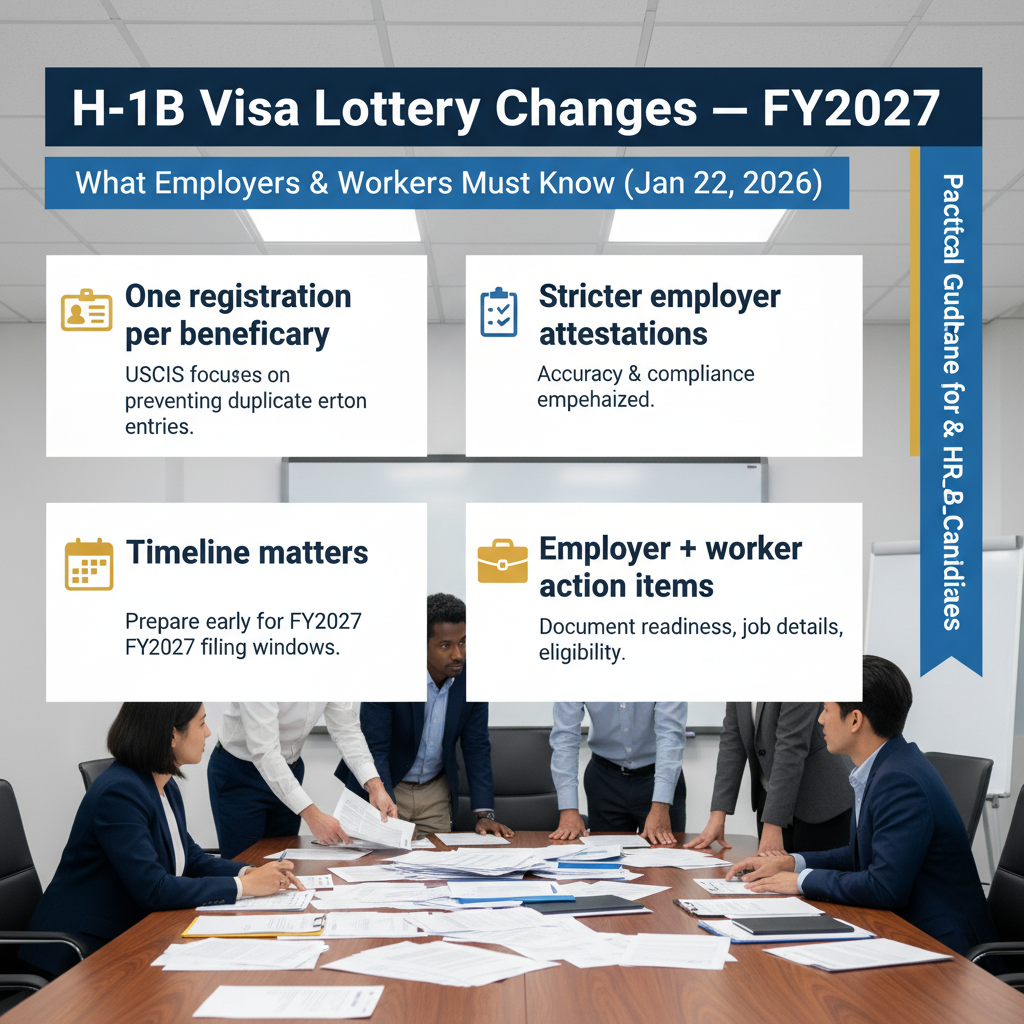
This article is based on trending coverage and commentary circulating in legal and immigration news feeds, including: H-1B Visa Lottery Changes for FY2027 (Legal News).
Important: News headlines often summarize proposed or newly finalized rules without the full operational details. USCIS implementation memos and Federal Register notices typically control how employers must comply. We link official resources throughout, including the USCIS official website.
Need Help? Our Orlando immigration team is ready to assist. Call +1 786-791-3106 for a free consultation, or message us online. Se Habla Español.
What This News Means for Immigrants in Orlando and Across Florida
Why this news is showing up now
H-1B rules tend to “trend” every year for one simple reason: the H-1B cap season is one of the most competitive immigration processes in the U.S., and it runs on a predictable calendar. Employers typically register beneficiaries in March, selections are issued soon after, and cap-subject filings follow.
For FY2027, the attention is even higher because USCIS has been steadily modernizing the H-1B system—especially the electronic registration process, anti-fraud measures, and how it determines whether multiple registrations unfairly increase selection odds.
Reminder: Even when a rule is “final,” USCIS may phase in implementation (for example, updating myUSCIS accounts, revising form instructions, or changing the way it validates passport/travel document data). That’s why planning early matters.
How it can affect Florida residents
Florida has a large and growing population of international students, STEM graduates, healthcare professionals, hospitality and finance workers, and multinational corporate transfers—many of whom rely on H-1B as the bridge from F-1 OPT to longer-term work authorization and, eventually, permanent residence.
- For Central Florida residents along the I-4 corridor (Orlando, Kissimmee, Lake Mary, Sanford, Winter Park, and beyond), H-1B sponsorship is common in tech, simulation, aerospace/defense contracting, healthcare, higher education, and professional services.
- If your case is in Orlando, your employer’s strategy may need to account for local hiring timelines, university graduation cycles, and the reality that many candidates are on a strict work authorization clock (OPT/STEM OPT).
- Any shift in lottery mechanics can change the risk profile for workers living in Orange County and surrounding counties: whether to rely on the cap, pursue a cap-exempt option, or build a “Plan B” such as STEM OPT extension, O-1, L-1, TN (if eligible), or family-based paths like Form I-130 and Form I-485 via Adjustment of Status.
What H-1B Visa Lottery Changes for FY2027 Is (and Why It Matters)
A plain-English definition
The “H-1B visa lottery” is the selection process USCIS uses when it receives more H-1B cap registrations than available cap numbers. Most private-sector employers are subject to an annual cap (generally 65,000 regular cap plus 20,000 for U.S. master’s or higher degree holders). Because demand exceeds supply, USCIS runs a random selection to decide which employers may file full H-1B petitions for their chosen workers.
“H-1B Visa Lottery Changes for FY2027” refers to rule and process updates that may affect:
- How employers register beneficiaries
- How USCIS identifies and prevents duplicate or improper registrations
- What data must be provided at registration (and how it is validated)
- How selections are issued and what happens if USCIS conducts multiple selection rounds
- Compliance expectations and fraud enforcement
Why it matters: If you miss a registration requirement, submit inconsistent identity data, or rely on risky “multiple registration” schemes, you can lose your chance for the entire fiscal year��often with major consequences for your ability to stay and work lawfully in the U.S.
Key terms you need to know
- Cap-subject H-1B: H-1B petitions counted against the annual cap (most private employers).
- Cap-exempt H-1B: H-1B petitions not counted against the cap (certain universities, nonprofit entities affiliated with higher education, and nonprofit/government research organizations).
- Electronic registration: The online pre-registration system employers use before filing a full H-1B petition.
- Beneficiary-centric selection: A system designed so each person (beneficiary) is entered once into the lottery, even if multiple employers register them—reducing incentives for duplicate registrations.
- Specialty occupation: A role that normally requires at least a U.S. bachelor’s degree (or equivalent) in a specific specialty.
- LCA (Labor Condition Application): A Department of Labor filing that sets wage and worksite terms; it must be certified before filing the H-1B petition.
- RFE: Request for Evidence—USCIS asks for more documentation before deciding.
- Consular processing vs. Change of Status: Whether you obtain H-1B via a U.S. consulate abroad or change status inside the U.S.
- Priority Date: More relevant to green cards than H-1B, but important in long-term planning (especially for PERM/I-140 and Adjustment of Status with Form I-485).
Need Help? Our Orlando immigration team is ready to assist. Call +1 786-791-3106 for a free consultation, or message us online. Se Habla Español.
Current Immigration Law: The Foundation
Even when USCIS tweaks lottery procedures, H-1B eligibility still rests on the same legal framework: the Immigration and Nationality Act (INA), federal regulations, and agency policy guidance.
Federal requirements
Key federal authorities include:
- INA § 214 (governing nonimmigrant admissions and conditions)
- 8 U.S.C. § 1184 (statutory basis for H visas, including H-1B)
- 8 C.F.R. § 214.2(h) (core H-1B regulatory requirements, including specialty occupation and petition rules)
- 20 C.F.R. § 655 (Department of Labor regulations for LCAs)
In practice, most cap-subject H-1B cases involve these filings and systems:
- USCIS online H-1B registration (myUSCIS)
- DOL LCA submission and certification
- USCIS petition filing (often with Form I-129, Petition for a Nonimmigrant Worker)
You can verify forms and instructions at: USCIS Forms and the USCIS official website.
Warning: H-1B is employer-driven. The worker cannot “self-petition” for a cap-subject H-1B in the way some green card categories allow. If your employment changes, your status may be affected, and you may need an H-1B transfer/amendment.
Florida-specific considerations
Florida does not set separate H-1B eligibility rules (H-1B is federal), but Florida realities affect case strategy:
- Multi-site worksites: Many Florida employers operate across Orlando, Tampa, and the Space Coast. Worksite changes can trigger LCA and H-1B amendment requirements.
- Tourism/hospitality vs. specialty occupation: Some Florida industries struggle to fit the specialty occupation standard. Careful job description and degree relevance documentation is critical.
- Healthcare placements: Staffing models (third-party worksites) can increase scrutiny. Contracts, itineraries, and control/supervision evidence become essential.
- The Orlando USCIS Field Office typically handles interviews for many family-based Adjustment of Status cases (such as Form I-130 + Form I-485). While H-1B petitions are generally adjudicated at USCIS service centers, family-based strategies often run in parallel for long-term planning.
Track general USCIS timelines here: USCIS Processing Times. For consular steps, see: U.S. Department of State.How to Prepare for FY2027 H-1B Lottery Changes: A Complete Step-by-Step Guide
This step-by-step guide is designed for (1) employers planning to sponsor and (2) workers who need to coordinate documentation, timing, and backup options. While the “action” is employer-led, beneficiaries can dramatically improve outcomes by preparing early and avoiding common pitfalls.
1) Confirm the role qualifies as a specialty occupation (and document it)
Before you worry about the lottery, confirm the job is H-1B-eligible. USCIS focuses on whether the position normally requires at least a bachelor’s degree in a specific field and whether the beneficiary’s education matches.
Documents to gather (employer):
- Detailed job description (duties, tools/tech, supervision, deliverables)
- Minimum requirements (degree level, majors accepted, experience)
- Org chart and reporting structure
- Evidence of similar hires (job postings, prior hiring records)
- Client letters/contracts if third-party placement is involved
Documents to gather (worker):
- Diplomas and transcripts (U.S. and foreign)
- Credential evaluation for foreign degrees (if needed)
- Resume/CV and reference letters verifying specialized experience
- Professional licenses (if applicable)
- Immigration history (I-94, prior approvals, visa stamps)
Important: A weak specialty-occupation case can be selected in the lottery and still be denied later. Think of the lottery as “permission to file,” not “approval.”
2) Build a compliant registration strategy (one beneficiary, consistent identity data)
Recent USCIS reforms have focused on discouraging duplicate registrations designed solely to increase odds. For FY2027, expect continued emphasis on identity consistency and fraud detection.
Documents/data to prepare (employer and worker):
- Exact legal name (matching passport)
- Passport or travel document information (number, issuance, expiration)
- Date of birth and country of birth/citizenship
- U.S. master’s degree eligibility evidence (if applicable)
- Prior SEVIS/OPT details for F-1 beneficiaries
Warning: Inconsistent passport data or multiple registrations filed without legitimate job offers can create denials, revocations, or fraud findings. If multiple employers truly want to hire you, each must have a real, independent job offer and the ability to employ you—paper “offers” are risky.
3) Align with the cap season calendar and the 90-day window realities
USCIS typically opens the electronic registration period in March and then issues selections. If selected, employers get a filing window (often around 90 days, though USCIS controls the exact dates each year) to submit the full H-1B petition.
Documents to prepare early (employer):
- Company support letter draft
- FEIN verification and corporate documents (as needed)
- Financials or payroll records (to show ability to pay)
- Worksite addresses and hybrid/remote policy details
Documents to prepare early (worker):
- All prior I-20s/DS-2019s (if any)
- EAD card (OPT/STEM OPT) and approval notices
- Pay stubs and employment verification
- Current I-94 record
Reminder: If you’re on F-1 OPT and not selected, you may need a backup plan before your EAD end date. Don’t wait until the last minute.
4) Prepare the LCA and wage compliance file
The LCA is filed with the Department of Labor and is a core compliance requirement. It lists the work location(s), wage, and attestations about working conditions.
Documents to prepare (employer):
- Prevailing wage analysis (internal or via wage data)
- Offered wage and payroll plan
- Worksite details (including remote arrangements)
- Public Access File components (posting notices, LCA copy, wage memo)
Important: Wage and worksite mistakes can lead to RFEs, denials, or future compliance issues. Multi-location work along the I-4 corridor (e.g., Orlando plus Tampa client sites) must be handled carefully.
5) File the H-1B petition correctly (and choose premium processing strategically)
If selected, the employer files the full petition—typically with Form I-129 and H Classification Supplement—plus supporting documentation. Premium processing may be available and can be strategically valuable for travel, work authorization transitions, and certainty.
Documents to include (typical):
- Form I-129 and supplements (signed)
- Certified LCA
- Employer support letter
- Degree evidence and evaluations (if applicable)
- Evidence of maintenance of status (I-94, pay stubs)
- Company documents (as needed)
- Filing fees checks and fee calculation worksheet
Warning: Filing fees and who must pay them are regulated. Improper fee arrangements can create compliance risk. Always document who pays which fees.
6) Plan for post-filing outcomes: approval, RFE, denial, or second-round selections
After filing, USCIS may approve, issue an RFE, or deny. In some years USCIS conducts additional selection rounds if it does not receive enough approvable filings from the first round.
Documents to keep ready for an RFE response:
- More detailed job duty breakdown (percentage of time per duty)
- Project documentation and technical explanations
- End-client letters and statements of work (if third-party)
- Expert opinion letters (when appropriate)
- Additional proof of degree-job nexus
Important: If denied, the worker’s status implications depend on their current status (F-1, STEM OPT, etc.) and whether a change of status was requested. Denials can trigger immediate planning needs.
7) Coordinate long-term strategy (green card, family options, and status “bridges”)
Many H-1B workers ultimately pursue permanent residence. Depending on your situation, you may be looking at:
- Employment-based green card (PERM → I-140 → Form I-485 when the Priority Date is current)
- Family-based options (e.g., marriage to a U.S. citizen via Form I-130 + Form I-485 through Adjustment of Status)
- Travel and consular processing planning through the U.S. Department of State
Reminder: The best time to plan a green card is often earlier than people think—especially for those born in countries with long backlogs, where the Priority Date can define your entire timeline.
Need Help? Our Orlando immigration team is ready to assist. Call +1 786-791-3106 for a free consultation, or message us online. Se Habla Español.
Practical Steps You Can Take Today
Whether you’re an employer in Orlando or a worker living in Central Florida, preparation is the difference between a smooth filing and a scramble.
- Checklist item #1: Confirm your passport is valid through at least October 1 of the cap year. If renewal is needed, start now. Warning: Identity document mismatches can derail registration.
- Checklist item #2: Build a “one source of truth” identity sheet (exact name spelling, DOB, passport number, country, degree level). Share it with HR and counsel.
- Checklist item #3: Gather degree documents early (transcripts, diplomas, evaluations). For foreign degrees, obtain a credible equivalency evaluation and, if needed, experience letters.
- Checklist item #4: If you’re on OPT/STEM OPT, map your work authorization end date and plan your cap-gap/transition. Don’t assume you have 180 days of cushion—many people do not.
- Checklist item #5: Employers: draft a job description that is specific, technical, and consistent with industry norms—avoid vague language like “assist with” or “support tasks.”
- Checklist item #6: Employers with remote/hybrid roles: document where the employee will work and who supervises them. LCA postings and worksite compliance must match reality.
- Checklist item #7: Create a Plan B: cap-exempt H-1B, O-1, L-1, TN (if eligible), or family-based pathways such as Form I-130 and Form I-485 via Adjustment of Status.
Timeline expectations (typical):
- January–February: Role review, document gathering, wage planning
- March: Electronic registration period (USCIS sets exact dates)
- Late March–April: Selection notifications; filing prep begins
- Spring–Summer: Petition filing window and adjudication (premium processing can shorten)
- October 1: Earliest start date for cap-subject H-1B employment
To monitor adjudication timing, use USCIS Processing Times. For removal proceedings resources (if your situation involves court), see Executive Office for Immigration Review.
How Imigrar Helps Immigrants in Orlando
At Imigrar, we help employers and workers navigate H-1B strategy with a bigger-picture approach: compliance today, and stability tomorrow. Our team supports:
- H-1B cap registration planning and risk review
- Specialty occupation analysis and RFE-ready documentation
- Third-party placement documentation strategies
- Change of status vs. consular processing planning
- Long-term options, including family-based green cards (Form I-130, Form I-485) and employment-based pathways tied to your Priority Date
If you’re a worker in Orange County or anywhere along the I-4 corridor, we can help you coordinate the H-1B timeline with OPT/STEM OPT deadlines and travel plans. If you’re an employer hiring nationwide, we can support multi-state compliance while keeping the strategy clear and defensible.
Free consultation available. Call +1 786-791-3106 or message us online. Se Habla Español.
Frequently Asked Questions
Q: Who is eligible to be entered in the H-1B lottery for FY2027?
A: The beneficiary must have a real job offer from a U.S. employer for a qualifying specialty occupation, and the employer must submit an electronic registration during the USCIS registration period. Most beneficiaries need at least a U.S. bachelor’s degree (or equivalent) in a field related to the job. If you earned a U.S. master’s or higher degree, you may also qualify for the advanced degree cap. Confirm requirements and updates on the USCIS official website.
Q: If I live in Orlando, does my location change my odds in the lottery?
A: No. The lottery is federal and not based on where you live. However, how your job is structured in Central Florida can affect petition strength (worksite, wage level, degree relevance, third-party placement). If your case is in Orlando and your role includes travel to client sites along the I-4 corridor, your employer should document worksites and supervision carefully.
Q: Will the new FY2027 rules affect my current immigration status (F-1, OPT, STEM OPT, etc.)?
A: The rules primarily affect registration and selection mechanics, but the consequences can impact your status planning. If you’re not selected, you may need to rely on STEM OPT, another status, or depart the U.S. before unlawful presence issues arise. If you are selected and the employer files a change of status, timing and maintenance of status are critical. Warning: A denial can create urgent next steps depending on your I-94 and current authorization.
Q: What documents are required for the FY2027 H-1B registration and petition?
A: Registration generally requires identity data (name, DOB, passport/travel document info) and cap category. The full petition typically includes Form I-129, a certified LCA, employer support letter, degree documents, and proof you maintained status (I-94, pay stubs, EAD if applicable). Use USCIS Forms to confirm current editions and instructions.
Q: How long does the H-1B process take for FY2027?
A: The process has multiple phases: registration (March), selection results (often late March), petition filing window (often a 90-day window), and adjudication (weeks to months). Premium processing can speed up the USCIS decision after filing, but it does not speed up the lottery. Check current estimates at USCIS Processing Times.
Q: How much does it cost to file an H-1B?
A: Costs include the registration fee (set by USCIS), USCIS filing fees for Form I-129, and potentially anti-fraud fees and optional premium processing. Attorney fees vary by case complexity (especially third-party placements or complex credentials). Important: Some fees must be paid by the employer under wage and labor rules—fee shifting can create compliance issues.
Q: What happens if my H-1B is denied after selection?
A: A denial means the petition is not approved, and you cannot work in H-1B status based on that filing. Next steps depend on your current status and whether you had a valid fallback (e.g., remaining OPT/STEM OPT time). You may consider refiling (if eligible and within the window), appealing/motioning, or pursuing alternatives (cap-exempt H-1B, O-1, L-1, TN, or family-based options like Form I-130 and Form I-485 through Adjustment of Status). If you are placed into removal proceedings, consult counsel immediately and review resources at Executive Office for Immigration Review.
Q: Does having multiple employers register me increase my chances under the new approach?
A: USCIS has moved toward selection models that reduce the advantage of multiple registrations for the same beneficiary. Even where multiple employers may register the same person, each registration must be based on a legitimate job offer, and any appearance of coordination or “gaming” can create fraud risk. The safest approach is a single strong, bona fide employer filing—or multiple only where each offer is real, independent, and well documented.
Common Mistakes (and How to Avoid Them)
Mistake #1: Treating the lottery like the whole case
Selection is only step one. Many denials happen because the petition does not prove specialty occupation, degree-job nexus, or employer-employee relationship (especially at third-party worksites). Avoid this by building an RFE-ready file from the start.
Mistake #2: Inconsistent identity and passport data at registration
Small errors (name order, passport digits, expiration dates) can create major issues. Avoid this by using a single identity worksheet and having both HR and the beneficiary verify entries before submission.
Mistake #3: No backup plan for OPT/STEM OPT timelines
Many Central Florida workers assume selection will happen and do not plan for non-selection. Avoid this by mapping your expiration dates, travel needs, and alternative statuses early—well before the March registration period.
Need Help? Our Orlando immigration team is ready to assist. Call +1 786-791-3106 for a free consultation, or message us online. Se Habla Español.
Official Resources and Where to Verify FY2027 Updates
Because operational details can change quickly, rely on official sources for final requirements and dates:
- USCIS official website (news alerts, registration updates, policy guidance)
- USCIS Forms (current form editions and instructions)
- USCIS Processing Times (case time estimates)
- U.S. Department of State (visa stamping and consular processing)
- Executive Office for Immigration Review (immigration court information)
Reminder: If you see social media claims about “guaranteed selection,” “special filings,” or “multiple registrations that always work,” treat them as a Warning: sign and get legal advice.

Closing: Get a Personalized FY2027 H-1B Plan
FY2027 H-1B lottery changes can reward early organization and punish last-minute, inconsistent filings. If you’re an employer preparing to hire—or a worker trying to stay employed lawfully in Orlando, Orange County, or anywhere in Florida—now is the time to align your documents, deadlines, and backup options.
Need a strategy you can trust? Call Imigrar at +1 786-791-3106 for a free consultation, or message us online. Se Habla Español. Our tagline says it best: Keep Families Together.


