


The landscape of U.S. immigration law is constantly evolving, and perhaps no area sees more intense competition and frequent adjustments than the H-1B visa program. As we look ahead to the Fiscal Year 2027 (FY2027) H-1B visa lottery, it’s crucial for employers and prospective beneficiaries in Orlando, across Florida, and nationwide to understand the significant changes that have been implemented and those that continue to shape the process.
At Imigrar, an immigration law firm based in Orlando, Florida, our mission is to "Keep Families Together." We understand that the H-1B visa is often a critical pathway for skilled foreign workers to contribute to the U.S. economy and build a life here, frequently bringing their families along. The recent modifications to the H-1B lottery system are designed to enhance program integrity and curb potential fraud, but they also introduce new complexities that require careful navigation.
Need Expert Guidance on the H-1B Visa? The rules are changing, and expert legal advice is more critical than ever. Our Orlando immigration team is ready to assist you or your employer. Call +1 786-791-3106 for a free consultation, or message us online. Se Habla Español.
NEWS SOURCE REFERENCE SECTION
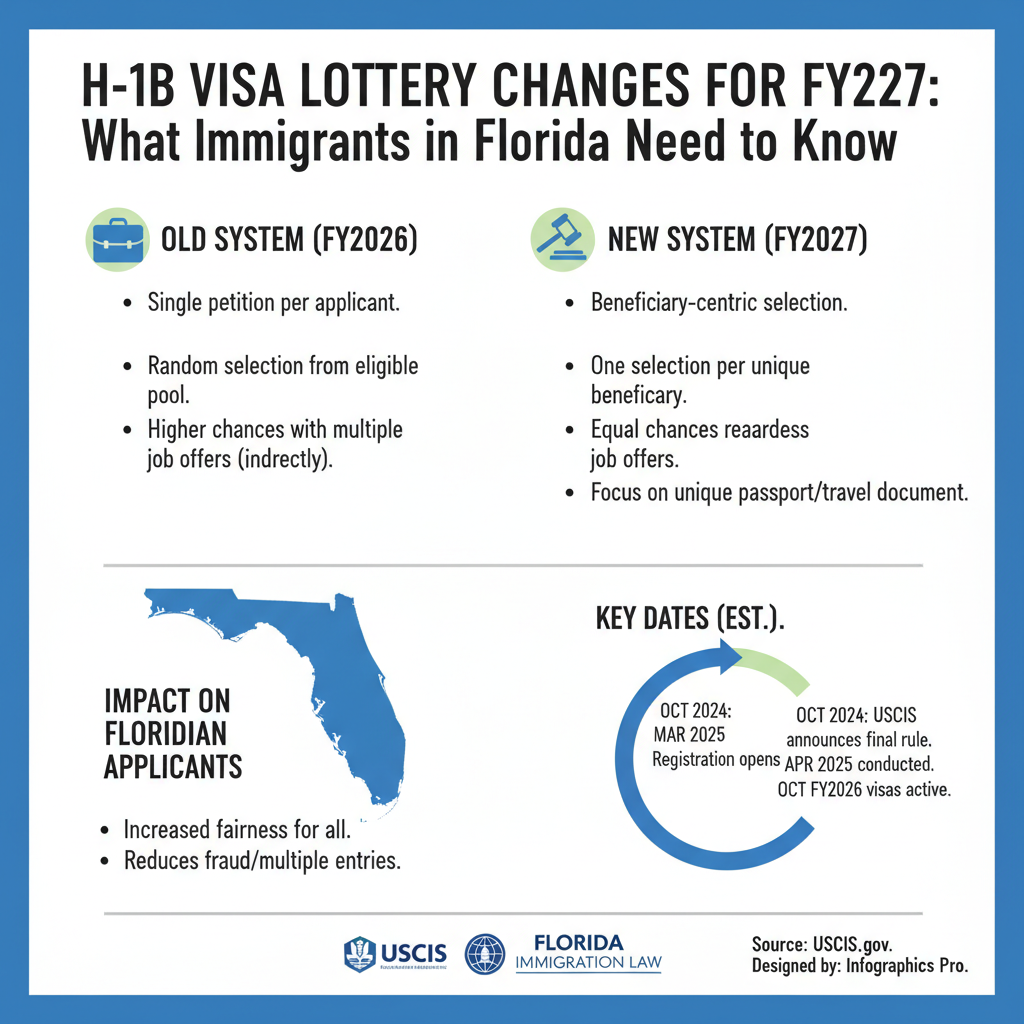
The reporting that sparked this guide: H-1B Visa Lottery Changes for FY2027 (Legal News)
What This News Means for Immigrants in Orlando and Across Florida
The H-1B visa program is a lifeline for many highly skilled foreign workers seeking employment in specialty occupations in the United States. For businesses, especially in thriving tech hubs like Orlando, it's a vital tool for attracting top global talent. The recent changes to the H-1B lottery process, particularly the shift to a beneficiary-centric selection and increased fees, have significant implications for everyone involved.
Why this news is showing up now
The H-1B visa program operates on a fiscal year basis, running from October 1st to September 30th. The registration period for each fiscal year's lottery typically occurs in March of the preceding calendar year. For FY2027, the registration window is anticipated to open in March 2027, with selected petitions eligible for an October 1, 2027, start date. However, the most impactful "new rules" were officially rolled out by U.S. Citizenship and Immigration Services (USCIS) in late 2023 and early 2024, specifically affecting the FY2025 lottery and all subsequent lotteries, including FY2027.
These changes, formalized through an interim final rule and subsequent fee adjustments, were implemented to address concerns over widespread abuse of the previous lottery system, where multiple employers might submit registrations for the same individual, artificially inflating selection odds. The shift to a beneficiary-centric selection process is a direct response to these integrity issues, aiming to ensure fairness and reduce fraudulent registrations. Additionally, USCIS adjusted various fees, including the H-1B registration fee, to better cover processing costs.
As we approach the FY2027 cycle, these rules are now well-established, but their full impact and ongoing refinement remain a topic of intense discussion and preparation within the immigration community. Staying informed is paramount to a successful application.
How it can affect Florida residents
Florida, with its booming economy, diverse industries, and growing tech sector, is a significant destination for H-1B visa holders. Cities like Orlando, Tampa, and Miami are home to numerous companies in technology, hospitality, healthcare, aerospace, and finance that rely on skilled foreign workers. The H-1B visa changes will have a direct impact on:
- Employers in Central Florida: Businesses in the Orlando area, from innovative startups to established corporations along the I-4 corridor, must now adapt their H-1B sponsorship strategies. They need to ensure they understand the new beneficiary-centric selection process and the increased costs associated with registration and petition filing.
- International Students and Graduates: Florida's universities, including the University of Central Florida (UCF) in Orlando, produce thousands of talented graduates each year, many of whom seek to transition from F-1 Optional Practical Training (OPT) to H-1B status. The new rules mean that each individual has only one chance in the lottery, regardless of how many employers register them, emphasizing the importance of securing a legitimate, strong job offer.
- Skilled Professionals Living in Florida: Many individuals already living and working in Florida on other nonimmigrant visas (e.g., L-1, TN, E-3) or those on H-4 dependent visas, may be eligible for H-1B sponsorship. These changes directly affect their pathways to potentially adjust their status and continue their careers in the state.
- Fraud Prevention: The increased scrutiny and beneficiary-centric model aim to crack down on fraudulent registrations. This means legitimate applicants in Florida will face a fairer lottery, but also underscores the need for meticulous compliance from both employers and beneficiaries.
For Central Florida residents, understanding these changes is not just about compliance; it's about strategizing for success in an increasingly competitive environment. Imigrar, located right here in Orlando, is uniquely positioned to guide you through these complexities.
What H-1B Visa Lottery Changes Are (and Why They Matter)
The H-1B visa program allows U.S. employers to temporarily employ foreign workers in specialty occupations. These occupations generally require a bachelor's degree or higher in a specific specialty. Due to high demand, the number of H-1B visas available each fiscal year is capped by Congress, necessitating an annual lottery when demand exceeds supply. The recent "changes" refer primarily to the shift in how USCIS conducts this lottery and the associated fee structure.
A plain-English definition
Imagine the H-1B visa as a special work permit for highly skilled jobs. Each year, the U.S. government sets a limit on how many of these permits can be given out (this is called the "cap"). Because many more people want these permits than are available, USCIS runs a "lottery" to select who gets to apply. The recent changes mean *how* people are picked in this lottery has changed, and it now costs more to even enter the lottery.
Specifically, the biggest change is that the lottery now focuses on the *person* (the beneficiary) rather than the *employer* (the petitioner). In the past, if five different companies registered you for an H-1B, you effectively had five chances in the lottery. Now, no matter how many companies register you, you only get one chance. This makes the process fairer and aims to prevent companies from submitting many registrations for one person just to increase their odds.
Key terms you need to know
Navigating the H-1B process requires familiarity with several key terms:
- H-1B Visa: A nonimmigrant visa that allows U.S. employers to temporarily employ foreign workers in specialty occupations.
- Specialty Occupation: An occupation that requires theoretical and practical application of a body of highly specialized knowledge, and a bachelor's degree or higher in the specific specialty (or its equivalent) as a minimum for entry into the occupation.
- USCIS (U.S. Citizenship and Immigration Services): The government agency that oversees lawful immigration to the United States. This is the primary agency you'll interact with for H-1B petitions. You can find more information on the USCIS official website.
- Beneficiary: The foreign national who will be employed in the specialty occupation.
- Petitioner: The U.S. employer filing the H-1B petition on behalf of the beneficiary.
- Cap-Subject H-1B: Refers to H-1B petitions that are subject to the annual numerical limit (cap) set by Congress.
- Cap-Exempt H-1B: Certain employers, such as institutions of higher education, non-profit organizations affiliated with higher education, and government research organizations, are exempt from the annual H-1B cap.
- H-1B Cap: The annual limit on the number of H-1B visas issued. Congress currently sets the annual regular cap at 65,000 and an additional 20,000 for those with a U.S. master's degree or higher (the "master's cap").
- H-1B Lottery (or Selection Process): When the number of H-1B registrations exceeds the annual cap, USCIS conducts a random selection process.
- LCA (Labor Condition Application): Form ETA-9035, filed with the U.S. Department of Labor (DOL) by the employer. It attests that the employer will pay the H-1B worker at least the prevailing wage or the actual wage paid to similarly qualified workers, and will provide working conditions that will not adversely affect other workers.
- FY (Fiscal Year): The federal government's fiscal year runs from October 1st to September 30th. H-1B visas are allocated per fiscal year.
- Registration Period: The specific window (usually in March) during which employers must electronically register prospective H-1B beneficiaries with USCIS for the upcoming fiscal year's lottery.
- Beneficiary-Centric Selection: The *new* method where selection is based on unique beneficiaries, not on the number of registrations submitted on their behalf. This is a critical change for FY2025 and beyond.
- Premium Processing: An expedited service offered by USCIS for certain petitions, including H-1B. For an additional fee, USCIS guarantees processing within a specific timeframe (currently 15 calendar days).
- RFE (Request for Evidence): A notice from USCIS requesting additional documentation or information to support an H-1B petition.
- COS (Change of Status): Applying to change from one nonimmigrant status (e.g., F-1, L-1) to H-1B status while remaining in the U.S.
- Consular Processing: Applying for an H-1B visa stamp at a U.S. embassy or consulate abroad.
Confused by the H-1B Jargon? Our team at Imigrar speaks your language, both English and Spanish. We're here to demystify the process for you. Contact our Orlando office at +1 786-791-3106 for a free consultation. Se Habla Español.
Current Immigration Law: The Foundation of the H-1B Program
The H-1B visa program is governed primarily by the Immigration and Nationality Act (INA), specifically Section 101(a)(15)(H)(i)(b), which defines the H-1B nonimmigrant classification, and Section 214(g), which establishes the annual numerical cap. Regulations at 8 CFR Part 214.2(h) further detail the requirements and procedures for H-1B petitions.
These laws and regulations outline the core requirements for both the employer and the beneficiary, ensuring that the program serves its intended purpose of bringing highly skilled workers to fill critical needs in the U.S. economy.
Federal requirements
To be eligible for an H-1B visa, both the employer (petitioner) and the foreign worker (beneficiary) must meet specific federal criteria:
For the Employer (Petitioner):
- The employer must offer a job in a "specialty occupation."
- The employer must pay the H-1B worker at least the prevailing wage for the occupational classification in the area of employment, or the actual wage paid by the employer to other employees with similar experience and qualifications, whichever is higher.
- The employer must file a Labor Condition Application (LCA) (Form ETA-9035) with the U.S. Department of Labor and receive certification before filing the H-1B petition with USCIS.
- The employer must provide a safe working environment and other required working conditions.
For the Employee (Beneficiary):
- The individual must possess at least a U.S. bachelor's degree or its equivalent, or a license in a specialty occupation field, or work experience equivalent to a bachelor's degree.
- The individual must be qualified to perform services in the specialty occupation.
- The individual must have a job offer from a U.S. employer in a specialty occupation.
Important: The H-1B program is not a green card program, but it is often a stepping stone to permanent residency. The initial period of stay is typically three years, extendable for a total of six years. Further extensions beyond six years may be possible under specific circumstances, particularly if a green card process has been initiated.
Florida-specific considerations
While H-1B law is federal, its application has local nuances. Florida's economy is diverse, with strong sectors in:
- Technology: Orlando, specifically, has a rapidly growing tech sector, often referred to as "Silicon Beach" or "Tech City," attracting software developers, engineers, and IT professionals. Companies here frequently sponsor H-1B visas.
- Aerospace and Defense: The Space Coast and areas around Orlando have significant aerospace and defense industries, requiring specialized engineering and technical talent.
- Healthcare: Florida has a large and aging population, driving demand for healthcare professionals, including doctors, nurses, and medical researchers, many of whom are eligible for H-1B visas (often cap-exempt if working for non-profit hospitals or universities).
- Hospitality and Tourism: While many roles in tourism may not qualify as "specialty occupations," certain positions in management, finance, or specialized IT within large hospitality corporations in Orlando could.
The presence of major universities like the University of Central Florida (UCF), the University of Florida (UF), and the University of South Florida (USF) also means a constant supply of highly educated international graduates who are potential H-1B beneficiaries. Many of these graduates choose to stay and work in Florida, contributing to the local economy.
When considering an H-1B in Florida, it's beneficial to work with a law firm that understands both the federal regulations and the specific economic landscape of the state, as well as the local USCIS Field Offices, such as the Orlando USCIS Field Office.
For more detailed information on forms and processes, always refer to the USCIS Forms section of their official website.

How to Navigate the H-1B Visa Lottery Changes: A Complete Step-by-Step Guide
Successfully securing an H-1B visa, especially with the recent lottery changes, requires meticulous planning and execution. Here’s a comprehensive guide to the process for FY2027 and beyond.
1) Understand the New Rules & Confirm Eligibility (Beneficiary-Centric Focus)
Before any action is taken, both the employer and the prospective employee must thoroughly understand the eligibility criteria and the latest lottery changes. The most critical update is the **beneficiary-centric selection process**.
- What it means: USCIS will now select registrations based on the unique passport or travel document number of the beneficiary. If a beneficiary has multiple registrations submitted by different employers, they still only get one chance in the lottery. If selected, USCIS will then identify all petitions filed on that beneficiary's behalf and verify that each employer submitted a legitimate job offer. This aims to prevent multiple entries for the same person from artificially boosting their odds.
- Action for Beneficiaries: Ensure your passport or travel document is valid and that its details are consistent across all potential registrations if multiple employers are considering you. Understand that choosing the employer with the strongest, most legitimate job offer is paramount, not the one that registers you the most times.
- Action for Employers: Verify the beneficiary's unique identification details carefully. Focus on submitting a single, high-quality registration for each legitimate candidate you intend to hire, rather than relying on multiple employers to register the same person.
- Eligibility Check:
- For the Beneficiary: Do you have a bachelor's degree or higher in a specialty occupation field, or its foreign equivalent, or sufficient work experience (3 years of experience for every 1 year of college)?
- For the Employer: Is the job truly a specialty occupation? Can you pay the prevailing wage?
2) Employer Preparation & LCA Filing (Form ETA-9035)
This critical preliminary step is solely the employer's responsibility and must be completed before the H-1B registration or petition can be filed.
- Determine Prevailing Wage: The employer must determine the appropriate prevailing wage for the specific occupation in the geographic area of employment. This is usually done using the Department of Labor's Online Wage Library (OWLS).
- Prepare and File LCA (Form ETA-9035): The employer must file a Labor Condition Application with the U.S. Department of Labor (DOL). This form attests to compliance with wage and working condition requirements.
- Posting Requirements: The employer must provide notice of the LCA filing to employees at the work site. This is typically done by posting a hard copy notice or electronically.
- LCA Certification: The DOL typically processes and certifies LCAs within 7 business days. A certified LCA is required before an H-1B petition can be filed.
- Required Documents for LCA:
- Employer's Federal Employer Identification Number (FEIN)
- Employer's legal name and address
- Job title and duties for the H-1B position
- Proposed wage for the H-1B worker
- Worksite location(s)
- Prevailing wage determination documentation
3) H-1B Electronic Registration Process (Increased Fee)
This is where the lottery begins. The employer (or their authorized representative, like Imigrar) must submit an electronic registration for each prospective H-1B beneficiary.
- Create USCIS Online Account: Both the employer and their legal representative must have a registrant account with USCIS.
- Submit Registration: During the designated registration period (typically in March for FY2027), the employer electronically submits basic information about the company and the beneficiary. This includes the beneficiary's full name, date of birth, country of birth, country of citizenship, passport number, and gender.
- Pay Registration Fee: For FY2025 and subsequent years, the H-1B registration fee has increased from $10 to $215 per registration. This fee is non-refundable.
- Reminder: Under the beneficiary-centric selection, only one registration per beneficiary is counted towards the lottery, even if multiple employers submit registrations for the same individual. USCIS will identify and reject duplicate registrations for a single beneficiary.
- Timeline: The registration window is usually open for a minimum of 14 calendar days in March.
- Required Information for Registration:
- Employer's legal name, address, and FEIN
- Employer's representative's name and contact information
- Beneficiary's full legal name, date of birth, country of birth, country of citizenship, passport number, and gender
- Whether the beneficiary has a U.S. master's degree or higher (for master's cap eligibility)
- Attorney/Accredited Representative information (if applicable)
4) If Selected: Petition Filing & Supporting Documents (Form I-129)
If your registration is selected in the lottery, USCIS will notify the registrant (employer or attorney) of the selection. This typically happens by the end of March.
- Notification of Selection: USCIS will send a "Selection Notice" to the online account. This notice will include the specific filing period during which the H-1B petition (Form I-129) must be filed. This window is usually 90 days.
- Prepare H-1B Petition (Form I-129): This is the main petition document. It's a comprehensive form requiring detailed information about the employer, the beneficiary, the job, and compliance with H-1B regulations.
- Gather Supporting Documentation: This is the most extensive part of the process. Accuracy and completeness are crucial.
- Filing Fees: The base filing fee for Form I-129 has also increased significantly for FY2025 and beyond. Additionally, there are other fees:
- Form I-129 Filing Fee: $460 (small employers/non-profits) or $780 (large employers)
- American Competitiveness and Workforce Improvement Act (ACWIA) Fee: $750 (employers with 1-25 FTE employees) or $1,500 (employers with 26+ FTE employees)
- Fraud Prevention and Detection Fee: $500
- Public Law 114-113 Fee (for employers with 50+ employees, where more than 50% are H-1B or L-1): $4,000 (This fee is particularly relevant for large tech companies along the I-4 corridor.)
- Required Documents for Form I-129 Petition:
- Certified LCA (Form ETA-9035)
- Beneficiary's educational documents (degrees, transcripts, evaluations of foreign degrees)
- Beneficiary's resume/CV
- Beneficiary's passport, visa, I-94 record, EAD (if applicable)
- Employer's support letter detailing the job offer, specialty occupation duties, and beneficiary qualifications
- Employer's financial documents (e.g., tax returns, annual reports) to demonstrate ability to pay wage
- Organizational charts, company brochures, and other evidence of the employer's business operations
- Evidence of employer-employee relationship (if applicable, especially for third-party placements)
- Any previous USCIS approval notices (e.g., for OPT, previous H-1B)
5) Premium Processing & Decision
Once the petition is filed, you await a decision from USCIS. You can opt for expedited processing.
- Premium Processing: Employers can choose to pay an additional fee (currently $2,805, effective February 26, 2024) to have USCIS process the H-1B petition within 15 calendar days. This requires filing Form I-907, Request for Premium Processing Service.
- Regular Processing: Without premium processing, H-1B petitions can take several months to process. You can check estimated processing times on the USCIS Processing Times page.
- Possible Outcomes:
- Approval: USCIS issues an I-797 Approval Notice.
- Request for Evidence (RFE): USCIS requests additional information or documentation. Responding to an RFE is critical and often requires legal expertise.
- Denial: The petition is denied. This can happen for various reasons, including insufficient evidence or failure to meet eligibility criteria.
6) Consular Processing or Change of Status
After petition approval, the beneficiary takes the next step to obtain H-1B status.
- Change of Status (COS): If the beneficiary is already in the U.S. in a valid nonimmigrant status (e.g., F-1 OPT, L-1), and the H-1B petition requested a Change of Status, their status automatically changes to H-1B on October 1st (or the petition approval date if later). No further action is needed to begin employment.
- Consular Processing: If the beneficiary is outside the U.S. or the petition did not request a Change of Status, they must attend an interview at a U.S. embassy or consulate abroad to obtain an H-1B visa stamp in their passport.
- Required Documents for Consular Processing:
- Valid passport
- DS-160 confirmation page
- Visa interview appointment confirmation
- Original I-797 Approval Notice
- LCA copy
- Employer support letter
- Educational documents
- Proof of ties to home country (if applicable)
- Required Documents for Consular Processing:
7) Post-Approval Considerations
Once H-1B status is secured, there are ongoing responsibilities.
- Start Date: H-1B employment can typically begin on October 1st of the fiscal year for which the petition was approved.
- Employer Compliance: The employer must continue to comply with all LCA attestations, including paying the prevailing wage.
- Amendments: If there are significant changes to the job duties, work location, or terms of employment, an amended H-1B petition may be required.
- Extensions: H-1B status is initially granted for up to three years and can


