

The landscape of U.S. immigration law is constantly evolving, and few areas see as much dynamic change as the H-1B visa program. As an essential pathway for skilled foreign professionals to work in specialty occupations within the United States, the H-1B visa is highly sought after. Each year, the demand far exceeds the available supply, necessitating a lottery system. For Fiscal Year (FY) 2027, significant changes have been implemented that profoundly impact how employers and beneficiaries approach the application process. At Imigrar, your trusted immigration law firm in Orlando, Florida, we are committed to keeping you informed and prepared.
Navigating H-1B Changes? Our Orlando immigration team is ready to assist. Call +1 786-791-3106 for a free consultation, or message us online. Se Habla Español.
NEWS SOURCE REFERENCE SECTION
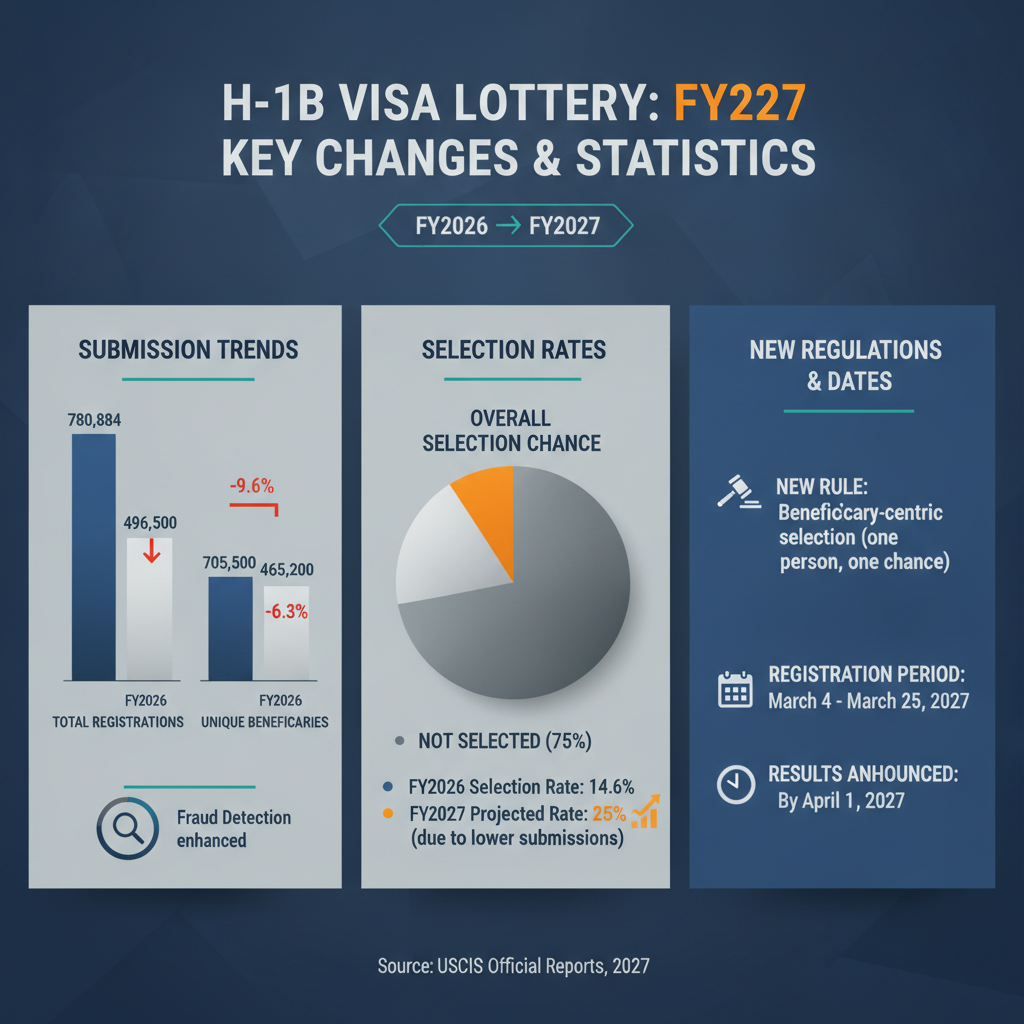
The reporting that sparked this guide: H-1B Visa Lottery Changes for FY2027 (Legal News)
What This News Means for Immigrants in Orlando and Across Florida
The H-1B visa program is a cornerstone of the U.S. economy, enabling American companies, particularly those in rapidly growing sectors like technology, healthcare, and engineering, to hire highly skilled foreign workers when qualified U.S. workers are unavailable. For immigrants and their families in Orlando, Central Florida, and indeed nationwide, changes to this critical program can have far-reaching implications, affecting career paths, family plans, and long-term residency goals.
Why this news is showing up now
As of August 26, 2026, the H-1B visa lottery for Fiscal Year (FY) 2027 has already concluded its registration and selection phases. The U.S. Citizenship and Immigration Services (USCIS) typically conducts the H-1B registration period in March for the fiscal year starting October 1st of that same calendar year. For FY2027, the registration period was in March 2026, and selections were announced shortly thereafter. The filing window for selected petitions (Form I-129) typically extends from April 1st through June 30th. Therefore, the "news" now, in August 2026, is likely focused on the *impact* and *outcomes* of these changes for those who participated in the FY2027 lottery, insights into USCIS processing trends, or perhaps discussions around future adjustments for FY2028 based on the FY2027 experience. It could also involve new policy clarifications, fee adjustments, or enhanced integrity measures that apply to petitions currently being processed or those anticipated for the next fiscal year. The primary "change" that continues to be a focal point is the shift to a beneficiary-centric selection process, which significantly alters the strategy for employers and beneficiaries alike, aiming to curb fraud and ensure fairness.
How it can affect Florida residents
Florida, particularly the Orlando metropolitan area and the I-4 corridor, is a hub for innovation, technology, tourism, aerospace, and healthcare. Companies in these sectors frequently rely on H-1B visas to fill highly specialized roles. For Florida residents who are foreign nationals hoping to work in specialty occupations, or for employers in Orange County and beyond seeking to hire global talent, these changes directly influence their ability to secure the necessary work authorization. The H-1B program allows graduates from Florida universities (such as UCF, UF, USF) on Optional Practical Training (OPT) to transition into long-term employment. Any shift in the lottery process, selection methodology, or processing times can create uncertainty for these individuals and the local economy. Understanding these changes is crucial for strategic planning, whether you are a prospective H-1B beneficiary, a sponsoring employer, or a family member whose future is tied to this visa category.
What H-1B Visa Lottery Changes for FY2027 Is (and Why It Matters)
The H-1B visa is a nonimmigrant visa that allows U.S. employers to temporarily employ foreign workers in specialty occupations. A specialty occupation generally requires a bachelor's degree or higher in a specific specialty, or its equivalent. Examples include IT professionals, engineers, scientists, architects, and certain types of medical professionals.
A plain-English definition
Think of the H-1B visa as a special temporary work permit for highly skilled jobs. Each year, the U.S. government sets a limit (a "cap") on how many new H-1B visas can be issued. This cap is currently 65,000 general visas and an additional 20,000 for those with a U.S. master's degree or higher (the "master's cap"). Because many more people apply than there are visas available, USCIS conducts a random lottery to select registrations. The "changes for FY2027" primarily refer to the shift towards a beneficiary-centric selection process, which means that instead of allowing employers to submit multiple registrations for the same individual, each unique individual (beneficiary) is entered into the lottery only once, regardless of how many employers register them. This change aims to make the lottery fairer and reduce fraud by preventing individuals from gaining an unfair advantage through multiple entries.
Key terms you need to know
- USCIS (U.S. Citizenship and Immigration Services): The government agency that oversees lawful immigration to the United States and manages the H-1B program.
- Beneficiary: The foreign national who seeks to obtain the H-1B visa.
- Petitioner/Sponsoring Employer: The U.S. employer filing the H-1B petition on behalf of the beneficiary.
- Specialty Occupation: An occupation that requires theoretical and practical application of a body of highly specialized knowledge, and a bachelor's degree or higher in the specific specialty (or its equivalent) as a minimum for entry into the occupation in the United States.
- H-1B Cap: The annual numerical limit on the number of H-1B visas issued. Currently, 65,000 for the general category and 20,000 for the U.S. Master's Cap.
- Master's Cap: The additional 20,000 H-1B visas reserved for beneficiaries who have earned a U.S. master's degree or higher.
- H-1B Registration Period: The annual period (typically in March) during which prospective petitioners electronically register beneficiaries for the H-1B lottery.
- Selection Notice: The notification from USCIS indicating that a beneficiary's registration has been selected in the lottery, allowing the employer to file an H-1B petition.
- Labor Condition Application (LCA): ETA Form 9035/9035E. An application filed with the U.S. Department of Labor (DOL) by the employer, attesting that they will pay the H-1B worker at least the prevailing wage or the actual wage paid to similarly situated employees, whichever is higher, and provide working conditions that will not adversely affect other workers. This must be certified before an H-1B petition can be filed with USCIS.
- Form I-129, Petition for a Nonimmigrant Worker: The primary form filed by the sponsoring employer with USCIS after a beneficiary is selected in the lottery.
- Premium Processing: An optional service that allows petitioners to pay an additional fee to USCIS to receive a decision on their petition within 15 calendar days (or 15 business days for some petition types).
- Change of Status (COS): If the beneficiary is already in the U.S. in another valid nonimmigrant status (e.g., F-1 OPT), they can request to change their status to H-1B without leaving the country.
- Consular Processing: If the beneficiary is outside the U.S. or chooses to leave, they will apply for the H-1B visa stamp at a U.S. consulate or embassy abroad after the petition is approved.
The "beneficiary-centric" selection model for FY2027 and beyond is a critical shift. Previously, an employer could submit multiple registrations for the same beneficiary, increasing their statistical odds of selection. This led to concerns about abuse and fairness. Now, each unique beneficiary is entered only once into the lottery, regardless of how many employers register them. This ensures a level playing field and strengthens the integrity of the lottery process. It matters because it fundamentally changes the strategy for both employers and job seekers, emphasizing legitimate job offers over multiple entries.
Confused by H-1B terminology? Let Imigrar clarify. Call +1 786-791-3106 for a free consultation, or message us online. Se Habla Español.
Current Immigration Law: The Foundation
The H-1B visa program is governed primarily by the Immigration and Nationality Act (INA), specifically sections related to nonimmigrant visas and temporary workers. These regulations are further detailed in the Code of Federal Regulations (8 CFR), particularly Part 214.2(h).
Federal requirements
To qualify for an H-1B visa, both the employer and the beneficiary must meet stringent federal requirements:
- For the Beneficiary:
- Must hold a bachelor's degree or its equivalent, or possess a license in a specialty occupation field, or have work experience equivalent to a bachelor's degree.
- Must be coming to the U.S. to perform services in a specialty occupation.
- Must meet the minimum requirements for the specific specialty occupation position.
- For the Sponsoring Employer:
- Must offer a job that qualifies as a specialty occupation.
- Must pay the H-1B worker at least the prevailing wage for the occupation in the area of intended employment or the actual wage paid to other employees with similar experience and qualifications, whichever is higher. This is attested to in the Labor Condition Application (LCA).
- Must meet other specific conditions related to working conditions and notification requirements.
- Must have an Employer Identification Number (EIN).
The H-1B cap and the lottery process are established under INA § 214(g). The beneficiary-centric selection process for FY2027 was formalized under a final rule published by USCIS, enhancing the integrity of the H-1B cap registration process. This rule specifically amends 8 CFR Part 214.2(h) to define "beneficiary" for selection purposes and outlines the process for electronic registration.
All official forms and detailed instructions can be found on the USCIS official website.
Florida-specific considerations
While immigration law is federal, the implications are felt locally. Florida does not have its own specific H-1B laws beyond federal statutes. However, the state's economic landscape makes the H-1B program particularly relevant. Orlando, in particular, has seen significant growth in technology, simulation, aerospace, and biomedical industries, all of which frequently rely on H-1B workers. For example, companies along the I-4 corridor often seek software engineers, data scientists, and healthcare specialists who might be H-1B eligible. The presence of major universities like the University of Central Florida (UCF) means a strong pipeline of international graduates on F-1 OPT visas who are prime candidates for H-1B sponsorship. Employers in Central Florida must be diligent in understanding these federal requirements to ensure compliance and attract top talent.
Required USCIS Forms: The primary form for an H-1B petition is the Form I-129, Petition for a Nonimmigrant Worker. If premium processing is desired, Form I-907, Request for Premium Processing Service, must also be filed. Before filing Form I-129, employers must obtain a certified ETA Form 9035/9035E (Labor Condition Application) from the U.S. Department of Labor. These forms are critical, and any errors or omissions can lead to delays or denials.
How to Navigate the New H-1B Lottery Process: A Complete Step-by-Step Guide
Navigating the H-1B process, especially with the FY2027 changes, requires meticulous planning and adherence to strict timelines. While the registration period for FY2027 is over, these steps are crucial for those whose petitions were selected and are currently being processed, or for those planning for FY2028.
1) Employer Determines Eligibility and Need (Ongoing / For FY2028 Planning)
Before any registration or petition can occur, the prospective sponsoring employer must determine if the position qualifies as a specialty occupation and if the beneficiary meets the requirements for that role. This involves a detailed analysis of the job duties, required qualifications, and the beneficiary's educational background and experience.
- Required Documents (Employer):
- Detailed job description, including duties, responsibilities, and minimum educational/experience requirements.
- Organizational charts showing where the position fits within the company.
- Evidence of the company's financial stability and ability to pay the required wage.
- Required Documents (Beneficiary - for employer review):
- Educational degrees, diplomas, and academic transcripts (foreign degrees may require an educational equivalency evaluation).
- Professional licenses (if applicable).
- Resume/CV detailing work experience.
- Passport copy and previous visa stamps (if applicable).
2) Labor Condition Application (LCA) Filing with DOL (Prior to Petition Filing)
Once the employer and position are deemed eligible, the employer must file a Labor Condition Application (LCA), ETA Form 9035/9035E, with the U.S. Department of Labor (DOL). This form attests that the employer will pay the H-1B worker at least the prevailing wage or the actual wage, whichever is higher, and that the employment will not adversely affect the working conditions of U.S. workers. The LCA must be certified by the DOL before an H-1B petition can be filed with USCIS. This process typically takes 7-10 business days.
- Required Documents/Information:
- Employer's EIN.
- Job title, duties, and proposed wage.
- Worksite location(s).
- Prevailing wage determination (obtained from DOL's Foreign Labor Certification Data Center or through an independent survey).
- Proof of notice to employees (posting requirements at the worksite).
Important: The LCA must accurately reflect the terms and conditions of employment. Any discrepancies can lead to significant issues later in the H-1B process.
3) H-1B Registration Submission (For FY2028 Planning)
For FY2027, this step is complete. For those planning for FY2028, employers must submit an electronic registration for each prospective H-1B beneficiary during the designated registration period (typically March). Under the beneficiary-centric model, each unique beneficiary can only have one registration submitted on their behalf. If multiple employers wish to sponsor the same beneficiary, each can submit a registration, but the beneficiary's name and passport information will ensure they are entered into the lottery only once. This change aims to level the playing field and prevent fraud.
- Required Information for Registration:
- Employer's legal name, EIN, and mailing address.
- Employer's authorized signatory information.
- Beneficiary's full legal name, date of birth, country of birth, country of citizenship.
- Beneficiary's passport number.
- Beneficiary's gender.
- Whether the beneficiary has a U.S. master's degree or higher.
- Attorney or representative information (if applicable).
Warning: Submitting multiple registrations for the same beneficiary by related entities or to gain an unfair advantage is considered fraud and can lead to severe penalties, including denial of petitions and criminal prosecution.
4) Lottery Selection and Notification (For FY2027, this is complete)
Once the registration period closes, USCIS conducts the random lottery. The selection process first draws enough registrations to meet the master's cap, then proceeds with the general cap. USCIS notifies selected registrants (employers or their legal representatives) through their USCIS online accounts. For FY2027, selections were announced in late March/early April 2026.
- Key Action: If selected, the employer receives a Selection Notice, which includes a case number and instructions for filing the H-1B petition.
5) Petition Filing (Form I-129) (For FY2027, this period is closed)
Only employers whose registrations were selected in the lottery can proceed to file the full H-1B petition (Form I-129) with USCIS. The filing window for selected petitions is typically from April 1st to June 30th for the fiscal year starting October 1st. For FY2027, this window has closed. Petitions must be filed correctly and with all supporting documentation.
- Required Documents (Employer):
- Certified LCA (ETA Form 9035/9035E).
- Copy of the H-1B Registration Selection Notice.
- Detailed letter from the employer explaining the specialty occupation, the beneficiary's qualifications, and the terms of employment.
- Employer's financial statements, tax returns, and business licenses.
- Evidence of employer-employee relationship (e.g., offer letter, employment contract, payroll records if applicable).
- Required Documents (Beneficiary):
- Copies of all educational documents (degrees, transcripts, evaluations).
- Copies of professional licenses (if applicable).
- Copies of all prior immigration documents (I-20s, EADs, I-797 approval notices, visa stamps, I-94 records).
- Passport biographical page and visa pages.
- Resume/CV.
- USCIS Filing Fees:
- Form I-129 Filing Fee.
- American Competitiveness and Workforce Improvement Act (ACWIA) Fee (if applicable).
- Fraud Prevention and Detection Fee.
- Public Law 114-113 Fee (for employers with 50+ employees, over 50% of whom are H-1B or L-1 status, if applicable).
Reminder: The petition must be filed at the correct USCIS Service Center, as indicated on the Form I-129 instructions, based on the employer's location or other specific criteria.
6) Premium Processing (Optional)
Employers can opt for Premium Processing by filing Form I-907 and paying an additional fee. This guarantees USCIS will take action on the petition (approval, denial, Request for Evidence (RFE), or Notice of Intent to Deny (NOID)) within 15 calendar days. While Premium Processing expedites the decision, it does not guarantee approval. For FY2027, Premium Processing was generally available for cap-subject H-1B petitions. It is particularly useful for those needing a quick decision for travel plans or to start work by October 1st.
- Required Document: Form I-907, Request for Premium Processing Service.
- Fee: Separate Premium Processing Fee.
7) Decision and Next Steps (Change of Status or Consular Processing)
Upon approval, USCIS sends an Approval Notice (Form I-797). The next steps depend on the beneficiary's current location and immigration status:
- Change of Status (COS): If the beneficiary is in the U.S. in a valid nonimmigrant status and the petition requested a change of status, the I-797 will indicate approval for the change of status to H-1B, effective October 1st. The beneficiary can begin working for the H-1B employer on this date.
- Consular Processing: If the beneficiary is outside the U.S. or opted for consular processing, the I-797 will indicate approval of the petition but instruct the beneficiary to apply for an H-1B visa stamp at a U.S. embassy or consulate abroad. This involves scheduling a visa interview, attending the interview, and receiving the visa stamp in their passport before entering the U.S.
Important: Even with an approved petition, beneficiaries outside the U.S. must still undergo a visa interview, which may involve additional scrutiny.

Practical Steps You Can Take Today
Even if the FY2027 lottery registration and filing periods are closed, there are crucial actions you can take now, whether you were selected or are planning for future H-1B opportunities, especially for those in Orlando and Central Florida.
Need a game plan for H-1B? Imigrar offers clear, actionable advice. Call +1 786-791-3106 for a free consultation, or message us online. Se Habla Español.
Actionable Checklist:
- Consult with an Experienced Immigration Attorney: This is paramount. An attorney can assess your specific situation, review your eligibility, guide your employer, and ensure compliance with all new rules. For Central Florida residents, Imigrar is here to help.
- For FY2027 Selected Beneficiaries:
- If your petition was filed and approved, ensure you understand your effective start date (October 1st) and any travel restrictions if you changed status.
- If your petition is still pending, monitor USCIS processing times (USCIS Processing Times) and be prepared to respond to an RFE (Request for Evidence) promptly if issued.
- If you are consular processing, begin scheduling your visa interview at the appropriate U.S. consulate or embassy.
- For FY2027 Not Selected Beneficiaries & Future Applicants (FY2028):
- Evaluate Alternatives: Explore other visa options (e.g., O-1 for extraordinary ability, L-1 for intracompany transfers, E-3 for Australians, TN for Canadians/Mexicans) that might be available to you or your employer.
- Strengthen Your Profile: Pursue advanced degrees (especially a U.S. master's for the master's cap), gain more relevant work experience, or acquire specialized certifications.
- Network Strategically: Connect with employers known for sponsoring H-1B visas in Orlando's thriving tech and healthcare sectors.


