


The landscape of U.S. immigration is constantly evolving, and for skilled foreign workers and the employers who rely on their talent, few programs are as critical as the H-1B visa. As we look towards Fiscal Year 2027, significant changes to the H-1B lottery process are taking effect, aiming to enhance integrity and fairness. For individuals and businesses in Orlando, Central Florida, and across the nation, understanding these updates is not just beneficial—it's essential for success.
Navigating the New H-1B Rules? Don't face the complexities alone. Our Orlando immigration team is ready to assist. Call +1 786-791-3106 for a free consultation, or message us online. Se Habla Español.
The reporting that sparked this guide
Our commitment at Imigrar is to keep you informed about the latest developments that impact your immigration journey. This comprehensive guide has been developed in response to the latest updates surrounding the H-1B Visa Lottery Changes for FY2027 (Legal News), which signal a critical shift in how H-1B petitions will be processed. We've synthesized official government announcements and legal analyses to provide you with the most accurate and actionable information.
What This News Means for Immigrants in Orlando and Across Florida
The H-1B visa program is a cornerstone for many seeking to live and work in the U.S. based on their specialized skills. These new changes, particularly for the upcoming FY2027 lottery, carry profound implications for prospective beneficiaries and their sponsoring employers, especially in high-growth areas like Florida.
Why this news is showing up now
The U.S. Citizenship and Immigration Services (USCIS) typically announces changes and timelines for the upcoming fiscal year's H-1B cap lottery well in advance. As of today, March 24, 2026, we are on the cusp of the FY2027 H-1B cap season. The H-1B electronic registration period for FY2027 is expected to occur in March 2026, with selections announced shortly thereafter, and the filing window for selected petitions beginning on April 1, 2026. Therefore, the news about these changes is surfacing now to give employers and beneficiaries ample time to prepare. USCIS implemented significant structural changes to the H-1B lottery process, effective for the FY2025 cap season and intended to continue for subsequent years, including FY2027. These changes were finalized to address concerns about fraud and to ensure a fairer selection process. The current reporting reflects the finalization and implementation of these new rules, which will govern the upcoming lottery.
How it can affect Florida residents
Florida, particularly the Orlando metropolitan area, is a hub for various industries that heavily rely on H-1B talent, including information technology, hospitality, aerospace, healthcare, and engineering. The I-4 corridor, stretching from Tampa Bay through Orlando to Daytona Beach, is a prime example of economic zones attracting skilled foreign professionals. These H-1B lottery changes will directly impact:
- Tech Professionals: Orlando's burgeoning tech sector, often referred to as "Silicon Sandbar," depends on H-1B visas to fill specialized roles. The new rules, particularly the "beneficiary-centric" selection process, aim to provide a more equitable chance for genuinely qualified individuals, potentially reducing the advantage gained by fraudulent multiple registrations.
- University Graduates: Florida boasts numerous world-class universities, including the University of Central Florida (UCF) in Orlando, the University of Florida, and the University of South Florida. Many international students graduating with STEM degrees aim for H-1B sponsorship. These changes will directly affect their post-graduation employment prospects and the strategies employers use to sponsor them.
- Healthcare Workers: With a growing population and demand for specialized medical services, Florida's hospitals and healthcare systems often sponsor H-1B visas for doctors, nurses, and other medical professionals. Understanding the updated lottery system is crucial for these employers.
- Florida Employers: Companies across Orange County and beyond that seek to sponsor H-1B workers must fully grasp the new registration requirements to avoid disqualification. Compliance is paramount.
For Central Florida residents and businesses, these changes mean a renewed focus on legitimate, single registrations per beneficiary, emphasizing the quality of the petition rather than the quantity of registrations. It underscores the importance of working with experienced immigration counsel like Imigrar to ensure compliance and maximize chances of success.
What H-1B Visa Lottery Changes for FY2027 Is (and Why It Matters)
The H-1B visa program allows U.S. employers to temporarily employ foreign workers in specialty occupations. A specialty occupation generally requires a bachelor's degree or higher in a specific specialty, or its equivalent. Due to high demand, the number of H-1B petitions often exceeds the annual cap set by Congress, necessitating a lottery system. The changes for FY2027 are designed to overhaul how this lottery operates, making it more secure and fair.
A plain-English definition
Simply put, the H-1B visa changes for FY2027 refer to new rules implemented by USCIS regarding how the H-1B cap lottery is conducted. The most significant change is the shift from an "employer-centric" registration system to a "beneficiary-centric" one. Previously, an employer could submit multiple registrations for the same beneficiary (though only one could be selected). Under the new rules, each individual beneficiary can only have *one* registration submitted on their behalf in a given fiscal year's lottery. If multiple employers register the same individual, all registrations for that individual will be deemed invalid. This change aims to prevent fraud and give every qualified individual an equal chance at selection, regardless of how many employers are interested in sponsoring them.
Key terms you need to know
- H-1B Visa: A nonimmigrant visa that allows U.S. employers to temporarily employ foreign workers in specialty occupations.
- Specialty Occupation: An occupation that requires theoretical and practical application of a body of highly specialized knowledge, and a bachelor's degree or higher in the specific specialty (or its equivalent) for entry into the occupation in the U.S.
- Annual Cap: The congressionally mandated limit on the number of H-1B visas issued each fiscal year. Currently, it is 65,000 for the regular cap and an additional 20,000 for those with a U.S. master's degree or higher (the "master's cap").
- Fiscal Year (FY): The U.S. government's fiscal year runs from October 1 to September 30. FY2027 begins on October 1, 2026.
- USCIS (U.S. Citizenship and Immigration Services): The government agency responsible for administering immigration and naturalization adjudication functions. USCIS official website
- Beneficiary: The foreign worker who is the subject of the H-1B petition.
- Petitioner: The U.S. employer who files the H-1B petition on behalf of the beneficiary.
- H-1B Electronic Registration Process: The online system where prospective petitioners (employers) or their authorized representatives submit basic information about the company and the beneficiary during a designated registration period.
- Lottery Selection: The random selection process conducted by USCIS when the number of registrations exceeds the annual cap.
- LCA (Labor Condition Application): Form ETA-9035. An application filed with the U.S. Department of Labor (DOL) that attests to certain conditions, including wages and working conditions, before an H-1B petition can be filed with USCIS.
- Cap-Exempt: Certain H-1B petitions are not subject to the annual cap, such as those filed by institutions of higher education, non-profit organizations affiliated with them, or government research organizations.
- Master's Cap (U.S. Master's Degree Exemption): An additional 20,000 visas reserved for beneficiaries who have earned a U.S. master's degree or higher.
- Petition Filing Window: The period during which selected petitioners can submit their full H-1B petition (Form I-129) to USCIS.
Confused by Immigration Jargon? Our team at Imigrar simplifies complex terms. For assistance with H-1B visas, contact us at +1 786-791-3106 for a free consultation. Se Habla Español.
Current Immigration Law: The Foundation of the H-1B Program
The H-1B visa program is governed by the Immigration and Nationality Act (INA), specifically Section 101(a)(15)(H)(i)(b), which defines the H-1B nonimmigrant classification. Further regulations are found in 8 CFR Part 214.2(h). Understanding these foundational laws is crucial, as the recent changes modify the *process* within the existing legal framework, rather than altering the fundamental eligibility criteria for the visa itself.
Federal requirements
To qualify for an H-1B visa, both the employer (petitioner) and the foreign worker (beneficiary) must meet specific federal requirements:
- For the Beneficiary:
- Hold a bachelor's degree or its equivalent, or a license in a specialty occupation field, or have work experience equivalent to a bachelor's degree.
- Be offered a job in a specialty occupation.
- If eligible for the master's cap, hold a U.S. master's or higher degree from an accredited institution.
- For the Petitioner (Employer):
- Offer a job in a specialty occupation.
- Pay the H-1B worker at least the prevailing wage for the occupation in the area of employment, or the actual wage paid by the employer to other employees with similar experience and qualifications, whichever is higher. This must be attested to in the Labor Condition Application (LCA).
- File an LCA with the Department of Labor (DOL) and receive certification before filing the H-1B petition with USCIS.
- Meet other regulatory requirements, such as providing proper working conditions.
The annual cap for H-1B visas remains 65,000, with an additional 20,000 for those with a U.S. master's degree or higher. These numbers are set by Congress and have not changed with the recent lottery modifications. The lottery is only triggered when the number of registrations exceeds these caps.
Important: The H-1B electronic registration system requires employers to submit information about the prospective employee, including their passport number or travel document number. This is a critical piece of information for the new beneficiary-centric system to identify unique individuals.
Florida-specific considerations
While immigration law is federal, its impact is felt locally. For Florida residents and employers, specific considerations include:
- Prevailing Wage Determination: The prevailing wage for a specialty occupation varies significantly by geographic location. Employers in Orlando, Tampa, Miami, or Jacksonville will have different prevailing wage requirements compared to other parts of the country. This impacts the financial commitment of the employer.
- Local Industry Demand: Florida's diverse economy means high demand for H-1B professionals in specific sectors. For instance, the tourism and hospitality technology sectors around Orlando, defense and aerospace in Brevard County, and biomedical research throughout the state all have unique needs.
- Orlando USCIS Field Office: While H-1B petitions are processed by service centers, the local Orlando USCIS Field Office (Orlando Field Office information) plays a role in other immigration matters and can be a resource for general inquiries, though not for H-1B petition adjudication directly.
The primary USCIS forms involved in the H-1B process are: Form I-129, Petition for a Nonimmigrant Worker, which is the main petition filed by the employer, and Form I-797, Notice of Action, which USCIS uses to communicate receipt, approval, or denial of petitions. For the electronic registration, employers use the USCIS online registration system.
You can find all official forms and instructions on the USCIS Forms page.
How to Navigate the H-1B Visa Lottery Changes for FY2027: A Complete Step-by-Step Guide
The FY2027 H-1B lottery introduces a critical shift in strategy. Here's a detailed guide incorporating the new beneficiary-centric approach:
1) Employer Assessment, LCA Preparation, and Strategic Planning
Before the registration period even opens, employers must conduct a thorough assessment. This includes confirming the job qualifies as a specialty occupation and determining the appropriate wage. Given the new rules, strategic planning is more vital than ever.
- Job Qualification: Confirm the position requires a bachelor's degree or higher in a specific field and is a "specialty occupation."
- Prevailing Wage Determination: Research and determine the prevailing wage for the position in the specific geographic area of employment (e.g., Orlando, FL). This is a crucial step for the LCA.
- LCA Preparation: The employer, or their attorney, prepares and files Form ETA-9035, Labor Condition Application, with the U.S. Department of Labor (DOL). This form attests that the employer will pay the H-1B worker at least the prevailing wage and offer working conditions that will not adversely affect other workers. The LCA must be certified by DOL before an H-1B petition can be filed.
- Strategic Discussions (Employer & Beneficiary): With the beneficiary-centric system, it's paramount that if a beneficiary is being considered by multiple employers, they clearly communicate which employer (if any) will register them. Duplicate registrations for the same beneficiary by different employers will lead to invalidation of ALL registrations for that individual. Open communication is key to avoid this fatal error.
Required Documents (for LCA and internal assessment):
- Job description and requirements
- Employer's Federal Employer Identification Number (FEIN)
- Beneficiary's educational credentials and professional experience (for assessment)
- Prevailing wage determination sources (e.g., DOL's FLCDataCenter)
2) H-1B Electronic Registration Submission (Beneficiary-Centric)
This is where the major change for FY2027 comes into play. The registration period typically occurs in March (e.g., March 2026 for FY2027). The employer (petitioner) or their authorized representative must create a USCIS online account and submit the required registration information.
- USCIS Online Account: Employer or attorney creates or logs into their USCIS online account.
- Beneficiary Information: Provide the beneficiary's full legal name, date of birth, country of birth, country of citizenship, gender, and importantly, their passport number or travel document number. This unique identifier is critical for USCIS to prevent duplicate registrations.
- Employer Information: Provide the employer's name, address, and Federal Employer Identification Number (FEIN).
- Education Details: Indicate if the beneficiary has a U.S. master's degree or higher, as this qualifies them for the master's cap lottery.
- Registration Fee: Pay the non-refundable H-1B registration fee for each beneficiary. For FY2027, this fee is expected to be $10 (though USCIS has proposed significant increases for future years, for FY2027, the fee is confirmed at $10 as per the rule effective December 2020).
- Submission: Submit the registration within the designated window.
Warning: Under the new beneficiary-centric rules, if USCIS finds that the same beneficiary has more than one registration submitted on their behalf by multiple petitioners, all registrations for that beneficiary will be deemed invalid. Ensure clear communication and only one registration submission per beneficiary.
Required Information for Registration:
- Beneficiary's full legal name, date of birth, country of birth, country of citizenship, gender.
- Beneficiary's valid passport number or travel document number.
- Employer's legal name, FEIN, and mailing address.
- Attorney or representative's name and contact information (if applicable).
- Indication of eligibility for the master's cap.
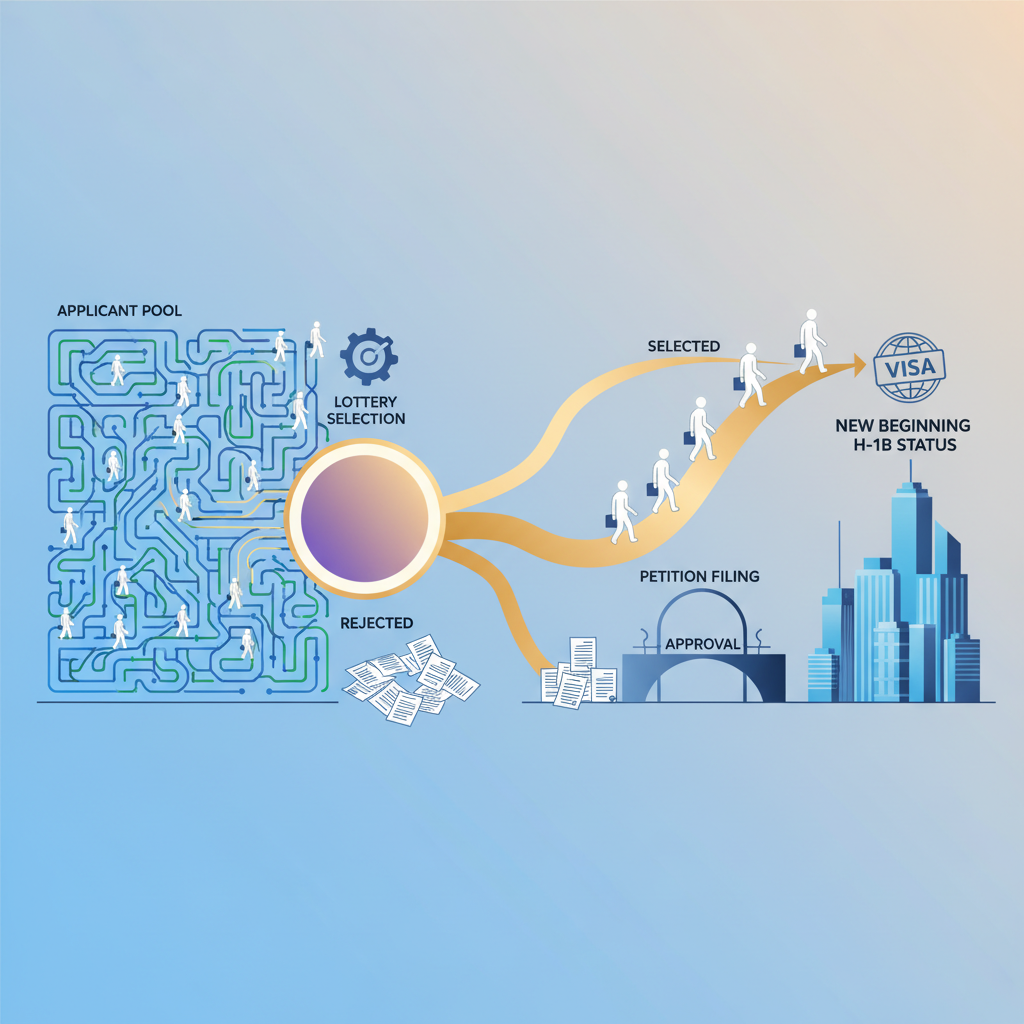
3) Lottery Selection and Notification
After the registration period closes, if the number of eligible registrations exceeds the annual cap, USCIS conducts a random lottery selection. This usually happens within a few weeks after the registration window closes (late March/early April 2026 for FY2027).
- Master's Cap First: USCIS first selects enough registrations to meet the master's cap (20,000).
- Regular Cap: All unselected master's degree beneficiaries, along with all bachelor's degree beneficiaries, are then entered into the regular cap lottery (65,000).
- Notification: USCIS notifies petitioners with "Selected" status in their online accounts. Unselected registrations will show "Not Selected."
Timeline Expectation:
- Registration period: Early-to-mid March 2026.
- Selection announcements: Late March/early April 2026.
4) H-1B Petition Filing (Form I-129)
Only petitioners whose registrations were selected in the lottery are eligible to file an H-1B petition (Form I-129) on behalf of the named beneficiary. The filing window typically opens on April 1st of the fiscal year (e.g., April 1, 2026, for FY2027) and lasts for at least 90 days.
- Prepare Form I-129: Complete Form I-129, Petition for a Nonimmigrant Worker, and its required supplements.
- Certified LCA: Attach the certified Form ETA-9035, Labor Condition Application.
- Supporting Documentation: Gather all supporting documents, including evidence of the beneficiary's qualifications, employer's ability to pay, and the specialty occupation nature of the job.
- Filing Fees: Include all applicable USCIS filing fees (base filing fee, ACWIA fee, fraud prevention and detection fee, public law 114-113 fee if applicable). USCIS has proposed significant fee increases, so ensure you are using the most current fee schedule for FY2027 petitions.
- Submission: Mail the complete petition package to the correct USCIS service center indicated on the selection notice.
Required Documents (for Petition Filing):
- Completed and signed Form I-129 and supplements (e.g., H-1B Data Collection and Filing Fee Exemption Supplement).
- Certified Form ETA-9035, Labor Condition Application.
- Copy of the H-1B registration selection notice.
- Beneficiary's educational degrees, transcripts, evaluations of foreign degrees, and professional licenses.
- Beneficiary's resume and letters of experience.
- Beneficiary's passport, visa, and I-94 records (if already in the U.S.).
- Employer's company profile, articles of incorporation, financial statements, and tax returns.
- Detailed job description, organizational charts, and evidence of specialty occupation nature.
- Client letters/contracts (for third-party placement).
- Filing fee checks/money orders.
5) Premium Processing (Optional)
For an additional fee, employers can opt for premium processing, which guarantees USCIS will take action on the petition within 15 calendar days. This option is often available for H-1B petitions, though it may be temporarily suspended during peak filing periods or at the start of the cap season.
- Form I-907: File Form I-907, Request for Premium Processing Service, along with the required fee.
- Expedited Processing: USCIS will issue an approval, denial, Request for Evidence (RFE), or Notice of Intent to Deny (NOID) within 15 days.
Consideration: While premium processing speeds up adjudication, it does not increase the chances of approval. It's often used when an urgent decision is needed.
6) Petition Adjudication and Decision
USCIS reviews the submitted petition and supporting documents. They may issue a Request for Evidence (RFE) if more information is needed. Once a decision is made, USCIS issues a Form I-797, Notice of Action.
- Approval: If approved, the H-1B status will become effective on October 1, 2026 (the start of FY2027), for beneficiaries seeking a change of status within the U.S. For those outside the U.S., they will need to apply for an H-1B visa stamp at a U.S. consulate abroad.
- Denial: If denied, USCIS will provide reasons for the denial. An appeal or a new petition may be possible depending on the grounds.
7) Visa Stamping (for Beneficiaries outside the U.S.) or Change of Status (for Beneficiaries within the U.S.)
Once the H-1B petition is approved:
- Outside the U.S.: Beneficiaries must schedule an interview at a U.S. embassy or consulate in their home country to obtain an H-1B visa stamp in their passport. They can then enter the U.S. in H-1B status no earlier than 10 days before October 1st.
- Inside the U.S.: If the beneficiary is already in the U.S. in a valid nonimmigrant status (e.g., F-1 OPT) and the petition requested a change of status, their status will automatically change to H-1B on October 1, 2026. They can begin working for the H-1B employer on this date.
Need Expert Guidance for Your H-1B Petition? Imigrar has extensive experience with H-1B visas. Contact our Orlando office at +1 786-791-3106 for a free consultation. Se Habla Español.
Practical Steps You Can Take Today
Given the beneficiary-centric changes for FY2027, preparation is paramount. Here's an actionable checklist for both beneficiaries and employers:
Actionable Checklist for Beneficiaries:
- Verify Your Passport: Ensure your passport is valid and will remain valid for at least six months beyond your intended H-1B start date (October 1, 2026). If you need to renew, do so immediately, as your passport number is critical for registration.
- Gather Educational Documents: Collect all diplomas, transcripts, and any foreign degree evaluations. Ensure they are readily available and properly translated if necessary.
- Update Your Resume: Keep your resume current and tailored to specialty occupations.
- Communicate with Employers: If you are being considered by multiple employers, have an open and honest conversation about who will register you for the H-1B lottery. Reminder: Only ONE registration per beneficiary is allowed.
- Understand the New Rules: Educate yourself on the beneficiary-centric selection process. This knowledge empowers you to ask the right questions and ensure your employer is compliant.
- Explore Alternatives: Have a backup plan. What if you're not selected? Consider other visa options (e.g., O-1, TN, E-3, F-1 OPT extension, or other nonimmigrant visas) or alternative career paths.
Actionable Checklist for Employers:
- Consult Immigration Counsel: Engage with an experienced immigration law firm like Imigrar well in advance. We can help you navigate the new rules, ensure compliance, and prepare a strong petition.
- Internal Policy Review: If you typically sponsor multiple H-1B candidates, review your internal policies for H-1B sponsorship in light of the beneficiary-centric approach. Ensure your HR and recruiting teams are aware of the "one registration per beneficiary" rule.
- LCA Preparation: Begin the process of determining prevailing wages and preparing the Labor Condition Application (LCA) for potential H-1B hires.
- Educate Candidates: Inform prospective H-1B beneficiaries about the new "one registration" rule and the importance of clear communication if they are considering offers from other employers.
- Prepare for Registration: Ensure you have all necessary employer and beneficiary information (including passport numbers) ready before the registration window opens.
- Budget for Fees: Account for the USCIS filing fees and attorney fees in your budget. Be aware that USCIS fees can change.
Document Preparation Guidance
For both beneficiaries and employers, meticulous document preparation is key. Keep all original documents secure and provide only copies unless originals are specifically requested. Organize everything clearly, logically, and chronologically.
- Beneficiary Documents: Copies of passport bio page, previous visas, I-94 records, birth certificate, marriage certificate (if applicable), all educational degrees, transcripts, and professional evaluations.
- Employer Documents: Company incorporation documents, IRS EIN verification,


