


Navigating the complex world of U.S. immigration law can be challenging, especially when significant changes are introduced. For skilled foreign workers and the U.S. employers who seek their talent, the H-1B visa program is a cornerstone. Each year, the demand for H-1B visas far outstrips the available supply, necessitating a lottery system. As we approach the H-1B cap season for Fiscal Year 2027 (FY2027), the United States Citizenship and Immigration Services (USCIS) has solidified crucial changes to the lottery process that began with FY2025, profoundly impacting how beneficiaries are selected. Imigrar, your trusted immigration law firm in Orlando, Florida, is here to demystify these updates and provide clear, actionable guidance.
Need Expert H-1B Guidance? The new H-1B lottery rules for FY2027 bring both clarity and complexity. Don't navigate them alone. Our Orlando immigration team is ready to assist. Call +1 786-791-3106 for a free consultation, or message us online. Se Habla Español.
The reporting that sparked this guide
The information and guidance in this comprehensive article are informed by ongoing developments in U.S. immigration policy, particularly concerning the annual H-1B cap lottery. Our insights are grounded in official USCIS announcements and expert legal analysis of the updated regulations that began impacting the H-1B process with the FY2025 lottery and continue for FY2027. We encourage readers to consult official sources for the latest updates:
H-1B Visa Lottery Changes for FY2027 (Legal News)
For the most current official information, always refer to the USCIS official website.
What This News Means for Immigrants in Orlando and Across Florida
The H-1B visa program is vital for many seeking to live and work in the U.S., including those who call Orlando and Florida home. The recent changes to the H-1B lottery system, particularly the shift to a beneficiary-centric selection process, represent a significant evolution in how these coveted visas are allocated. Understanding these modifications is not just about compliance; it's about strategizing effectively for your future.
Why this news is showing up now
The H-1B cap lottery is an annual event that typically kicks off in early March for the fiscal year beginning October 1st of that same calendar year. For FY2027, the registration period will likely open in March 2026. The "changes" in question aren't entirely new for FY2027, but rather a solidification and continuation of the beneficiary-centric selection process that USCIS implemented starting with the FY2025 lottery. This fundamental shift was designed to increase fairness and reduce the potential for fraud by making selection based on unique beneficiaries, rather than the number of registrations submitted on their behalf. Given that the FY2027 registration period is on the horizon (or has recently concluded, depending on the exact timing of this publication in early April 2026), this news is highly relevant and critical for prospective H-1B beneficiaries and their sponsoring employers to understand. USCIS continuously refines its processes, and while the core beneficiary-centric model is established, employers and beneficiaries must remain vigilant for any minor procedural updates or guidance from the agency for the upcoming cycle.
How it can affect Florida residents
Florida, particularly the I-4 corridor encompassing cities like Orlando, Tampa, and Daytona Beach, is a hub of economic activity and innovation. Industries such as technology, aerospace, tourism, healthcare, and finance thrive here, often relying on skilled foreign workers to fill specialized roles that drive growth. The H-1B visa is crucial for these sectors. For Florida residents, including international students graduating from universities like the University of Central Florida (UCF) or the University of Florida, and professionals already working on other nonimmigrant visas (like OPT), these changes have direct implications:
- Fairer Chance for Selection: The beneficiary-centric approach aims to give every unique individual an equal chance in the lottery, regardless of how many employers register them. This could be beneficial for highly qualified individuals who might have previously been disadvantaged by a system where employers could submit multiple registrations for the same person.
- Increased Employer Scrutiny: Employers in Orlando and across Florida must now be even more diligent in verifying beneficiary information and ensuring legitimate job offers. The focus is squarely on the individual, reducing the incentive for employers to submit frivolous registrations.
- Planning and Strategy: For those hoping to secure an H-1B visa and continue their careers in Florida, understanding the new rules is paramount for strategic planning. This includes early engagement with potential sponsoring employers and meticulous document preparation.
- Impact on Local Economy: A more equitable H-1B process could ensure that Florida's thriving industries continue to attract and retain the best global talent, fostering innovation and economic prosperity in places like Orange County.
What H-1B Visa Lottery Changes for FY2027 Is (and Why It Matters)
The H-1B visa program allows U.S. employers to temporarily employ foreign workers in specialty occupations. These occupations generally require a bachelor's degree or higher in a specific field. Due to annual statutory limits (caps) on the number of H-1B visas issued, demand often exceeds supply, necessitating a lottery system to select eligible registrations.
A plain-English definition
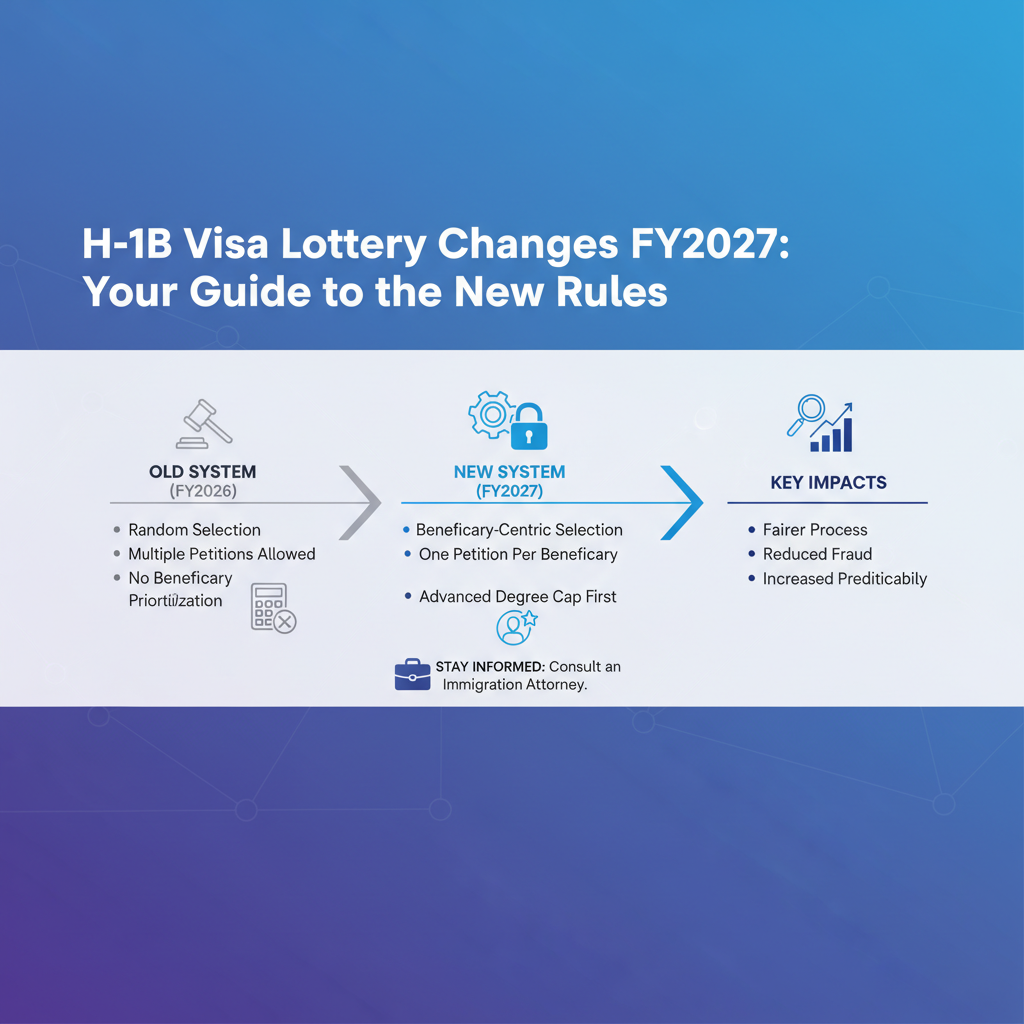
The H-1B Visa Lottery Changes for FY2027 refers to the updated method USCIS uses to select registrations for the annual H-1B cap. Previously, if multiple employers registered the same foreign worker, each registration was entered into the lottery individually, potentially giving that worker multiple "chances" to be selected. The significant change, which began with FY2025 and is now the established process for FY2027, is that selection is now based on each unique beneficiary. This means that if a foreign worker has multiple registrations submitted on their behalf by different employers, they are entered into the lottery only once. If selected, all employers who registered that unique individual are notified, and any one of those employers can then file a full H-1B petition. This change aims to level the playing field, ensure fairness, and reduce potential misuse of the system by preventing multiple entries for the same individual from increasing their odds of selection.
Important: This is a fundamental shift from a "per registration" model to a "per unique beneficiary" model.
Key terms you need to know
To fully grasp the H-1B process and the impact of these changes, familiarize yourself with these essential terms:
- H-1B Visa: A nonimmigrant visa that allows U.S. employers to temporarily employ foreign workers in specialty occupations.
- Specialty Occupation: An occupation that requires theoretical and practical application of a body of highly specialized knowledge, and a bachelor's or higher degree in the specific specialty (or its equivalent) as a minimum for entry into the occupation.
- Beneficiary: The foreign worker who is the subject of the H-1B petition.
- Petitioner: The U.S. employer filing the H-1B petition on behalf of the foreign worker.
- Annual Cap: The statutory limit on the number of H-1B visas issued each fiscal year. Currently, it's 65,000 for the regular cap and an additional 20,000 for the "master's cap" (for those with a U.S. master's degree or higher).
- Cap-Subject: An H-1B petition that is subject to the annual cap. Most H-1B petitions fall into this category.
- Cap-Exempt: Certain H-1B petitions that are not subject to the annual cap, such as those filed by institutions of higher education, non-profit organizations affiliated with higher education, or governmental research organizations.
- H-1B Registration: An electronic process where prospective H-1B cap-subject petitioners (employers) or their authorized representatives submit basic information about the company and each prospective H-1B beneficiary. This is the first step in the lottery process.
- Lottery/Random Selection: When the number of H-1B registrations exceeds the annual cap, USCIS conducts a random selection process to choose which registrations can proceed to file a full H-1B petition.
- Registration Period: The specific window of time (usually in March) when H-1B registrations can be submitted to USCIS. For FY2027, this is expected in March 2026.
- Petition Filing Period: The specific window of time (usually starting April 1st) when selected petitioners can submit their full H-1B petitions to USCIS.
- Labor Condition Application (LCA): A certification from the U.S. Department of Labor (DOL) that an employer has met specific labor condition requirements in an H-1B petition. This is filed on ETA Form 9035.
- Premium Processing: An optional service offered by USCIS that guarantees processing of certain petitions (including H-1B) within a specified timeframe (typically 15 calendar days) for an additional fee.
Confused by H-1B Terminology? Our legal team can clarify every step of the process. For assistance with your H-1B strategy in Orlando or anywhere nationwide, call +1 786-791-3106 for a free consultation. Se Habla Español.
Current Immigration Law: The Foundation
The H-1B visa program is authorized under the Immigration and Nationality Act (INA), specifically Section 101(a)(15)(H)(i)(b) and Section 214(g)(1)(A) (8 U.S.C. § 1101(a)(15)(H)(i)(b) and 8 U.S.C. § 1184(g)(1)(A)). These statutes establish the framework for the H-1B nonimmigrant classification and the annual numerical limitations (caps).
Federal requirements
To qualify for an H-1B visa, both the employer and the prospective employee must meet specific federal requirements:
- For the Position (Specialty Occupation): The job must generally require a bachelor's degree or higher in a specific field, and the employer must demonstrate that the duties are sufficiently complex or unique to warrant such a degree.
- For the Beneficiary: The foreign worker must hold a bachelor's degree or its equivalent, or possess a license in a specialty occupation field, or have work experience equivalent to a bachelor's degree.
- For the Employer (Petitioner): The employer must offer a "specialty occupation" position, agree to pay the H-1B worker at least the prevailing wage for the occupation in the area of employment, and meet other regulatory requirements. Before filing an H-1B petition, the employer must file a Labor Condition Application (LCA) with the U.S. Department of Labor (DOL) on ETA Form 9035, which attests to these wage and working condition requirements.
- Annual Cap: As mentioned, there is an annual cap of 65,000 H-1B visas, with an additional 20,000 visas reserved for those holding a U.S. master's degree or higher. This cap resets each fiscal year (October 1st to September 30th).
- The Lottery System: When the number of eligible electronic registrations received by USCIS during the designated registration period exceeds the annual cap, USCIS conducts a lottery. The new beneficiary-centric selection process for FY2027 means that each unique beneficiary is entered into the lottery once, regardless of the number of registrations submitted on their behalf by different employers. If selected, any employer who registered that beneficiary may file a petition. This change is codified in 8 CFR Part 214.2(h)(8)(i)(A)(4).
For detailed information on H-1B eligibility and requirements, please visit the USCIS H-1B Specialty Occupations page.
Florida-specific considerations
While H-1B law is federal, its practical application has regional nuances. Florida's robust economy creates significant demand for H-1B workers. For residents in Orlando and Central Florida:
- Local Employers: Many major corporations and growing tech startups in the Orlando metropolitan area actively sponsor H-1B visas. Companies along the I-4 corridor, from defense contractors to theme park technology developers, rely on this program.
- Prevailing Wage: The prevailing wage requirements vary by geographic area. For example, the prevailing wage for a software engineer in Orlando, Orange County, might differ from that in Miami or Silicon Valley. Employers must ensure they are meeting the local prevailing wage standards established by the Department of Labor.
- USCIS Field Office: While H-1B petitions are generally processed at USCIS service centers, the Orlando USCIS Field Office may handle certain follow-up interviews or requests for information related to status adjustments if an H-1B worker later seeks a green card. Understanding the local office's role can be beneficial for long-term planning.
- Educational Institutions: Florida is home to numerous colleges and universities. Many international students graduating from these institutions, such as UCF, USF, and UF, seek H-1B sponsorship to transition from Optional Practical Training (OPT) to long-term employment. These changes directly impact their chances.
How to Navigate the New H-1B Lottery System: A Complete Step-by-Step Guide
For FY2027, navigating the H-1B lottery requires careful attention to the updated beneficiary-centric process. Here’s a comprehensive guide:
1) Employer Assessment, LCA Filing, and Registration Preparation
This initial phase is critical for both the employer and the prospective H-1B beneficiary.
- Employer Assessment: The U.S. employer (petitioner) must first determine if the position qualifies as a "specialty occupation" and if the prospective employee (beneficiary) meets the educational or experience requirements. They must also confirm their ability to pay the required prevailing wage.
- Prevailing Wage Determination: The employer obtains a prevailing wage determination from the Department of Labor or uses an accepted alternative wage source to ensure compliance with wage requirements for the specific occupation and geographic area (e.g., Orlando, FL).
- File Labor Condition Application (LCA): The employer files ETA Form 9035, the Labor Condition Application, with the U.S. Department of Labor. This form attests that the employer will pay the H-1B worker at least the prevailing wage or the actual wage paid to similarly situated employees, whichever is higher, and provide working conditions that do not adversely affect other workers. The LCA must be certified by the DOL before an H-1B petition can be filed.
- Gather Beneficiary Information: The employer and beneficiary work together to gather all necessary personal and educational details required for the H-1B registration.
- Required Documents for LCA/Registration Prep:
- Beneficiary's full legal name, date of birth, country of birth, country of citizenship, passport number.
- Beneficiary's gender.
- Beneficiary's highest level of education.
- Employer's legal name, Federal Employer Identification Number (EIN).
- Employer's mailing address and contact information.
- Job title and SOC (Standard Occupational Classification) code.
- Prevailing wage data.
2) H-1B Registration Period (Beneficiary-Centric Submission)
The H-1B electronic registration process is the gateway to the lottery. For FY2027, this period is anticipated to be in March 2026.
- Employer Account Creation: If not already done, the employer (or their authorized legal representative, like Imigrar) must create a USCIS online account.
- Submit Electronic Registrations: During the designated registration period, the employer submits an electronic registration for each prospective H-1B beneficiary. Critically, under the new rules, each unique beneficiary must only be registered once. If multiple employers wish to sponsor the same beneficiary, each employer must submit a separate registration, but USCIS will internally identify and count that beneficiary only once for the lottery selection process.
- Pay Registration Fee: A non-refundable fee (currently $10) must be paid for each registration submitted.
- Reminder: Ensure all beneficiary information is accurate. Errors can lead to disqualification or issues later.
- Required Documents (Information entered into online system):
- Employer's Federal Employer Identification Number (EIN).
- Employer's legal name, mailing address.
- Authorized signatory's name, title, and contact information.
- Beneficiary's full legal name, date of birth, country of birth, country of citizenship, passport number.
- Beneficiary's gender.
- Beneficiary's highest level of education.
- Whether the beneficiary has a U.S. master's or higher degree (for master's cap eligibility).
3) Lottery Selection Notification
After the registration period closes, USCIS conducts the lottery if the number of registrations exceeds the cap.
- Selection Process: USCIS first conducts the lottery for the master's cap (20,000 visas). Unselected master's degree beneficiaries are then entered into the regular cap lottery (65,000 visas). Under the beneficiary-centric model, if a unique beneficiary is selected, USCIS notifies all registrants (employers) who submitted a registration for that individual.
- Notification: USCIS typically announces selection results within a few weeks after the registration period closes. Notifications are posted to the registrants' USCIS online accounts.
- Next Steps: If your registration for a beneficiary is selected, the employer receives a selection notice that indicates they are eligible to file an H-1B cap-subject petition for that specific beneficiary.
- Timeline Expectation: Selection notifications are typically issued by the end of March or early April for the FY2027 cycle.
4) Petition Filing (Form I-129)
If a registration is selected, the employer can proceed to file the full H-1B petition.
- Prepare and File Form I-129: The employer, with legal counsel, prepares and files Form I-129, Petition for a Nonimmigrant Worker, along with all supporting documentation, within the designated filing period (typically April 1st to June 30th). The petition must be filed for the specific beneficiary whose registration was selected.
- LCA Certification: A certified LCA (ETA Form 9035) must be included with the Form I-129.
- Supporting Documentation: This is a comprehensive package that proves the beneficiary's qualifications, the specialty occupation nature of the job, and the employer's ability to pay.
- Fees: All required filing fees must be submitted with the petition.
- Required Documents for Form I-129:
- Certified ETA Form 9035 (LCA).
- Offer letter and employment contract.
- Beneficiary's academic credentials (degrees, transcripts, evaluations if foreign degrees).
- Beneficiary's resume/CV.
- Beneficiary's passport, visa, I-94 record, and previous I-797 approval notices (if applicable).
- Employer's business license, tax ID, and financial statements (to prove ability to pay).
- Detailed job description, organizational chart.
- Employer's letter of support explaining the specialty occupation and the beneficiary's qualifications.
- Client letters/vendor agreements (if applicable, for third-party worksites).
5) Premium Processing (Optional)
For those who need a faster decision, Premium Processing is available.
- Expedited Processing: Petitioners can opt for Premium Processing by filing Form I-907, Request for Premium Processing Service, along with an additional fee (currently $2,805). This guarantees a decision within 15 calendar days.
- When to File: This can be filed concurrently with Form I-129 or at a later date after the initial submission.
- Benefit: Provides quicker clarity on the petition outcome, which can be crucial for beneficiaries needing to start work by October 1st.
6) Decision and Visa Stamping/Change of Status
Once USCIS reviews the petition, a decision is issued.
- Approval (Form I-797): If approved, USCIS sends an I-797 Approval Notice. If the beneficiary is already in the U.S. and eligible for a Change of Status, the I-797 will reflect the new H-1B status effective October 1st.
- Request for Evidence (RFE): USCIS may issue an RFE if they need more information or clarification. Responding promptly and thoroughly is critical.
- Denial: If the petition is denied, USCIS will provide a reason. Depending on the reason, options may include filing an appeal or a new petition in a future cycle.
- Visa Stamping (for those outside U.S.): If the beneficiary is outside the U.S. or needs to travel internationally, they will need to schedule an interview at a U.S. embassy or consulate to obtain an H-1B visa stamp in their passport.
- Effective Date: For cap-subject H-1B petitions, the earliest start date for employment is October 1st of the fiscal year for which the petition was filed (e.g., October 1, 2026, for FY2027).
Overwhelmed by the Steps? Imigrar simplifies the H-1B process for you. From registration to approval, our attorneys provide comprehensive support. Call +1 786-791-3106 for your free consultation today. Se Habla Español.
Practical Steps You Can Take Today
Preparation is key, especially with the H-1B lottery's competitive nature and the new beneficiary-centric rules. Here are actionable steps you can take today for the FY2027 H-1B cap season:
Actionable Checklist:
- Verify Eligibility: Both employers and beneficiaries should re-confirm their eligibility under current H-1B requirements. Beneficiaries, ensure your degree or work experience aligns perfectly with a specialty occupation.
- Understand the New Rules Thoroughly: Familiarize yourself with the beneficiary-centric selection process. If you are a beneficiary, understand that multiple registrations from different employers no longer increase your odds of selection. If you are an employer, understand that you can still register a beneficiary even if another employer is also registering them, but selection is tied to the individual.
- Gather All Necessary Documents: Start compiling all educational transcripts, diplomas, work experience letters, passport copies, and any other relevant personal identification documents. For employers, ensure you have all corporate documents ready.
- Consult with an Experienced Immigration Attorney: This is perhaps the most crucial step. An attorney can help assess your eligibility, guide you through the new registration process, and ensure your petition is meticulously prepared. Imigrar specializes in H-1B visas and can provide tailored advice.
- Identify Sponsoring Employers (Beneficiaries): Begin networking and applying to companies in Orlando, across Florida, or nationwide that are known to sponsor H-1B visas. Early engagement is vital.
- Prepare for Potential RFEs: Understand that USCIS may issue a Request for Evidence (RFE). Work with your attorney to proactively prepare for potential questions regarding specialty occupation, employer-employee relationship, or beneficiary qualifications.


