


What This News Means for Immigrants in Orlando and Across Florida
The H-1B visa program is a cornerstone for many skilled foreign professionals seeking to work in the United States, particularly in high-demand fields like technology, healthcare, and engineering. For families in Orlando and across Florida, news of changes to the H-1B visa lottery can be a source of both anxiety and opportunity. The H-1B visa is a nonimmigrant visa that allows U.S. employers to temporarily employ foreign workers in specialty occupations. These occupations generally require a bachelor's degree or higher in a specific specialty.
Why this news is showing up now
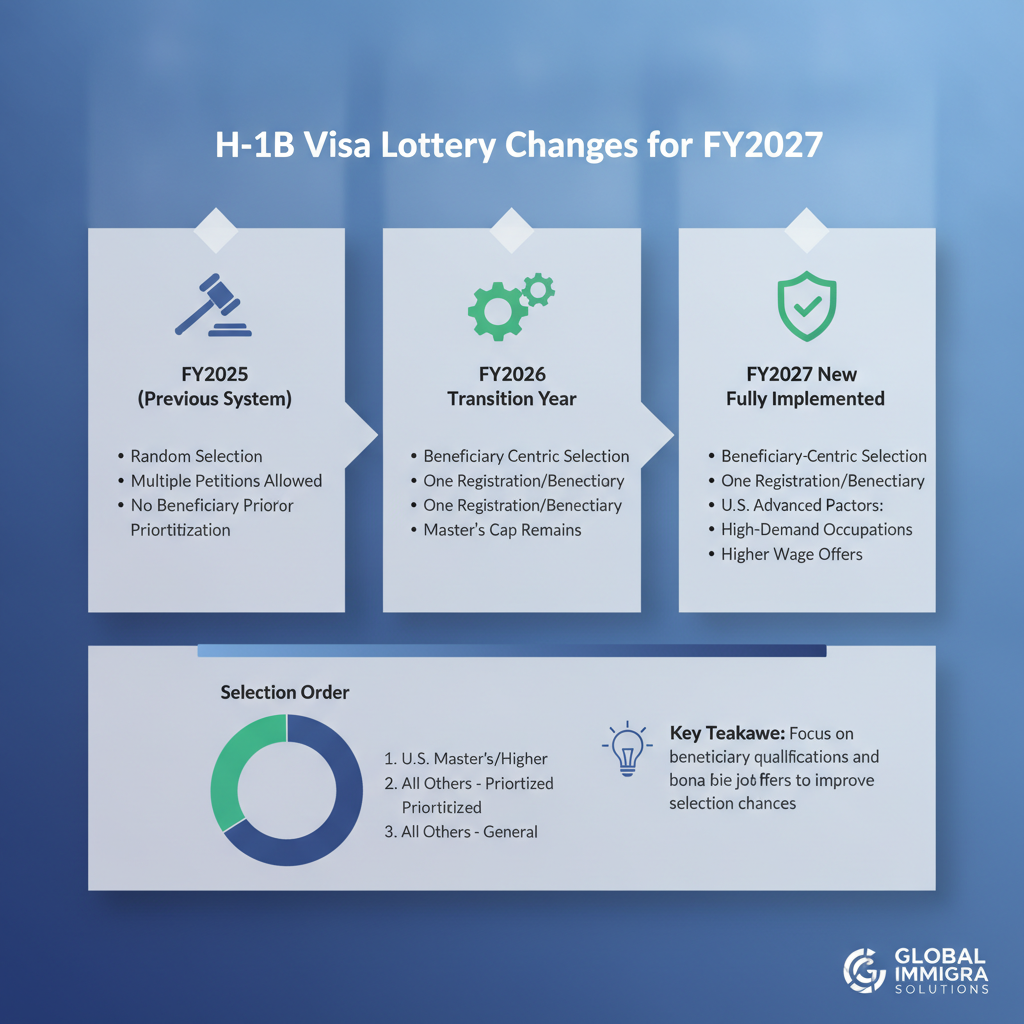
The H-1B visa program is subject to an annual cap, meaning only a limited number of visas are available each fiscal year. Due to overwhelming demand, U.S. Citizenship and Immigration Services (USCIS) conducts a lottery to select eligible registrations. The "news" surrounding the H-1B visa lottery for Fiscal Year 2027 (FY2027) stems from critical policy adjustments made by USCIS in recent years, particularly the shift to a beneficiary-centric selection process. These changes, initially introduced for the FY2025 lottery, are now firmly in place and will govern the upcoming FY2027 selection process. The goal behind these reforms is to reduce fraud, ensure fairness, and increase the integrity of the lottery system, which had seen an alarming rise in duplicate registrations by multiple employers for the same individual, artificially inflating selection odds.
As the FY2027 H-1B cap season approaches (typically with registration in March of the preceding year, i.e., March 2026 for FY2027), immigration attorneys, employers, and prospective beneficiaries are preparing for this refined process. Understanding these changes *now* is crucial for anyone planning to participate in the upcoming lottery, ensuring compliance and maximizing their chances of selection.
How it can affect Florida residents
Florida, especially the Orlando metropolitan area, is a hub for innovation, tourism, healthcare, and aerospace. These industries heavily rely on skilled foreign talent, making the H-1B visa program vital for many employers and professionals in the state. For Florida residents, particularly those on F-1 (student) or J-1 (exchange visitor) visas, or those already working on Optional Practical Training (OPT), the H-1B lottery is often the next critical step towards long-term employment and potentially permanent residency in the U.S.
- Increased Fairness for Beneficiaries: The beneficiary-centric model means that if you are a prospective H-1B worker in Orlando, your chances of selection are no longer diluted by fraudulent multiple registrations. Each unique individual gets one chance, regardless of how many employers register them. This levels the playing field for genuine candidates.
- Employer Due Diligence: Florida employers, particularly those along the I-4 corridor in high-tech or medical fields, must now be even more diligent in verifying genuine job offers and understanding the new registration system. They can no longer simply register a candidate through multiple shell companies to game the system.
- Impact on Local Talent Pool: For companies in Orange County and across Central Florida seeking to hire specialized talent, these changes aim to ensure that the H-1B program genuinely serves its purpose: filling critical skill gaps with qualified foreign professionals.
- Planning and Preparation: For individuals and businesses in Orlando, early planning and thorough preparation, guided by experienced immigration counsel, are more important than ever to navigate the refined lottery process successfully.
Navigating the H-1B changes can be complex. Our Orlando immigration team at Imigrar specializes in H-1B petitions and understands the nuances of the new lottery system. Call +1 786-791-3106 for a free consultation to discuss your specific situation, or message us online. Se Habla Español.
What H-1B Visa Lottery Changes for FY2027 Is (and Why It Matters)
The H-1B visa is a nonimmigrant visa that permits U.S. employers to temporarily employ foreign workers in specialty occupations. These occupations typically require theoretical and practical application of a body of highly specialized knowledge and a bachelor's degree or higher in the specific specialty (or its equivalent) as a minimum for entry into the occupation in the U.S.
A plain-English definition
Think of the H-1B visa as a special work permit for highly skilled jobs. Because there are many more people who want this permit than there are available each year, the U.S. government holds a "lottery" to decide who gets to apply. The "H-1B Visa Lottery Changes for FY2027" refers to new rules that USCIS put in place to make this lottery fairer and prevent fraud. The biggest change is that now, instead of employers entering the lottery, it's the person (beneficiary) who gets one entry, no matter how many companies want to hire them. This stops companies from trying to game the system by submitting many applications for the same person, which used to inflate selection odds. Now, if you're a skilled professional, your individual chance of being selected is based purely on your unique registration, making the process more equitable for everyone.
Key terms you need to know
- H-1B Cap: The annual limit on the number of H-1B visas issued. Congress currently sets the annual regular cap at 65,000, with an additional 20,000 visas reserved for those who hold a U.S. master's degree or higher (the Master's Cap). Certain employers, like universities and non-profit research organizations, are cap-exempt.
- Beneficiary: The foreign national worker who is the subject of the H-1B petition.
- Petitioner: The U.S. employer who files the H-1B petition on behalf of the beneficiary.
- H-1B Registration: The initial electronic process where employers (or their attorneys) submit basic information about the company and the prospective H-1B worker to USCIS during a specific window, typically in March. This is the entry into the lottery.
- Beneficiary-Centric Selection: The core new rule. For FY2027, USCIS will select registrations based on the unique beneficiary, rather than the registration itself. This means if a beneficiary has multiple registrations submitted on their behalf by different employers, they will still only be entered into the lottery once. If selected, all employers who registered that beneficiary will be notified, and any one of them can then proceed with filing the H-1B petition. This significantly reduces the ability to increase selection odds through multiple filings for the same individual.
- Lottery Selection Period: The window following the registration period when USCIS conducts the random selection process and announces the results.
- Petition Filing Period: The window during which selected employers can file the full Form I-129, Petition for a Nonimmigrant Worker, and supporting documents.
- Specialty Occupation: An occupation that requires a theoretical and practical application of a body of highly specialized knowledge, and a bachelor's degree or higher in the specific specialty (or its equivalent) as a minimum for entry into the occupation in the U.S.
- Labor Condition Application (LCA): Form ETA-9035. An application filed by the employer with the Department of Labor (DOL) attesting that they will pay the H-1B worker at least the prevailing wage or the actual wage paid to other employees with similar experience and qualifications, whichever is higher, and provide working conditions that will not adversely affect other workers. This must be certified by DOL before an H-1B petition can be filed with USCIS.
The shift to a beneficiary-centric selection process is the most impactful change for FY2027. Previously, each registration was treated as a distinct entry, meaning a beneficiary could have multiple entries if multiple employers registered them. This led to widespread concerns about fraud, where some individuals had dozens of registrations, giving them an unfair advantage and reducing the chances for others. The new system aims to eliminate this practice, ensuring that every unique beneficiary has an equal chance of selection, regardless of how many employers are interested in sponsoring them. This change also means that employers must ensure their offers are genuine and that they are truly committed to sponsoring the individual, as the ability to "try again" with multiple entries for the same person is gone.
Current Immigration Law: The Foundation
The H-1B visa program is governed by federal immigration laws, primarily the Immigration and Nationality Act (INA), and regulations issued by the Department of Homeland Security (DHS) through USCIS. Understanding these foundational laws is crucial for navigating the H-1B process, especially with the recent changes.
The authority for the H-1B nonimmigrant visa classification is found in Section 101(a)(15)(H)(i)(b) of the Immigration and Nationality Act (INA), 8 U.S.C. § 1101(a)(15)(H)(i)(b). Regulations governing the H-1B program are detailed in 8 CFR 214.2(h). These legal frameworks define who qualifies for an H-1B visa, the requirements for employers, and the procedures for application and adjudication.
For the FY2027 lottery, USCIS has finalized changes to the H-1B cap lottery process, specifically amending 8 CFR 214.2(h)(8) to implement the beneficiary-centric selection process. This rule also formalized the increase in registration fees and the ability to file Form I-129 online for H-1B petitions.
USCIS official websiteFederal requirements
To qualify for an H-1B visa, both the employer (petitioner) and the foreign national (beneficiary) must meet specific federal criteria:
Employer Requirements:
- The employer must offer a job in a specialty occupation.
- The employer must file a Labor Condition Application (LCA), Form ETA-9035, with the U.S. Department of Labor (DOL) and receive certification before filing the H-1B petition. The LCA attests that the employer will pay the H-1B worker at least the prevailing wage for the occupation in the area of employment or the actual wage paid to other employees with similar experience and qualifications, whichever is higher.
- The employer must not displace U.S. workers.
- The employer must be able to demonstrate a valid employer-employee relationship with the beneficiary.
Beneficiary Requirements:
- The beneficiary must hold a bachelor's degree or its equivalent, or a higher degree in a specialty occupation, or possess a license in a specialty occupation field, or have work experience equivalent to a bachelor's degree. Generally, three years of specialized work experience is considered equivalent to one year of college education.
- The beneficiary must be qualified to perform services in the specialty occupation.
- The beneficiary must intend to enter the U.S. solely for the purpose of performing services in the specialty occupation.
Important: The H-1B visa is a "dual intent" visa, meaning that an H-1B holder can simultaneously intend to apply for permanent residency (Green Card) without it negatively impacting their nonimmigrant status.
Florida-specific considerations
While H-1B is a federal program, its impact and application have regional nuances. For Florida residents and employers, several factors are particularly relevant:
- Key Industries: Florida's robust sectors in technology (especially in Orlando, Tampa, and Miami), healthcare, aerospace, and tourism heavily utilize H-1B visas. Companies along the I-4 corridor, from Orlando to Tampa, are significant petitioners.
- Prevailing Wage: The prevailing wage determination for an LCA is location-specific. Wages in major metropolitan areas like Orlando, Miami, or Jacksonville will differ from those in more rural parts of Florida. Employers must ensure they meet the prevailing wage for their specific Florida location.
- Orlando USCIS Field Office: While H-1B petitions are processed at USCIS service centers, residents of Orlando and Central Florida may interact with the Orlando USCIS Field Office for other immigration matters, such as interviews for adjustment of status if they eventually transition from H-1B to a Green Card.
- Local Legal Expertise: Given Florida's diverse economy and significant immigrant population, having legal counsel familiar with both federal H-1B regulations and local economic factors, like Imigrar in Orlando, can be a distinct advantage. Our firm understands the unique needs of Florida's businesses and professionals.
Don't navigate the complex H-1B legal landscape alone. Imigrar's experienced attorneys in Orlando provide expert guidance on federal requirements and Florida-specific considerations. Contact us at +1 786-791-3106 for a free, no-obligation consultation. Se Habla Español.

How to Navigate the H-1B Visa Lottery Changes for FY2027: A Complete Step-by-Step Guide
The H-1B visa process, especially with the lottery, can be intricate. The FY2027 changes emphasize the need for precision and adherence to the new beneficiary-centric rules. Here’s a detailed step-by-step guide:
1) Employer Determines Eligibility and Need, and Prepares for Registration
The process begins with a U.S. employer identifying a need for a foreign worker in a specialty occupation and confirming their intent to sponsor that individual for an H-1B visa. This initial phase is crucial for laying a strong foundation for the entire application process under the new rules.
- Assess Job Position: The employer must confirm that the job offered qualifies as a specialty occupation, requiring at least a bachelor's degree in a specific field.
- Verify Beneficiary Qualifications: Ensure the prospective employee (beneficiary) meets the minimum educational and experiential requirements for the specialty occupation.
- Determine Prevailing Wage: Research the prevailing wage for the specific occupation in the geographic area of employment (e.g., Orlando, FL) to ensure compliance with Department of Labor (DOL) requirements. This is a critical step for the subsequent LCA filing.
- Engage Legal Counsel: Especially with the new beneficiary-centric rules, employers should consult with an experienced immigration attorney like Imigrar early in the process. We can help assess eligibility, prepare for registration, and ensure compliance.
- Internal Review: Review company hiring policies and ensure all internal stakeholders (HR, hiring managers) understand the H-1B process and the new lottery rules.
Required Documents for this step (internal for employer/beneficiary):
- Beneficiary's resume/CV
- Beneficiary's educational transcripts and diplomas (translated and evaluated if from foreign institutions)
- Detailed job description
- Employer's FEIN (Federal Employer Identification Number)
2) Employer Submits H-1B Electronic Registrations for the Lottery
This is the entry point into the H-1B lottery. Under the new rules for FY2027, the focus is on the unique beneficiary. This phase typically occurs in March of the calendar year preceding the fiscal year (e.g., March 2026 for FY2027).
- Create/Access USCIS Online Account: Employers (or their authorized representatives/attorneys) must have a registrant account with USCIS.
- Submit Registrations: For each prospective H-1B worker, the employer submits an electronic registration. This includes basic information about the employer and the beneficiary (name, date of birth, country of birth, passport number, educational credentials).
- Pay Registration Fee: A non-refundable fee (which increased for FY2025 and will apply to FY2027) must be paid for each registration.
- Beneficiary-Centric Compliance: The system is designed to identify duplicate registrations for the *same unique beneficiary*. Even if multiple employers register the same individual, that individual will only have one chance in the lottery. USCIS will use the beneficiary's valid passport information or other designated travel document to identify unique individuals.
Required Documents/Information for this step (to be entered online):
- Employer's legal name, address, and FEIN
- Employer's authorized signatory information
- Beneficiary's full legal name, date of birth, country of birth, country of citizenship
- Beneficiary's passport number or other designated travel document number
- Beneficiary's gender
- Indication of whether the beneficiary qualifies for the Master's Cap (U.S. master's degree or higher)
Timeline Expectation: The registration period is usually a 14-day window in March. Warning: Missing this window means missing the opportunity for the entire fiscal year.
3) USCIS Conducts Lottery and Notifies Selected Registrations
After the registration period closes, USCIS conducts the electronic lottery. This random selection process determines which beneficiaries are eligible to have an H-1B petition filed on their behalf.
- Random Selection: USCIS conducts a random selection among the properly submitted registrations. The first selections are typically made for the Master's Cap, and then any unselected Master's cap registrations are pooled with regular cap registrations for the remaining 65,000 visas.
- Notification of Selection: USCIS notifies selected registrants through their online accounts. If a beneficiary was registered by multiple employers, all employers who registered that beneficiary will receive a selection notification. This is a key aspect of the new beneficiary-centric process.
- Notification of Non-Selection: Unselected registrants are also notified. USCIS may conduct subsequent lotteries if initial selections do not result in enough filed petitions to meet the cap.
Timeline Expectation: Lottery results are typically announced by the end of March or early April.
4) Employer Files Form I-129 Petition for Selected Beneficiaries
Only employers whose registrations were selected in the lottery can proceed to this step. This is where the full H-1B petition is prepared and submitted to USCIS.
- Prepare LCA: The employer must file a Labor Condition Application (LCA), Form ETA-9035, with the Department of Labor (DOL) and receive certification. This is a prerequisite for filing Form I-129.
- Complete Form I-129: Fill out Form I-129, Petition for a Nonimmigrant Worker, accurately and completely. This form is central to the H-1B petition.
- Gather Supporting Documents: Compile all necessary evidence to support the petition, demonstrating the specialty occupation nature of the job, the beneficiary's qualifications, and the employer-employee relationship.
- File with USCIS: Submit the completed Form I-129, certified LCA, supporting documents, and required filing fees to the appropriate USCIS service center. USCIS now allows for online filing of Form I-129 for H-1B cap petitions, which can streamline the process.
Required Documents for this step (comprehensive list):
- Certified Form ETA-9035 (LCA)
- Form I-129, Petition for a Nonimmigrant Worker
- H-1B Data Collection and Filing Fee Exemption Supplement (part of I-129)
- H-1B and H-1B1 Qualifying Attestations, A Supplement (part of I-129)
- Copy of the H-1B lottery selection notice
- Letter of support from the employer detailing the job offer, specialty occupation duties, and beneficiary's qualifications
- Beneficiary's educational documents (diplomas, transcripts, foreign degree evaluations)
- Beneficiary's resume/CV and professional licenses (if applicable)
- Beneficiary's passport biographical page and visa stamps (if applicable)
- Beneficiary's I-94 arrival/departure record (if already in U.S.)
- Employer's business license, incorporation documents, and financial statements (to prove ability to pay wages)
- Organizational charts, employee lists, and other evidence of a bona fide employer-employee relationship
- Photographs of the workplace (if applicable)
Timeline Expectation: The filing window for selected petitions is typically a 90-day window starting April 1st. Reminder: Premium processing is often available for an additional fee, potentially reducing processing times to 15 calendar days.
USCIS Forms5) USCIS Processes Petition and Approves/Denies
After receiving the petition, USCIS reviews all submitted documents. This stage can involve requests for additional evidence.
- Receipt Notice: USCIS issues a Form I-797C, Notice of Action, acknowledging receipt of the petition.
- Review and Adjudication: USCIS adjudicators review the petition for compliance with all H-1B requirements.
- Request for Evidence (RFE): If USCIS needs more information, they will issue an RFE. Responding comprehensively and promptly to an RFE is critical.
- Approval/Denial: If approved, USCIS issues a Form I-797B, Notice of Action (Approval Notice). If denied, a denial notice is issued with reasons.
Timeline Expectation: Regular processing times can range from 3 to 6 months or more. USCIS Processing Times
6) Beneficiary Applies for H-1B Visa Stamp (if outside U.S.) or Change of Status (if inside U.S.)
Upon H-1B petition approval, the beneficiary takes the next step to gain H-1B status.
- Consular Processing (Outside U.S.): If the beneficiary is outside the U.S., they must schedule an interview at a U.S. embassy or consulate in their home country to obtain an H-1B visa stamp. This involves completing Form DS-160, Online Nonimmigrant Visa Application.
- Change of Status (Inside U.S.): If the beneficiary is already in the U.S. in a valid nonimmigrant status (e.g., F-1 OPT), and the employer requested a change of status on Form I-129, their status automatically changes to H-1B on October 1st (the start of the fiscal year), provided the petition was approved.
Required Documents for Consular Processing:
- Valid passport
- DS-160 confirmation page
- Appointment confirmation page
- Original Form I-797B (H-1B Approval Notice)
- LCA (Form ETA-9035)
- Employer letter, job offer, and detailed job description
- Beneficiary's educational documents, resume, and professional licenses
- Photographs
- Proof of intent to return to home country (though H-1B is dual intent, some consulates may still inquire)
Timeline Expectation: Consular interview wait times vary by country. U.S. Department of State
7) Beneficiary Begins Employment
Once H-1B status is acquired, the beneficiary can commence work for the petitioning employer.
- Start Date: H-1B status typically begins on October 1st of the fiscal year for which the petition was approved.
- Maintain Status: Beneficiaries must adhere to H-1B regulations, including working only for the petitioning employer in the approved specialty occupation. Any significant changes (e.g., job duties, work location, employer) require an amended H-1B


