What This News Means for Immigrants in Orlando and Across Florida
The landscape of U.S. immigration is constantly evolving, and few changes impact skilled foreign workers more directly than those affecting the H-1B visa program. As of March 30, 2026, the discussion around the H-1B visa lottery for Fiscal Year 2027 (FY2027) is dominated by significant new rules implemented by U.S. Citizenship and Immigration Services (USCIS). These changes are designed to enhance the integrity of the lottery process, reduce fraud, and ensure a more equitable chance for eligible beneficiaries. For professionals, employers, and families throughout Florida, understanding these updates is not just beneficial—it's critical.Why this news is showing up now
The H-1B visa program operates on a fiscal year that begins on October 1st. To allow sufficient time for petition filing and processing before the new fiscal year, USCIS typically conducts the H-1B cap registration period in March. For **Fiscal Year 2027 (FY2027)**, which begins on October 1, 2026, the registration period would have recently concluded, or is just concluding, in March 2026. This timing makes any new rules or changes highly relevant right now, as applicants and employers are either preparing for or have just participated in the lottery under these new guidelines. The news cycle intensifies as USCIS releases official guidance, clarification, and results from the initial phase of the lottery. The implications of these changes are immediate and far-reaching, necessitating prompt attention from all stakeholders.How it can affect Florida residents
Florida, particularly areas like Orlando, Tampa, and the I-4 corridor, is a hub for technology, tourism, healthcare, and education—sectors that heavily rely on H-1B visa holders. * **For Skilled Workers in Florida:** If you are a foreign national currently working in Florida on another visa (e.g., F-1 OPT/CPT) or residing abroad and seeking employment in a specialty occupation, these changes directly impact your chances of securing an H-1B visa. The new beneficiary-centric selection process means that your individual eligibility and proper registration are paramount, rather than the number of employers who register on your behalf. This levels the playing field, potentially reducing the advantage some had by having multiple registrations. * **For Florida Employers:** Tech companies in Orlando's "Silicon Swamp," hospitals, universities like the University of Central Florida (UCF), and other businesses across the state frequently sponsor H-1B visas. These employers must now adapt their registration strategies. They need to ensure they have accurate beneficiary information, including passport details, and understand that multiple registrations for the same individual will no longer increase that individual's lottery odds. This shifts the focus to identifying truly qualified candidates and diligently preparing their individual registrations. * **For Families:** The H-1B visa is a pathway for many families to live and work in the U.S. Changes to the lottery process can cause anxiety and uncertainty. Understanding the new rules can help families plan their futures more effectively, knowing that the process aims for greater fairness. At Imigrar, we understand the unique challenges and opportunities these changes present for the vibrant immigrant community in Orlando and throughout Florida. Our mission is to **"Keep Families Together,"** and navigating complex H-1B rules is a crucial part of that commitment.Need Help Navigating the New H-1B Rules? Our Orlando immigration team is ready to assist. Call +1 786-791-3106 for a free consultation, or message us online. Se Habla Español.
What H-1B Visa Lottery Changes for FY2027 Is (and Why It Matters)
The H-1B visa program is a cornerstone of U.S. immigration for skilled workers. It allows U.S. employers to temporarily employ foreign workers in specialty occupations. These occupations generally require a bachelor's degree or higher in a specific field. Due to high demand, the number of H-1B petitions far exceeds the annual cap set by Congress, necessitating a lottery system. The changes for FY2027 are a direct response to concerns about widespread fraud and abuse within this lottery.A plain-English definition
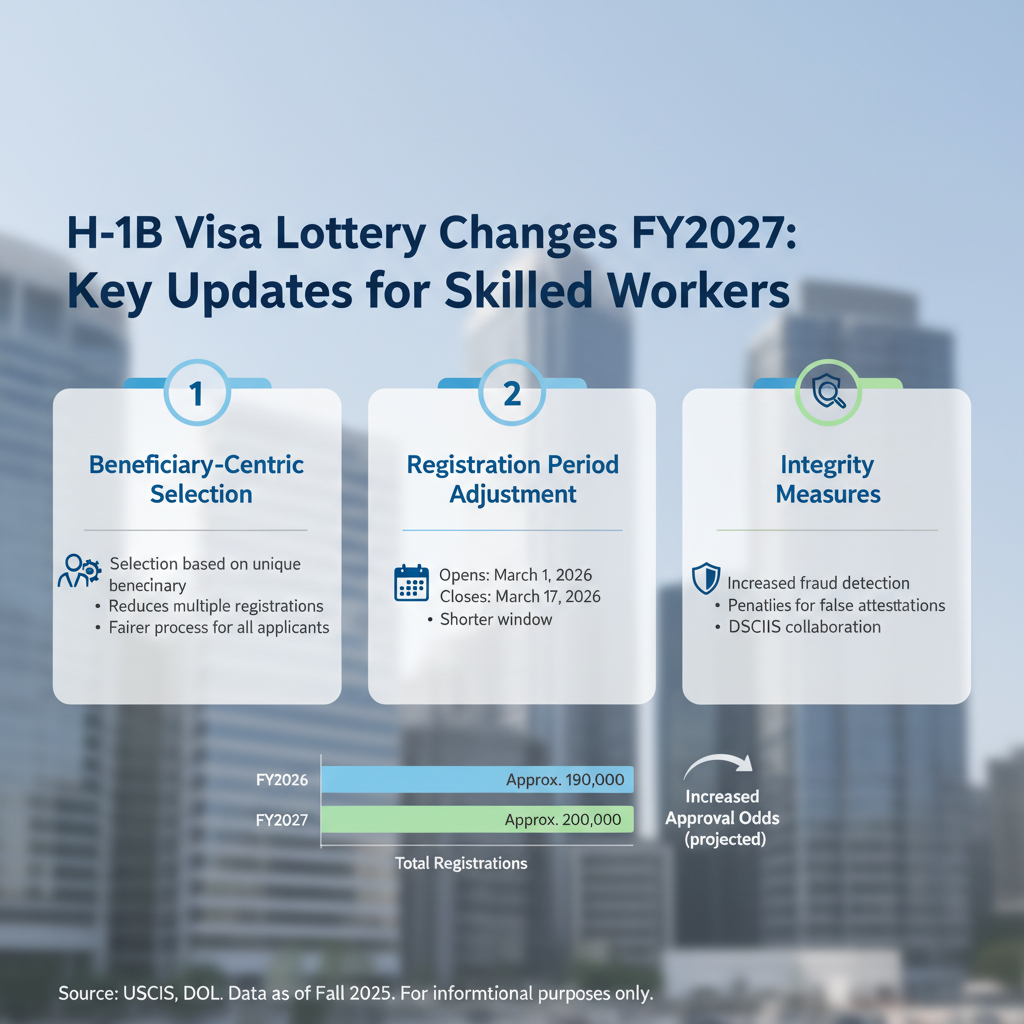
Imagine a golden ticket lottery for a highly sought-after job in the U.S. That's essentially the H-1B visa lottery. Each year, the U.S. government makes a limited number of H-1B visas available—typically 65,000 for the regular cap and an additional 20,000 for those with a U.S. master's degree or higher (the "master's cap"). Because many more people want these visas than are available, USCIS runs a lottery. Previously, an employer would register a potential employee (the "beneficiary") for the lottery. If multiple employers registered the *same* person, that person would effectively have multiple "tickets" in the lottery, increasing their chances of selection. This system was widely abused, with some companies submitting many registrations for the same individual, often without a genuine job offer, simply to game the system. The **H-1B Visa Lottery Changes for FY2027** introduce a **beneficiary-centric selection process**. This means that regardless of how many employers register you, you, as the individual beneficiary, only get one "ticket" in the lottery. If you are selected, then one of the employers who registered you can proceed with filing a full petition. This change aims to make the lottery fairer, giving everyone an equal, single chance, and reducing fraudulent registrations.Key terms you need to know
Understanding these terms is crucial when navigating the H-1B process: * **H-1B Visa:** A nonimmigrant visa that allows U.S. employers to temporarily employ foreign workers in specialty occupations. * **Specialty Occupation:** An occupation that requires theoretical and practical application of a body of highly specialized knowledge, and a bachelor's or higher degree in the specific specialty (or its equivalent) as a minimum for entry into the occupation. * **USCIS (U.S. Citizenship and Immigration Services):** The government agency that oversees lawful immigration to the United States. This is the primary agency you'll interact with for H-1B petitions. You can find more information on the USCIS official website. * **H-1B Cap:** The annual numerical limit on the number of H-1B visas issued. Currently, this is 65,000 for the regular cap and an additional 20,000 for the U.S. master's cap. * **H-1B Cap-Exempt:** Certain employers are exempt from the annual cap, such as institutions of higher education, non-profit organizations affiliated with them, and non-profit research organizations or government research organizations. * **H-1B Registration:** The electronic process where prospective petitioners (employers) submit information about themselves and each requested beneficiary to USCIS for the lottery. This typically occurs in March. * **Beneficiary:** The foreign national worker for whom the H-1B petition is being filed. * **Petitioner:** The U.S. employer filing the H-1B petition on behalf of the beneficiary. * **Lottery (or Selection Process):** If the number of registrations exceeds the annual cap, USCIS conducts a random selection process. For FY2027, this is now **beneficiary-centric**. * **LCA (Labor Condition Application):** A certification from the U.S. Department of Labor (DOL) that an employer has met certain conditions, including offering prevailing wages and working conditions to H-1B workers. This must be certified before filing an H-1B petition. * **Prevailing Wage:** The average wage paid to similarly employed workers in a specific occupation in the area of intended employment. Employers must pay H-1B workers at least the prevailing wage or the actual wage paid to employees with similar experience and qualifications, whichever is higher. * **Form I-129, Petition for a Nonimmigrant Worker:** The primary form used to petition for an H-1B nonimmigrant worker. * **Request for Evidence (RFE):** A notice from USCIS asking for additional information or documents to support an H-1B petition. * **Premium Processing:** An optional service offered by USCIS for certain petition types, including H-1B, which guarantees processing within a shorter timeframe (typically 15 calendar days) for an additional fee. * **DHS (Department of Homeland Security):** The federal department responsible for public security, including immigration enforcement. USCIS is an agency within DHS. * **DOS (Department of State):** The federal department responsible for U.S. foreign policy and issuing visas at U.S. embassies and consulates abroad. You can find more information on the U.S. Department of State website. The FY2027 changes are particularly significant because they shift the focus from the employer to the individual beneficiary, aiming to close loopholes that allowed for fraudulent multiple registrations. This underscores the importance of legitimate job offers and proper documentation from the outset.Current Immigration Law: The Foundation
The H-1B visa program is governed by the Immigration and Nationality Act (INA), specifically **8 U.S.C. § 1101(a)(15)(H)(i)(b)** and **8 U.S.C. § 1184(g)**, which establishes the annual numerical cap. The regulatory framework is found in **8 CFR Part 214.2(h)**. These laws and regulations outline the eligibility criteria for both employers and beneficiaries, the cap limits, the application process, and the duration of the visa.Federal requirements
To qualify for an H-1B visa, both the employer and the beneficiary must meet stringent federal requirements: * **For the Employer (Petitioner):** * Must have a legitimate need for a foreign worker in a specialty occupation. * Must file a **Labor Condition Application (LCA) (Form ETA-9035)** with the U.S. Department of Labor, attesting to prevailing wage requirements and working conditions, before filing the H-1B petition. * Must agree to pay the H-1B worker at least the prevailing wage for the occupation in the area of employment or the actual wage paid to similarly qualified employees, whichever is higher. * Must provide a bona fide job offer in a specialty occupation. * **For the Beneficiary (Foreign Worker):** * Must hold a bachelor's degree or its equivalent, or a higher degree required by the specialty occupation, from an accredited college or university. * Alternatively, must possess an unrestricted state license, or have work experience equivalent to a bachelor's degree in the specialty occupation. * Must perform services in a specialty occupation. * Must have the qualifications required to perform the services in the specialty occupation. The annual H-1B cap is 65,000 visas, with an additional 20,000 reserved for those with a U.S. master's degree or higher. Certain exemptions apply for cap-exempt employers (e.g., universities, non-profit research organizations). The H-1B visa is typically granted for an initial period of up to three years and can be extended for a maximum of six years. Further extensions are possible under specific circumstances, such as having an approved I-140 immigrant petition. Key forms involved in the process include: * **Form I-129, Petition for a Nonimmigrant Worker**: This is the core petition form filed by the employer after a successful lottery selection. * **Form G-28, Notice of Entry of Appearance as Attorney or Accredited Representative**: Filed by your legal representative. It is crucial to understand that even with a successful lottery selection, the H-1B petition itself must be meticulously prepared and supported by extensive documentation to prove eligibility for both the employer, the beneficiary, and the specialty occupation itself. USCIS is vigilant in scrutinizing petitions, and errors or omissions can lead to RFEs or denials.Florida-specific considerations
While H-1B law is federal, its application has local nuances. Florida's economy is diverse, with significant H-1B demand in: * **Technology:** Orlando, Tampa, and Miami are growing tech hubs, attracting software developers, IT professionals, and engineers. Companies in the Research Park at UCF, or those along the I-4 corridor, frequently seek H-1B talent. * **Healthcare:** Hospitals and medical centers across Florida, including those in Orange County, often sponsor H-1B visas for medical professionals, researchers, and specialized staff. * **Education:** Florida's robust university system (e.g., UCF, University of Florida, Florida State University) and research institutions employ H-1B workers as professors, researchers, and post-doctoral fellows, often under cap-exempt categories. * **Tourism & Hospitality:** While less common for the H-1B specialty occupation itself, related tech and management roles within large corporations in the tourism sector may also utilize H-1B visas. The presence of a **USCIS Field Office in Orlando** (and other locations like Miami and Tampa) means that while most H-1B petition processing is handled by service centers, local services for other immigration matters might be relevant to H-1B visa holders and their families. For Central Florida residents, understanding the local employer landscape and prevalent industries can help tailor H-1B applications to local demand.Confused about H-1B laws and how they apply to your situation in Florida? Don't navigate the complexities alone. Call Imigrar at +1 786-791-3106 for a free consultation. Our expert team is here to help. Se Habla Español.
How to Navigate the New H-1B Lottery Rules: A Complete Step-by-Step Guide
The FY2027 H-1B lottery changes introduce a crucial shift, making the process **beneficiary-centric**. This guide outlines the updated steps for employers and beneficiaries.1) Understand the New Rules and Verify Eligibility
Before anything else, both the employer and the prospective H-1B worker must understand the new beneficiary-centric selection process and confirm their eligibility. The most significant change is that selections are now based on unique beneficiaries, identified by their valid passport or travel document information. This means each beneficiary has only **one chance** in the lottery, regardless of how many employers register them. * **Employer Responsibilities:** * Confirm the job offered meets the definition of a **specialty occupation**. * Ensure the wage offered meets or exceeds the **prevailing wage** for the occupation in the geographic area. * Verify they have a legitimate, bona fide job offer for the beneficiary. * Understand the new requirement to provide the beneficiary's passport/travel document information during registration. * **Beneficiary Responsibilities:** * Possess the required educational qualifications (bachelor's degree or higher, or its equivalent in experience) for the specialty occupation. * Ensure their passport or travel document is **valid and unexpired** and that the information matches exactly what will be provided by the employer(s) during registration. * Communicate clearly with all prospective employers if more than one is considering sponsoring. **Required Documents for this step (for verification):** * **Beneficiary's:** Valid passport or travel document. Academic degrees, transcripts, and any professional licenses or evaluations of foreign degrees. Resume/CV. * **Employer's:** Detailed job description for the specialty occupation. Wage information for the position.2) Employer Creates USCIS Online Account and Submits Registration
The H-1B cap registration process is entirely electronic. The employer (or their authorized legal representative) must create a registrant account on the USCIS online portal. * **Action:** The employer (petitioner) or their attorney creates a USCIS online account specifically for H-1B registrants. * **During the designated registration period (typically March 1st to March 17th for FY2027):** * The employer inputs their company's information. * For each prospective beneficiary, the employer provides: * Beneficiary's full legal name. * Date of birth. * Country of birth. * Country of citizenship. * Gender. * **Crucially, the beneficiary's valid passport or travel document number.** This is the new identifier for the beneficiary-centric selection. * Whether the beneficiary is eligible for the U.S. master's cap. * A **non-refundable $10 fee** per registration is paid. **Important:** Each unique beneficiary, identified by their passport number, will only be entered into the lottery once, even if multiple employers submit registrations on their behalf. USCIS will consolidate these registrations for the lottery selection.3) Lottery Selection and Notification
After the registration period closes, USCIS conducts the lottery. * **Action:** USCIS performs the random selection process, first for the master's cap, then for the regular cap, ensuring each unique beneficiary has an equal chance. * **Notification:** USCIS notifies selected registrants (employers/attorneys) through their online accounts. This typically happens by March 27th, but can vary. * **Status Updates:** Registrants will see one of the following statuses for each beneficiary: * **"Selected":** The registration has been selected in the lottery. * **"Not Selected":** The registration was not chosen. * **"Denied":** If multiple registrations were submitted by the same employer for the same beneficiary (which is prohibited), or if payment failed. * **"Invalidated":** If USCIS determines the registration was fraudulent or improperly submitted. **Timeline Expectation:** Lottery results are usually announced within days of the registration period closing. For FY2027, expect notifications around late March 2026.4) Filing the H-1B Petition (Form I-129)
Only after a registration is "Selected" can the employer proceed with filing the full H-1B petition. * **Action:** The employer, with the help of legal counsel, prepares and files **Form I-129, Petition for a Nonimmigrant Worker**, along with all supporting documentation, within the designated filing window (typically 90 days from the selection notification, e.g., April 1st to June 30th for FY2027). * **Key Pre-filing Step:** The employer must have a certified **Labor Condition Application (LCA) (Form ETA-9035)** from the Department of Labor. This process can take 7-10 business days, so it must be initiated promptly after selection. * **Petition Contents:** The **Form I-129** package must include: * The I-129 form itself. * The original H-1B registration selection notice. * Certified LCA. * Support letter from the employer detailing the job offer, specialty occupation requirements, and beneficiary's qualifications. * Evidence of beneficiary's qualifications (degrees, transcripts, evaluations). * Evidence that the job is a specialty occupation. * Beneficiary's passport copies, visa stamps, I-94 records (if already in the U.S.). * Employer's financial documents, business license, and tax IDs. * Any other required supplements or addendums. **Warning:** The filing location (USCIS service center) depends on the employer's address. Ensure timely and complete submission within the specified window.5) Responding to Requests for Evidence (RFEs)
It is common for USCIS to issue an **RFE** if they require more information or clarification regarding the petition. * **Action:** If an RFE is received, the employer and beneficiary, with their attorney, must carefully review the RFE, gather the requested evidence, and submit a comprehensive response by the deadline provided (typically 60-90 days). * **Common RFE Topics:** Specialty occupation issues, employer-employee relationship, prevailing wage, beneficiary qualifications, availability of work, and evidence of a bona fide job offer. **Reminder:** A strong, well-organized RFE response is critical to avoiding a denial. This is where experienced legal counsel is invaluable.6) Petition Approval and Visa Interview/Change of Status
If the petition is approved, the next steps depend on whether the beneficiary is inside or outside the U.S. * **For Beneficiaries Outside the U.S. (Consular Processing):** * Upon I-129 approval, USCIS sends the approval notice to the employer/attorney. * The beneficiary will then apply for an H-1B visa stamp at a U.S. embassy or consulate in their home country. This involves completing **Form DS-160 (Online Nonimmigrant Visa Application)**, paying fees, and attending an interview. * **Required Documents for Visa Interview:** Passport, I-797 Approval Notice, DS-160 confirmation page, photograph, interview appointment confirmation, employer support letter, LCA, educational documents, employment verification letters, and any other requested documents. * **For Beneficiaries Inside the U.S. (Change of Status):** * If the beneficiary is maintaining a valid nonimmigrant status (e.g., F-1 OPT) when the H-1B petition is filed and approved with a request for **Change of Status**, their status automatically changes to H-1B on October 1st (the start of the fiscal year) or the petition approval date, whichever is later. * **Important:** Maintain lawful status until October 1st. Cap-gap extensions may apply for F-1 students. **Timeline:** Visa interview wait times vary by consulate. Change of status is typically effective October 1st.Practical Steps You Can Take Today
Preparing for the H-1B lottery, especially with the new rules, requires foresight and meticulous planning. * **Actionable Checklist:** * [ ] **Confirm Beneficiary Eligibility:** Review your educational background and work experience against the requirements for a specialty occupation. Ensure your degree is recognized in the U.S. * [ ] **Verify Passport Validity:** Ensure your passport or travel document is valid for at least six months beyond your intended H-1B stay. This document number will be your unique identifier in the lottery. * [ ] **Communicate with Employers:** If multiple employers are interested in sponsoring you, ensure they are aware of the new beneficiary-centric selection process. Provide them with accurate and consistent passport information. * [ ] **Gather Educational Documents:** Collect all original diplomas, transcripts, and any foreign degree evaluations. * [ ] **Update Resume/CV:** Ensure your resume accurately reflects your skills, education, and work experience, aligning with the specialty occupation you are seeking. * [ ] **Research Prevailing Wages:** Understand the typical wages for your occupation in your intended work location (e.g., Orlando, Florida) to ensure any job offers are compliant. * [ ] **Consult an Immigration Attorney:** This is perhaps the most crucial step. An expert can guide both you and your employer through the complexities, ensure compliance with new rules, and prevent costly mistakes. * **Document Preparation Guidance:** * **Digital Copies:** Create high-quality digital scans of all original documents. * **Translations:** If any documents are not in English, obtain certified translations. * **Organization:** Keep all documents meticulously organized in a secure, accessible format. * **Consistency:** Ensure all names, dates, and other identifying information are consistent across all documents. * **Timeline Expectations (FY2027 based on typical patterns):** * **March 1-17, 2026:** H-1B electronic registration period. Employers submit registrations. * **By March 27, 2026:** USCIS announces lottery results (selection notifications). * **April 1, 2026 – June 30, 2026 (approx.):** Window for selected employers to file **Form I-129 H-1B petitions**. * **October 1, 2026:** Earliest start date for H-1B employment for petitions approved under the FY2027 cap. * **Processing Times:** Varies significantly. Check USCIS Processing Times for current estimates. Premium processing (additional fee) can expedite I-129 processing to 15 calendar days. **Important:** Missing any deadline or submitting incorrect information can lead to your registration or petition being denied, requiring you to wait until the next fiscal year.