


The landscape of U.S. immigration is constantly evolving, and for those aspiring to work in the United States, staying informed is paramount. This year, significant changes to the H-1B visa lottery process for Fiscal Year 2027 (FY22027) have been announced, marking a pivotal shift in how highly skilled foreign workers gain access to the American job market. At Imigrar, an immigration law firm based in Orlando, Florida, we understand the profound impact these changes can have on individuals, families, and businesses across the nation, especially within our vibrant Central Florida community.
Our mission is to "Keep Families Together," and a crucial part of that is ensuring our clients have the most accurate, up-to-date, and actionable information to navigate complex immigration processes. This comprehensive guide will break down the new H-1B lottery rules, explain what they mean for you, and provide a clear roadmap for success.
Navigating H-1B changes can be complex. Our Orlando immigration team is ready to assist. Call +1 786-791-3106 for a free consultation, or message us online. Se Habla Español.
The reporting that sparked this guide
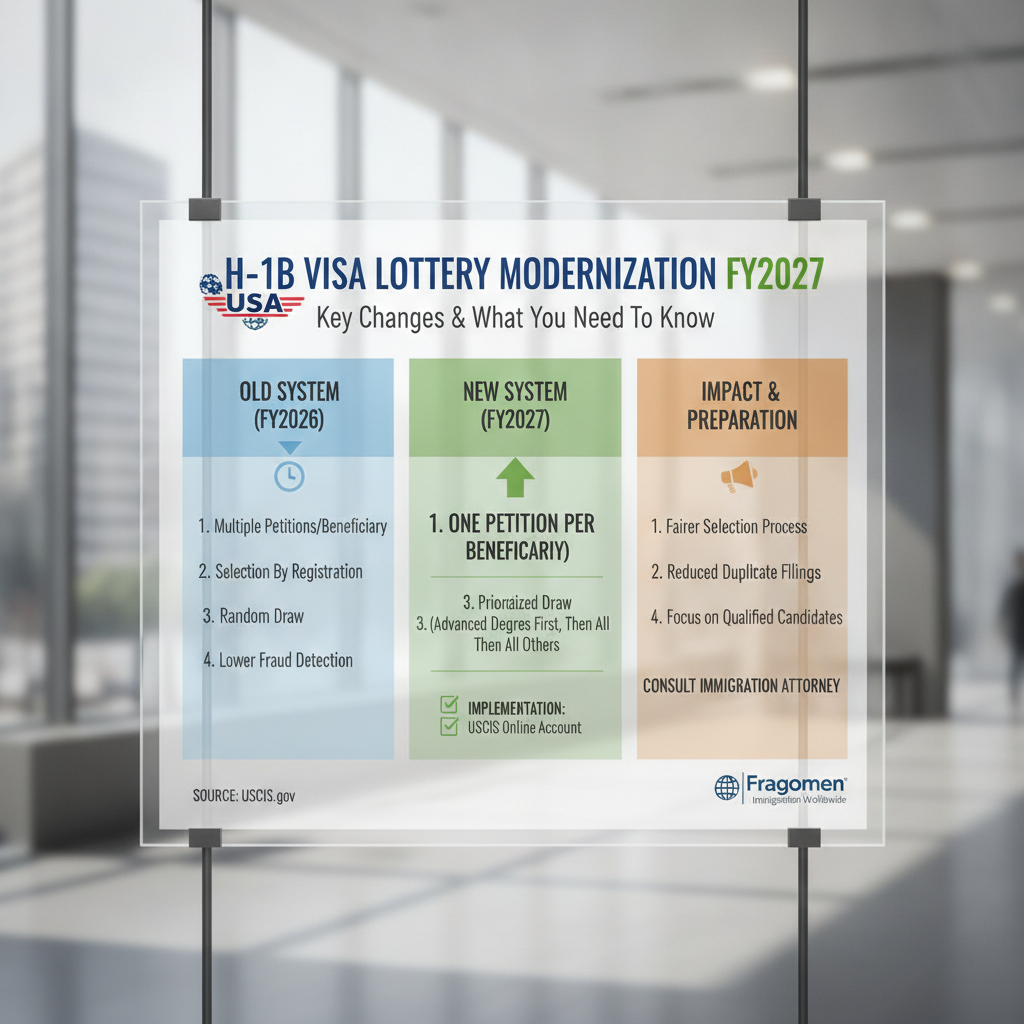
The U.S. Citizenship and Immigration Services (USCIS) recently finalized new rules affecting the H-1B visa registration process. These changes aim to enhance the integrity of the lottery system and reduce the potential for fraud, which has been a growing concern in recent years. This move directly responds to widespread reporting and calls for reform, ensuring a fairer and more equitable system for all eligible beneficiaries.
For detailed information on the evolving immigration landscape, refer to:
H-1B Visa Lottery Changes for FY2027 (Legal News)
What This News Means for Immigrants in Orlando and Across Florida
The H-1B visa program is a cornerstone for many skilled professionals seeking to work in the U.S., particularly in tech, engineering, medicine, and other specialized fields. For individuals and employers in Florida, these changes are not just regulatory updates; they represent a significant shift in strategy for securing talent and building careers.
Why this news is showing up now
The H-1B visa program operates on an annual cap, meaning only a limited number of visas are available each fiscal year. Demand consistently far outstrips supply, necessitating a lottery system. In recent years, USCIS identified a concerning trend: a significant increase in registrations submitted on behalf of the same beneficiary by multiple employers, often with no legitimate job offer. This practice, known as "multiple registrations," was perceived as an attempt to game the system, artificially inflating selection chances and reducing opportunities for truly qualified individuals.
To combat this fraud and ensure a more equitable distribution of H-1B visas, USCIS initiated a rulemaking process, culminating in the finalization of new regulations. These changes were officially announced in late 2023 and early 2024, giving applicants and employers time to prepare for the upcoming FY2027 lottery cycle, which typically begins with registration in March 2026.
How it can affect Florida residents
Florida, particularly the Orlando metropolitan area, is a rapidly growing hub for technology, aerospace, healthcare, and tourism. Companies along the I-4 corridor, from startups to established corporations, frequently rely on the H-1B program to fill specialized roles that require specific expertise. Universities like the University of Central Florida (UCF) and the University of Florida also sponsor international graduates for H-1B visas.
- For H-1B Beneficiaries in Florida: If you are a student graduating from a Florida university, an international professional working on an Optional Practical Training (OPT) visa in Orlando, or an individual living elsewhere but seeking employment in Florida, these changes directly impact your strategy. The new beneficiary-centric selection process means your chances are no longer diluted by fraudulent multiple registrations. You get one chance, just like everyone else, regardless of how many employers register on your behalf. This levels the playing field, potentially increasing the statistical odds for legitimate candidates.
- For Florida Employers: Companies in Orlando, Tampa, Miami, and beyond must now adjust their H-1B sponsorship strategies. While the goal is to reduce fraud, employers must ensure their internal processes comply with the new rules, particularly regarding the truthful attestation of job offers. The focus shifts from merely submitting registrations to ensuring a genuine employment relationship for each sponsored candidate. This change reinforces the importance of working with experienced legal counsel to ensure compliance and maximize success.
- Increased Integrity: The changes aim to restore public confidence in the H-1B program by making the selection process more transparent and fair. This ultimately benefits legitimate employers and highly skilled workers who are genuinely seeking to contribute to the U.S. economy.
What H-1B Visa Lottery Changes for FY2027 Is (and Why It Matters)
The H-1B visa program allows U.S. employers to temporarily employ foreign workers in specialty occupations. These occupations generally require a bachelor's degree or higher in a specific field. Due to high demand, USCIS utilizes a lottery system to select eligible registrations when the number of submissions exceeds the annual cap.
A plain-English definition
For Fiscal Year 2027, the biggest change to the H-1B lottery is how USCIS selects registrations. Previously, if multiple employers registered the same individual (beneficiary), each registration had an equal chance in the lottery. This meant a beneficiary with five registrations effectively had five chances. The new rule, effective for the FY2027 cap season, shifts to a beneficiary-centric selection process. This means that regardless of how many employers submit a registration on behalf of a single individual, that individual will only be entered into the lottery ONCE. If that individual is selected, all employers who submitted a registration for them will be notified, and any of those employers can then proceed to file an H-1B petition. This change is designed to eliminate the unfair advantage gained by individuals with multiple registrations and to deter fraudulent practices.
Key terms you need to know
- H-1B Visa: A non-immigrant visa that allows U.S. employers to temporarily employ foreign workers in specialty occupations.
- Specialty Occupation: An occupation that requires theoretical and practical application of a body of highly specialized knowledge, and a bachelor's or higher degree in the specific specialty (or its equivalent) as a minimum for entry into the occupation in the United States.
- Beneficiary: The foreign national (the individual seeking the H-1B visa).
- Petitioner: The U.S. employer who files the H-1B petition on behalf of the beneficiary.
- H-1B Cap: The annual limit on the number of H-1B visas issued. Currently, this is 65,000 for the regular cap and an additional 20,000 for those with a U.S. master’s degree or higher (the "master's cap").
- H-1B Lottery (or Cap Lottery): The random selection process USCIS uses when the number of eligible registrations exceeds the annual H-1B cap.
- Registration Period: The specific window (typically in March) when prospective H-1B petitioners (employers) must electronically register their beneficiaries with USCIS for the lottery.
- Selection Notice: Notification from USCIS that a beneficiary's registration has been selected in the lottery, allowing the employer to file an H-1B petition.
- Cap-Exempt: Certain H-1B petitions are not subject to the annual cap, such as those filed by institutions of higher education, non-profit organizations affiliated with higher education, or governmental research organizations.
- Labor Condition Application (LCA): Form ETA-9035, certified by the U.S. Department of Labor (DOL), which attests that the employer will pay the H-1B worker the prevailing wage or actual wage, whichever is higher, and provide working conditions that will not adversely affect other workers. This must be certified before filing the H-1B petition.
- FY2027: Fiscal Year 2027, which begins on October 1, 2026. H-1B petitions selected in the FY2027 lottery would have an earliest start date of October 1, 2026.
Confused by the terminology? Our Orlando immigration attorneys speak your language. Contact us at +1 786-791-3106 for clear, actionable advice. Se Habla Español.
Current Immigration Law: The Foundation
The H-1B visa program is governed by the Immigration and Nationality Act (INA), specifically Sections 101(a)(15)(H)(i)(b) and 214(g). The regulations implementing these statutes are found in the Code of Federal Regulations (CFR), primarily at 8 CFR Part 214.2(h).
Federal requirements
To qualify for an H-1B visa, both the petitioner (employer) and the beneficiary (employee) must meet specific federal requirements:
- For the Employer (Petitioner):
- Must have a U.S. Employer Identification Number (EIN).
- Must offer a job in a specialty occupation.
- Must pay the H-1B worker at least the prevailing wage for the occupation in the area of intended employment or the actual wage paid to other employees with similar experience and qualifications, whichever is higher. This is attested to in the Labor Condition Application (LCA), Form ETA-9035.
- Must demonstrate that the employment relationship is genuine and bona fide.
- For the Employee (Beneficiary):
- Must hold a bachelor's degree or its equivalent, or possess a license in a specialty occupation field, or have work experience equivalent to a bachelor's degree.
- Must be qualified to perform services in the specialty occupation.
- Must have a valid job offer from a U.S. employer for a position that meets the specialty occupation criteria.
The annual cap for H-1B visas is 65,000, with an additional 20,000 reserved for those who have earned a U.S. master's degree or higher. USCIS conducts an electronic registration process each year to manage the overwhelming demand for these visas.
For more details on H-1B requirements and regulations, always refer to the USCIS official website.
Florida-specific considerations
While federal law governs the H-1B program, the economic landscape of Florida presents unique opportunities and considerations:
- Tech and Innovation Hubs: Central Florida, particularly Orlando, is home to a burgeoning tech sector, modeling and simulation industry, and a growing cybersecurity presence. Companies in these fields are frequent H-1B petitioners.
- Hospitality and Tourism Management: While often requiring specific degrees, some roles in advanced hospitality management or theme park engineering may qualify as specialty occupations.
- Education and Research: Florida's major universities, including UCF, UF, USF, and FSU, are significant employers of H-1B workers, often under the cap-exempt category. They also attract international students who later seek H-1B sponsorship.
- Healthcare Sector: With a large and aging population, Florida's healthcare industry is constantly seeking skilled professionals, including H-1B physicians, nurses with advanced degrees, and medical researchers.
The Orlando USCIS Field Office primarily handles applications for individuals already in the U.S. who are adjusting their status or seeking other benefits. For H-1B petitions, the processing is typically handled by USCIS Service Centers, but local attorneys like Imigrar are crucial for guiding Florida residents through the application process and responding to any Requests for Evidence (RFEs) that may arise.
Important: All H-1B petitions are filed using Form I-129, Petition for a Nonimmigrant Worker. If the beneficiary is already in the U.S. and seeking to change status, additional forms like Form I-539, Application to Extend/Change Nonimmigrant Status might be relevant for dependents.
How to Navigate the H-1B Visa Lottery Changes: A Complete Step-by-Step Guide
Understanding the new beneficiary-centric selection process is crucial. Here’s a detailed guide for prospective H-1B beneficiaries and their sponsoring employers.
1) Understand the New Rules and Eligibility
Before any action, both the employer and prospective employee must thoroughly understand the updated H-1B lottery rules for FY2027. The primary change is that selection will now be based on the unique beneficiary, identified by their passport or travel document information, rather than on the number of registrations submitted on their behalf. This means each beneficiary has one chance in the lottery, regardless of how many employers register them.
- Key Action: Ensure you meet the H-1B eligibility criteria (specialty occupation, required education/experience). Discuss with potential employers how the new rule impacts their internal registration strategy.
- Required Documents (for understanding):
- Your valid passport/travel document.
- Your educational degrees and transcripts.
- Any professional licenses or certifications.
- Detailed resume/CV demonstrating work experience.
2) Secure Employer Sponsorship and LCA Filing
The H-1B process is employer-driven. You cannot apply for an H-1B visa on your own; a U.S. employer must sponsor you. Once an employer agrees to sponsor you, they must first file a Labor Condition Application (LCA), Form ETA-9035, with the Department of Labor (DOL).
- Key Action: Actively seek and secure a job offer from a U.S. employer willing to sponsor an H-1B visa. The employer (or their attorney) will then prepare and file the LCA. This step is critical and must be completed and certified by DOL before the H-1B registration can be submitted to USCIS.
- Required Documents (Employer's responsibility for LCA):
- Job description, salary, and work location.
- Prevailing wage determination (often obtained through DOL or private wage surveys).
- Employer's EIN.
3) H-1B Registration Process (New System)
Once the LCA is certified, the employer can proceed with the electronic H-1B registration. This is the stage where the new beneficiary-centric selection method comes into play. Employers will submit registrations online via the USCIS H-1B registrant account.
- Key Action: The sponsoring employer (or their authorized representative/attorney) will submit an electronic registration for each beneficiary. Crucially, each registration must include the beneficiary's valid passport or travel document information. Even if multiple employers register the same beneficiary, USCIS's system will identify the unique beneficiary and only enter them once into the lottery.
- Timeline Expectation: The H-1B registration period typically runs for about three weeks in March (e.g., March 1 to March 25 for FY2027).
- Required Information (for Registration, provided by employer):
- Employer’s Name, Address, and EIN.
- Employer’s authorized signatory information.
- Beneficiary’s full name, date of birth, country of birth, country of citizenship.
- Beneficiary’s gender.
- Beneficiary’s passport number (Important: this is how USCIS identifies a unique beneficiary).
- Whether the beneficiary holds a U.S. master’s degree or higher.
4) Lottery Selection and Petition Filing for Selected Registrants
After the registration period closes, USCIS conducts the lottery. Under the new rules, if a beneficiary is selected, USCIS will notify *all* employers who submitted a registration on their behalf. Any of these employers can then proceed to file an H-1B petition for that selected beneficiary.
- Key Action: If your registration is selected, the sponsoring employer must prepare and file the full H-1B petition (Form I-129) within the specified filing window (typically 90 days from April 1). This petition must include the certified LCA and extensive supporting documentation.
- Timeline Expectation: Lottery results are usually announced by late March. The filing window for selected petitions typically runs from April 1 to June 30.
- Required Documents (for Petition Filing, provided by employer and beneficiary):
- Certified LCA (Form ETA-9035).
- Form I-129, Petition for a Nonimmigrant Worker.
- Employer's letter of support outlining the job offer, specialty occupation details, and need for the beneficiary.
- Beneficiary's educational degrees, transcripts, and evaluations of foreign degrees.
- Beneficiary's resume/CV.
- Evidence of beneficiary's qualifications for the specialty occupation (e.g., letters from previous employers).
- Copies of beneficiary's passport, visa, and I-94 record.
- Photos of the beneficiary.
- Company financial documents, organizational charts, and business plans (to demonstrate ability to pay and legitimate business operations).
- Any contracts between the employer and beneficiary.
- For beneficiaries already in the U.S. seeking Change of Status: Form I-94, current visa stamp, and proof of maintaining lawful status.
5) Post-Selection and Visa Stamping/Change of Status
Once the H-1B petition is approved, the beneficiary can begin working for the petitioning employer on October 1st of the fiscal year. If the beneficiary is outside the U.S., they will need to attend a visa interview at a U.S. embassy or consulate in their home country to get the H-1B visa stamp. If the beneficiary is already in the U.S. and requested a Change of Status, their status will automatically change to H-1B on October 1st.
- Key Action: For those abroad, schedule and attend a visa interview. For those in the U.S., ensure you maintain lawful status until October 1st.
- Required Documents (for Visa Interview, if applicable):
- Valid passport.
- Form I-797, Approval Notice for the H-1B petition.
- DS-160 confirmation page.
- Appointment confirmation page.
- LCA and supporting documents provided by the employer.
- Proof of ties to home country (if applicable).
6) Maintaining H-1B Status
Once H-1B status is granted, it is crucial to maintain compliance with all immigration laws and regulations. This includes working only for the petitioning employer in the approved specialty occupation and ensuring that all terms of the LCA are met.
- Key Action: Understand the terms of your H-1B status. Any significant changes in employment (e.g., new employer, major change in job duties, new work location) may require an amended H-1B petition.
- Reminder: H-1B status is typically granted for three years and can be extended for a maximum total of six years, with certain exceptions for those pursuing lawful permanent residency.
Practical Steps You Can Take Today
Even though the FY2027 lottery registration is months away, proactive preparation is key, especially with the new rules in place. For immigrants in Orlando and across Florida, getting an early start can significantly improve your chances.
- Update Your Resume and Professional Portfolio: Ensure your qualifications clearly align with a specialty occupation. Highlight your degrees, certifications, and experience in detail.
- Network Actively: Connect with employers in your field, particularly those known for sponsoring H-1B visas in Central Florida's tech, healthcare, and engineering sectors. Attend industry events and job fairs (virtual or in-person).
- Verify Your Passport: Ensure your passport or travel document is valid and will remain valid for the foreseeable future. The passport number is now the primary identifier for your lottery entry. Any discrepancies could cause issues.
- Educate Potential Employers: If you are speaking with multiple employers, make sure they understand the new beneficiary-centric lottery system. Advise them that only one selection notice will be issued per beneficiary, regardless of how many registrations they submit.
- Consult with an Experienced Immigration Attorney: This is perhaps the most crucial step. An attorney can assess your eligibility, advise on potential employers, and guide employers through the complex LCA and petition filing processes. They can also explain the implications of the new rules in detail.
- Gather Educational Documents: Collect all your academic transcripts, diplomas, and any foreign degree evaluations. Having these ready will expedite the LCA and petition filing process once an employer is secured.
- Understand the Costs: Be aware of the various fees associated with the H-1B process, including attorney fees, USCIS filing fees, and anti-fraud fees. While the employer is responsible for most of these, understanding them is important for planning.
Document preparation guidance
Start compiling a digital folder of all relevant documents:
- High-resolution scans of your passport (biographic page, visa stamps, entry stamps).
- Copies of all academic degrees, certificates, and detailed transcripts.
- Any professional licenses or certifications relevant to your specialty occupation.
- Detailed, up-to-date resume/CV.
- Letters of experience from previous employers outlining job duties and duration.
- I-20s, EAD cards, I-94 records, and any previous USCIS approval notices (if applicable).
Timeline expectations (Approximate for FY2027)
- Late 2025 – Early 2026: Secure employer sponsorship. Employer begins LCA preparation.
- January – February 2026: LCA filed with the Department of Labor.
- March 1 – March 25, 2026: H-1B Electronic Registration Period for FY2027 (exact dates to be announced by USCIS).
- Late March – Early April 2026: USCIS conducts the lottery and announces selections. Notification sent to all petitioners who registered a selected beneficiary.
- April 1 – June 30, 2026: Filing window for selected H-1B petitions.
- October 1, 2026: Earliest start date for approved H-1B petitions.
Warning: These dates are approximate based on historical patterns. USCIS announces official dates annually, so always check the USCIS official website for the most current information.
Don't miss a deadline! Let Imigrar guide your H-1B journey. Call +1 786-791-3106 for expert assistance in Orlando and beyond. Se Habla Español.
How Imigrar Helps Immigrants in Orlando
At Imigrar, we understand that the H-1B visa process can be daunting, especially with new regulations. Our firm is dedicated to providing compassionate, comprehensive, and effective legal representation to immigrants and their families in Orlando, Central Florida, and nationwide.
Our experience and expertise
Our team of experienced immigration attorneys specializes in employment-based visas, including the H-1B. We have a deep understanding of USCIS regulations, DOL requirements, and the nuances of the lottery system. We stay abreast of all legal changes, like the FY2027 H-1B lottery modifications, to ensure our clients receive the most accurate and strategic advice.
We work closely with both beneficiaries and sponsoring employers to:
- Assess Eligibility: Determine if the occupation qualifies as a specialty occupation and if the beneficiary meets educational and experience requirements.
- Employer Guidance: Advise employers on the new beneficiary-centric registration rules, ensuring compliance and ethical practices.
- LCA Preparation and Filing: Meticulously prepare and submit the Labor Condition Application (Form ETA-9035) to the Department of Labor.
- H-1B Registration: Guide employers through the electronic registration process, ensuring all information is accurate and submitted correctly.
- Petition Preparation: For selected registrations, prepare and file robust Form I-129 petitions with comprehensive supporting documentation.
- Responding to RFEs: Strategically respond to any Requests for Evidence (RFEs) from USCIS, strengthening the petition.
- Consular Processing: Assist beneficiaries with visa interview preparation if they are applying from outside the U.S.
- Maintaining Status: Provide ongoing advice on maintaining H-1B status and planning for future immigration goals.
Our commitment to "Keep Families Together" extends to helping individuals secure their professional futures in the U.S., knowing that career stability often underpins family unity.
Free consultation offer
Don't navigate these complex changes alone. Imigrar offers a free consultation to discuss your specific H-1B visa situation, assess your eligibility, and outline a clear path forward under the new FY2027 rules. We are here to answer your questions and provide the peace of mind that comes with expert legal guidance.
Se Habla Español


