


Today is June 3, 2026. The H-1B visa lottery for Fiscal Year 2027 has concluded its registration phase, and the filing window for selected petitions is well underway. This year's process has been significantly shaped by the new rules implemented by U.S. Citizenship and Immigration Services (USCIS), particularly the "beneficiary-centric" selection process and enhanced fraud prevention measures. For immigrants and employers in Orlando, across Florida, and nationwide, understanding these changes is critical to navigating the H-1B landscape successfully.
The reporting that sparked this guide
The recent discussions and analyses surrounding the impact of new H-1B visa lottery regulations, especially concerning the Fiscal Year 2027 cycle, have been a hot topic in immigration legal circles and news outlets. These reports highlight the critical shifts in how H-1B visas are allocated, directly affecting countless individuals and businesses. This guide is built upon the insights from these developments.
What This News Means for Immigrants in Orlando and Across Florida
The H-1B visa program is a cornerstone for many skilled foreign workers seeking employment in specialty occupations in the United States. For Florida, a state with a booming tech sector, growing healthcare industry, and diverse economy, the H-1B visa is crucial for attracting top talent. The recent changes to the lottery process, particularly those impacting the FY2027 cycle, are not just administrative tweaks; they represent a significant shift in strategy designed to enhance integrity and fairness.
Why this news is showing up now
The H-1B visa lottery registration for Fiscal Year 2027 typically opened in early March 2026, with selections announced later that month. The news surrounding the "changes" for FY2027 refers to the full implementation and impact of the new rules that USCIS finalized and put into effect for the FY2025 cap season. These rules, primarily the beneficiary-centric selection process, have now undergone their second full cycle of application (for FY2026 and now FY2027), and their implications are becoming clearer. Legal news outlets are analyzing the results, the effectiveness of fraud prevention, and the overall fairness of the process as it unfolds for FY2027. With the filing window for selected petitions currently open (April 1 to June 30, 2026), the focus is on understanding the requirements for successful petition submission under these new guidelines.
How it can affect Florida residents
Florida, particularly Central Florida and cities along the I-4 corridor like Orlando, is a magnet for innovation and industry. Companies in Orlando's "Medical City" Lake Nona, the expanding tech parks, and the simulation and entertainment industries heavily rely on foreign talent. These new H-1B rules have a direct impact:
- For Employers: Florida-based companies, from startups to large corporations, must now meticulously adhere to the "one registration per beneficiary" rule. This means heightened diligence in coordinating with potential employees and legal counsel to avoid disqualification. The emphasis on preventing multiple registrations for the same individual aims to level the playing field, potentially benefiting smaller businesses that previously faced overwhelming competition from applicants with numerous employer registrations.
- For Prospective H-1B Workers: If you are a skilled professional residing in Florida or hoping to work here, these changes mean a more transparent and potentially fairer lottery. However, it also means you must be acutely aware of the rules. If multiple employers wish to sponsor you, only one registration can be legitimately submitted on your behalf. Coordination is paramount. The increased scrutiny on fraud also means that every piece of information provided must be accurate and verifiable.
- For the Florida Economy: By promoting a more equitable lottery, these changes could help ensure that Florida businesses, especially those in high-demand fields like IT, engineering, and healthcare, have a better chance of securing the talent they need to grow and innovate, thereby strengthening the state's economy.
Navigating the H-1B lottery is complex, especially with new rules. Our Orlando immigration team at Imigrar specializes in H-1B visas and is ready to assist. Call +1 786-791-3106 for a free consultation, or message us online. Se Habla Español.
What H-1B Visa Lottery Changes for FY2027 Is (and Why It Matters)
The H-1B visa program allows U.S. employers to temporarily employ foreign workers in specialty occupations. These occupations generally require a bachelor's degree or higher in a specific specialty. Due to high demand, USCIS conducts an annual lottery to select petitions from those submitted, as the number of petitions often far exceeds the statutory annual cap.
A plain-English definition
Think of the H-1B visa as a special work permit for professionals like engineers, IT specialists, doctors, and scientists to work in the U.S. for a specific company. Because many more people want these visas than are available each year (there's a limit, or "cap," of 85,000 annually), USCIS runs a computer-generated "lottery" to decide who gets a chance to apply. The "changes" for FY2027 refer to the updated rules for this lottery process, primarily aimed at making it fairer and preventing fraud. Instead of employers registering multiple times for the same person, now each person (beneficiary) can only have one registration entered on their behalf, regardless of how many companies want to hire them. This is a big deal because it stops people from unfairly increasing their chances by having many employers submit entries for them.
Key terms you need to know
- H-1B Visa: A nonimmigrant visa that permits U.S. employers to temporarily employ foreign workers in specialty occupations.
- Specialty Occupation: An occupation that requires theoretical and practical application of a body of highly specialized knowledge, and a bachelor's degree or higher in the specific specialty (or its equivalent).
- Annual Cap: The statutory limit on the number of H-1B visas issued each fiscal year. Currently, it is 65,000 for the regular cap and an additional 20,000 for the U.S. Master's Cap (for those with a U.S. master's degree or higher). For FY2027, the total is 85,000.
- Lottery/Registration Period: The specific timeframe, usually in March, when employers (or their representatives) electronically register potential H-1B beneficiaries with USCIS.
- Beneficiary: The foreign national worker whom the employer intends to hire.
- Petitioner: The U.S. employer who files the H-1B petition on behalf of the beneficiary.
- DHS (Department of Homeland Security): The federal department that oversees USCIS.
- USCIS (U.S. Citizenship and Immigration Services): The agency responsible for administering immigration and naturalization benefits.
- Employer Identification Number (EIN): A unique nine-digit number assigned by the IRS to businesses, used for tax purposes.
- Labor Condition Application (LCA): Form ETA-9035, a document certified by the Department of Labor (DOL) that attests the employer will pay the H-1B worker at least the prevailing wage for the occupation in the area of intended employment, and will provide working conditions that will not adversely affect other workers.
- Beneficiary-Centric Selection: The new rule for the H-1B lottery where selections are based on unique beneficiaries rather than unique registrations. This means each beneficiary, regardless of how many employers register them, has only one chance in the lottery.
Current Immigration Law: The Foundation
The H-1B visa program is governed by the Immigration and Nationality Act (INA). Specifically, **INA § 101(a)(15)(H)(i)(b)** defines the H-1B nonimmigrant classification, and **INA § 214(g)** establishes the annual numerical limitations (the cap). Regulations found in **8 CFR Part 214.2(h)** provide detailed rules for the H-1B program, including eligibility, petition requirements, and the lottery process.
Federal requirements
To qualify for an H-1B visa, both the employer and the beneficiary must meet specific federal criteria:
- Employer Requirements:
- Must be a U.S. employer.
- Must offer a job in a specialty occupation.
- Must file and receive certification for a Labor Condition Application (LCA) with the Department of Labor (DOL) before filing the H-1B petition with USCIS. The LCA ensures the employer pays the prevailing wage and provides appropriate working conditions.
- Must have an Employer Identification Number (**EIN**).
- Beneficiary Requirements:
- Must hold a U.S. bachelor's degree or its equivalent, or a higher degree, or possess a license in a specialty occupation field, or have work experience equivalent to a bachelor's degree.
- The job offered must be in a specialty occupation directly related to their field of study.
- Must possess the theoretical and practical application of highly specialized knowledge required by the specialty occupation.
- Cap-Subject vs. Cap-Exempt:
- Most H-1B petitions are subject to the annual cap.
- Certain employers are cap-exempt, including institutions of higher education, non-profit organizations affiliated with institutions of higher education, and non-profit research organizations or governmental research organizations. This means they can file H-1B petitions at any time, outside the lottery process.
The primary form used for an H-1B petition is **Form I-129**, Petition for a Nonimmigrant Worker. This form is used by employers to petition USCIS for nonimmigrant workers to come to the United States temporarily to perform services or labor, or to receive training.
For more detailed information, always refer to the USCIS official website.
Florida-specific considerations
While immigration law is federal, its application has unique impacts in different states. Florida's vibrant economy means a high demand for H-1B workers:
- Tech Hubs: Cities like Orlando, Tampa, and Miami have burgeoning technology sectors that continuously seek H-1B professionals in software development, data analytics, and cybersecurity.
- Healthcare Industry: With a large and aging population, Florida's hospitals and medical facilities frequently sponsor H-1B physicians, nurses, and medical researchers.
- Engineering and Aerospace: The Space Coast and various engineering firms across Florida are major employers of H-1B engineers.
- Tourism and Hospitality (Specialized Roles): While many roles in tourism are not specialty occupations, some highly specialized positions in large theme parks or international resort management may qualify for H-1B.
For Central Florida residents and employers, understanding the local labor market and prevailing wage determinations is crucial for the LCA process. The Department of Labor's Foreign Labor Certification Data Center provides specific wage information by occupation and geographic area, which directly impacts the LCA filing for Florida-based positions.
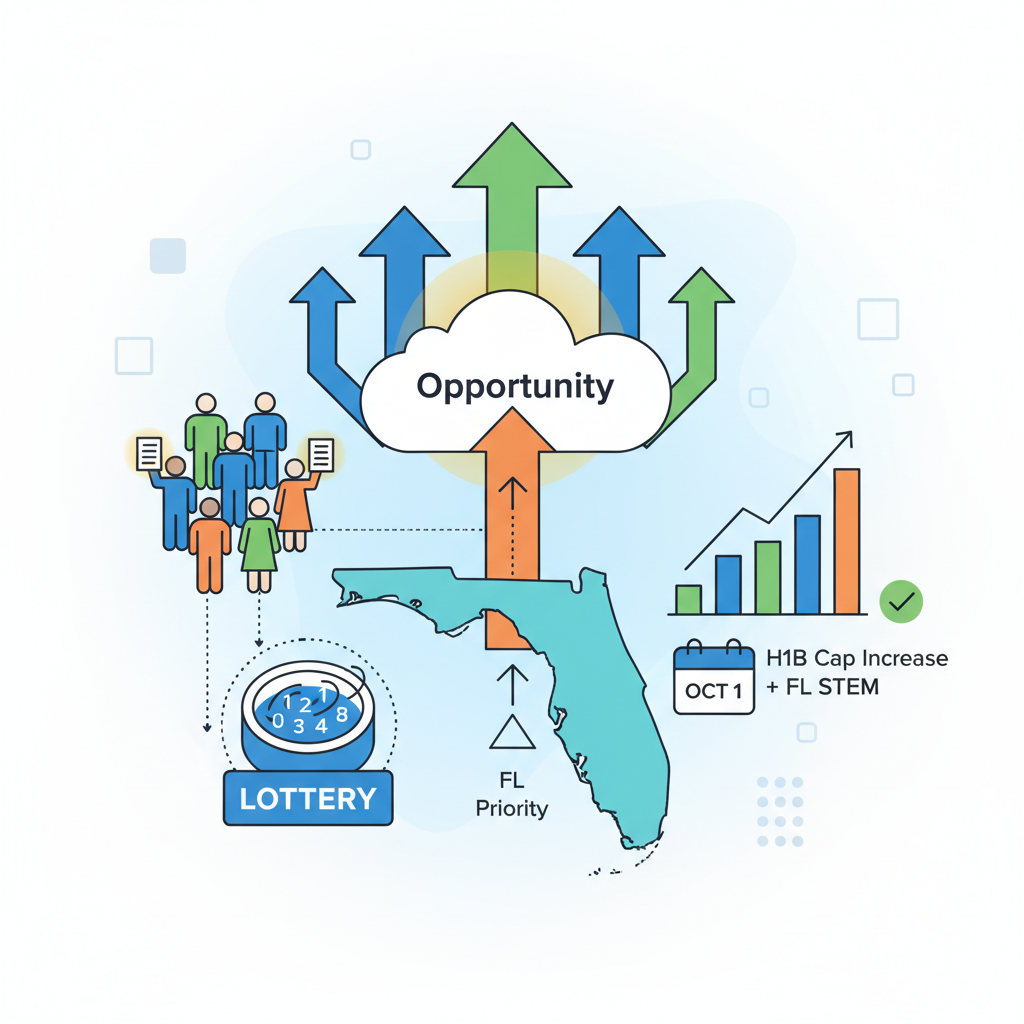
How to Navigate the H-1B Visa Lottery Changes for FY2027: A Complete Step-by-Step Guide
The FY2027 H-1B lottery process has concluded its registration and selection phase, and we are now in the critical petition filing period. If you or your sponsored employee was selected, here’s a guide to the next steps and how the new rules influence them.
1) Understand the New Rules and Eligibility
The most significant change for FY2027 (and since FY2025) is the beneficiary-centric selection process. This rule dictates that selection in the lottery is based on each unique beneficiary, not on the number of registrations submitted by employers. If multiple employers registered the same beneficiary, USCIS considers all but one of those registrations invalid. This aims to reduce fraud and provide a fairer chance for all unique individuals.
- Key takeaway: A beneficiary only gets one chance in the lottery, no matter how many employers want to sponsor them.
- Fraud Prevention: USCIS has increased its efforts to detect and deter fraud related to multiple registrations for the same beneficiary. This includes closer scrutiny of employer-employee relationships and business legitimacy.
- Who Can Register: Employers, or their authorized representatives (like Imigrar), can submit registrations.
Required Information for Registration (already completed for FY2027, but vital for future cycles):
- Beneficiary's full legal name, date of birth, country of birth, country of citizenship, and passport number.
- Employer's legal name, **EIN**, and mailing address.
- Attorney or representative's information (if applicable).
2) Employer Pre-Registration and LCA Filing (Pre-Lottery, but foundational)
Before an H-1B petition can even be filed (after selection), the employer must have a certified **Labor Condition Application (LCA)**, **Form ETA-9035**, from the Department of Labor (DOL). This step usually occurs *before* or *during* the lottery registration period to ensure the employer can meet filing deadlines if selected.
- Purpose of LCA: To ensure that employing an H-1B worker will not adversely affect the wages and working conditions of U.S. workers similarly employed. It requires the employer to attest to paying the prevailing wage or the actual wage, whichever is higher.
- LCA Process:
- The employer (or their attorney) files **Form ETA-9035** electronically with the DOL.
- The DOL reviews the LCA for completeness and accuracy, typically certifying it within 7 business days.
- Important: The LCA must be certified *before* **Form I-129** can be filed.
3) H-1B Electronic Registration Process (Completed for FY2027)
This phase concluded in March 2026 for FY2027. Employers, or their representatives, create a USCIS online account and submit electronic registrations for each prospective H-1


Have Questions About Your Case?
Schedule a free consultation with our attorney-reviewed team today