


The landscape of U.S. immigration is constantly evolving, and for skilled professionals seeking to work in the United States, few changes are as impactful as those affecting the H-1B visa lottery. As we look towards the Fiscal Year 2027 (FY2027), U.S. Citizenship and Immigration Services (USCIS) has introduced significant modifications designed to enhance the integrity of the lottery process and combat widespread fraud. These changes are crucial for prospective H-1B beneficiaries and their sponsoring employers, especially as the registration period for FY2027 approaches.
Navigating these complex H-1B changes can be daunting. Our Orlando immigration team at Imigrar is here to simplify the process and ensure your application is strong and compliant. Call +1 786-791-3106 for a free consultation, or message us online. Se Habla Español.
The reporting that sparked this guide
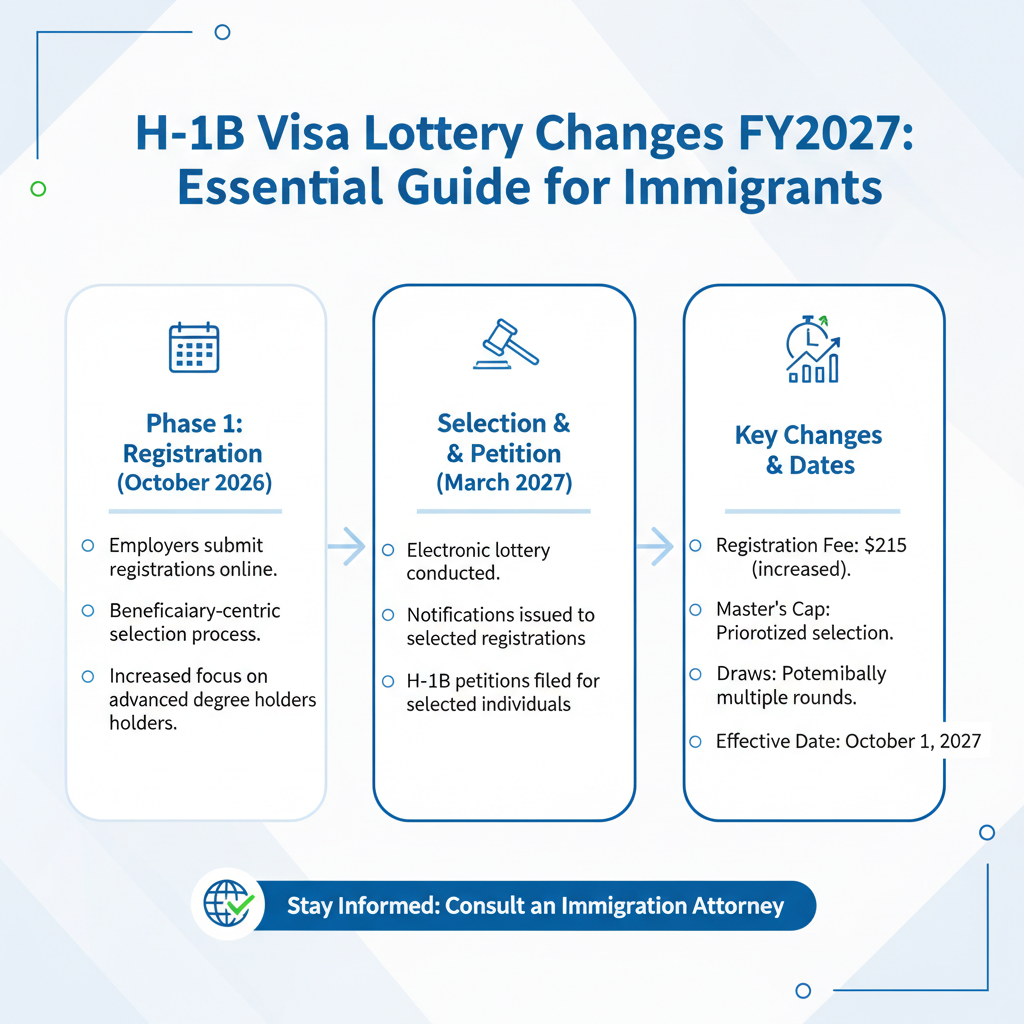
This comprehensive guide is built upon recent legal news concerning the H-1B visa lottery process. For further details on the evolving landscape of immigration law, you can refer to: H-1B Visa Lottery Changes for FY2027 (Legal News)
What This News Means for Immigrants in Orlando and Across Florida
For many skilled professionals and companies in Orlando, Florida, the H-1B visa is a vital pathway to talent and opportunity. The Sunshine State, with its growing tech sector, tourism industry, and diverse economy, relies heavily on skilled foreign workers. These new H-1B visa lottery changes for FY2027 have direct implications for individuals living in or planning to move to Florida, as well as for the employers who sponsor them.
Why this news is showing up now
The H-1B visa program operates on a fiscal year cycle, with new visas becoming available on October 1st. The registration period for the upcoming fiscal year typically occurs in March of the preceding calendar year. Therefore, in early 2026, USCIS would have released detailed announcements and updates regarding the H-1B lottery process for FY2027, which will govern registrations taking place in March 2026 for visas available October 1, 2026. These updates are a response to ongoing efforts by USCIS to enhance the integrity of the H-1B program, particularly after observing patterns of fraud and abuse in previous lottery cycles. The primary driver behind these changes is to ensure fairness and increase the chances for legitimate petitioners and beneficiaries by preventing multiple, fraudulent registrations.
How it can affect Florida residents
Florida is a significant hub for H-1B workers, particularly in tech, healthcare, and engineering fields. Cities like Orlando, Tampa, and Miami attract a substantial number of skilled foreign professionals. The new rules directly impact:
- Prospective H-1B Beneficiaries in Florida: If you are an international student graduating from a Florida university (like UCF, UF, or FIU) on an F-1 visa with Optional Practical Training (OPT), or a professional already working in Florida on another nonimmigrant visa, these changes are critical. The new beneficiary-centric selection process means that each individual will only be entered into the lottery once, regardless of how many employers register them. This aims to level the playing field, potentially reducing the overall selection rate but increasing the fairness for each unique candidate.
- Florida Employers: Companies in Central Florida and across the state that rely on H-1B visas to fill specialized roles must adjust their registration strategies. Employers must now ensure that any registration they submit is for a genuine job offer and that they have a direct employer-employee relationship with the beneficiary. They must also be vigilant about not collaborating with other employers to submit multiple registrations for the same individual, as this is now a clear violation.
- Orlando USCIS Field Office: While H-1B petitions are primarily processed by USCIS Service Centers, local field offices like the one in Orlando may handle certain follow-up actions or interviews in specific circumstances. The increased scrutiny on fraud could lead to more Requests for Evidence (RFEs) or site visits, which could involve local USCIS personnel.
Understanding these changes is paramount for anyone involved in the H-1B process in the Sunshine State. The goal is to prepare thoroughly and ensure compliance to maximize your chances of success.
What H-1B Visa Lottery Changes for FY2027 Is (and Why It Matters)
The H-1B visa program is a nonimmigrant visa that allows U.S. employers to temporarily employ foreign workers in specialty occupations. These occupations generally require a bachelor's degree or higher in a specific specialty. Due to high demand, the number of H-1B petitions often exceeds the annual cap set by Congress, necessitating a lottery system to select eligible registrations.
A plain-English definition
Think of the H-1B visa as a special temporary work permit for highly skilled jobs. Because so many people want these visas each year, the U.S. government holds a "lottery" to pick who gets a chance to apply. The "H-1B Visa Lottery Changes for FY2027" refers to new rules that USCIS has put in place for how this lottery will work for the fiscal year starting October 1, 2026. The most significant change is that the lottery will now focus on the individual person (the "beneficiary") rather than the number of job offers they receive. This means that no matter how many companies want to hire you and register you for the lottery, your name will only be entered once. This change is designed to stop companies from trying to game the system by submitting many registrations for the same person, which unfairly reduced others' chances in the past.
Key terms you need to know
- H-1B Visa: A nonimmigrant visa that permits U.S. employers to temporarily employ foreign workers in specialty occupations.
- Specialty Occupation: An occupation that requires theoretical and practical application of a body of highly specialized knowledge, and a bachelor's or higher degree in the specific specialty (or its equivalent) as a minimum for entry into the occupation in the United States.
- USCIS (U.S. Citizenship and Immigration Services): The government agency responsible for administering immigration and naturalization benefits. USCIS official website
- H-1B Cap: The annual numerical limit on the number of H-1B visas issued. Congress currently sets the annual regular cap at 65,000 and an additional 20,000 for beneficiaries with a U.S. master's degree or higher (the "master's cap").
- H-1B Lottery (or Cap-Gap): The randomized selection process used when the number of H-1B registrations exceeds the annual cap.
- Beneficiary: The foreign worker who is seeking the H-1B visa.
- Petitioner: The U.S. employer filing the H-1B petition on behalf of the foreign worker.
- LCA (Labor Condition Application): Form ETA-9035 filed with the U.S. Department of Labor (DOL) by the employer, attesting to specific conditions regarding wages and working conditions for H-1B workers. This must be certified before filing Form I-129.
- Cap-Exempt: Certain employers are exempt from the H-1B cap, such as institutions of higher education, non-profit organizations affiliated with higher education, and non-profit research organizations or governmental research organizations.
- Registration Period: The designated window during which employers must electronically register prospective H-1B beneficiaries for the lottery. For FY2027, this typically occurs in March 2026.
- Beneficiary-Centric Selection: The core new rule change, where each unique beneficiary is entered into the lottery only once, regardless of the number of registrations submitted on their behalf by different employers. This is a critical departure from previous lotteries.
- DHS (Department of Homeland Security): The federal department that oversees USCIS.
These changes matter immensely because they aim to restore fairness and integrity to a highly competitive process. For legitimate employers and skilled foreign workers, these new rules mean a more equitable chance at selection, free from the manipulation of multiple registrations. For those who previously engaged in fraudulent practices, the consequences are now much more severe, including potential criminal prosecution and denial of future immigration benefits.
Confused about the H-1B terminology or new regulations? Imigrar's experienced immigration attorneys can clarify everything. Reach out for a free consultation at +1 786-791-3106, or contact us online. Se Habla Español.
Current Immigration Law: The Foundation of H-1B
The H-1B visa program is governed by the Immigration and Nationality Act (INA), specifically Section 101(a)(15)(H)(i)(b) and Section 214(g). These sections establish the framework for specialty occupations, numerical limitations (the annual cap), and the conditions under which H-1B visas are granted. Regulations further detail the application process, eligibility criteria, and employer responsibilities.
Federal requirements
To qualify for an H-1B visa under federal law, both the employer and the prospective employee must meet specific criteria:
For the Employer (Petitioner):
- The employer must offer a job in a "specialty occupation."
- The employer must agree to pay the H-1B worker at least the prevailing wage for the occupation in the area of employment or the actual wage paid to other employees with similar experience and qualifications, whichever is higher. This is verified through the Labor Condition Application (LCA), Form ETA-9035.
- The employer must provide a safe working environment and other required working conditions.
- The employer must attest that there is no strike or lockout at the place of employment.
- For cap-subject petitions, the employer must participate in the electronic registration process and be selected in the lottery.
- The employer must maintain a valid employer-employee relationship with the beneficiary. This has been a key area of scrutiny, especially with third-party placement models.
For the Employee (Beneficiary):
- The individual must possess a bachelor's degree or its equivalent, or a license in a specialty occupation field, or work experience equivalent to a bachelor's degree.
- The individual must be qualified to perform services in the specialty occupation.
- If applying for the master's cap, the individual must hold a U.S. master's or higher degree from an accredited institution.
- The individual must not have reached the maximum H-1B stay (generally six years, with exceptions for green card applicants).
The primary form used for filing an H-1B petition is Form I-129, Petition for a Nonimmigrant Worker. This form is filed by the U.S. employer on behalf of the foreign worker after a successful lottery selection. Other related forms include Form I-797 (Notice of Action, used for approvals) and potentially Form I-907 (Request for Premium Processing).
For official information, always refer to the USCIS official website.
Florida-specific considerations
While federal law governs the H-1B program, Florida's economic landscape influences its application. Florida boasts a growing tech industry, particularly in Orlando, Tampa, and South Florida, creating high demand for IT professionals, engineers, and healthcare workers. This means:
- Competitive Job Market: The demand for H-1B workers in Florida can be very high, making the lottery even more competitive for those seeking to work in the state.
- Prevailing Wage Variations: Prevailing wages differ significantly by geographic area. An H-1B position in Orlando, for example, will have a different prevailing wage than a similar position in New York or California. Employers must accurately determine the prevailing wage for their specific location using resources like the DOL's Foreign Labor Certification Data Center.
- Local Resources: Immigrants and employers in Central Florida have access to local immigration attorneys like Imigrar, who are familiar with the specific needs and challenges of the region. While the Orlando USCIS Field Office does not process H-1B petitions, it handles other immigration matters and can be a resource for general inquiries or in-person appointments for other visa types.
Important: There are no specific "Florida H-1B laws." The H-1B program is entirely federal. However, local economic conditions, employer needs, and the availability of legal counsel in areas like the I-4 corridor can significantly impact an individual's H-1B journey.
How to Navigate the H-1B Visa Lottery Changes for FY2027: A Complete Step-by-Step Guide
The H-1B process, especially with the new FY2027 changes, requires meticulous preparation and adherence to deadlines. This guide outlines the essential steps for employers and beneficiaries.
1) Understanding the New Rules and Eligibility (for both employer and employee)
Before any action is taken, both the prospective employer and the beneficiary must understand the new beneficiary-centric selection process and ensure basic eligibility.
- For the Beneficiary:
- Ensure you meet the minimum educational requirements (bachelor's degree or equivalent in a specialty occupation field).
- Confirm you have a genuine job offer from a U.S. employer in a specialty occupation.
- Understand that you can only be counted once in the lottery, even if multiple employers register on your behalf.
- For the Employer:
- Confirm the job offered qualifies as a specialty occupation.
- Verify you have a legitimate, non-speculative job offer for the beneficiary.
- Ensure you can meet the prevailing wage requirements for the position and location (e.g., Orlando, FL).
- Understand the new certification requirements for the H-1B registration, affirming that the job offer is bona fide and that you have not colluded with other employers for multiple registrations.
- Required Documents for this stage (for internal review):
- Beneficiary's educational degrees, transcripts, and evaluations of foreign degrees.
- Beneficiary's resume/CV and professional licenses.
- Detailed job description from the employer, including duties, minimum requirements, and salary.
- Employer's Federal Employer Identification Number (EIN).
2) Employer Registration Process (H-1B Electronic Registration)
This is the first formal step in the cap-subject H-1B process and is now critical due to the new beneficiary-centric approach. The registration period typically occurs in March.
- Employer Actions:
- Create or access a USCIS online account.
- For each prospective H-1B beneficiary, submit an electronic registration during the designated registration period (e.g., March 2026 for FY2027).
- Pay the non-refundable H-1B registration fee (currently $10, but this fee is subject to change and may increase for FY2027).
- Provide accurate information for both the petitioner (employer) and the beneficiary, including the beneficiary’s passport or travel document number. This is crucial for USCIS to identify unique beneficiaries across multiple registrations.
- Important: Certify under penalty of perjury that the information provided is true and that the registration is based on a bona fide job offer. This certification specifically addresses the new anti-fraud measures.
- Required Documents/Information for Registration:
- Employer's legal name, mailing address, EIN.
- Employer's authorized signatory information.
- Beneficiary's full legal name, date of birth, country of birth, country of citizenship.
- Beneficiary's passport number or other valid travel document number.
- Beneficiary's gender.
- Beneficiary's highest level of education.
- Whether the beneficiary is eligible for the U.S. master's cap.
3) Lottery Selection and Petition Filing (Form I-129)
After the registration period closes, USCIS conducts the lottery. Results are typically announced within a few weeks.
- USCIS Actions:
- USCIS conducts the lottery, first for the master's cap, then for the regular cap.
- Under the new rules, USCIS selects unique beneficiaries. If a beneficiary has multiple registrations, only one will be selected.
- Selected registrants (employers) are notified through their USCIS online accounts.
- Employer Actions (if selected):
- Upon selection, the employer has a specific filing window (typically 90 days from the selection notification date) to file the full Form I-129, Petition for a Nonimmigrant Worker, along with all supporting documentation.
- Before filing Form I-129, the employer must file and obtain a certified Labor Condition Application (LCA), Form ETA-9035, from the U.S. Department of Labor. This can take 7-10 business days.
- Prepare and submit a robust petition package, including evidence of specialty occupation, beneficiary qualifications, employer-employee relationship, and ability to pay the prevailing wage.
- Pay the USCIS filing fees for Form I-129 (base fee, ACWIA fee, fraud prevention and detection fee, public law 114-113 fee if applicable, and optional premium processing fee). These fees are substantial and subject to change.
- Required Documents for Form I-129 Petition (if selected):
- Certified LCA (Form ETA-9035).
- Copy of H-1B registration selection notice.
- Beneficiary's educational documents (degrees, transcripts, evaluations).
- Beneficiary's resume/CV.
- Beneficiary's passport, visa, and I-94 records (if currently in U.S.).
- Employer's support letter detailing the job offer, specialty occupation nature, and beneficiary's qualifications.
- Organizational charts, company brochures, and other evidence proving employer legitimacy and need for the H-1B worker.
- Employment contracts, offer letters.
- Evidence of employer's ability to pay the proffered wage (e.g., financial statements, tax returns).
- For third-party placements, detailed client letters, statements of work, and contracts demonstrating a clear employer-employee relationship.
4) Responding to RFEs and Adjudication
USCIS reviews the filed petition. They may issue a Request for Evidence (RFE) if they need more information or clarification.
- Employer/Attorney Actions:
- If an RFE is issued, carefully review it with your immigration attorney.
- Gather all requested documents and prepare a comprehensive response within the given deadline (typically 87 days).
- Address each point of the RFE thoroughly, providing strong evidence. Common RFE issues include specialty occupation, employer-employee relationship, and availability of work.
- USCIS Action:
- After review, USCIS adjudicates the petition.
- If approved, USCIS issues an Form I-797 Approval Notice. If the beneficiary is already in the U.S., this notice includes an I-94 indicating the change of status to H-1B.
- If denied, USCIS provides a denial letter outlining the reasons.
5) Visa Interview and Entry (for beneficiaries outside the U.S.)
If the beneficiary is outside the U.S. when the petition is approved, they must obtain an H-1B visa stamp.
- Beneficiary Actions:
- Schedule a visa interview at a U.S. embassy or consulate in their home country.
- Complete Form DS-160, Online Nonimmigrant Visa Application.
- Pay the visa application fee.
- Attend the interview with all required documents, including the Form I-797 Approval Notice, passport, photos, and supporting documents related to their qualifications and job offer.
- Required Documents for Visa Interview:
- Valid passport (at least 6 months beyond the intended H-1B stay).
- Form DS-160 confirmation page.
- Appointment confirmation page.
- Original Form I-797 Approval Notice.
- Copy of the filed Form I-129 petition and all supporting documents.
- LCA (Form ETA-9035).
- Educational degrees, transcripts, and professional licenses.
- Letters from previous employers, resume/CV.
- Recent passport-style photos.
- Proof of ties to home country (optional but helpful).
6) Maintaining H-1B Status
Once approved and entered into the U.S. in H-1B status, beneficiaries must maintain compliance.
- Beneficiary/Employer Actions:
- Work only for the H-1B sponsoring employer in the approved position and location.
- Report any material changes in employment (e.g., job duties, work location, salary) to USCIS via an amended H-1B petition.
- Keep track of H-1B validity dates and apply for extensions in a timely manner (typically 6 months before expiration).
7) What to do if not selected
If your H-1B registration is not selected in the lottery, it's not the end of the road.
- Beneficiary/Employer Actions:
- Explore other nonimmigrant visa options (e.g., O-1 for extraordinary ability, L-1 for intracompany transfers, E-3 for Australians, TN for Canadians/Mexicans, F-1 OPT extensions, or F-1 to F-1 transfer for further studies).
- Consider cap-exempt H-1B employment if eligible (e.g., with a university or research institution).
- Prepare for the next H-1B lottery cycle in the following year.

Practical Steps You Can Take Today for Your H-1B Application
Given the competitive nature and the new changes to the H-1B lottery for FY2027, proactive preparation is essential. Here's what you can do:
Actionable Checklist:
- Consult an Immigration Attorney Early: This is the single most important step. An experienced attorney, like those at Imigrar, can assess your eligibility, guide your employer, and ensure compliance with the new rules.
- Secure a Bona Fide Job Offer: Ensure your job offer is legitimate, detailed, and truly requires a specialty occupation degree.
- Gather All Educational and Professional Documents: Start collecting degrees, transcripts, academic evaluations, professional licenses, and your detailed resume/CV. Ensure all foreign documents are translated by certified translators.
- Verify Beneficiary Information: Ensure your passport or travel document is valid and that all personal information (name, date of birth, passport number) is accurate and consistent across all documents. This is critical for the beneficiary-centric lottery.
- Employer Due Diligence: Employers should review their hiring practices and internal compliance procedures to align with the new USCIS anti-fraud measures. Confirm the employer-employee relationship is strong and genuine.
- Understand the Costs: Be aware of all H-1B fees (registration, filing, fraud prevention, public law, premium processing, attorney fees). Budget accordingly.
- Develop a Backup Plan: Given the lottery's uncertainty, discuss alternative visa options with your attorney if the H-1B is not successful.
Document Preparation Guidance:
- Accuracy is Paramount: Any discrepancies, even minor ones, can lead to RFEs or denials. Double-check all dates, names, and numbers.
- Organization: Keep all documents well-organized


