

The landscape of U.S. immigration is constantly evolving, and for skilled foreign professionals and their prospective employers, few changes carry as much weight as those impacting the H-1B visa program. As of today, August 17, 2026, the immigration community is keenly focused on the significant new rules affecting the H-1B visa lottery for Fiscal Year 2027 (FY2027).
At Imigrar, an Orlando-based immigration law firm dedicated to helping families and professionals "Keep Families Together," we understand the anxiety and confusion these changes can cause. Our goal with this comprehensive guide is to demystify the new H-1B lottery process, providing clear, actionable information for immigrants and employers alike, whether you're in Central Florida or across the nation. Se Habla Español.
Navigating H-1B changes can be complex. Don't face it alone. Our Orlando immigration team is ready to assist. Call +1 786-791-3106 for a free consultation, or message us online. Se Habla Español.
The reporting that sparked this guide

The crucial updates regarding the H-1B visa lottery for FY2027 have been a significant topic across legal news outlets and immigration forums. These discussions highlight the U.S. government's ongoing efforts to refine the H-1B program, particularly in response to concerns about fairness and integrity in the lottery process. The changes aim to curb abuse and ensure that each eligible beneficiary has an equal chance of selection.
H-1B Visa Lottery Changes for FY2027 (Legal News)
What This News Means for Immigrants in Orlando and Across Florida
The H-1B visa program is a cornerstone for many U.S. employers seeking to hire foreign workers in specialty occupations, especially in technology, engineering, medicine, and research. These new rules for FY2027 are designed to create a more equitable and efficient system, but they also introduce new complexities that applicants and employers must understand.
Why this news is showing up now
The U.S. Citizenship and Immigration Services (USCIS) typically announces changes to major visa programs well in advance of the application cycle to allow time for preparation. The H-1B cap for FY2027 will begin on October 1, 2026, but the registration period for the lottery usually takes place in March 2026 (for the fiscal year starting October 1, 2026). The official announcements regarding the new rules were made earlier in 2026, giving employers and prospective beneficiaries ample time to adjust their strategies. These changes are a direct result of USCIS’s efforts to combat fraud and ensure that the lottery system adheres to its intended purpose: selecting qualified individuals fairly.
Important: These changes are not retroactive but apply specifically to the FY2027 cap season and beyond. This means that individuals who participated in previous lotteries under the old rules will need to understand and adapt to this new framework.
How it can affect Florida residents
Florida, particularly the Orlando metropolitan area, is a vibrant hub for tourism, technology, healthcare, and aerospace industries. Companies along the I-4 corridor, from startups in Lake Nona's "Medical City" to established tech firms in Orange County, frequently rely on H-1B visas to recruit highly skilled talent from around the world. Universities like the University of Central Florida (UCF) also attract and employ foreign researchers and professors who may utilize the H-1B visa.
- For Employers: Florida businesses, especially those in high-demand tech sectors, must now meticulously review their H-1B sponsorship practices. The new rules, particularly the beneficiary-centric selection process, mean employers need to verify each potential beneficiary's eligibility and ensure accurate, singular registration to avoid disqualification. This may impact recruitment strategies and timelines.
- For Prospective H-1B Beneficiaries: If you are a foreign national in Orlando on an F-1 OPT visa, a J-1 visa, or living abroad and hoping to work in Florida, these changes directly impact your chances of securing an H-1B visa. Understanding the new registration process and working closely with your potential employer and an experienced immigration attorney is more critical than ever.
- Increased Scrutiny: The Orlando USCIS Field Office, like others nationwide, will likely be processing petitions under these new, stricter guidelines. This could mean increased scrutiny on petitions and a greater need for robust, well-documented applications.
What H-1B Visa Lottery Changes for FY2027 Is (and Why It Matters)
The H-1B visa is a non-immigrant visa that allows U.S. employers to temporarily employ foreign workers in specialty occupations. A specialty occupation generally requires a bachelor's degree or higher in a specific specialty, or its equivalent. Examples include IT professionals, engineers, scientists, architects, and certain types of medical professionals.
The "lottery" comes into play because Congress sets an annual cap on the number of H-1B visas issued each fiscal year. The current annual cap is 65,000, with an additional 20,000 visas reserved for those with a U.S. master's degree or higher (the "master's cap"). Demand for H-1B visas has consistently far exceeded the available numbers, necessitating an electronic lottery system to select eligible registrations.
A plain-English definition
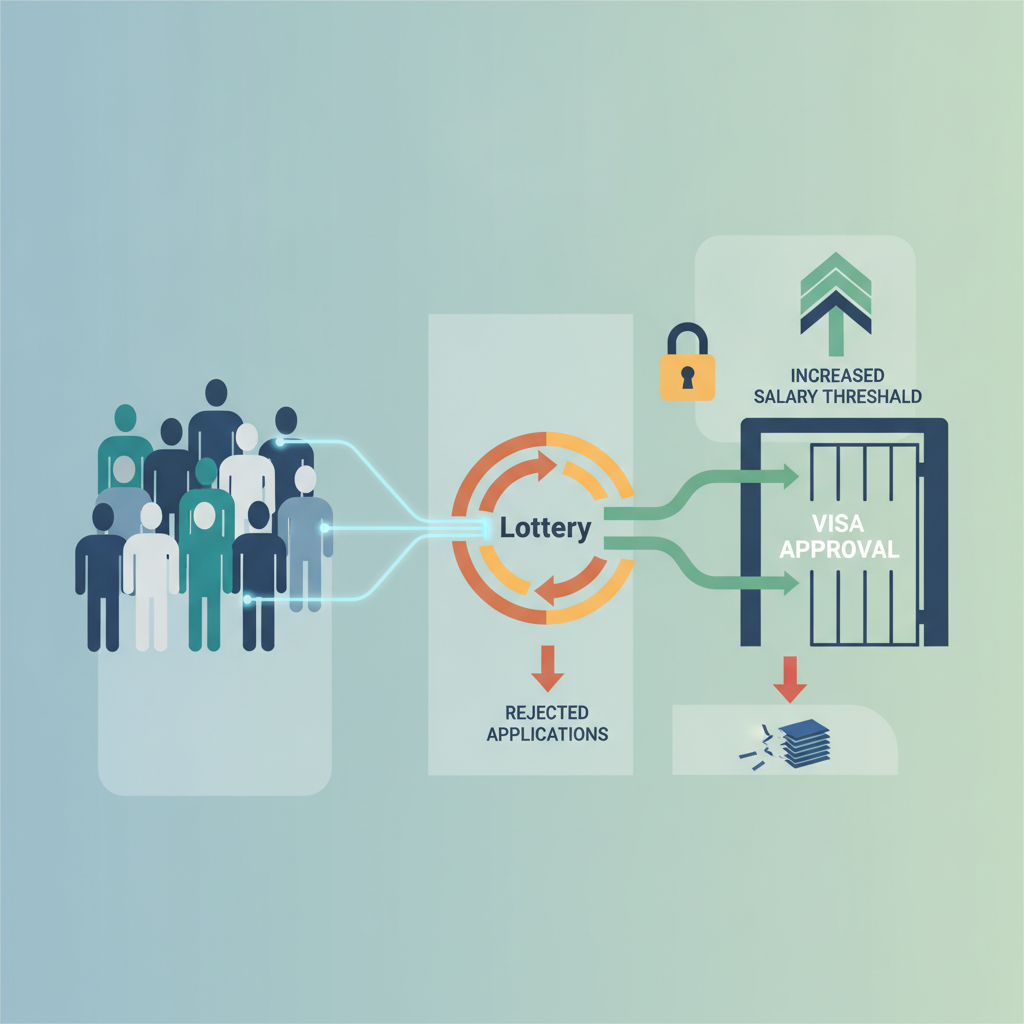
The H-1B visa lottery changes for FY2027 fundamentally alter *how* USCIS selects registrations for the limited number of H-1B visas. Historically, employers could register a single beneficiary multiple times through different related entities, potentially increasing that individual's chances of selection. The new rule shifts the focus from the employer (petitioner) to the individual worker (beneficiary). This means that each unique beneficiary can only be entered into the lottery *once*, regardless of how many employers wish to sponsor them. If a beneficiary has multiple job offers, only one employer can submit a registration on their behalf, or multiple employers can register, but all registrations for that single beneficiary will be consolidated and entered into the lottery only once. This change aims to eliminate the unfair advantage gained by multiple employer registrations for a single individual, creating a truly beneficiary-centric lottery system.
Warning: Any attempt to submit more than one registration for the same beneficiary by or on behalf of the same petitioner, or by related entities, will be considered a fraudulent submission and could lead to disqualification of all registrations for that beneficiary.
Key terms you need to know
- Beneficiary: The foreign national worker who is seeking the H-1B visa. Under the new rules, the beneficiary is the central figure in the lottery registration process.
- Petitioner: The U.S. employer who is sponsoring the foreign national for the H-1B visa.
- Cap-Subject H-1B: H-1B visas that are subject to the annual statutory limit (currently 65,000 regular cap + 20,000 master's cap). The lottery applies only to cap-subject petitions.
- Cap-Exempt H-1B: Certain H-1B petitions are not subject to the annual cap. These typically include petitions filed by institutions of higher education, non-profit organizations affiliated with higher education, or governmental research organizations. These petitions do not go through the lottery.
- H-1B Registration Period: A specific window, usually in March, during which prospective petitioners electronically submit basic information about the company and the beneficiary to enter the lottery.
- H-1B Lottery Selection: If the number of registrations exceeds the available annual cap, USCIS conducts a random selection process. Under the new rules, this selection is now based on unique beneficiaries.
- H-1B Petition Filing: If a registration is selected, the employer then has a specific window to file the full Form I-129, Petition for a Nonimmigrant Worker, along with all supporting documentation.
- Form I-129, Petition for a Nonimmigrant Worker: The primary form used by employers to petition for nonimmigrant workers, including H-1B.
- Labor Condition Application (LCA): Form ETA-9035, certified by the Department of Labor, which attests to certain conditions of employment, including prevailing wage and working conditions. This must be certified *before* filing the H-1B petition.
Confused by the H-1B jargon? Let Imigrar simplify it for you. Our Orlando-based attorneys specialize in H-1B visas. Call +1 786-791-3106 for a free consultation, or message us online. Se Habla Español.
Current Immigration Law: The Foundation
The H-1B visa program is governed by federal immigration law, primarily found in the Immigration and Nationality Act (INA) and its implementing regulations in the Code of Federal Regulations (CFR). Understanding these foundational elements is crucial, as the FY2027 changes operate within this existing legal framework.
Federal requirements
The authority for the H-1B visa program stems from Section 101(a)(15)(H)(i)(b) of the Immigration and Nationality Act (INA), 8 U.S.C. § 1101(a)(15)(H)(i)(b), and its regulations at 8 CFR § 214.2(h). These statutes and regulations define the requirements for both the employer (petitioner) and the foreign worker (beneficiary).
- Specialty Occupation: The position must qualify as a specialty occupation, meaning it requires theoretical and practical application of a body of highly specialized knowledge, and a bachelor's or higher degree in the specific specialty (or its equivalent) as a minimum for entry into the occupation in the U.S.
- Employer-Employee Relationship: A valid employer-employee relationship must exist between the petitioner and the beneficiary.
- Educational Requirements: The beneficiary must meet the educational requirements for the specialty occupation (e.g., bachelor's degree, licensure, or equivalent work experience).
- Labor Condition Application (LCA): Before filing an H-1B petition, the employer must obtain a certified LCA (Form ETA-9035) from the U.S. Department of Labor (DOL). The LCA attests that the employer will:
- Pay the H-1B worker at least the prevailing wage for the occupation in the area of employment or the actual wage paid to other employees with similar experience and qualifications, whichever is higher.
- Provide working conditions that will not adversely affect the working conditions of U.S. workers similarly employed.
- There is no strike or lockout in the occupational classification at the place of employment.
- Notice has been provided to the bargaining representative or posted at the worksite.
- Annual Cap: As mentioned, the H-1B program is subject to an annual cap, making the lottery system necessary for cap-subject petitions.
- H-1B Maximum Stay: An H-1B visa is generally granted for an initial period of up to three years and can be extended for a total maximum stay of six years. Exceptions exist for individuals with approved I-140 immigrant petitions or those in the PERM process.
For official information and detailed requirements, always refer to the USCIS official website.
Florida-specific considerations
While H-1B law is federal, its application has distinct implications for Florida residents and businesses. The state's economic landscape, with its booming tech and aerospace industries (e.g., Space Coast, Orlando's simulation and gaming sectors), creates a high demand for skilled foreign workers. This means:
- Competitive Environment: The competition for H-1B visas is particularly fierce for companies in Florida due to the high number of qualified beneficiaries seeking opportunities in the state.
- Prevailing Wage Levels: Prevailing wage determinations for various occupations can differ significantly based on the geographic area of employment. For example, a software engineer's prevailing wage in Orlando might be different from that in Miami or a rural part of Florida. Employers must ensure they are meeting the local prevailing wage requirements as determined by the DOL.
- Local USCIS Office: If your H-1B petition is ultimately approved, and you are seeking a change of status within the U.S., you may interact with the Orlando USCIS Field Office for certain follow-up processes, though H-1B petitions are processed by USCIS service centers. The Orlando office handles interviews for some adjustment of status cases, and while H-1B typically doesn't require an interview unless there are specific issues, it's good to be aware of the local presence.
How to Navigate the H-1B Lottery Changes: A Complete Step-by-Step Guide
The H-1B cap lottery process, especially with the FY2027 changes, requires meticulous attention to detail and strict adherence to timelines. Here’s a step-by-step guide to help you understand the journey.
1) Understand the New Beneficiary-Centric Selection Process
Action: Both beneficiaries and petitioners must grasp the core change: the lottery selection is now based on the *unique beneficiary*, not the number of registrations submitted on their behalf. This means one beneficiary, one chance, regardless of how many employers register them.
- For Beneficiaries: If you have multiple job offers, inform all potential employers about the new rule. You cannot have multiple registrations submitted by different employers on your behalf with the intent of increasing your odds. While multiple employers *can* submit registrations for you, USCIS will consolidate these and only one entry will be made into the lottery for your unique passport number (or travel document number).
- For Petitioners: Verify the beneficiary's identity documents (passport, travel document) to ensure that no duplicate registrations are inadvertently submitted for the same individual. USCIS will use these unique identifiers to consolidate entries.
Required Documents (for understanding, no submission at this stage):
- Beneficiary's valid passport or travel document (for unique identifier).
- Understanding of USCIS's official policy on beneficiary-centric selection.
2) Employer Eligibility & Labor Condition Application (LCA) Preparation
Action: Before even thinking about the lottery, the employer must confirm their eligibility to sponsor an H-1B worker and begin the crucial LCA process.
- The employer must be a legitimate U.S. entity with a valid Employer Identification Number (EIN).
- The job offered must qualify as a "specialty occupation."
- The employer must prepare and file an LCA (Form ETA-9035) with the U.S. Department of Labor (DOL). This typically takes 7-10 business days for certification, so plan well in advance of the H-1B petition filing window. Important: A certified LCA is *not* required for the H-1B registration, but it is mandatory before filing the H-1B petition (Form I-129) if selected.
Required Documents (for LCA):
- Employer's EIN.
- Detailed job description, including duties, minimum educational requirements, and experience.
- Information about the proposed wage and work location(s).
- Prevailing wage determination for the specific occupation and geographic area.
3) H-1B Electronic Registration Period
Action: During the designated registration window (typically in March for the FY2027 cap), the employer (or their authorized representative, like Imigrar) must electronically register the beneficiary with USCIS.
- Create or access a USCIS online account.
- Submit basic information about the petitioner (employer) and the beneficiary. This includes the beneficiary’s full legal name, date of birth, country of birth, country of citizenship, gender, and the unique identifying number from their valid passport or other travel document.
- Pay the non-refundable H-1B registration fee (currently $10 per registration).
- Reminder: Under the new rules, if multiple employers wish to sponsor the same beneficiary, each can submit a registration. However, USCIS will use the unique beneficiary identifier to consolidate these into a single entry for the lottery.
Required Documents (for Registration, information only):
- Beneficiary's complete biographical data (full name, date of birth, country of birth/citizenship, gender).
- Beneficiary's valid passport number or travel document number.
- Petitioner's legal name, EIN, and address.
- Name and contact information of the authorized signatory.
4) H-1B Lottery Selection and Notification
Action: USCIS conducts the lottery. If selected, both the employer and beneficiary are notified.
- USCIS will typically announce the results of the lottery within a few weeks after the registration period closes.
- If selected, the status in the online registration account will change to "Selected." Non-selected registrations will show "Not Selected" or "Denied" (if found to be a duplicate or invalid).
- Important: Selection in the lottery only grants the employer permission to file an H-1B petition. It does not guarantee H-1B approval.
Required Documents (None at this stage, awaiting notification):
- Access to the USCIS online account to check status.
- Notification of Selection (Form I-797C, Notice of Action) if selected.
5) H-1B Petition Filing (Form I-129)
Action: If selected, the employer must file the complete H-1B petition package within the designated filing window (typically 90 days from the selection date).
- Complete and sign Form I-129, Petition for a Nonimmigrant Worker, and its relevant supplements.
- Include the certified LCA (Form ETA-9035).
- Provide extensive supporting documentation to prove the specialty occupation, the beneficiary's qualifications, the employer-employee relationship, and the employer's ability to pay the required wage.
- Pay all required USCIS fees.
Required Documents (for Petition Filing):
- Certified LCA (Form ETA-9035).
- Form I-129 and H-1B Data Collection and Filing Fee Exemption Supplement.
- Beneficiary's educational documents (degrees, transcripts, evaluations).
- Beneficiary's resume/CV and professional licenses (if applicable).
- Beneficiary's passport biographical page, visa stamps, I-94 records.
- Employer support letter detailing the job offer, specialty occupation duties, and beneficiary's qualifications.
- Employer's financial documents (tax returns, bank statements) to demonstrate ability to pay.
- Organizational charts, company brochures, and other evidence of a legitimate employer-employee relationship.
- Any prior Form I-797 approval notices for the beneficiary (if applicable).
6) Premium Processing or Regular Processing
Action: Decide whether to opt for premium processing for an expedited decision.
- Regular Processing: USCIS processing times can vary significantly, often taking several months. You can check current estimates on the USCIS Processing Times website.
- Premium Processing: For an additional fee (currently $2,805), USCIS guarantees a decision or a Request for Evidence (RFE) within 15 calendar days. This can be very beneficial for employers needing a faster resolution, especially for start dates.
Required Documents (if opting for Premium Processing):
- Form I-907, Request for Premium Processing Service.
- Payment for the premium processing fee.
7) Petition Approval, Visa Interview (if applicable), and Status Activation
Action: Upon approval, the beneficiary either changes status within the U.S. or obtains an H-1B visa abroad.
- Change of Status (COS): If the beneficiary is already in the U.S. in valid nonimmigrant status (e.g., F-1 OPT, L-1), the approval notice (Form I-797A) will typically include a new I-94 reflecting H-1B status, effective October 1 (for cap-subject petitions).
- Consular Processing: If the beneficiary is outside the U.S. or opts for consular processing, they will receive an approval notice (Form I-797B) and must attend an H-1B visa interview at a U.S. embassy or consulate in their home country.
Required Documents (for Consular Processing):
- Approved Form I-797B.
- DS-160 confirmation page.
- Appointment confirmation.
- Valid passport.
- Passport-style photographs.
- Original educational documents and work experience letters.
- Employer's support letter and LCA.
- Evidence of ties to home country.
Practical Steps You Can Take Today
Even though the FY2027 lottery registration is still months away (as of August 2026), proactive preparation is key to success under the new rules. Here are actionable steps for both beneficiaries and employers:
Actionable Checklist:
- Review Beneficiary Information: For employers, ensure you have accurate and unique identifying information (especially passport numbers) for all potential H-1B beneficiaries. For beneficiaries, ensure your passport is valid and up-to-date.
- Educate Your Team/Self: Understand the nuances of the beneficiary-centric lottery. If you are an employer, ensure your HR and recruiting teams are fully aware of the new rules to prevent duplicate registrations.
- Consult an Immigration Attorney: This is paramount. An experienced attorney, like those at Imigrar, can assess your specific situation, provide tailored advice, and guide you through the complexities.
- Start LCA Preparation Early (for employers): While not needed for registration, a certified LCA is essential for the petition. Begin gathering the necessary wage and job description data now.
- Gather Beneficiary Documents: Even before selection, beneficiaries should start compiling their educational degrees, transcripts, evaluations, and professional experience letters.
- Financial Preparedness (for employers): Be prepared for the registration fee and, if selected, the significant filing fees (including premium processing if desired).
- Develop a Contingency Plan: What if you are not selected? Discuss alternative visa options (e.g., O-1, L-1, E-3, TN) with your attorney.
Document Preparation Guidance
Thorough documentation is critical. Here’s a general guide:
- For Beneficiaries:
- Valid passport (ensure it has at least 6 months validity beyond your intended H-1B start date).
- All university degrees, diplomas, and official transcripts.
- Any foreign degree evaluations (if applicable).
- Professional licenses or certifications.
- Detailed resume/CV outlining education and work experience.
- Copies of all previous U.S. visa stamps, I-94 records, and immigration documents (e.g., EADs for OPT, I-20s for F-1).
- For Employers:
- Company's EIN and legal name.
- Detailed job description, including duties, minimum requirements, and the specific skills/knowledge needed.
- Organizational chart showing where the H-1B worker fits.
- Evidence of ability to pay the required wage (e.g., financial statements, tax returns).
- Information about the work location(s).
- For new companies: Business plan, lease agreements, and other foundational documents.
Timeline Expectations (Based on historical patterns for FY2027):
- Early 2026 (Jan-Feb): USCIS issues official guidance on the FY2027 H-1B cap and registration process. Employers begin internal discussions and attorney consultations.
- March 2026: H-1B electronic registration period opens and closes (typically a 2-week window). Beneficiaries must have their unique identifier (passport number) ready.


