


The landscape of U.S. immigration law is constantly evolving, and for those pursuing professional opportunities, few changes resonate as profoundly as those affecting the H-1B visa program. As an immigration law firm deeply committed to keeping families together, Imigrar understands the critical importance of staying ahead of these developments. The H-1B visa, a lifeline for skilled foreign workers and the U.S. companies that rely on their talent, recently underwent significant modifications that directly impacted the Fiscal Year 2027 (FY2027) lottery.
This comprehensive guide from Imigrar, your trusted Orlando immigration attorneys, will break down these crucial H-1B visa lottery changes. We’ll explain what they mean for you, provide a step-by-step roadmap, and offer practical advice to help you navigate this complex process successfully. Whether you are an employer in Florida seeking to sponsor talent or a beneficiary hoping to secure your professional future in the U.S., understanding these updates is paramount.
Need Clarity on the H-1B Changes? The new rules can be complex. Our Orlando immigration team is ready to assist. Call +1 786-791-3106 for a free consultation to discuss your specific situation, or message us online. Se Habla Español.
NEWS SOURCE REFERENCE SECTION
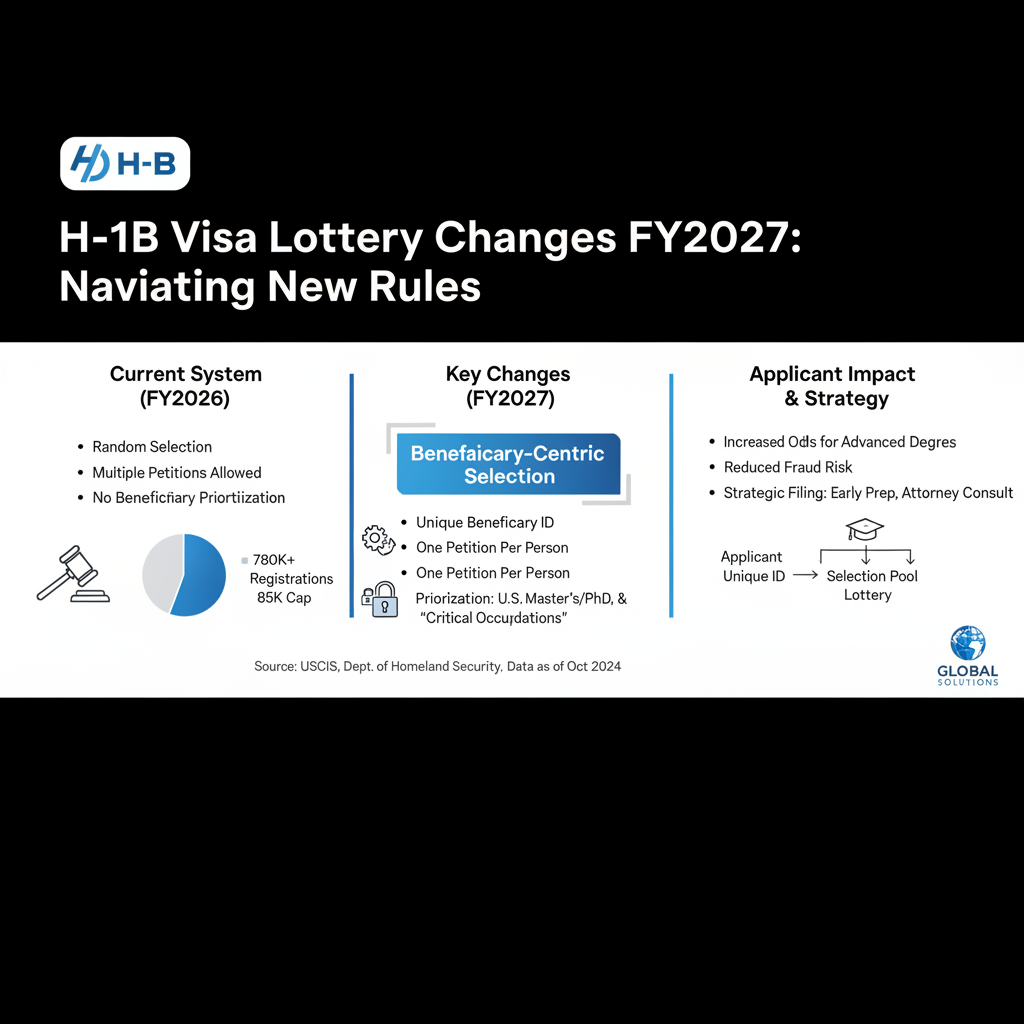
The reporting that sparked this guide: H-1B Visa Lottery Changes for FY2027 (Legal News)
What This News Means for Immigrants in Orlando and Across Florida
Why this news is showing up now
The changes affecting the H-1B visa lottery for Fiscal Year 2027 are not entirely new, but rather the continued implementation of a final rule announced by U.S. Citizenship and Immigration Services (USCIS) in January 2024. This rule, which became effective March 4, 2024, primarily revamped the H-1B cap registration process to a beneficiary-centric selection method. This means that for the FY2027 lottery, which concluded its registration period in March 2026 and announced selections shortly thereafter, the new rules were in full effect. News sources are now reporting on the implications of this first full cycle under the new system, as employers and prospective employees grapple with the outcomes and prepare for the next steps.
The timing of this news is crucial because, as of April 9, 2026, selections for the FY2027 H-1B lottery have already been made, and the filing window for selected petitions is open or about to open. This period is critical for employers and beneficiaries to understand the next steps, prepare their petitions, and ensure compliance with all new requirements. Furthermore, USCIS also adjusted fees for various immigration applications, including the H-1B, which also took effect earlier in 2024 and impacts current filings. These changes collectively aim to enhance the integrity of the H-1B program and deter fraud, particularly the submission of multiple registrations for the same individual.
How it can affect Florida residents
Florida, and particularly the Orlando metropolitan area, is a vibrant hub for tourism, technology, healthcare, and engineering industries. Companies across the I-4 corridor, from Orlando to Tampa, frequently rely on the H-1B visa program to attract highly skilled talent that fuels innovation and economic growth. For Florida residents who are foreign nationals hoping to work in these industries, or for local businesses seeking to sponsor them, these H-1B changes have direct and significant implications:
- Increased Fairness for Beneficiaries: The new beneficiary-centric selection process aims to reduce the advantage gained by individuals who had multiple employers submit registrations on their behalf. This could lead to a more equitable chance of selection for all eligible individuals, including those currently residing in Florida on other non-immigrant visas (like F-1 OPT or J-1).
- Impact on Tech and Healthcare Sectors: Orlando's growing tech sector, including modeling and simulation, aerospace, and digital media, as well as its robust healthcare industry, heavily utilizes H-1B visas. Employers in these fields must now meticulously ensure their registration strategy aligns with the new rules to avoid issues and successfully secure talent.
- Higher Costs for Employers: The fee increases implemented by USCIS mean that sponsoring an H-1B visa is now more expensive for Florida businesses. These costs, combined with legal fees, require careful budgetary planning.
- Enhanced Scrutiny: USCIS has signaled increased vigilance against fraud. Florida employers who have previously engaged in practices like submitting multiple registrations through related entities will face heightened scrutiny and potential investigations.
- Planning for Future Lotteries: For those not selected in the FY2027 lottery, understanding these changes is vital for strategizing for future H-1B cap seasons. Early preparation and expert legal guidance from firms like Imigrar are more critical than ever.
- Orlando USCIS Field Office: While H-1B petitions are processed centrally, residents of Orlando and Central Florida may interact with the Orlando USCIS Field Office for other immigration matters related to their overall status, making local legal expertise indispensable.
What H-1B Visa Lottery Changes for FY2027 Is (and Why It Matters)
A plain-English definition
The H-1B visa is a non-immigrant visa that allows U.S. employers to temporarily employ foreign workers in specialty occupations. A specialty occupation generally requires a bachelor's degree or higher in a specific field. Examples include IT professionals, engineers, doctors, scientists, and architects. Because there's a yearly limit (or "cap") on how many H-1B visas can be issued, USCIS uses a lottery system to select petitions when the number of registrations exceeds the available visas. The "H-1B Visa Lottery Changes for FY2027" refer to the new rules and procedures that USCIS implemented for the lottery process that determined who could apply for an H-1B visa for the fiscal year starting October 1, 2026. The most significant change is how the lottery selections are made, moving from an "employer-centric" to a "beneficiary-centric" system to prevent fraud and ensure fairness.
Key terms you need to know
Navigating the H-1B process requires understanding specific terminology. Here are some key terms:
- USCIS (U.S. Citizenship and Immigration Services): The government agency responsible for overseeing lawful immigration to the United States. USCIS official website
- Beneficiary: The foreign national worker who is seeking the H-1B visa.
- Petitioner/Sponsoring Employer: The U.S. employer filing the H-1B petition on behalf of the beneficiary.
- Specialty Occupation: An occupation that requires theoretical and practical application of a body of highly specialized knowledge, and a bachelor's degree or higher in the specific specialty (or its equivalent) as a minimum for entry into the occupation in the United States.
- H-1B Cap: The annual numerical limit on the number of H-1B visas issued. The general cap is 65,000, with an additional 20,000 for those with a U.S. master's degree or higher (the "Master's Cap").
- Cap-Exempt: Certain employers (e.g., universities, non-profit research organizations) are exempt from the annual H-1B cap.
- LCA (Labor Condition Application): Form ETA-9035, certified by the U.S. Department of Labor, confirming that the employer will pay the H-1B worker at least the prevailing wage and offer working conditions that will not adversely affect U.S. workers.
- H-1B Registration Period: The designated annual period, typically in March, when prospective petitioners (employers) must electronically register beneficiaries for the H-1B lottery.
- Beneficiary-Centric Selection: The new lottery system where each unique beneficiary is entered into the lottery only once, regardless of how many employers register them. If selected, the beneficiary will be able to have an H-1B petition filed on their behalf by any one of the employers who registered them. This is a major change for FY2027.
- Premium Processing: An optional service offered by USCIS that guarantees processing of certain petitions (including H-1B) within 15 calendar days for an additional fee.
- RFE (Request for Evidence): A notice from USCIS requesting additional documents or information to make a decision on a petition.
- Change of Status: Applying to change from one nonimmigrant visa status to another (e.g., from F-1 student to H-1B worker) while remaining in the U.S.
- Consular Processing: Applying for a visa stamp at a U.S. embassy or consulate abroad to enter the U.S. in H-1B status.
Confused by H-1B Jargon? Our knowledgeable team at Imigrar can clarify all terms and guide you through the H-1B process. Contact us today for a free consultation at +1 786-791-3106. Se Habla Español.
Current Immigration Law: The Foundation
The H-1B visa program is governed by the Immigration and Nationality Act (INA), specifically Section 101(a)(15)(H)(i)(b) and Section 214(g). These statutes establish the framework for specialty occupations, the annual cap, and the general eligibility criteria. Regulations found in 8 CFR Part 214.2(h) provide detailed rules for implementing the H-1B program, including requirements for petitioners and beneficiaries. The recent changes for FY2027 were enacted through a final rule published in the Federal Register, modifying these regulations to address perceived abuses of the lottery system and update fees.
Federal requirements
To qualify for an H-1B visa, both the employer and the employee must meet specific federal requirements:
- For the Employer (Petitioner):
- Must offer a "specialty occupation" position.
- Must have an Employer Identification Number (EIN).
- Must pay the H-1B worker at least the prevailing wage for the occupation in the area of intended employment or the actual wage paid to other employees with similar experience and qualifications, whichever is higher. This is certified through the Labor Condition Application (LCA), Form ETA-9035.
- Must demonstrate the ability to pay the offered wage.
- Must comply with all labor laws and H-1B program regulations.
- For the Employee (Beneficiary):
- Must hold a bachelor's degree or its equivalent, or possess a license in a specialty occupation field, or have work experience equivalent to a bachelor's degree.
- Must be qualified to perform services in the specialty occupation.
- Must meet any state licensure requirements for the occupation, if applicable.
- The Cap: The annual H-1B cap is 65,000 visas, with an additional 20,000 for beneficiaries with a U.S. master's degree or higher. This cap is typically met very quickly, necessitating the lottery system.
All H-1B petitions are filed using Form I-129, Petition for a Nonimmigrant Worker. This form is central to the entire application process.
For the most accurate and up-to-date information on H-1B requirements and forms, always refer to the USCIS official website and the USCIS Forms page.
Florida-specific considerations
While immigration law is federal, Florida's economic landscape and specific industries influence the H-1B program's relevance. There are no Florida-specific immigration laws that directly govern the H-1B visa beyond federal statutes. However, the concentration of certain industries in Central Florida, such as technology, aerospace, hospitality management, and healthcare, means that many local employers and potential H-1B beneficiaries are deeply invested in this visa category.
- Tech Hubs: The Orlando area, with its burgeoning tech scene, is home to numerous companies seeking H-1B talent. These companies, from startups to large corporations, must understand the new beneficiary-centric lottery system to effectively compete for skilled workers.
- Educational Institutions: Universities like the University of Central Florida (UCF) are major producers of graduates who may seek H-1B sponsorship and are often cap-exempt employers themselves.
- Local Economy: The H-1B program significantly contributes to Florida's economy by bringing in specialized skills that fill critical labor shortages and drive innovation. Understanding the changes is vital for maintaining this economic benefit.
For Central Florida residents or employers whose cases might involve local government interactions (e.g., business licenses, state professional licenses), while not directly H-1B related, these can be ancillary considerations that an experienced local firm like Imigrar can help navigate.
How to Navigate the H-1B Visa Lottery Changes: A Complete Step-by-Step Guide
The H-1B process, especially with the recent changes, demands meticulous attention to detail and strict adherence to timelines. Here’s a step-by-step guide to help you navigate it:
1) Understand the New Beneficiary-Centric Lottery System
What it is: For the FY2027 lottery, USCIS introduced a new rule where selections are based on unique beneficiaries, not unique registrations. If an employer submits multiple registrations for the same beneficiary, USCIS now considers only one registration for that beneficiary in the lottery. If multiple employers submit registrations for the same beneficiary, the beneficiary is still entered only once into the lottery. If selected, any one of the registering employers can then file a petition on that beneficiary's behalf.
Action:
- For Beneficiaries: If you have multiple potential employers, coordinate with them. Understand that having more employers register for you doesn't increase your chances of selection under the new rules. However, if selected, it provides options regarding which employer will proceed with the petition.
- For Employers: Ensure your internal policies and communications with potential beneficiaries reflect this change. Avoid submitting multiple registrations for the same beneficiary if those registrations are from related entities (e.g., parent company and subsidiary). USCIS explicitly states that related entities cannot submit multiple registrations for the same beneficiary.
2) Employer Pre-Registration and LCA Filing
Timeline: Typically, the H-1B electronic registration period is in March, several months before the fiscal year begins on October 1st. For FY2027, this period already concluded in March 2026.
Required Documents (for employer):
- Employer's EIN
- Employer's legal business name and address
- Authorized signatory information
- Beneficiary's full legal name, date of birth, country of birth, country of citizenship, passport number, and highest degree.
Action:
- Electronic Registration: The employer (or their authorized representative, like Imigrar) must create a USCIS online account and submit an electronic registration for each prospective H-1B beneficiary. A registration fee (which increased for FY2027) is required.
- LCA Preparation: If selected in the lottery, the employer must then file a Labor Condition Application (LCA) (Form ETA-9035) with the U.S. Department of Labor (DOL). This typically takes 7-10 business days for certification. This step must be completed and certified *before* filing the Form I-129 petition with USCIS.
- Warning: The LCA must accurately reflect the job duties, wage, and work location. Any discrepancies can lead to an RFE or denial.
3) H-1B Petition Preparation (Form I-129)
Timeline: If selected in the lottery (notifications typically go out by late March/early April), employers have a specific filing window (e.g., April 1st to June 30th for FY2027) to submit the full H-1B petition. USCIS processing times can vary significantly.
Required Documents (for petition, includes both employer and beneficiary info):
- Certified LCA (Form ETA-9035)
- Completed and signed Form I-129, Petition for a Nonimmigrant Worker
- H-1B cap registration selection notice
- Copy of the beneficiary's passport (biographic page)
- Copy of beneficiary's birth certificate
- Copies of all educational degrees, transcripts, and diplomas (foreign degrees may require an evaluation by a credential evaluation service)
- Copies of any professional licenses (if applicable)
- Beneficiary's resume/CV
- Letters of experience from previous employers (if degree equivalency is being claimed)
- Employer's support letter detailing the job offer, specialty occupation duties, and beneficiary's qualifications
- Organizational charts (if necessary to show position in company)
- Company financial documents (e.g., tax returns, annual reports) to demonstrate ability to pay the prevailing wage
- Beneficiary's current immigration documents (e.g., I-94, previous visa stamps, EAD if on OPT)
- Any other evidence proving the specialty occupation nature of the job and the beneficiary's qualifications.
Action:
- Gather all necessary documents from both the employer and the beneficiary.
- Prepare a detailed support letter from the employer explaining the specialty occupation, the beneficiary's qualifications, and why the position requires a professional with a specific degree.
- Assemble the petition packet meticulously, ensuring all forms are correctly filled out and signed, and all supporting documents are included.
- Important: The new fee schedule for Form I-129 and the H-1B cap fee, ACWIA fee, and fraud prevention and detection fee must be strictly followed. These fees increased significantly for FY2027.
4) Petition Submission and Lottery Selection
Timeline: The filing window typically spans 90 days following lottery selection. For FY2027, this would be approximately April 1, 2026, to June 30, 2026.
Action:
- Mail the complete H-1B petition packet to the correct USCIS service center. The specific service center depends on the employer's location and whether premium processing is requested.
- Upon receipt, USCIS will issue a receipt notice (Form I-797C). This notice is crucial for tracking the petition.
5) Premium Processing (Optional)
Timeline: If requested, USCIS guarantees a decision (approval, denial, or RFE) within 15 calendar days once premium processing officially begins for the petition. The fee for premium processing also increased for FY2027.
Required Documents:
- Form I-907, Request for Premium Processing Service
- Separate check for the premium processing fee.
Action:
- Decide with your employer if premium processing is necessary. It is often used when there is an urgent need for the H-1B worker to start employment or for peace of mind.
- Submit Form I-907 along with the Form I-129 petition, or file it later once the regular petition has been received by USCIS.
6) Decision and Next Steps
Timeline: Varies significantly. Regular processing can take several months. Check USCIS Processing Times for current estimates.
Possible Outcomes:
- Approval: USCIS issues an Approval Notice (Form I-797A/B). If the beneficiary is in the U.S. and applied for a change of status, their status automatically changes to H-1B, usually effective October 1st. If outside the U.S., they will need to apply for a visa stamp.
- Request for Evidence (RFE): USCIS requests more information or clarification. This is a common occurrence. Respond comprehensively and promptly.
- Denial: The petition is denied. This can happen for various reasons, including insufficient evidence or failure to meet eligibility criteria.
Action:
- If approved for change of status, the beneficiary can begin H-1B employment on October 1st.
- If approved for consular processing, the beneficiary must schedule an interview at a U.S. embassy or consulate abroad to obtain the H-1B visa stamp. Refer to the U.S. Department of State website for embassy-specific procedures.
- If an RFE is received, immediately consult with your immigration attorney to prepare a strong response.
- If denied, discuss options with your attorney, which may include refiling (if eligible) or exploring other visa categories.
7) Visa Stamping / Change of Status
Timeline: Consular processing times vary by embassy. Change of status is effective October 1st.
Action:
- Consular Processing: For beneficiaries outside the U.S. or those who chose consular processing, schedule an interview at a U.S. embassy or consulate in their home country. Attend the interview with all required documents, including the Form I-797 Approval Notice.
- Change of Status: For beneficiaries already in the U.S. (e.g., on F-1 OPT) whose Form I-129 included a request for change of status, their status automatically changes to H-1B on October 1st, provided the petition was approved. They can then begin working for the H-1B employer.
Practical Steps You Can Take Today
The H-1B process is competitive and complex. Proactive planning is crucial, especially with the FY2027 changes. Here’s an actionable checklist:
- Consult an Experienced Immigration Attorney: This is the most important step. An attorney can assess eligibility, guide you through the new rules, and ensure your registration and petition are compliant. Imigrar offers free consultations.
- Understand the New Beneficiary-Centric Lottery: If you are a beneficiary, ensure you understand how this affects your chances and how to coordinate with potential employers. If you're an employer, review your recruitment and sponsorship policies.
- Gather All Required Documents: Start collecting personal documents (passport, degrees, transcripts, I-94, previous visa stamps) and professional documents (resume, experience letters) early. For employers, prepare company financials and job descriptions.
- Verify Educational Credentials: If your degree is from a foreign institution, obtain a professional credential evaluation to determine its U.S. equivalency well in advance.
- Prepare for Increased Fees: Be aware of the higher USCIS filing fees for the registration and the Form I-129 petition, as well as the premium processing fee. Budget accordingly.
- Maintain Current Immigration Status: If you are in the U.S. on another non-immigrant visa (e.g., F-1 OPT), ensure you maintain your status diligently. If your OPT expires before October 1st and you are selected for H-1B, understand the "cap-gap" extension rules.
- Stay Informed: Follow updates from official sources like USCIS and reputable immigration law firms.
Document Preparation Guidance
- Accuracy is Key: Ensure all information on forms and documents is accurate and consistent. Even minor discrepancies can cause delays or RFEs.
- Translations: Any document not in English must be accompanied by a certified English translation.
- Organize: Present your documents clearly and logically. Use tabs and cover sheets if submitting a physical petition.
- Copies, Not Originals: Generally, submit copies of documents unless USCIS specifically requests originals.
Timeline Expectations
While specific dates vary annually, here's a general timeline for the H-1B cap season:
- March 2026: H-1B Electronic Registration Period for FY2027 (now closed).
- Late March/Early April 2026: USCIS announces lottery selections for FY2027.
- April 1, 2026 �� June 30, 2026: Filing window for selected H-1B petitions for FY2027.
- April 2026 onwards: USCIS processes petitions. Premium processing requests begin to be processed within 15 days. Regular processing can take several months.
- October 1, 2026: The start of Fiscal Year 2027. Approved H-1B petitions become effective. Beneficiaries can begin H-1B employment.


