


The H-1B visa, a cornerstone for highly skilled foreign professionals seeking to work in the United States, is undergoing significant changes for the Fiscal Year 2027 (FY2027) lottery. These updates, spearheaded by U.S. Citizenship and Immigration Services (USCIS), aim to enhance the integrity of the H-1B program and reduce the potential for fraud. For immigrants and their families in Orlando, across Florida, and nationwide, understanding these new rules is not just helpful—it's absolutely critical for successful application.
At Imigrar, an immigration law firm based in Orlando, Florida, we are committed to helping you navigate the complexities of U.S. immigration law. Our mission is to "Keep Families Together," and that includes ensuring professionals can pursue their careers in the U.S. with confidence and clarity. With these new H-1B regulations on the horizon, proactive preparation and expert legal guidance are more important than ever.
The reporting that sparked this guide
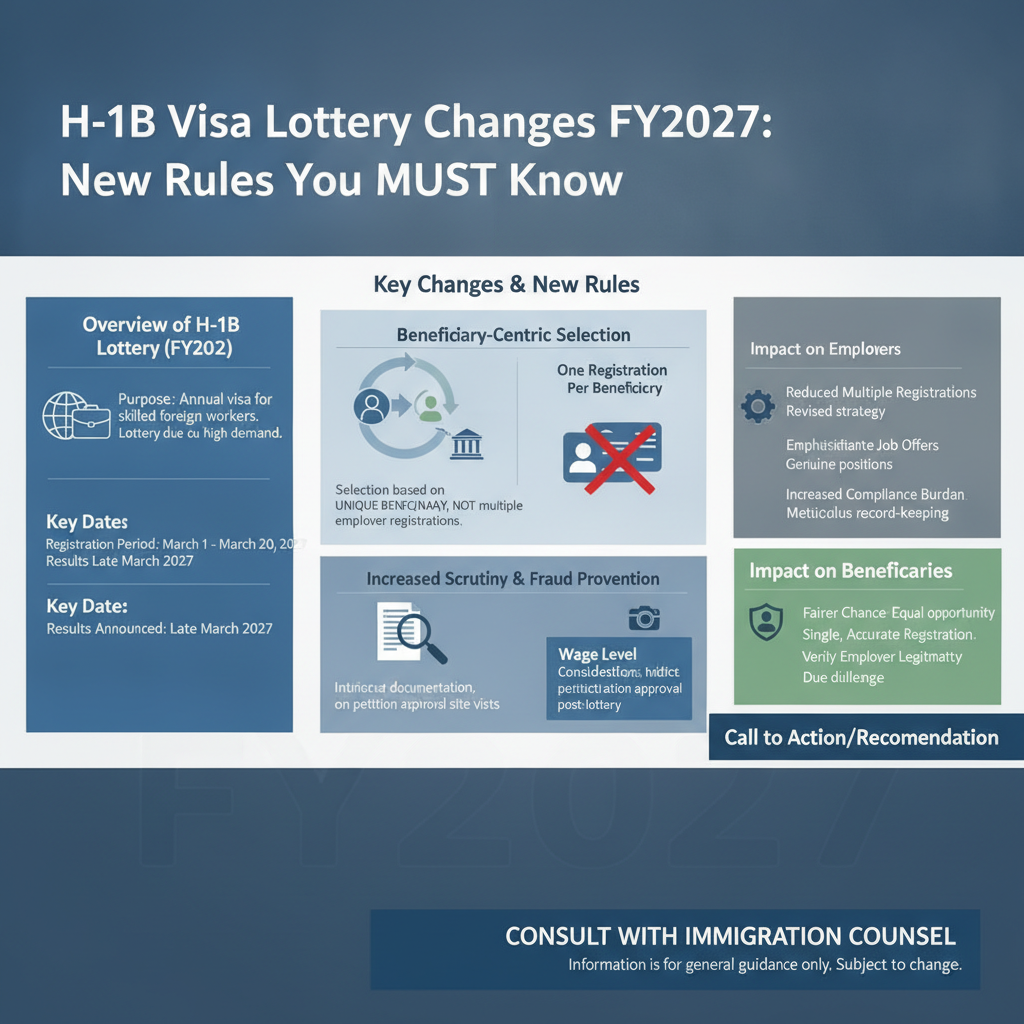
H-1B Visa Lottery Changes for FY2027 (Legal News)
What This News Means for Immigrants in Orlando and Across Florida
The H-1B visa program is a lifeline for many companies and professionals, particularly in high-growth sectors like technology, healthcare, and engineering. Florida, with its booming tech hubs in Orlando, Tampa, and Miami, its robust tourism and hospitality industry, and its expanding healthcare sector, is a significant destination for H-1B workers. These new rules will have a direct and profound impact on how both employers and prospective employees approach the annual H-1B lottery.
Why this news is showing up now
Immigration regulations are dynamic, constantly adapting to economic needs, legislative changes, and efforts to improve system efficiency and prevent abuse. The news regarding H-1B visa lottery changes for FY2027 emerged from USCIS's ongoing efforts to reform the H-1B program. The previous lottery system, while functional, presented vulnerabilities that allowed some entities to game the system by submitting multiple registrations for the same individual through various affiliated companies. This practice artificially inflated selection rates and reduced legitimate applicants' chances. Recognizing this flaw, the Department of Homeland Security (DHS) and USCIS moved to implement a "beneficiary-centric" selection process. This change was formally announced and went into effect for the FY2204 lottery, and now will continue for FY2027, signaling a permanent shift in how the lottery is administered.
The timing of this news, typically in late 2025 or early 2026, is strategic. It provides ample time for employers and beneficiaries to understand and adapt to the new rules before the **H-1B registration period** for FY2027 typically opens in March 2026. This allows for thorough preparation, ensuring compliance and maximizing the chances of a successful application under the revised framework.
How it can affect Florida residents
For individuals residing in Florida or those looking to secure an H-1B sponsored position within the state, these changes are highly significant. Florida's economy relies heavily on sectors that frequently utilize H-1B visas. For example:
- Technology Sector: Cities like Orlando, often dubbed "Silicon Beach," are home to numerous tech companies, from simulation and gaming to aerospace and cybersecurity. These firms actively recruit H-1B professionals.
- Healthcare: Florida's aging population and expansive healthcare systems (e.g., Orlando Health, AdventHealth) require a steady influx of medical professionals and IT specialists.
- Hospitality and Tourism: While less common, certain specialized roles in large resorts or theme parks (especially in the Orlando area) might also utilize H-1B visas for unique expertise.
- Education and Research: Florida's universities (e.g., University of Central Florida, University of Florida) are major H-1B sponsors for researchers, professors, and post-doctoral fellows.
The shift to a **beneficiary-centric selection** means that each individual, regardless of how many employers register them, will only have **one chance** in the lottery. This aims to level the playing field, making the process fairer and potentially increasing the actual selection odds for legitimate applicants, rather than those benefiting from multiple employer submissions. However, it also means that candidates and their prospective employers must be meticulous in their preparation and strategy. For employers in Orlando and beyond, it emphasizes the importance of carefully selecting their H-1B candidates and ensuring strong, bona fide job offers. For individuals, it underscores the need to secure a committed sponsoring employer and prepare all necessary documentation well in advance.
The Orlando USCIS Field Office primarily handles interviews for family-based petitions and **Adjustment of Status** applications, but its presence signifies the active immigrant community in Central Florida. While H-1B petitions are processed at USCIS Service Centers, the local impact of national policy changes is keenly felt here.
Need Help? Our Orlando immigration team is ready to assist. Call +1 786-791-3106 for a free consultation, or message us online. Se Habla Español.
What H-1B Visa Lottery Changes for FY2027 Is (and Why It Matters)
The H-1B visa program is one of the most sought-after nonimmigrant visa categories in the United States, allowing U.S. employers to temporarily employ foreign workers in **specialty occupations**. The recent changes for the FY2027 lottery are a significant evolution aimed at reinforcing the integrity of this vital program. This isn't just bureaucratic reshuffling; it's a fundamental shift in how the lottery operates, impacting every aspiring H-1B worker and sponsoring employer.
A plain-English definition
At its core, the **H-1B visa** is a nonimmigrant visa that allows U.S. employers to temporarily employ foreign workers in specialty occupations. A **specialty occupation** is generally defined as one that requires a theoretical and practical application of a body of highly specialized knowledge, and a bachelor's degree or higher in the specific specialty (or its equivalent) as a minimum for entry into the occupation. Examples include roles in IT, engineering, medicine, education, and architecture.
Because the demand for H-1B visas far exceeds the supply, USCIS conducts an annual lottery. The changes for FY2027 primarily concern *how* this lottery is conducted. Previously, an employer could submit multiple registrations for the same beneficiary if they were willing to file multiple petitions. This led to situations where a single individual might have numerous entries, artificially inflating their chances and reducing the overall fairness of the lottery. The **new rule** dictates that selection will be based on each *unique beneficiary*, regardless of the number of registrations submitted on their behalf. If a beneficiary has multiple registrations, they will only be counted once in the lottery, and if selected, all petitions filed on their behalf by different employers will be considered valid. This change ensures fairness and directly addresses concerns about registration fraud.
Key terms you need to know
Navigating the H-1B landscape requires familiarity with specific terminology. Here are the key terms relevant to the FY2027 changes:
- H-1B Cap: The annual limit on the number of H-1B visas issued. The statutory annual cap is 65,000, with an additional 20,000 visas reserved for those with a U.S. master's degree or higher (the "master's cap exemption").
- Specialty Occupation: An occupation that requires a bachelor's degree or higher in a specific field, or its equivalent, as a minimum for entry.
- Beneficiary-Centric Selection: The core of the new rule. Instead of counting each employer's registration, the lottery now counts each unique beneficiary once. This means one individual, one chance, regardless of how many employers register them.
- Petitioning Employer: The U.S. employer who files the H-1B petition on behalf of the foreign worker.
- Registration Period: The annual window, typically in March, when employers must electronically register their prospective H-1B employees with USCIS to be included in the lottery. For FY2027, this is expected in March 2026.
- Lottery Selection: The random process USCIS uses to select registrations when the number of eligible registrations exceeds the annual cap.
- USCIS (U.S. Citizenship and Immigration Services): The government agency responsible for administering immigration and naturalization adjudication functions. This is the primary agency for H-1B petitions. (USCIS official website)
- DHS (Department of Homeland Security): The federal department that oversees USCIS and other agencies responsible for U.S. border security and immigration enforcement.
- FY2027 (Fiscal Year 2027): The U.S. government's fiscal year, which runs from October 1, 2026, to September 30, 2027. H-1B visas approved during this cycle will become effective on October 1, 2026, at the earliest.
- LCA (Labor Condition Application): Form ETA-9035, certified by the U.S. Department of Labor (DOL), which attests that the employer will pay the H-1B worker at least the prevailing wage for the occupation in the area of employment and will provide working conditions that will not adversely affect other workers. This must be certified *before* filing the H-1B petition.
- Premium Processing: An optional service that allows petitioners to request expedited processing of certain forms, including **Form I-129**, typically within 15 calendar days, for an additional fee. This is filed using Form I-907.
Understanding these terms is crucial. The shift to **beneficiary-centric selection** is the most impactful change, emphasizing the individual's unique eligibility and reducing the strategic advantage of multiple employer registrations. This ensures that the lottery focuses on matching qualified individuals with legitimate job opportunities, rather than on the number of registrations submitted by various entities.
Current Immigration Law: The Foundation
The H-1B visa program is rooted in federal immigration law, primarily the Immigration and Nationality Act (INA). Understanding these statutory foundations is essential, even with new procedural changes like the lottery reform.
Federal requirements
The **Immigration and Nationality Act (INA)**, specifically **INA § 101(a)(15)(H)(i)(b)**, establishes the H-1B nonimmigrant classification. To qualify for an H-1B visa, both the employer and the beneficiary must meet stringent federal requirements:
- Employer Requirements:
- Must offer a job in a **specialty occupation**.
- Must demonstrate the ability to pay the required wage.
- Must file and obtain certification for a **Labor Condition Application (LCA)** (**Form ETA-9035**) from the Department of Labor, attesting to prevailing wage and working conditions.
- Must have an Employer Identification Number (EIN).
- Beneficiary Requirements:
- Must possess a bachelor's degree or its equivalent, or a license in a specialty occupation field, or work experience equivalent to a bachelor's degree.
- Must meet the minimum requirements for the specific specialty occupation position.
- Must have a valid passport.
The H-1B program is subject to an annual cap, currently 65,000 for the regular category and an additional 20,000 for those who hold a U.S. master's degree or higher. Certain employers are exempt from the cap, including institutions of higher education, non-profit organizations affiliated with institutions of higher education, and non-profit research organizations or governmental research organizations.
The primary form used for an H-1B petition is Form I-129, Petition for a Nonimmigrant Worker. This form is filed by the employer on behalf of the beneficiary. If premium processing is desired, **Form I-907, Request for Premium Processing Service**, must also be filed.
Important: All H-1B petitions must be supported by evidence demonstrating that the position qualifies as a **specialty occupation** and that the beneficiary is qualified for that position. This includes academic credentials, work experience letters, expert opinions, and detailed job descriptions.
Florida-specific considerations
While H-1B regulations are federal, the practical impact and local considerations in Florida are important. Florida's economy is highly diverse, with a strong demand for skilled labor in numerous sectors. Employers across the state, from the bustling I-4 corridor in Central Florida to the tech startups in Miami and the aerospace industry on the Space Coast, regularly utilize the H-1B program. The Orlando area, in particular, is a hub for simulation, advanced manufacturing, and tourism, all of which require specialized skills that H-1B visa holders often provide.
For **H-1B visa holders** seeking to transition to permanent residency through **Adjustment of Status** (if eligible), the Orlando USCIS Field Office may be involved in the interview process. However, the initial H-1B petition adjudication occurs at one of USCIS's Service Centers. It's crucial for individuals and employers in Florida to stay informed about local economic trends and the specific needs of their industries, as these can influence the types of H-1B positions available and the level of competition.
Reminder: While the H-1B is a federal program, local attorneys like those at Imigrar in Orlando understand the unique economic landscape and employer needs in Florida, offering tailored advice to both businesses and individuals.
For the most up-to-date forms and instructions, always refer to the USCIS official website.
Need Help? Our Orlando immigration team is ready to assist. Call +1 786-791-3106 for a free consultation, or message us online. Se Habla Español.

How to Navigate the New H-1B Visa Lottery Process: A Complete Step-by-Step Guide
The shift to **beneficiary-centric selection** fundamentally changes the H-1B lottery strategy. Here's a comprehensive step-by-step guide to navigating the FY2027 process effectively, keeping in mind the typical timelines.
1) Employer and Beneficiary Preparation (Late 2025 - Early 2026)
This initial phase is crucial for ensuring eligibility and readiness. Both the prospective H-1B employee (beneficiary) and the sponsoring employer must prepare thoroughly.
- For the Beneficiary:
- Confirm Eligibility: Ensure your educational background (bachelor's degree or higher, or equivalent work experience) aligns with a **specialty occupation**.
- Secure a Sponsoring Employer: Actively seek and secure a job offer from a U.S. employer willing to sponsor your H-1B visa. This is the single most critical step.
- Gather Academic Credentials: Collect all diplomas, transcripts, and degree certificates. If educated outside the U.S., consider obtaining an educational equivalency evaluation.
- Update Resume/CV: Ensure your professional experience is clearly documented.
- Passport Validity: Verify your passport is valid and will remain so for the foreseeable future.
- For the Sponsoring Employer:
- Identify Need: Determine if the position qualifies as a **specialty occupation** and if the candidate meets the requirements.
- Budget for Costs: Factor in government filing fees, attorney fees, and potentially premium processing fees.
- Select Candidates: Under the new rule, carefully choose the candidates you wish to sponsor, as each beneficiary will have only one chance.
- Consult Legal Counsel: Engage an experienced immigration attorney (like Imigrar) to advise on eligibility, compliance, and strategy.
Required Documents (Beneficiary): Passport, academic transcripts, diplomas/degrees, resume/CV, any professional licenses or certifications.
Required Documents (Employer): Employer Identification Number (EIN), company details, job offer letter, detailed job description.
2) H-1B Registration Period (March 2026)
This is when the employer electronically registers the beneficiary for the lottery. This period usually lasts for a few weeks in March.
- Employer Action:
- Access the **USCIS H-1B registrant account** online.
- Provide accurate information for both the employer and the beneficiary. This includes the beneficiary's full legal name, date of birth, country of birth, country of citizenship, passport number, and gender.
- Pay the non-refundable **H-1B registration fee** (currently $10 for FY2026, though this is subject to change for FY2027 based on proposed fee increases).
- Crucial: Under the new **beneficiary-centric selection**, only **one registration per beneficiary** should be submitted by an employer. If multiple employers register the same beneficiary, USCIS will consolidate these into a single entry for the lottery.
Required Information/Documents for Registration: Beneficiary's passport number, full name, date of birth, country of birth, country of citizenship, gender. Employer's name, EIN, mailing address, authorized signatory information. Job title and **SOC code** (Standard Occupational Classification).
3) Lottery Selection and Notification (Late March 2026)
After the registration period closes, USCIS conducts the electronic lottery. Notifications are typically sent out within a week or two.
- USCIS Process:
- USCIS uses a random selection process to choose enough unique beneficiaries to meet the annual **H-1B cap** and **master's cap**.
- The selections are made from the pool of all eligible registrations.
- Notification:
- Employers whose beneficiaries have been selected will receive an electronic notification in their USCIS online accounts. The status of the registration will change from "Submitted" to "Selected."
- If not selected, the status will eventually change to "Not Selected."
Important: Only selected registrations proceed to the next stage. If your beneficiary is not selected, you cannot file an H-1B petition for them for FY2027 unless they are cap-exempt.
4) Filing the H-1B Petition (April 1, 2026 - June 30, 2026)
For selected beneficiaries, the employer must file the full H-1B petition package within a specific filing window, usually starting April 1st and lasting 90 days.
- Employer Action:
- File LCA: First, the employer must file a **Labor Condition Application (Form ETA-9035)** with the Department of Labor and receive certification. This process can take 7-10 days.
- Prepare Form I-129: Complete **Form I-129, Petition for a Nonimmigrant Worker**, with all required supplements and addendums.
- Compile Supporting Documentation: Gather all necessary evidence to prove the **specialty occupation** nature of the job and the beneficiary's qualifications.
- Pay Fees: Include all required USCIS filing fees. These typically include the base filing fee, ACWIA fee, fraud prevention and detection fee, and if applicable, the Public Law 114-113 fee. (These fees are subject to change for FY2027; proposed increases are significant).
- Mail Petition: Send the complete petition package to the correct USCIS Service Center via mail or courier.
- Consider Premium Processing: If expedited processing is desired, file **Form I-907, Request for Premium Processing Service**, with the additional fee. This guarantees a decision within 15 calendar days.
Required Documents (Employer & Beneficiary):
- Certified **LCA (Form ETA-9035)**.
- Completed and signed **Form I-129** and H-1B Supplement.
- Company support letter detailing the job offer, duties, salary, and why it's a specialty occupation.
- Beneficiary's academic credentials (diplomas, transcripts, degree evaluations).
- Beneficiary's resume/CV.
- Copies of beneficiary's passport, visa, and I-94 record (if applicable).
- Employer's financial documents (e.g., tax returns, annual reports) to prove ability to pay.
- Organizational charts, client letters (for IT consulting firms).
- Any prior H-1B approval notices (if applicable).
- Form G-28, Notice of Entry of Appearance as Attorney or Accredited Representative (if represented by an attorney).
5) USCIS Processing and Adjudication (Throughout FY2027)
Once the petition is filed, USCIS reviews the application. This can take several months, unless premium processing is used.
- Receipt Notice: USCIS will send a **Form I-797C, Notice of Action**, confirming receipt of the petition.
- Request for Evidence (RFE): It's common for USCIS to issue an RFE if they need more information or clarification. Prompt and comprehensive responses are critical. Your attorney will guide you through this.
- Approval/Denial: If approved, USCIS will send an **Form I-797, Approval Notice**. If denied, a denial letter will be issued.
Required Documents: Any additional evidence requested by USCIS in an RFE.
6) Visa Interview and Entry (If applicable)
For beneficiaries outside the U.S., an approved petition means they can apply for an H-1B visa stamp at a U.S. consulate or embassy in their home country.
- Schedule Interview: Schedule a visa interview appointment.
- Complete DS-160: Fill out the online nonimmigrant visa application, **Form DS-160**.
- Attend Interview: Attend the interview, bringing all required documents.
- Visa Stamping: If approved, the visa will be stamped in the passport.
- Entry to U.S.: Enter the U.S. no earlier than 10 days before the H-1B start date (October 1, 2026, for FY2027).
Required Documents: Passport, **Form DS-160** confirmation page, visa interview appointment confirmation, **Form I-797 Approval Notice**, passport-style photos, job offer letter, company documents, academic credentials, and any other supporting documents provided in the I-129 petition.
7) Maintaining H-1B Status
Once in H-1B status, beneficiaries must adhere to its terms to maintain legal status.
- Work for Sponsoring Employer: Work only for the employer who sponsored the H-1B.
- Adhere to Job Duties: Perform the job duties as described in the petition.
- Report Changes: If there are material changes to employment (e.g., new job location, substantial change in duties), an amended H-1B petition may be required.


