


As an immigrant or a U.S. employer seeking to bring in top international talent, staying updated on the dynamic landscape of U.S. immigration law is not just helpful—it's essential. At Imigrar, we understand that changes to critical visa programs like the H-1B can create anxiety and confusion. That's why our mission is to "Keep Families Together" by providing clear, actionable guidance through every new development.
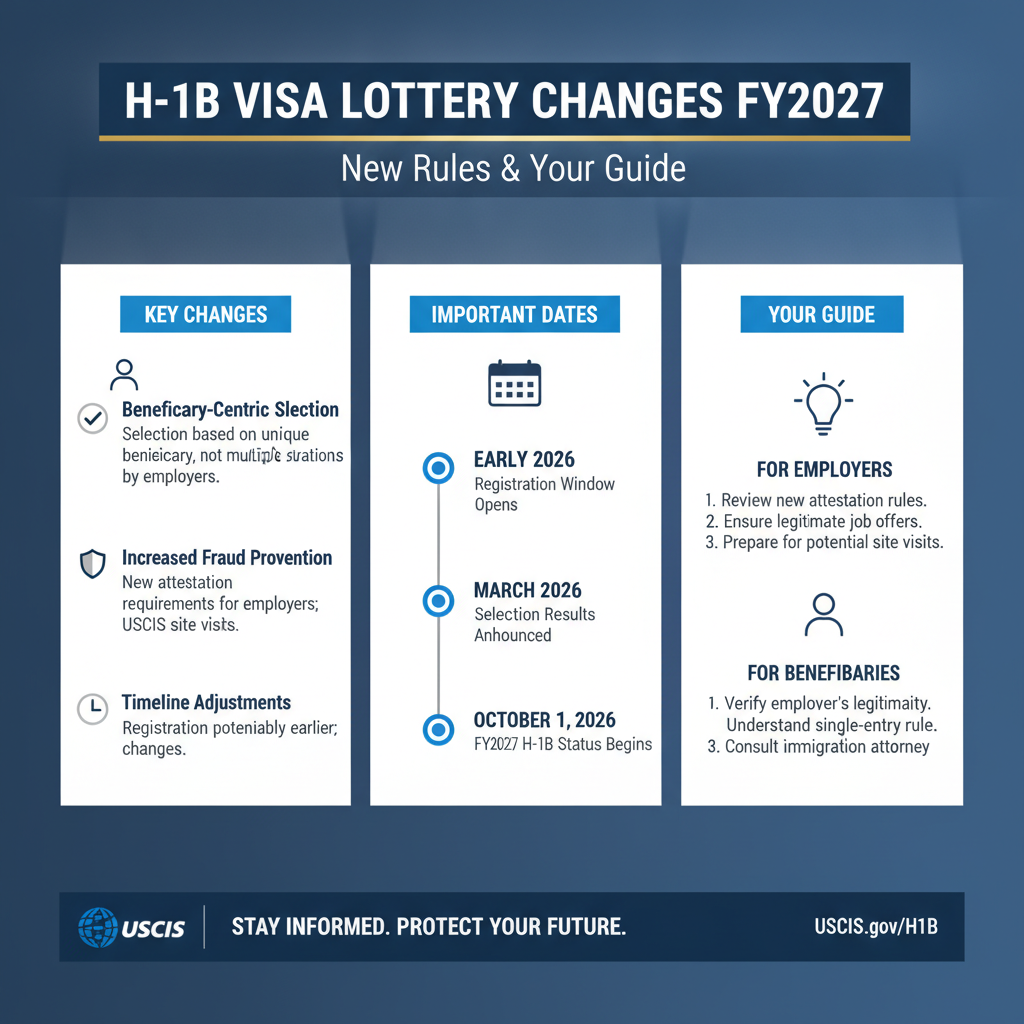
Today, we delve into the significant H-1B visa lottery changes announced by U.S. Citizenship and Immigration Services (USCIS) for Fiscal Year 2027. These updates fundamentally alter how the H-1B lottery will operate, aiming to enhance integrity and fairness in the selection process. For those in Orlando, across Florida, and nationwide, understanding these shifts is paramount for a successful application.
Need Help Navigating the New H-1B Rules? Our Orlando immigration team is ready to assist. Call +1 786-791-3106 for a free consultation, or message us online. Se Habla Español.
The reporting that sparked this guide
The information and analysis presented in this comprehensive guide are informed by recent developments in immigration policy, specifically concerning the integrity of the H-1B visa program. We consistently monitor official announcements from government agencies and reputable legal news sources to ensure our advice is current and accurate. For context on the ongoing discussions and reforms, you can refer to general legal news on the topic:
H-1B Visa Lottery Changes for FY2027 (Legal News)
What This News Means for Immigrants in Orlando and Across Florida
For countless skilled professionals and the U.S. companies that rely on their expertise, the H-1B visa program is a critical pathway. The recent changes announced for the FY2027 H-1B lottery represent a pivotal shift in how beneficiaries are selected, directly impacting individuals and employers seeking to participate in this highly competitive process. As of July 29, 2026, these new rules are already shaping strategies for the upcoming registration period.
Why this news is showing up now
The H-1B visa program, which allows U.S. employers to temporarily employ foreign workers in specialty occupations, has long been oversubscribed. The annual cap of 65,000 visas (plus an additional 20,000 for those with U.S. master's degrees or higher) consistently falls short of demand, leading to a lottery system for selection. In recent years, USCIS identified a growing trend of "fraudulent multiple registrations" where multiple employers would register the same beneficiary to artificially inflate their chances of selection. This practice undermined the fairness of the lottery, disadvantaging legitimate applicants and employers.
In response, USCIS, under the Department of Homeland Security (DHS), has implemented new regulations to reform the H-1B cap registration process. These changes aim to combat fraud, enhance fairness, and ensure that each unique beneficiary has an equal chance in the lottery. The reforms were designed to take effect for the FY2027 H-1B cap season, giving stakeholders time to understand and adapt to the new requirements. This proactive approach ensures that by the time the registration window opens in March 2027, the new system will be fully operational and understood.
How it can affect Florida residents
Florida, particularly the Orlando and Central Florida region, is a hub for industries that heavily rely on H-1B talent. Technology companies, theme parks, healthcare providers, and academic institutions along the I-4 corridor frequently sponsor H-1B visas. For individuals living, studying, or working in Florida on other nonimmigrant visas (like F-1 OPT or J-1) who hope to transition to H-1B status, these changes are critical.
- Increased Fairness for Legitimate Applicants: If you are a highly qualified individual with a genuine job offer, the new "beneficiary-centric" selection process is designed to level the playing field. It reduces the advantage gained by those who previously engaged in multiple, potentially fraudulent, registrations.
- Employer Due Diligence: Florida employers must now be even more vigilant. If an Orlando-based company is considering sponsoring an H-1B visa for an individual who might also have offers from other companies, clear communication is essential. Submitting multiple registrations for the same beneficiary will lead to disqualification for *all* registrations involving that beneficiary.
- Strategic Planning for Students: Graduates from Florida universities (such as UCF, UF, USF) on F-1 visas who are seeking H-1B sponsorship must coordinate carefully with their prospective employers. They will need to choose one employer to register them for the lottery.
- Reduced "Lottery Fatigue": While the lottery remains competitive, the intent of the changes is to reduce the sheer volume of registrations by eliminating fraudulent entries, potentially leading to a slightly more transparent and less chaotic process for legitimate participants.
For Central Florida residents and employers, understanding these new rules is not just about compliance; it's about strategizing effectively to maximize the chances of a successful H-1B petition in the upcoming fiscal year.
What H-1B Visa Lottery Changes for FY2027 Is (and Why It Matters)
The H-1B visa program is a cornerstone of U.S. immigration for skilled foreign workers. The recent modifications to its lottery system for Fiscal Year 2027 are a significant development that impacts thousands of individuals and businesses nationwide, including those in Orlando and the broader Florida economy.
A plain-English definition
Imagine a highly sought-after concert ticket where demand far exceeds supply. To ensure fairness, a lottery is held. The H-1B visa works similarly: there's an annual limit (the "cap"), and because more people want these visas than are available, USCIS conducts an electronic lottery to select who gets to apply. The "changes for FY2027" refer to new rules for *how* this lottery is conducted.
Specifically, the most crucial change is the shift to a beneficiary-centric selection process. Previously, each employer could register a prospective H-1B employee, and if multiple employers registered the *same* employee, each registration increased that employee's chances. This led to a situation where some employers would collaborate to submit many registrations for one individual, effectively "gaming" the system. The new rule states that each unique beneficiary can now only have *one* registration submitted on their behalf in any given fiscal year. USCIS will identify beneficiaries using their valid passport or travel document number.
This matters because it aims to make the lottery truly random and fair for every individual applicant, removing the advantage gained by those who previously engaged in multiple registrations. It also places a greater responsibility on beneficiaries to communicate clearly with their potential employers.
Key terms you need to know
Navigating the H-1B landscape requires familiarity with specific terminology. Here are the key terms relevant to the FY2027 H-1B lottery changes:
- H-1B Visa: A nonimmigrant visa that allows U.S. employers to temporarily employ foreign workers in specialty occupations.
- Specialty Occupation: An occupation that requires theoretical and practical application of a body of highly specialized knowledge, and a bachelor's or higher degree in the specific specialty (or its equivalent) as a minimum for entry into the occupation in the United States.
- Cap-Subject H-1B: Refers to H-1B visas that are subject to the annual statutory cap of 65,000, plus an additional 20,000 for those with a U.S. master's degree or higher. Most H-1B petitions fall under this category.
- Cap-Exempt: Certain H-1B petitions are exempt from the annual cap. These typically include petitions filed on behalf of beneficiaries working at institutions of higher education, related or affiliated nonprofit entities, or nonprofit research organizations or governmental research organizations.
- Beneficiary: The foreign national worker for whom the H-1B visa is sought.
- Petitioner: The U.S. employer filing the H-1B petition on behalf of the foreign national beneficiary.
- USCIS (U.S. Citizenship and Immigration Services): The government agency responsible for processing immigration benefits, including H-1B petitions. (USCIS official website)
- DHS (Department of Homeland Security): The cabinet department that oversees USCIS, U.S. Customs and Border Protection (CBP), and U.S. Immigration and Customs Enforcement (ICE).
- H-1B Registration: The electronic process where prospective petitioners (employers) submit basic information about the company and the beneficiary to enter the lottery. This is the first step before a full petition is filed.
- Lottery (Selection Process): The random selection process conducted by USCIS when the number of H-1B registrations exceeds the annual cap.
- FY2027 (Fiscal Year 2027): Refers to the government fiscal year starting October 1, 2026, and ending September 30, 2027. The lottery for this fiscal year typically occurs in March 2027.
- Beneficiary-Centric Selection: The core new rule for FY2027, meaning the lottery selection is based on the unique beneficiary, identified by their passport or travel document number. Each beneficiary can only have one registration submitted on their behalf.
- Form I-129, Petition for a Nonimmigrant Worker: The main form used by employers to petition for nonimmigrant workers, including H-1B.
- Form I-797, Notice of Action: A general notice from USCIS, used for various actions including lottery selection notices (Form I-797C) and petition approvals.
Confused by H-1B Terminology? Imigrar breaks down complex legal terms into plain English. Contact us for clarity on your immigration journey. Call +1 786-791-3106 or reach out online. Se Habla Español.
Current Immigration Law: The Foundation
The H-1B visa program is governed by specific sections of the Immigration and Nationality Act (INA) and federal regulations. Understanding these foundational laws is crucial for appreciating the significance of the recent changes.
The authority for the H-1B nonimmigrant visa is primarily found in Section 101(a)(15)(H)(i)(b) of the INA, which defines the H-1B classification. The annual numerical limitations, or "cap," are established under INA Section 214(g). This section mandates the current annual cap of 65,000 H-1B visas, with an additional 20,000 visas reserved for beneficiaries who have earned a U.S. master's degree or higher. These statutory limits are the reason for the highly competitive lottery process.
Furthermore, federal regulations, primarily found in 8 Code of Federal Regulations (CFR) Part 214.2(h), outline the detailed requirements for H-1B petitions, including eligibility criteria for both petitioners and beneficiaries, the filing process, and the specific definitions of a "specialty occupation." The new rules for the FY2027 H-1B lottery are implemented through amendments to these federal regulations, specifically addressing the electronic registration process and selection methods.
Federal requirements
To qualify for an H-1B visa, both the employer (petitioner) and the foreign worker (beneficiary) must meet specific federal requirements:
For the Employer (Petitioner):
- The employer must offer employment in a specialty occupation. This means the job typically requires a bachelor's degree or higher in a specific field.
- The employer must demonstrate the ability to pay the H-1B beneficiary the required wage. This wage must be at least the actual wage paid to other employees with similar experience and qualifications for the same position, or the prevailing wage for the occupational classification in the area of intended employment, whichever is higher.
- The employer must file a Labor Condition Application (LCA) with the U.S. Department of Labor (DOL) and receive certification before filing the H-1B petition. The LCA, Form ETA-9035, attests that the employer will meet certain conditions regarding wages and working conditions.
- The employer must maintain an employer-employee relationship with the beneficiary.
For the Beneficiary (Foreign Worker):
- The beneficiary must possess at least a U.S. bachelor's degree or its equivalent, or a full unrestricted state license to practice the specialty occupation, or authorization to practice in the specialty occupation from a state board, or work experience equivalent to a bachelor's degree.
- The beneficiary's qualifications must directly relate to the specialty occupation offered.
- The beneficiary must possess a valid passport or other travel document. This is particularly important for the new beneficiary-centric registration process.
The primary form used for filing an H-1B petition is Form I-129, Petition for a Nonimmigrant Worker. This complex form requires extensive supporting documentation to prove eligibility for both the employer and the beneficiary. You can find more information about this and other forms on the USCIS Forms page.
Florida-specific considerations
While H-1B immigration law is federal, its impact is keenly felt at the state level. Florida does not have its own H-1B specific laws or regulations that supersede federal requirements. However, the state's economic landscape makes it a significant player in the H-1B program:
- High Demand Industries: Florida's booming technology sector, robust healthcare industry, and thriving tourism and hospitality management companies (especially around Orlando and Miami) are frequent petitioners for H-1B visas. This means many Florida-based employers and their international hires will be directly affected by the FY2027 lottery changes.
- University Graduates: Florida is home to numerous top-tier universities, attracting international students who often pursue H-1B status post-graduation. Graduates from institutions like the University of Central Florida (UCF) in Orlando, the University of Florida (UF), and the University of South Florida (USF) are frequently among H-1B hopefuls.
- Orlando USCIS Presence: While H-1B petitions are primarily processed by USCIS service centers, the Orlando USCIS Field Office handles various other immigration matters for Central Florida residents. If an H-1B worker later seeks to adjust their status or process other family-based petitions, local offices will become relevant.
- Economic Impact: H-1B workers contribute significantly to the Florida economy, bringing specialized skills and filling critical labor shortages. The integrity and efficiency of the H-1B process are therefore of great interest to the state's economic development.
Understanding these federal requirements and how they intersect with Florida's unique environment is key. For employers and beneficiaries in Orlando and across the state, navigating the new H-1B lottery changes effectively will require meticulous preparation and adherence to the updated federal guidelines.
How to Navigate the H-1B FY2027 Lottery Changes: A Complete Step-by-Step Guide
The FY2027 H-1B lottery changes introduce a crucial new dimension to the application process. This step-by-step guide walks you through the revised journey, focusing on the beneficiary-centric selection and critical requirements for a successful petition.
1) Understanding the New Beneficiary-Centric Lottery System
This is the most critical change for FY2027. Before any registration, both beneficiaries and employers must grasp this core principle: USCIS will now select registrations based on the unique beneficiary, identified by their valid passport or travel document number. This means:
- One Registration Per Beneficiary: A unique beneficiary can only have *one* H-1B cap registration submitted on their behalf in a given fiscal year.
- Disqualification for Multiple Entries: If USCIS finds that a beneficiary has more than one registration submitted by *any* employer in the same fiscal year, all registrations for that beneficiary will be deemed invalid and disqualified. This is a severe penalty designed to combat fraud.
- Employer Coordination: If you, as a beneficiary, have multiple job offers, you *must* choose one employer to submit your registration. You cannot allow multiple employers to register you. Employers must also confirm with their prospective H-1B beneficiaries that no other employer is submitting a registration for them.
Required Documents (for understanding):
- Beneficiary's valid passport or travel document.
- Confirmation of employment offers (if multiple).
Important: This change places a significant burden on the beneficiary to communicate clearly and make a decision about which employer will sponsor their registration.
2) Employer and Beneficiary Eligibility Assessment
Before the registration period, both the prospective employer and the beneficiary must confirm they meet the fundamental H-1B eligibility criteria. This foundational step is unchanged by the new lottery rules but remains paramount.
For the Employer (Petitioner):
- Confirm the job offered is a specialty occupation. This means it requires theoretical and practical application of a body of highly specialized knowledge and a bachelor's degree or higher in a specific specialty (or its equivalent) as a minimum for entry.
- Verify the employer's ability to pay the required wage (actual or prevailing wage, whichever is higher).
- Ensure the employer has a valid Employer Identification Number (EIN).
For the Beneficiary (Foreign Worker):
- Possess a U.S. bachelor's degree or its equivalent in a field related to the specialty occupation.
- Hold any necessary professional licenses required for the occupation in the state of intended employment (e.g., in Florida, for certain healthcare professions).
- Have a valid, unexpired passport or travel document that will be used for the H-1B registration. Ensure the biographical information matches exactly across all documents.
Required Documents (for assessment):
- Employer: Business license, EIN, organizational charts, job description, financial statements, documentation of similar positions and wages.
- Beneficiary: Academic degrees, transcripts, diploma evaluations (if foreign degree), professional licenses, detailed resume, letters of experience from previous employers, valid passport biographical page.
3) H-1B Electronic Registration Submission (March 2027)
The electronic registration period is typically in early March. For FY2027, USCIS is expected to open the registration window around the first week of March 2027. This is where the new rules are directly applied.
- Employer Account Creation: The petitioning employer (or their authorized representative, like Imigrar) must create or access a USCIS online account.
- Beneficiary Data Input: For each prospective H-1B worker, the employer will submit the following information through the online system:
- Beneficiary's full legal name
Have Questions About Your Case?
Schedule a free consultation with our attorney-reviewed team today
- Beneficiary's full legal name


