


Navigating the complex landscape of U.S. immigration law can be challenging, especially when significant changes are introduced to crucial visa programs. The H-1B visa, a lifeline for U.S. employers seeking to hire foreign workers in specialty occupations, has recently undergone substantial modifications to its lottery system for Fiscal Year 2027 (FY2027) and beyond. These changes, enacted by U.S. Citizenship and Immigration Services (USCIS), aim to enhance fairness, reduce fraud, and streamline the selection process. For individuals and businesses in Orlando, throughout Florida, and across the nation, understanding these updates is paramount to a successful application.
Need Expert Guidance on H-1B Changes? The new rules can be intricate. Our Orlando immigration team is ready to assist you in understanding and preparing for the H-1B lottery. Call +1 786-791-3106 for a free consultation, or message us online. Se Habla Español.
NEWS SOURCE REFERENCE SECTION
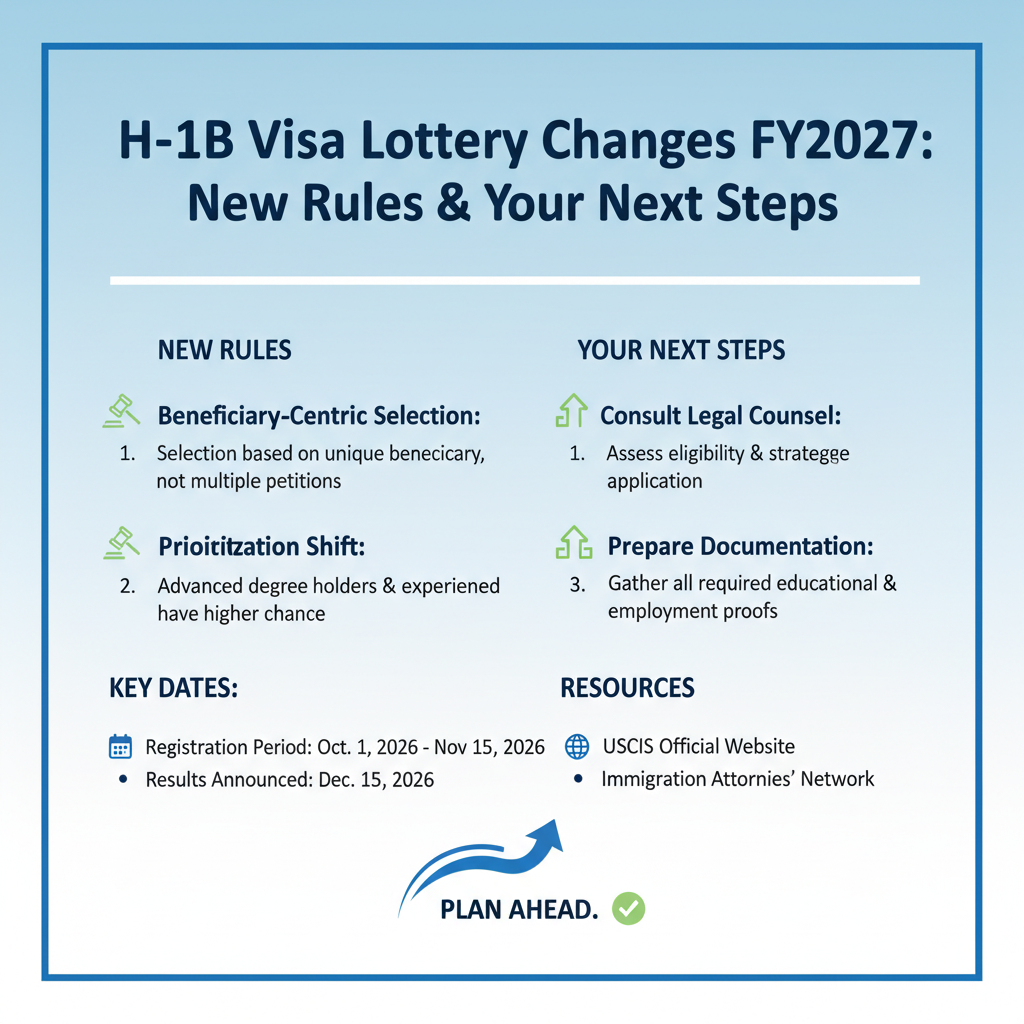
The reporting that sparked this guide: H-1B Visa Lottery Changes for FY2027 (Legal News)
What This News Means for Immigrants in Orlando and Across Florida
The H-1B visa program is a cornerstone of the U.S. economy, allowing American companies to employ foreign workers in specialized fields such as technology, engineering, medicine, and education. Given the high demand and limited number of available visas, USCIS conducts an annual lottery to select eligible registrations. The latest changes for the FY2027 lottery represent a significant shift in how this process operates, directly impacting prospective H-1B beneficiaries and their sponsoring employers.
Why this news is showing up now
As of April 16, 2026, the H-1B Cap-Subject Electronic Registration Period for FY2027 has concluded (it ran from March 6 to March 22, 2026), and USCIS has already announced the selection results (by March 27, 2026). Employers with selected registrations are currently in the active window to file their full H-1B petitions, a period that runs from April 1 to June 30, 2026. The "news" refers to the new final rule, "H-1B Registration Fee Final Rule," published by USCIS on January 30, 2024, which introduced several critical changes that were implemented for the FY2027 lottery and will continue to apply to future lotteries. These changes are highly relevant now because they dictated the process for the recently concluded lottery and are shaping the petition filing stage. Furthermore, these updates have significant implications for how future H-1B applicants and employers must strategize and prepare.
How it can affect Florida residents
Florida, particularly Central Florida, is a hub for innovation and economic growth. Cities like Orlando are home to thriving tech industries, world-class universities, healthcare systems, and engineering firms that heavily rely on skilled foreign talent. The H-1B program is vital for these sectors to fill critical labor shortages and remain competitive globally.
- For Employers in Orlando and Central Florida: Businesses, from startups in Lake Nona's Medical City to established tech companies along the I-4 corridor, must now meticulously ensure their H-1B registrations are legitimate and comply with the new "per-beneficiary" selection process. The new rules aim to prevent the submission of multiple registrations for the same individual by related entities, which was a concern in previous years. This means a more level playing field but also demands stricter adherence to regulations.
- For Prospective H-1B Workers: If you are an international student graduating from a Florida university (like UCF, UF, or FIU) on an F-1 visa with Optional Practical Training (OPT), or a professional seeking to transition to an H-1B visa, these changes directly impact your chances of selection. The shift to a beneficiary-centric selection process means that each unique individual has an equal chance, regardless of how many employers registered them. This is generally seen as a positive change for beneficiaries, as it eliminates the advantage of those with multiple registrations. However, it also means that employers must be extra diligent in their filings, as errors or non-compliance could jeopardize a beneficiary's sole chance.
- Increased Scrutiny: USCIS is enhancing its ability to detect and deter fraud. This means all applications, particularly those from Florida-based companies, will face heightened scrutiny to ensure compliance with the new rules.
What H-1B Visa Lottery Changes for FY2027 Is (and Why It Matters)
The H-1B visa allows U.S. employers to temporarily employ foreign workers in specialty occupations. These occupations generally require a bachelor's degree or higher in a specific specialty. Due to the annual cap on H-1B visas (currently 65,000 for the regular cap and an additional 20,000 for the U.S. master's cap), USCIS employs a lottery system when the number of registrations exceeds the available visas. The changes for FY2027 fundamentally alter how this lottery is conducted.
A plain-English definition
Think of the H-1B visa lottery as a drawing where many employers want to hire foreign professionals, but there are only a limited number of "slots" (visas) available each year. In the past, an employer would submit a registration for each foreign worker they wanted to hire. If one worker had multiple employers register for them, that worker would have multiple "tickets" in the lottery, increasing their chances. The new rule changes this: now, regardless of how many employers register for a single foreign worker, that worker (the "beneficiary") only gets one ticket in the lottery. USCIS will identify each unique beneficiary by their passport or travel document number. This makes the process fairer for everyone and aims to stop fraud where multiple companies might have colluded to submit many registrations for one person to game the system.
Key terms you need to know
- H-1B Cap: The statutory annual limit on the number of H-1B visas issued. Currently, this is 65,000 for the regular cap and an additional 20,000 for the U.S. master's cap.
- Cap-Exempt: Certain employers (like universities, non-profit research organizations, and government research organizations) are exempt from the annual H-1B cap.
- LCA (Labor Condition Application): Form ETA-9035. This form, filed with the U.S. Department of Labor, certifies that the employer will pay the H-1B worker the prevailing wage or the actual wage paid to similarly qualified employees, whichever is higher, and provide working conditions that will not adversely affect other workers. This must be certified *before* filing the H-1B petition.
- Specialty Occupation: An occupation that requires theoretical and practical application of a body of highly specialized knowledge, and a bachelor's or higher degree in the specific specialty (or its equivalent) as a minimum for entry into the occupation in the United States.
- Beneficiary: The foreign worker for whom the H-1B visa is sought.
- Petitioner: The U.S. employer filing the H-1B petition on behalf of the foreign worker.
- Registration Period: The specific window (usually in March) during which employers must electronically register their prospective H-1B beneficiaries with USCIS.
- Selection Process: The lottery system USCIS uses to randomly select registrations when demand exceeds the annual cap. For FY2027, this shifted to a beneficiary-centric selection.
- Master's Cap: The additional 20,000 H-1B visas reserved for beneficiaries who have earned a U.S. master's degree or higher. These are drawn before the regular cap.
- Passport or Travel Document Number: The unique identifier USCIS now uses to identify each beneficiary and prevent duplicate entries in the lottery.
Confused by H-1B Jargon? Our team at Imigrar specializes in making complex immigration law understandable. We can help you navigate the terms and requirements for your H-1B application. Call +1 786-791-3106 for a free consultation. Se Habla Español.
Current Immigration Law: The Foundation
The H-1B visa program is governed primarily by the Immigration and Nationality Act (INA). Specifically, Section 101(a)(15)(H)(i)(b) defines the H-1B nonimmigrant classification, and Section 214(g) outlines the annual numerical limitations (the cap) and exemptions. The recent changes regarding the lottery process are implemented under the regulatory authority granted to USCIS to manage the H-1B program efficiently and fairly.
Federal requirements
To qualify for an H-1B visa, both the employer (petitioner) and the foreign worker (beneficiary) must meet specific federal criteria:
- For the Beneficiary:
- Hold a bachelor's degree or its equivalent, or a higher degree in a specialty occupation field.
- Possess a state license, if required, to practice the occupation.
- Have work experience equivalent to a bachelor's degree.
- Be qualified to perform the services in the specialty occupation.
- For the Petitioner (Employer):
- Offer a job in a "specialty occupation."
- Pay at least the prevailing wage for the occupation in the geographic area of employment or the actual wage paid to other employees with similar experience and qualifications, whichever is higher.
- File and obtain certification of a Labor Condition Application (LCA), Form ETA-9035, from the U.S. Department of Labor.
- Have an Employer Identification Number (EIN).
The recent changes primarily impact the *selection* process, not the fundamental eligibility criteria. USCIS has also adjusted the H-1B registration fee from $10 to $215, effective for the FY2027 registration period.
Florida-specific considerations
While federal law governs H-1B visas, the impact is felt at the local level. Florida does not have its own specific H-1B laws that supersede federal regulations. However, the concentration of certain industries and educational institutions in Florida means the H-1B program is particularly relevant:
- Tech and Tourism Hubs: Orlando's tech sector, including modeling and simulation, and its massive tourism industry, often seek specialized talent that can be sponsored through H-1B.
- Healthcare Industry: Florida's growing healthcare sector, especially in cities like Orlando, Tampa, and Miami, employs numerous H-1B professionals in fields like nursing, physical therapy, and medical research.
- Academic Institutions: Universities like the University of Central Florida (UCF) in Orlando are cap-exempt H-1B employers and also produce many graduates who seek H-1B sponsorship from other companies.
- Fraud Prevention: Given the increased focus on fraud prevention, Florida-based employers must be especially diligent. USCIS may conduct site visits to verify employment conditions and compliance. The Orlando USCIS Field Office may be involved in such verification processes for local employers.
For more detailed information on H-1B requirements and forms, always refer to the USCIS official website.
How to Navigate the H-1B Lottery Changes: A Complete Step-by-Step Guide
The H-1B cap-subject petition process begins with electronic registration. For FY2027, this initial step was significantly altered. Here’s a detailed guide on navigating the process under the new rules:
1) Understand the New Lottery Rules (FY2027 and Beyond)
The most critical change for FY2027 is the shift to a beneficiary-centric selection process. Instead of selecting registrations based on each submission, USCIS now bases selections on each unique beneficiary. Each beneficiary, identified by a valid passport or travel document number, is entered into the lottery only once, regardless of how many employers register them.
- Key Impact: This change prevents multiple entries for a single individual, ensuring a fairer chance for all. It also significantly reduces the incentive for employers to submit multiple registrations for the same beneficiary through related entities, a practice USCIS considers a form of fraud.
- Action: Ensure that your employer (or employers, if multiple are interested) provides accurate and consistent information, especially your passport or travel document number, during registration.
2) Employer Registration and LCA Filing
The process starts with the prospective employer. For cap-subject H-1B petitions, the employer must first complete the electronic registration process.
- Employer Action:
- Obtain EIN: Ensure the U.S. employer has a valid Employer Identification Number.
- Create USCIS Online Account: The employer or their authorized representative (like Imigrar) must create or access a USCIS online account.
- Prepare Beneficiary Information: For each prospective H-1B worker, the employer must gather the beneficiary’s full legal name, date of birth, country of birth, country of citizenship, gender, and a valid passport or travel document number. This number is crucial for the new beneficiary-centric selection.
- Submit Electronic Registration: During the designated registration period (for FY2027, this was March 6 - March 22, 2026), the employer submits the electronic registration for each beneficiary and pays the non-refundable registration fee ($215 for FY2027).
- Required Documents for Registration (Information Only):
- Employer's EIN
- Employer's legal name, mailing address, and contact information
- Beneficiary's full legal name, date of birth, country of birth, country of citizenship, gender
- Beneficiary's valid passport or travel document number
- Whether the beneficiary qualifies for the U.S. master's degree cap.
3) H-1B Lottery Selection Process (and What Happens Next)
After the registration period closes, USCIS conducts the lottery. For FY2027, selections were announced by March 27, 2026.
- Selection Notification: USCIS notifies petitioners with selected registrations through their online accounts. The selection notice will include instructions on where and when to file the H-1B cap-subject petition.
- Petition Filing Window: If selected, the employer has a specific window to file the full H-1B petition. For FY2027, this window is from April 1, 2026, to June 30, 2026. It is crucial to file within this period.
- Important: Only employers with selected registrations may proceed to file an H-1B cap-subject petition for the named beneficiary.
4) If Selected: Petition Filing and Supporting Documents
Once a registration is selected, the employer must prepare and file the comprehensive H-1B petition.
- Employer Action:
- File LCA (Form ETA-9035): Before filing the H-1B petition, the employer must file and obtain certification for a Labor Condition Application (LCA) from the U.S. Department of Labor. This process can take several days to weeks.
- Prepare Form I-129: Complete Form I-129, Petition for a Nonimmigrant Worker, specifically the H-1B classification supplement.
- Gather Supporting Documentation: Collect all necessary evidence to prove the beneficiary’s qualifications, the specialty occupation nature of the job, and the employer’s ability to pay the required wage.
- Pay Filing Fees: Include all required filing fees, including the Form I-129 fee, ACWIA fee, fraud prevention and detection fee, and (if applicable) the Public Law 114-113 fee.
- Mail Petition: File the complete package with the appropriate USCIS service center as indicated on the selection notice.
- Required Documents for H-1B Petition (Bullet List):
- Certified Form ETA-9035 (LCA)
- Completed and signed Form I-129 and H-1B Supplement
- Copies of beneficiary’s educational degrees, transcripts, and evaluations (if foreign degree)
- Copies of beneficiary’s professional licenses (if applicable)
- Beneficiary’s resume and employment letters
- Copy of beneficiary’s passport, visa, I-94 record, and previous I-797 approval notices (if applicable)
- Employer's federal EIN, business license, and company financial statements
- Organizational chart and job description detailing specialty occupation duties
- Letters of support from the employer
- Proof of payment for all USCIS fees
- If represented, a signed Form G-28, Notice of Entry of Appearance as Attorney or Accredited Representative
5) Premium Processing & Subsequent Steps (Status Changes/Consular Processing)
After filing, employers have options for processing speed and beneficiaries have options depending on their location.
- Premium Processing: Employers can opt for Premium Processing by filing Form I-907, Request for Premium Processing Service, along with an additional fee. This guarantees USCIS will take action on the petition (approval, denial, RFE, or NOID) within 15 calendar days.
- Change of Status (COS): If the beneficiary is already in the U.S. on a valid nonimmigrant status (e.g., F-1 OPT, L-1, H-4), the H-1B petition can include a request for a change of status to H-1B. If approved, the H-1B status typically becomes effective on October 1st (the start of the fiscal year).
- Consular Processing: If the beneficiary is outside the U.S. or chooses to depart, they will undergo consular processing. Upon H-1B petition approval, USCIS sends the approval notice to the U.S. Department of State, which then forwards it to the U.S. embassy or consulate where the beneficiary will apply for an H-1B visa stamp.
6) Maintaining H-1B Status and Future Considerations
Once H-1B status is granted, beneficiaries must adhere to its terms.
- Compliance: Maintain employment with the sponsoring employer, adhere to the job duties outlined in the petition, and notify USCIS of any material changes (e.g., new work location).
- Extensions: H-1B status is generally granted for an initial period of up to three years, with a possible extension for a total of six years. Further extensions beyond six years are possible under certain circumstances (e.g., if a green card process has been initiated).
- Green Card Path: The H-1B visa is a "dual intent" visa, meaning H-1B holders can pursue permanent residency (a green card) while maintaining H-1B status.
Practical Steps You Can Take Today
Whether you're an employer in Orlando or a prospective H-1B beneficiary anywhere in Florida, proactive preparation is key, especially with the new rules in place for FY2027 and future lotteries.
Actionable Checklist:
- Verify Eligibility (Employer & Employee): Double-check that the job truly qualifies as a specialty occupation and that the beneficiary meets the educational requirements.
- Secure Passport/Travel Document: Ensure the beneficiary has a valid, unexpired passport or travel document. This number is critical for the new beneficiary-centric lottery.
- Gather Educational and Professional Documents Early: Collect all diplomas, transcripts, foreign degree evaluations, and professional licenses. Have them translated and evaluated if necessary.
- Understand the New Rules Fully: Familiarize yourself with the beneficiary-centric selection process to avoid misunderstandings or attempting to game the system, which could lead to fraud accusations.
- Consult an Experienced Immigration Attorney: This is perhaps the most crucial step. An attorney can assess your specific situation, ensure compliance, and guide you through the complexities.
- Plan for Alternatives: Given the competitive nature of the H-1B lottery, always have a backup plan. This might include pursuing other visa options (e.g., O-1, L-1, E-3, TN) or considering cap-exempt employment.
Document Preparation Guidance
Start compiling documents well in advance. Create a checklist and a secure digital folder for all copies. For physical documents, organize them neatly for quick access.
- Educational Documents: Original diplomas, official transcripts. If degrees are from outside the U.S., obtain a professional evaluation to determine U.S. equivalency.
- Employment Documents: Detailed job descriptions, letters from previous employers, resume, and any professional certifications.
- Personal Documents: Birth certificate, marriage certificate (if applicable), all passport pages (including stamps and visas), I-94 records, previous visa approval notices (I-797s).
- Employer Documents: Company profile, financial statements, tax returns, office lease, and any marketing materials to establish legitimacy.
Timeline Expectations (FY2027 and future H-1B lotteries)
- January-February (pre-registration): Employers and beneficiaries prepare, gather documents, and consult with legal counsel. USCIS announces registration dates and final rules for the upcoming fiscal year.
- March 6 - March 22, 2026 (FY2027 Registration): Electronic registration period for employers.
- By March 27, 2026 (FY2027 Selection): USCIS announces lottery results.
- April 1 - June 30, 2026 (FY2027 Petition Filing): Selected employers


