


The reporting that sparked this guide
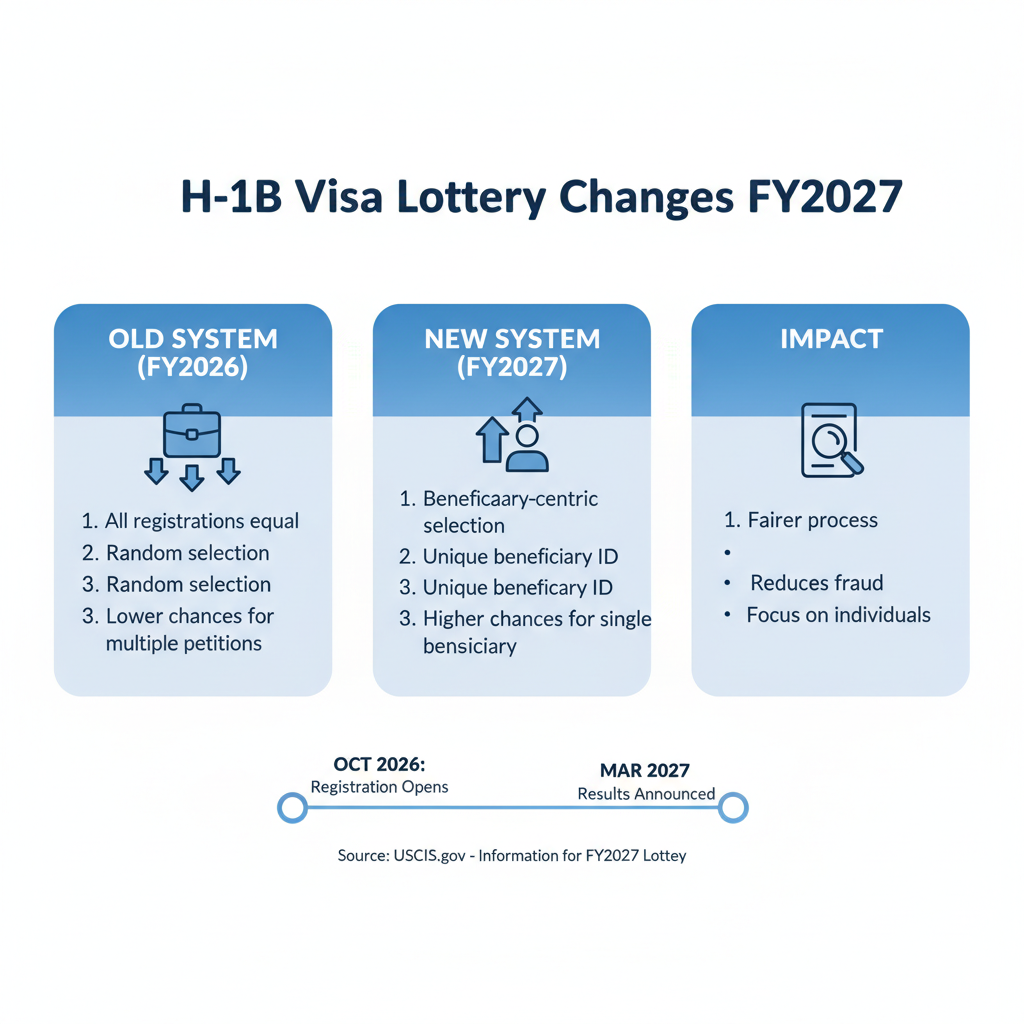
The U.S. Citizenship and Immigration Services (USCIS) recently finalized significant changes to the H-1B visa lottery system, impacting the upcoming Fiscal Year 2027. These reforms aim to combat fraud and enhance the integrity of the H-1B program, particularly concerning the registration process. The news has been widely covered across legal and immigration news outlets, highlighting a pivotal shift in how employers and beneficiaries approach this highly sought-after visa. Understanding these updates is crucial for anyone involved in the H-1B process, from employers to potential beneficiaries.
What This News Means for Immigrants in Orlando and Across Florida
The H-1B visa program is a lifeline for many skilled foreign workers and the U.S. employers who rely on their expertise. As an immigration law firm based in Orlando, Florida, Imigrar understands the profound impact that changes to this program can have on individuals, families, and businesses across the Sunshine State. The new rules for the FY2027 H-1B lottery are not just technical adjustments; they represent a fundamental shift in strategy that demands careful attention and proactive planning.
Why this news is showing up now
The U.S. Citizenship and Immigration Services (USCIS) published a final rule in early 2024, titled "Registration Fee Final Rule," which codified several significant changes to the H-1B cap registration process. While some fee changes became effective on April 1, 2024, the most impactful procedural changes, particularly the "beneficiary-centric" selection process, were specifically implemented for the FY2025 cap season and onward. For the FY2027 lottery, which had its registration period in March 2026, these new rules were fully in effect. As of today, April 6, 2026, the H-1B cap registration period for FY2027 has closed, and selections are either just being announced or are imminent. This timing makes understanding the new rules critical for those who have registered and are awaiting results, as well as for those planning for future H-1B opportunities.
The primary driver behind these changes is a concerted effort by USCIS to prevent fraud and ensure fairness in the H-1B lottery. In previous years, some employers and their affiliates submitted multiple registrations for the same beneficiary, artificially inflating their chances of selection. The new rules directly address this loophole, aiming to create a more equitable system for all eligible registrants.
How it can affect Florida residents
Florida, particularly the Orlando metropolitan area, is a vibrant hub for tourism, technology, aerospace, and healthcare industries. These sectors frequently rely on H-1B visa holders to fill specialized roles that require specific expertise not readily available in the U.S. workforce. From engineers working in simulated environments in Central Florida to IT professionals supporting the growing tech corridor along I-4, many individuals and companies depend on the H-1B program.
- For H-1B Beneficiaries in Florida: If you are a foreign national currently working on an Optional Practical Training (OPT) visa, a student visa, or another nonimmigrant status in Florida, and you were hoping for an H-1B, the new rules directly impact your prospects. The shift to a beneficiary-centric selection means that you, as the individual, will only be entered into the lottery once, regardless of how many employers register on your behalf. This levels the playing field but also emphasizes the importance of choosing a legitimate, committed employer.
- For Florida Employers: Businesses in Orlando, Tampa, Miami, and other Florida cities that sponsor H-1B visas must now adapt their strategies. The focus must be on legitimate job offers and a single, valid registration per beneficiary. Employers who previously relied on multiple registrations for a single candidate will find this tactic ineffective and potentially detrimental.
- Increased Integrity: The changes are designed to reduce the prevalence of "ghost" registrations and increase the chances for genuine employment opportunities to be selected. This could benefit legitimate Florida businesses and their prospective employees by reducing competition from fraudulent entries.
- Heightened Scrutiny: With enhanced integrity measures, USCIS may apply more rigorous scrutiny to petitions, especially those from employers with a history of suspicious activity. This underscores the need for meticulous preparation and adherence to all regulations.
Navigating the New H-1B Landscape? Don't face the complexities alone. Our Orlando immigration team at Imigrar specializes in H-1B visas and is ready to assist. Call +1 786-791-3106 for a free consultation, or message us online. Se Habla Español.
What H-1B Visa Lottery Changes for FY2027 Is (and Why It Matters)
The H-1B visa program allows U.S. employers to temporarily employ foreign workers in specialty occupations. These occupations generally require a bachelor's degree or higher in a specific field. Due to high demand, USCIS conducts a lottery to select eligible registrations when the number of registrations exceeds the annual cap.
A plain-English definition
Imagine the H-1B visa as a special work permit for highly skilled professionals, like software engineers, doctors, or architects. Because so many people want this permit each year, and there's a limit (a "cap") on how many can be issued, USCIS holds a lottery. For the FY2027 lottery, the big change is that instead of employers registering, the beneficiary (the foreign worker) is now the central figure in the lottery. This means each unique beneficiary can only have one entry in the lottery, no matter how many different employers want to sponsor them. If that beneficiary is selected, then any one of the employers who registered for them can file the full H-1B petition. This change is designed to stop companies from submitting many registrations for the same person to increase their odds, making the system fairer.
Key terms you need to know
Understanding the following terms is crucial for navigating the H-1B process, especially with the new changes:
- H-1B Visa: A nonimmigrant visa that allows U.S. employers to temporarily employ foreign workers in specialty occupations.
- Specialty Occupation: An occupation that generally requires a bachelor's degree or higher in a specific specialty as a minimum for entry into the occupation.
- Annual Cap: The statutory limit on the number of H-1B visas issued each fiscal year. Currently, this is 65,000 for the regular cap and an additional 20,000 for those with a U.S. master's degree or higher (the "master's cap").
- Fiscal Year (FY): The federal government's accounting year, which runs from October 1 to September 30. H-1B visas are typically valid starting October 1st of the fiscal year they are allotted for. For FY2027, the visas become effective on October 1, 2026.
- H-1B Cap Registration: The electronic process where prospective H-1B petitioners (employers) submit basic information about the company and the prospective H-1B worker (beneficiary) to USCIS. This is the first step before the lottery.
- Beneficiary: The foreign national who is the subject of an immigration petition or application. With the new rules, the lottery selection is now "beneficiary-centric," meaning the beneficiary's unique passport or travel document number is key.
- Registrant: The prospective H-1B petitioner (employer) who submits an H-1B cap registration on behalf of a beneficiary.
- Selection Notice: A notification from USCIS indicating that a registration has been selected in the lottery, allowing the employer to file an H-1B petition.
- Petition (Form I-129): The actual application package filed by the employer after a registration has been selected in the lottery.
- Labor Condition Application (LCA): Form ETA-9035, certified by the U.S. Department of Labor (DOL), attesting to wage and working conditions for H-1B workers. This must be certified before filing the H-1B petition.
The "beneficiary-centric" approach is the cornerstone of the FY2027 changes. Previously, if multiple employers registered for the same beneficiary, each registration was entered into the lottery. This allowed some beneficiaries to have multiple chances. Now, USCIS conducts the lottery based on the unique beneficiary. If a beneficiary has multiple registrations submitted by different employers, they are still only entered into the lottery once. If that unique beneficiary is selected, then any one of the employers who validly registered for them can proceed to file the H-1B petition. This dramatically shifts the strategy for both employers and beneficiaries, prioritizing fairness and reducing the incentive for fraudulent or speculative registrations.
Current Immigration Law: The Foundation of the H-1B Program
The H-1B visa program is authorized under the Immigration and Nationality Act (INA), specifically Section 214(g). This section establishes the annual numerical limitations (the "cap") on H-1B visas and outlines the general requirements for eligibility. While the core statutory framework remains, USCIS has the authority to implement regulations that govern the registration and petition process, which is where the FY2027 changes come into play.
Federal requirements
At its core, the H-1B visa requires:
- Specialty Occupation: The job must qualify as a specialty occupation, meaning it requires theoretical and practical application of a body of highly specialized knowledge, and a bachelor's or higher degree in the specific specialty (or its equivalent) for entry.
- Employer-Employee Relationship: A valid employer-employee relationship must exist between the petitioner and the beneficiary. The employer must control the work of the beneficiary.
- Required Qualifications: The beneficiary must meet the educational and/or licensure requirements for the specialty occupation. This typically means holding a U.S. bachelor's or higher degree, or its foreign equivalent, or having an unrestricted state license, or work experience equivalent to a bachelor's degree.
- Labor Condition Application (LCA): Before filing an H-1B petition, the employer must obtain a certified Form ETA-9035 from the U.S. Department of Labor (DOL). The LCA attests that the employer will pay the H-1B worker at least the prevailing wage for the occupation in the area of employment or the actual wage paid to other similarly employed workers, whichever is higher, and that working conditions will not adversely affect U.S. workers.
- Cap-Subject vs. Cap-Exempt: Most H-1B petitions are subject to the annual cap. However, certain employers are "cap-exempt," such as institutions of higher education, non-profit organizations affiliated with higher education institutions, and non-profit research organizations or government research organizations.
For detailed information on H-1B requirements and the latest regulations, always refer to the USCIS official website for H-1B visas.
Florida-specific considerations
While federal law governs the H-1B program, Florida's unique economic landscape influences its application:
- Key Industries: Florida boasts thriving sectors in technology, aerospace, healthcare, and advanced manufacturing. Cities like Orlando, Tampa, and Melbourne are growing tech hubs, attracting H-1B talent. The demand for IT professionals, engineers, data scientists, and medical specialists is consistently high.
- Prevailing Wages: The prevailing wage determinations by the DOL are location-specific. Employers in Florida must ensure they meet the prevailing wage for their specific geographic area within the state. For instance, the prevailing wage for a software developer in Orlando's Orange County might differ from that in Miami-Dade County.
- Educational Institutions: Florida has numerous universities and colleges, many of which are H-1B cap-exempt employers. Graduates from institutions like the University of Central Florida (UCF), University of Florida (UF), and Florida International University (FIU) are often sought after by Florida employers for H-1B sponsorship.
- Orlando USCIS Field Office: While H-1B petitions are processed centrally, individuals changing status or seeking local assistance might interact with the Orlando USCIS Field Office for certain matters. However, H-1B petition adjudication is generally handled by service centers.
Concerned about H-1B eligibility or compliance in Florida? Imigrar has extensive experience with Florida-based employers and employees. Contact us at +1 786-791-3106 for expert guidance. Se Habla Español.
How to Navigate the New H-1B Lottery System: A Complete Step-by-Step Guide
The H-1B lottery process for FY2027, with its new beneficiary-centric approach, requires meticulous planning and execution. Here’s a detailed guide to help employers and beneficiaries understand the steps involved, especially after the registration period has closed and selections are underway.
1) Employer Preparation and Labor Condition Application (LCA)
Before Registration (or for Future Reference): The foundation of any H-1B petition is the employer. The employer must identify a legitimate need for a foreign worker in a specialty occupation. They must also determine the appropriate prevailing wage for the position in the specific geographic area where the H-1B worker will be employed. This step involves filing a Labor Condition Application (Form ETA-9035) with the U.S. Department of Labor (DOL). The DOL typically takes 7-10 business days to certify an LCA.
Required Documents (for LCA):
- Detailed job description, including duties and requirements.
- Employer identification number (EIN).
- Prevailing wage determination (often obtained through online tools or private wage surveys).
- Company information (name, address, industry).
Important: An LCA must be certified by the DOL *before* an H-1B petition can be filed with USCIS. While not strictly required for the *registration* phase, having a plan for the LCA is crucial for the subsequent petition filing.
2) H-1B Cap Registration (Beneficiary-Centric)
Status as of April 6, 2026: The registration period for FY2027 closed in March 2026. If you or your employer participated, you are now awaiting selection results. For future reference, this is how it works:
During the designated registration period (typically in March), prospective H-1B petitioners (employers) must electronically register each desired beneficiary with USCIS. Under the new rules, each unique beneficiary can only be entered into the lottery once. If multiple employers register for the same beneficiary, USCIS will consolidate these registrations and only enter that beneficiary once into the selection process. If selected, any of the employers who validly registered for that beneficiary can then proceed to file the petition.
Required Information (for Registration):
- Employer’s legal name, EIN, and mailing address.
- Authorized signatory’s name, title, and contact information.
- Beneficiary’s full legal name, date of birth, country of birth, country of citizenship.
- Beneficiary’s passport number (or other valid travel document number).
- Beneficiary’s gender.
- Whether the beneficiary has a U.S. master's or higher degree (to qualify for the master's cap).
- Attorney or representative information (if applicable).
- Registration fee (for FY2027, this was $10 per registration).
Warning: Submitting multiple registrations for the same beneficiary using different travel documents or fraudulent information is strictly prohibited and can lead to severe penalties, including denial of petitions and criminal prosecution. Ensure all information is accurate and consistent.
3) Lottery Selection and Notification
Status as of April 6, 2026: USCIS is currently conducting or has just completed the lottery selection for FY2027. Notifications are typically sent out in late March or early April.
USCIS conducts the lottery if the number of eligible registrations exceeds the annual cap. The selection process occurs in two tiers:
- Master's Cap: First, registrations for beneficiaries with a U.S. master's degree or higher are selected against the 20,000 master's cap exemption.
- Regular Cap: All unselected master's cap registrations, along with all other regular cap registrations, are then pooled and selected against the 65,000 regular cap.
Under the new beneficiary-centric system, if a unique beneficiary is selected, USCIS will notify *all* employers who submitted a valid registration for that beneficiary that the beneficiary has been selected. However, only *one* of those employers can proceed to file the H-1B petition for that selected beneficiary.
Notification: Employers whose registrations have been selected will receive a "Selection Notice" via their USCIS online account. This notice will indicate the filing period during which the H-1B petition must be submitted.
4) H-1B Petition Filing (Form I-129)
If your registration (on behalf of a beneficiary) is selected, you enter the petition filing phase. This is where the employer submits the full H-1B petition package to USCIS.
Required Documents (for Petition Filing):
- Certified Labor Condition Application (Form ETA-9035).
- Form I-129, Petition for a Nonimmigrant Worker, along with the H-1B supplement.
- Employer's letter of support, detailing the job offer, specialty occupation duties, and beneficiary's qualifications.
- Beneficiary's educational documents (degrees, transcripts, evaluations of foreign degrees).
- Beneficiary's resume/CV.
- Copy of beneficiary's passport, visa, and I-94 record.
- Evidence of employer's ability to pay the proffered wage.
- Company financial documents (e.g., tax returns, annual reports).
- Client letters, statements of work, or contracts (for third-party placement cases).
- Filing fees (check or money order payable to "U.S. Department of Homeland Security").
- Optional: Form I-907, Request for Premium Processing Service, if expedited processing is desired.
Reminder: The filing period for selected petitions is specified on the selection notice, typically from April 1st to June 30th. Missing this deadline will result in denial.
5) USCIS Adjudication and Request for Evidence (RFE)
After receiving the petition, USCIS reviews the application to ensure all requirements are met. This process can take several months. It's common for USCIS to issue a Request for Evidence (RFE) if they need more information or clarification on any aspect of the petition, such as the specialty occupation qualification or the employer-employee relationship. Responding to an RFE accurately and promptly is critical.
6) Approval and Change of Status or Consular Processing
If the petition is approved, USCIS will issue an Approval Notice (Form I-797). The next steps depend on the beneficiary's current location and immigration status:
- Change of Status (for beneficiaries in the U.S.): If the beneficiary is already in the U.S. in a valid nonimmigrant status (e.g., F-1 OPT, L-1, H-4), and the petition requested a change of status, their status will automatically change to H-1B on October 1, 2026 (the start of FY2027), provided the petition was approved.
- Consular Processing (for beneficiaries outside the U.S.): If the beneficiary is outside the U.S. or opted for consular processing, they will need to schedule an interview at a U.S. embassy or consulate in their home country to obtain the H-1B visa stamp in their passport. This typically happens closer to the October 1st start date.
Important: Even after approval, strict adherence to H-1B rules and regulations, including maintaining employer-employee relationship and working only for the petitioning employer, is essential.

Practical Steps You Can Take Today to Prepare for the H-1B Lottery
Even though the FY2027 registration period has closed, preparation for the next steps or future lotteries is paramount. Here’s an actionable checklist:
Actionable Checklist:
- Verify FY2027 Lottery Results: If you or your employer participated in the March 2026 registration, check your USCIS online account for selection notifications. This is the most immediate action.
- Communicate with Your Employer: If you are a beneficiary, confirm with your sponsoring employer(s) whether your registration was selected. If multiple employers registered for you, ensure clear communication on which employer will file the petition.
- Gather All Required Documents (If Selected): Start compiling all documents needed for the Form I-129 petition. This includes academic credentials, professional experience letters, passport copies, and any previous immigration documents.
- Review Specialty Occupation Requirements: Ensure your job duties and your qualifications unequivocally meet the "specialty occupation" criteria. Be prepared to provide detailed evidence.
- Understand the New Beneficiary-Centric Rules: Internalize that the system now focuses on the individual beneficiary. This prevents fraud and means previous strategies of multiple registrations for one person are obsolete and risky.
- Consult with an Experienced Immigration Attorney: This is perhaps the most critical step. An attorney can review your case, advise on eligibility, help prepare the petition, and respond to RFEs.
- Stay Informed: Regularly check


