


The landscape of U.S. immigration law is constantly evolving, and for those aspiring to work in a specialty occupation in the United States, staying informed about changes to the H-1B visa program is paramount. As your trusted immigration law firm in Orlando, Imigrar is dedicated to providing clarity and guidance through these complex updates.
Today, we delve into the significant H-1B visa lottery changes for Fiscal Year 2027 (FY2027), particularly focusing on the new rules that aim to enhance fairness and combat fraud in the selection process. These adjustments will directly impact how employers register prospective H-1B beneficiaries and how USCIS conducts its annual lottery.
Navigating these new H-1B rules can be challenging. Our experienced immigration attorneys at Imigrar are here to help you understand every step. Call +1 786-791-3106 for a free consultation to discuss your specific situation, or message us online. Se Habla Español.
The reporting that sparked this guide
Our insights and analysis on the H-1B visa lottery changes for FY2027 are informed by ongoing developments and official announcements from U.S. Citizenship and Immigration Services (USCIS), as well as expert commentary within the legal news landscape. For those interested in tracking broader immigration law trends, the following resource provides a window into the latest updates:
H-1B Visa Lottery Changes for FY2027 (Legal News)
What This News Means for Immigrants in Orlando and Across Florida
The H-1B visa program is a lifeline for many skilled professionals seeking opportunities in the U.S. and for American businesses needing specialized talent. The recent changes to the lottery system for FY2027 are not just bureaucratic adjustments; they represent a fundamental shift in how the coveted H-1B visas are allocated. For immigrants living in or considering a move to Orlando, Central Florida, or anywhere across the Sunshine State, understanding these changes is crucial for future planning and successful application.
Why this news is showing up now
The discussion around H-1B visa lottery changes typically intensifies in the months leading up to the annual registration period, which usually occurs in March for the fiscal year starting October 1st. For FY2027, the registration period will likely be in March 2026. USCIS has been actively working to modernize and fortify the H-1B program, particularly in response to concerns about fraud and system abuse. Past lottery seasons saw instances where multiple employers would register the same beneficiary, artificially inflating the odds of selection and disadvantaging legitimate applicants. The new rules, particularly the "beneficiary-centric selection process," are a direct outcome of these efforts. This proactive approach by USCIS aims to ensure fairness and integrity in the lottery system, making the process more equitable for all eligible applicants and their sponsoring employers.
How it can affect Florida residents
Florida, especially the Orlando metropolitan area and the I-4 corridor, is a burgeoning hub for technology, aerospace, healthcare, and tourism – sectors that heavily rely on H-1B visa holders. Cities like Orlando, Tampa, and Miami attract a significant number of international professionals and boast numerous companies that sponsor H-1B visas. For Florida residents currently on F-1 OPT (Optional Practical Training), J-1 visas, or other nonimmigrant statuses, these changes directly impact their prospects of transitioning to an H-1B visa and continuing their careers in the state. The new beneficiary-centric selection process means that if you have multiple job offers, each employer can still register you, but your name will only be entered into the lottery once. This reduces the overall chance of "gaming" the system, potentially leveling the playing field for all applicants. While this might seem to reduce individual chances if you had multiple registrations before, it ultimately makes the lottery more transparent and fair. Florida employers, particularly those in Orange County's tech parks or the medical districts, will need to adapt their recruitment and sponsorship strategies to align with these updated regulations, ensuring compliance and maximizing their chances of securing talent through the H-1B program.
What H-1B Visa Lottery Changes Are (and Why They Matter)
The H-1B visa program is one of the most sought-after avenues for skilled foreign nationals to work in the United States. However, due to high demand, the annual cap often necessitates a lottery. The recent changes, particularly for FY2027, represent a significant shift in how this lottery operates, directly impacting beneficiaries and employers alike.
A plain-English definition
At its core, the H-1B visa is a nonimmigrant visa that allows U.S. employers to temporarily employ foreign workers in specialty occupations. These occupations generally require a bachelor's degree or higher in a specific field, such as IT, engineering, medicine, education, or business. Because the number of applications far exceeds the available visas each year, USCIS conducts an electronic registration lottery to select who can proceed with filing a full H-1B petition.
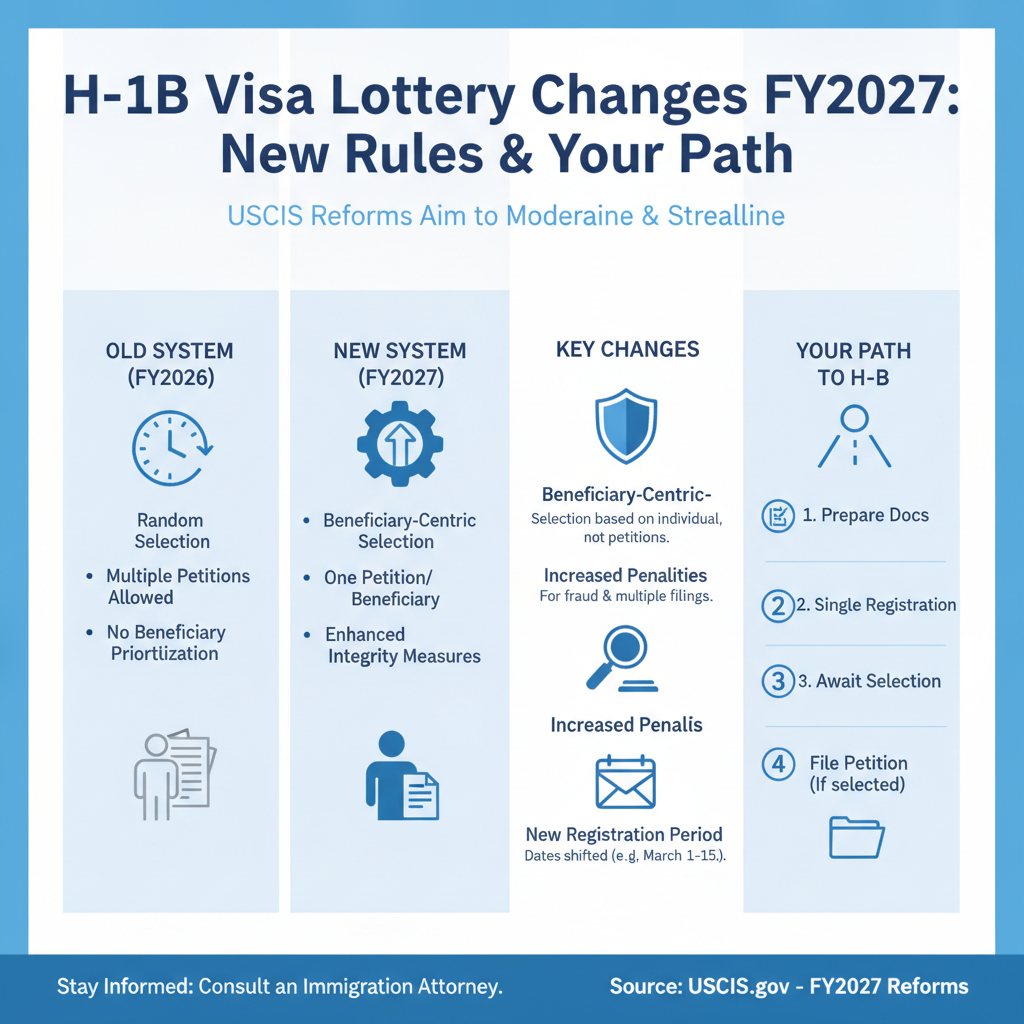
The "H-1B Visa Lottery Changes for FY2027" primarily refer to the implementation of a new beneficiary-centric selection process. Previously, if multiple employers registered the same foreign national, that individual would have multiple entries in the lottery, increasing their statistical chance of being selected. The new rule, finalized and implemented starting with the FY2025 lottery, dictates that each *unique beneficiary* is entered into the lottery only *once*, regardless of how many employers register them. If a beneficiary is selected, USCIS will then notify all employers who registered that individual. This change aims to prevent fraud and ensure that every eligible individual has an equal, fair chance at selection.
Key terms you need to know
- Beneficiary: The foreign national worker who will be employed in the specialty occupation. Under the new rules, the lottery selection is now centered on the beneficiary.
- Petitioner: The U.S. employer who files the H-1B petition on behalf of the beneficiary.
- Cap-Subject H-1B: H-1B petitions that are subject to the annual statutory cap of 85,000 visas. This includes 65,000 for the regular cap and an additional 20,000 for the U.S. master's cap (for those with a U.S. master's degree or higher).
- Cap-Exempt H-1B: Certain organizations are exempt from the annual cap, such as institutions of higher education, non-profit organizations affiliated with higher education, and non-profit research organizations or governmental research organizations.
- H-1B Registration Period: The designated timeframe (usually in March) during which prospective petitioners must electronically register their beneficiaries with USCIS for the lottery. This is distinct from the full petition filing.
- Lottery Selection Process: The computerized random selection process conducted by USCIS when the number of registrations exceeds the annual cap.
- Master's Cap: The additional 20,000 H-1B visas reserved for beneficiaries who have earned a U.S. master's degree or higher. These individuals are first entered into the master's cap lottery; if not selected, they are then entered into the regular cap lottery, effectively giving them two chances.
- Labor Condition Application (LCA): Form ETA-9035/9035E. An attestation by the employer to the Department of Labor regarding wages and working conditions, required before an H-1B petition can be filed with USCIS.
Understanding these terms is vital for anyone involved in the H-1B process, particularly with the new beneficiary-centric approach. This change means that while multiple employers can still register you, your chances of selection are now truly based on your individual eligibility, not on the number of registrations submitted on your behalf. This is a crucial step towards a fairer system.
Current Immigration Law: The Foundation of the H-1B Visa
The H-1B visa program is rooted in the Immigration and Nationality Act (INA), specifically Section 101(a)(15)(H)(i)(b) and Section 214(g) and (i) (8 U.S.C. § 1101(a)(15)(H)(i)(b) and § 1184(g) and (i)). These statutes establish the legal framework for nonimmigrant visas for specialty occupations, defining eligibility criteria, duration of stay, and annual numerical limitations (the "cap"). The regulations governing the program are found in 8 CFR Part 214.2(h).
Federal requirements
To qualify for an H-1B visa, both the employer (petitioner) and the foreign national (beneficiary) must meet specific federal requirements:
For the Employer (Petitioner):
- The employer must offer a job in a "specialty occupation" that requires a theoretical and practical application of a body of highly specialized knowledge and a bachelor's degree or higher in the specific specialty (or its equivalent) as a minimum for entry into the occupation.
- The employer must obtain a certified Labor Condition Application (LCA) (Form ETA-9035/9035E) from the U.S. Department of Labor. This LCA attests that the employer will pay the H-1B employee at least the prevailing wage for the occupation in the area of employment or the actual wage paid to other employees with similar experience and qualifications, whichever is higher. It also attests to acceptable working conditions.
- The employer must have an Employer Identification Number (EIN).
For the Employee (Beneficiary):
- Hold a bachelor's degree or its equivalent, or a higher degree required by the specialty occupation, from an accredited college or university.
- Possess a state license, if required, to practice the occupation.
- Have work experience in the specialty occupation equivalent to a bachelor's degree. USCIS generally considers three years of specialized training or work experience as equivalent to one year of college education.
- The job offered must be in a specialty occupation.
The H-1B cap is set at 65,000 visas annually, with an additional 20,000 visas reserved for those with a U.S. master's degree or higher (the master's cap). The H-1B visa is initially granted for up to three years and can be extended for a total of six years. In certain circumstances, extensions beyond six years are possible, particularly if a green card process has been initiated.
Florida-specific considerations
While there are no Florida-specific immigration laws that directly govern the H-1B visa program (as immigration is federal), the economic landscape and job market in Florida significantly influence H-1B applications. Major metropolitan areas like Orlando, Miami, Tampa, and Jacksonville are home to thriving industries such as:
- Technology: Orlando's "Silicon Swamp" and research parks, the Tampa Bay tech scene.
- Healthcare: Numerous hospitals, research institutions, and specialized clinics across the state.
- Aerospace & Defense: The Space Coast and various defense contractors along the I-4 corridor.
- Tourism & Hospitality: While many roles may not qualify as "specialty occupations," there are IT, management, and marketing roles that do.
- Education: Florida's extensive university system, including the University of Central Florida (UCF) in Orlando, a major producer of international graduates.
Employers in these sectors in Florida frequently sponsor H-1B visas. For beneficiaries, finding an employer in Florida willing to sponsor an H-1B visa often means tapping into these robust industries. The Orlando USCIS Field Office may handle certain follow-up processes for those adjusting status, but the initial H-1B petition processing is handled by USCIS service centers. The prevalence of educational institutions also means a strong pool of potential master's cap beneficiaries in Central Florida and beyond.
It is always essential to work with an attorney who understands both federal immigration law and how it intersects with the realities of the local job market. For comprehensive details, always refer to the USCIS official website.
Considering an H-1B visa in Florida? Don't navigate the new rules alone. Imigrar offers expert legal support for employers and beneficiaries. Contact us at +1 786-791-3106 for a free consultation. Se Habla Español.
How to Navigate the New H-1B Visa Lottery Process: A Complete Step-by-Step Guide
The H-1B visa process, particularly with the new beneficiary-centric lottery, requires meticulous planning and strict adherence to timelines. This guide outlines the key steps for the FY2027 cycle, incorporating the latest changes.
1) Understand the New Beneficiary-Centric Selection Process
What it means: For FY2027 and beyond, USCIS will select registrations based on unique beneficiaries, not on the number of registrations submitted on their behalf. This means each eligible individual has an equal chance, regardless of how many employers register them. If a beneficiary is selected, USCIS will notify all registrants who submitted for that individual. This is a significant anti-fraud measure.
- Action: If you are a beneficiary, inform all potential employers of this change. If you are an employer, understand that submitting multiple registrations for the same beneficiary will not increase their chances, but it is permissible for multiple employers to register the same individual.
- Key Document (for awareness): USCIS policy memos related to the final rule for the H-1B registration process.
2) Employer Pre-Registration and LCA Filing
Before the H-1B registration period even begins, the employer must complete crucial preliminary steps.
- Action: The employer must first determine if the position qualifies as a specialty occupation and confirm the beneficiary's qualifications meet the requirements.
- Action: The employer must then file a Labor Condition Application (LCA), Form ETA-9035/9035E, with the U.S. Department of Labor (DOL). This form attests to the prevailing wage and working conditions. The DOL typically processes LCAs within 7 business days. A certified LCA is a prerequisite for filing the H-1B petition, but not for the initial registration.
- Required Documents (Employer):
- Employer's EIN
- Detailed job description, duties, and required qualifications.
- Information on the prevailing wage for the occupation and geographic area (e.g., Orlando, FL).
- Proof of ability to pay the proffered wage.
- Required Documents (Beneficiary, for employer's reference):
- Copies of academic degrees and transcripts (bachelor's, master's, etc.).
- Foreign degree evaluations (if applicable).
- Resumé/CV.
- Professional licenses (if applicable).
3) H-1B Registration Submission
This is the critical step for entering the lottery.
- Timeline: Typically, the online registration period opens in early March (e.g., March 2026 for FY2027) and lasts for about two to three weeks.
- Action: The prospective petitioner (employer) creates a USCIS online account, pays the non-refundable H-1B registration fee (currently $10 for FY2027, but this fee is subject to increase in future fiscal years), and provides basic information about both the company and the beneficiary.
- Important: Ensure all information is accurate. Errors can lead to disqualification.
- Required Information/Documents for Registration:
- Employer's legal name, address, and EIN.
- Authorized signatory's name, title, and contact information.
- Beneficiary's full legal name, date of birth, country of birth, country of citizenship.
- Beneficiary's passport number.
- Beneficiary's gender.
- Whether the beneficiary has a U.S. master's or higher degree.
- Attorney or representative information (if applicable).
4) Lottery Selection and Notification
After the registration period closes, USCIS conducts the lottery.
- Timeline: Lottery results are usually announced by the end of March or early April (e.g., late March/early April 2026 for FY2027).
- Action: USCIS notifies selected registrants through their online accounts. If selected, the status in the online account will change to "Selected." Non-selected registrations will show "Not Selected" or "Denied."
- Reminder: If selected, all employers who registered that unique beneficiary will be notified. The beneficiary then decides which employer's petition they wish to proceed with.
- Key Document: H-1B Selection Notice (Form I-797C, Notice of Action).
5) Petition Filing (Form I-129)
Only selected registrants can proceed to this step.
- Timeline: Petition filing generally opens on April 1st (e.g., April 1, 2026 for FY2027) and lasts for a specific window, usually 90 days.
- Action: The employer files the full H-1B petition (Form I-129, Petition for a Nonimmigrant Worker) with USCIS. This is a comprehensive package requiring substantial documentation.
- Warning: The petition must be filed within the designated filing window and must be based on the exact registration that was selected.
- Required Documents (Employer):
- Certified LCA (Form ETA-9035/9035E).
- Letter of support/employer's letter.
- Evidence of the employer's ability to pay the proffered wage.
- Company financial statements, tax returns.
- Office lease agreements, business licenses.
- Organizational charts.
- Required Documents (Beneficiary):
- Copies of all academic degrees, diplomas, and transcripts.
- Foreign degree evaluations from a USCIS-recognized service (if applicable).
- Proof of professional licenses (if applicable).
- Detailed resumé/CV.
- Copies of passport, visa, and I-94 records.
- Prior employment letters/experience certificates.
- Any other supporting evidence of qualifications for the specialty occupation.
6) USCIS Processing and Adjudication
After filing, USCIS reviews the petition.
- Timeline: Processing times vary significantly depending on the USCIS service center and current caseload. You can check USCIS Processing Times online.
- Action: USCIS may issue a Request for Evidence (RFE) if they need more information or clarification. Responding to an RFE promptly and thoroughly is critical.
- Optional: Employers can opt for Premium Processing (Form I-907) for an additional fee, guaranteeing a decision within 15 calendar days.
- Outcome: If approved, USCIS issues an Approval Notice (Form I-797A or I-797B). If denied, a denial notice is issued.
7) Visa Interview (Consular Processing) or Change of Status (Adjustment of Status)
The final step depends on the beneficiary's location.
- Consular Processing (for those outside the U.S.):
- Upon H-1B approval, the beneficiary attends an interview at a U.S. embassy or consulate in their home country.
- Required Documents: Valid passport, visa interview appointment confirmation, Form DS-160 confirmation page, H-1B Approval Notice (Form I-797B), photos, and supporting documents similar to those submitted with the I-129.
- Upon successful interview, the H-1B visa stamp is placed in the passport, allowing entry to the U.S.
- Change of Status (for those already in the U.S.):
- If the beneficiary is already in the U.S. in a valid nonimmigrant status (e.g., F-1 OPT, L-1, H-4), and the I-129 petition requested a change of status, the H-1B approval notice (Form I-797A) will include a new I-94 indicating H-1B status.
- The new H-1B status typically becomes effective on October 1st of the fiscal year.
- Important: Maintain lawful status until October 1st.

Practical Steps You Can Take Today for Your H-1B Journey
Preparing for the H-1B lottery requires foresight and meticulous organization. Even with the new beneficiary-centric selection, proactive steps can significantly enhance your chances and streamline the process.
Actionable Checklist:
- Review Your Qualifications: Ensure your degree and work experience align perfectly with a "specialty occupation." If you have a foreign degree, consider obtaining a U.S. equivalency evaluation well in advance.
- Identify Potential Employers: Start networking and applying to companies in Orlando, Central Florida, and nationwide that are known to sponsor H-1B visas. The earlier you secure a job offer, the more time your employer has to prepare.
- Gather Personal Documents: Collect certified copies of your academic transcripts, diplomas, passport, birth certificate, and any previous visa documents (I-20, DS-2019, I-797 notices).
- Update Your Resume/CV: Tailor it to highlight skills and experiences relevant to specialty occupations. Be ready to provide detailed employment verification letters.
- Understand the New Rules: Familiarize yourself with the beneficiary-centric selection process. If multiple employers want to register you, ensure they understand that only one entry per beneficiary is counted in the lottery.
- Consult an Immigration Attorney: This is perhaps the most crucial step. An expert attorney, like those at Imigrar, can assess your eligibility, advise your potential employer, ensure compliance, and manage the entire application process.
Document Preparation Guidance:
- Academic Credentials: Ensure you have official transcripts and degree certificates. If your degree is from outside the U.S., get a professional educational evaluation from a NACES-approved organization.
- Passport & Visa History: Provide clear copies of your current passport, all previous U.S. visas, and I-94 admission records.


