


Navigating the complex landscape of U.S. immigration law can be challenging, especially when significant changes are introduced. For skilled foreign workers and the U.S. employers who rely on their talent, few immigration processes are as critical and competitive as the H-1B visa lottery. As we approach the registration period for Fiscal Year 2027 (FY2027), a pivotal shift in how the H-1B lottery operates is set to redefine the path for many aspiring professionals.
At Imigrar, an immigration law firm based in Orlando, Florida, we understand the profound impact these changes can have on individuals and families striving to build a life in the United States. Our mission is to "Keep Families Together," and that includes ensuring that talented individuals have every opportunity to pursue their professional goals here. This comprehensive guide is designed to break down the new H-1B visa lottery rules for FY2027, offering clarity, practical advice, and actionable steps for immigrants, employers, and their families in Orlando, Central Florida, and nationwide.
Feeling overwhelmed by the H-1B changes? Don't navigate the new rules alone. Our experienced Orlando immigration team at Imigrar is here to help you understand your options and prepare a strong case. Call +1 786-791-3106 for a free consultation, or message us online. Se Habla Español.
NEWS SOURCE REFERENCE SECTION
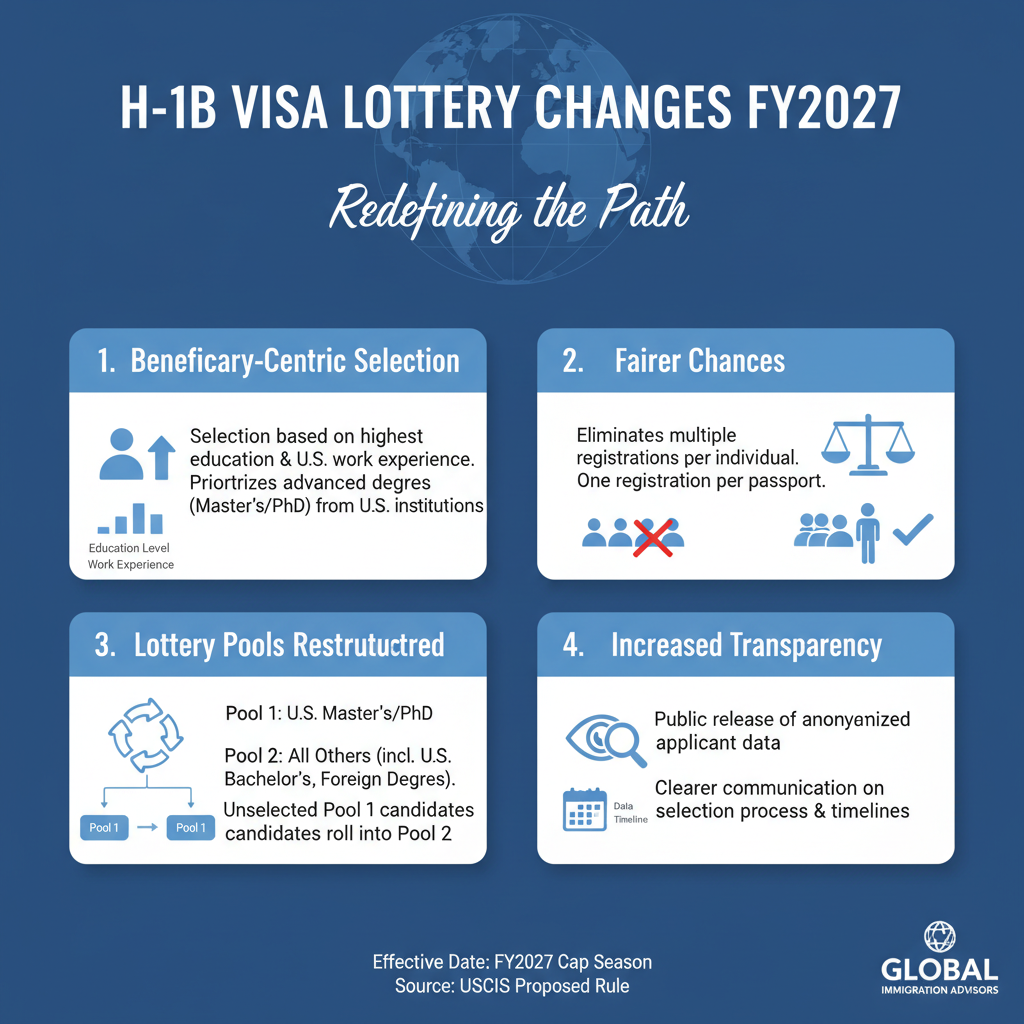
The reporting that sparked this guide: H-1B Visa Lottery Changes for FY2027 (Legal News)
What This News Means for Immigrants in Orlando and Across Florida
The H-1B visa program is a cornerstone for U.S. companies seeking to employ foreign workers in specialty occupations, especially in fields like technology, engineering, medicine, and research. Given the annual cap on these visas, demand consistently outstrips supply, necessitating a lottery system to select eligible petitions. The changes for FY2027 are perhaps the most significant in recent memory, aiming to enhance fairness and reduce fraud.
Why this news is showing up now
The U.S. Citizenship and Immigration Services (USCIS) announced these new rules as part of a final rule titled "H-1B Modernization Rule." While the H-1B cap for FY2026 has already passed, these regulations are specifically designed to be in effect for the upcoming H-1B cap registration period for FY2027, which typically occurs in March 2026. USCIS has been working to update the H-1B program to address issues like multiple registrations for the same beneficiary by different employers, which has historically skewed lottery odds and undermined the integrity of the process. The new rules aim to make the lottery more equitable and efficient, ensuring that each unique beneficiary has an equal chance.
How it can affect Florida residents
Florida, particularly the Orlando metropolitan area and the I-4 corridor, is a hub for growing industries such as technology, aerospace, healthcare, and tourism. Companies in these sectors, from startups to major corporations, frequently rely on H-1B visas to fill specialized roles where domestic talent may be scarce. Universities like the University of Central Florida (UCF), the University of Florida, and Florida International University also attract a significant number of international students who, upon graduation, often seek H-1B sponsorship to remain in the U.S. and contribute to the local economy.
For Florida residents, these changes mean:
- For H-1B Beneficiaries: If you are an international student graduating from a Florida university or a foreign professional working in Orlando on an OPT/STEM OPT, the new "beneficiary-centric" lottery system offers a more level playing field. Instead of multiple employers registering you, increasing your chances unnaturally, each unique beneficiary now gets one entry, regardless of how many employers register on their behalf. This could mean a more genuine chance for selection, but also emphasizes the need for a strong, legitimate job offer.
- For Florida Employers: Companies in Orlando and across Florida sponsoring H-1B workers must adapt their registration strategies. The focus shifts from quantity of registrations to the quality and legitimacy of each job offer. Employers must ensure their registrations are accurate and genuinely reflect an intent to employ the specific beneficiary for a specialty occupation. This change aims to curb fraudulent practices where employers would submit numerous registrations for the same individual without a true job offer, which has been a concern for the Orlando USCIS Field Office and other regional offices.
- Reduced Fraud: The new rules are expected to significantly reduce instances of fraud and abuse in the H-1B lottery system. This benefits legitimate employers and deserving beneficiaries by making the process fairer for all.
What H-1B Visa Lottery Changes for FY2027 Is (and Why It Matters)
The H-1B visa program allows U.S. employers to temporarily employ foreign workers in specialty occupations that require theoretical or technical expertise in specialized fields. These positions often require a bachelor's degree or higher in a specific discipline. The program is vital for maintaining the competitiveness of U.S. industries and attracting top global talent.
A plain-English definition
Imagine a highly competitive job market where there are far more qualified applicants than available positions. To decide who gets a chance, the employer uses a lottery. That's essentially the H-1B visa lottery. The "changes for FY2027" mean that instead of allowing multiple entries for the same person (if different companies sponsored them), USCIS will now identify each unique person (the "beneficiary") and give them only ONE chance in the lottery, no matter how many companies register for them. If that person is selected, then any company that registered for them can proceed with filing the full H-1B petition. This is called a "beneficiary-centric" selection process. It's designed to make the lottery fairer and reduce the advantage gained by individuals who had many employers register for them.
Key terms you need to know
- H-1B Visa: A nonimmigrant visa that allows U.S. employers to temporarily employ foreign workers in specialty occupations.
- Specialty Occupation: An occupation that requires a theoretical and practical application of a body of highly specialized knowledge, and a bachelor's or higher degree in the specific specialty (or its equivalent) as a minimum for entry into the occupation in the United States.
- H-1B Cap: The annual numerical limit on the number of H-1B visas issued. The current annual regular cap is 65,000, with an additional 20,000 visas reserved for those with a U.S. master's degree or higher (the "master's cap").
- Cap-Subject: Refers to petitions that are subject to the annual H-1B cap. Certain organizations, such as non-profit research organizations, government research organizations, and institutions of higher education, are cap-exempt.
- Beneficiary: The foreign national (the employee) for whom the H-1B petition is filed.
- Petitioner: The U.S. employer filing the H-1B petition on behalf of the beneficiary.
- H-1B Registration: The electronic process where prospective petitioners (employers) submit basic information about the company and the beneficiary to USCIS during a designated period. This is the first step before the lottery.
- Lottery Selection Process: If the number of registrations exceeds the annual cap, USCIS conducts a random selection process to determine which beneficiaries are eligible to have an H-1B petition filed on their behalf.
- Registration Period: The specific timeframe, typically in March, during which employers must submit H-1B registrations. For FY2027, this is expected in March 2026.
- DHS (Department of Homeland Security): The federal department that oversees USCIS and U.S. immigration policy.
- USCIS (U.S. Citizenship and Immigration Services): The government agency responsible for processing immigration benefits, including H-1B visas. USCIS official website.
- LCA (Labor Condition Application): Form ETA-9035, certified by the Department of Labor, which attests that the employer will pay the H-1B worker at least the prevailing wage for the occupation in the area of employment and will provide working conditions that will not adversely affect other workers. This is a prerequisite for filing the H-1B petition.
- Prevailing Wage: The average wage paid to similarly employed workers in a specific occupation in the geographic area of intended employment.
- Master's Cap: The additional 20,000 H-1B visas reserved for beneficiaries who have earned a U.S. master's or higher degree. These individuals are first selected under the master's cap; if not selected, they are then entered into the regular cap lottery.
- Duplicate Registrations: Under the new rules, these are multiple registrations submitted by different employers for the same unique beneficiary. While employers can still submit registrations for the same beneficiary, the lottery will only consider one entry per unique beneficiary.
Current Immigration Law: The Foundation
The H-1B visa program is authorized under the Immigration and Nationality Act (INA), specifically Section 101(a)(15)(H)(i)(b) and Section 214(g). The regulations governing the H-1B program are found in Title 8 of the Code of Federal Regulations (8 CFR), particularly 8 CFR 214.2(h).
These laws establish the framework for specialty occupations, employer responsibilities, and the numerical limitations (caps) that necessitate the lottery system. The recent changes for FY2027 are implemented through regulatory amendments to these existing laws, rather than entirely new legislation, demonstrating USCIS's authority to modify the operational aspects of the H-1B program to enhance its integrity and efficiency.
Federal requirements
To qualify for an H-1B visa, both the beneficiary and the petitioner must meet specific federal criteria:
- For the Beneficiary:
- Hold a bachelor's degree or its equivalent, or a license in a specialty occupation field, or work experience equivalent to a bachelor's degree.
- Be offered a job in a specialty occupation.
- Possess the qualifications required for the specialty occupation.
- For the Petitioner (Employer):
- Offer a job in a specialty occupation that requires a theoretical and practical application of a body of highly specialized knowledge.
- Pay the H-1B employee at least the prevailing wage or the actual wage paid to other employees with similar experience and qualifications, whichever is higher. This is verified through the certified LCA (Form ETA-9035).
- Have an employer-employee relationship with the beneficiary.
- Provide working conditions that will not adversely affect other workers.
The primary form for an H-1B petition is Form I-129, Petition for a Nonimmigrant Worker. This form is filed by the U.S. employer on behalf of the foreign national. If an employer wishes to expedite processing, they can file Form I-907, Request for Premium Processing Service, which guarantees a 15-calendar day processing time for an additional fee.
Florida-specific considerations
While H-1B laws are federal, their impact is felt keenly at the local level. Florida's burgeoning tech industry, particularly in Orlando, Tampa, and Miami, creates a high demand for skilled H-1B workers. The state's universities produce a large pool of international graduates eligible for the H-1B program. The new lottery changes will directly affect these individuals and the employers who sponsor them.
For employers in Central Florida, understanding the new rules is paramount to avoid delays or denials. The Orlando USCIS Field Office, while not directly processing H-1B petitions (which are handled by service centers), is part of the broader ecosystem that monitors immigration compliance in the region. Employers must ensure their internal processes for H-1B sponsorship align with the updated regulations, particularly concerning the registration phase and the prevention of any perceived circumvention of the new beneficiary-centric selection.
Reminder: While the lottery process is federal, local economic conditions and employer needs significantly influence the types of H-1B petitions filed from Florida. Consulting with an immigration attorney familiar with both federal law and local market dynamics is crucial.
Navigating the H-1B changes requires expert guidance. Imigrar's team, serving Orlando and clients nationwide, is fluent in both English and Spanish, ensuring clear communication. Reach out today for a free consultation: +1 786-791-3106. Contact us online.
How to Navigate the New H-1B Visa Lottery Rules: A Complete Step-by-Step Guide
The process of obtaining an H-1B visa is multi-faceted, and the new rules for FY2027 primarily impact the initial registration and selection phase. Here’s a detailed guide to help beneficiaries and employers understand the steps involved under the updated system.
1) Understand the New Beneficiary-Centric Lottery System
This is the most critical change. Previously, each employer could register a beneficiary, and if multiple employers registered the same person, that person effectively had multiple entries in the lottery. Now, the lottery selection will be based on each unique beneficiary. USCIS will use passport or travel document information to identify each unique individual. If a beneficiary is registered by multiple employers, they still only get one "ticket" in the lottery. If their unique entry is selected, then any of the employers who registered for them can proceed with filing the H-1B petition.
- Required Documents for Beneficiary Identification:
- Valid passport (most common) or other official travel document from the beneficiary.
- Information about the beneficiary's date of birth, country of birth, country of citizenship.
Important: This change aims to prevent fraud and ensure fairness. Beneficiaries should communicate clearly with all potential employers to ensure accurate and consistent information is used for registration. Any attempt to circumvent this rule could lead to denial or even legal repercussions.
2) Employer Registration with USCIS (H-1B Registration Period)
The first official step for an employer is to electronically register their intent to file an H-1B petition for a specific beneficiary during the designated H-1B cap registration period. This period typically opens in early March and lasts for several weeks. For FY2027, expect this to be in March 2026. Each registration requires a fee of $10 (though this fee is subject to increase in the future, it was $10 for FY2026). USCIS requires specific information about both the prospective employer and the beneficiary.
- Required Information/Documents for Registration:
- Employer's legal name, EIN (Employer Identification Number), and mailing address.
- Employer's authorized signatory information.
- Beneficiary's full legal name, date of birth, country of birth, country of citizenship, passport number (or other valid travel document number), and gender.
- Beneficiary's highest degree attained and the name of the U.S. institution that awarded the degree (if applicable, for master's cap eligibility).
- Employer's attorney or representative information (if applicable).
- A certified LCA (Form ETA-9035) is NOT required at the registration stage but is crucial for the subsequent petition filing.
Warning: The new rules explicitly state that if USCIS finds that the same beneficiary has been submitted multiple times by the same registrant, or if a registrant submitted a registration based on a false attestation, USCIS may deny or revoke the petition. This emphasizes the importance of accurate and truthful submissions.
3) Lottery Selection and Notification
Once the registration period closes, USCIS conducts the lottery. Under the new system, once a unique beneficiary is selected, USCIS will notify *all* registrants who submitted a registration for that selected beneficiary. This means if three employers registered for Jane Doe, and Jane Doe is selected, all three employers will be notified of her selection. Only one of these employers can then proceed to file the H-1B petition on her behalf. USCIS then sends selection notices to the selected registrations through the online account.
- Timeline Expectation: Selection notifications are typically issued by the end of March for the registration period that occurred earlier that month. For FY2027, expect notifications around late March 2026.
4) Petition Filing (Form I-129)
Only if a beneficiary's registration is selected can a petitioner (employer) proceed to file the full H-1B petition. This involves submitting Form I-129, Petition for a Nonimmigrant Worker, along with extensive supporting documentation, to USCIS. The filing period for selected petitions usually begins on April 1st of the fiscal year for which the visas are being sought (e.g., April 1, 2026, for FY2027) and typically lasts for 90 days. The petition must be filed by the employer whose registration was selected or by another employer who also registered for the selected beneficiary and received a selection notification.
- Required Documents for Form I-129 Filing:
- Certified LCA (Form ETA-9035) for the specific position and location.
- Employer's letter of support outlining the job duties, specialty occupation nature, and beneficiary's qualifications.
- Copies of beneficiary's educational degrees, transcripts, and evaluations of foreign degrees.
- Copies of beneficiary's professional licenses, certifications, and resume.
- Copies of beneficiary's passport, visa, I-94 record, and previous U.S. immigration documents (e.g., EAD for OPT).
- Company financial documents, business license, tax returns, and organizational charts to demonstrate ability to pay and legitimate business operations.
- Detailed job description, including duties, responsibilities, and required qualifications.
- Evidence of employer-employee relationship (e.g., employment contract).
- Photographs (passport-style) of the beneficiary.
- Any other evidence proving the specialty occupation nature of the job and the beneficiary's qualifications.
Important: The petition must be filed accurately and comprehensively. Any discrepancies between the registration information and the petition, or insufficient documentation, can lead to Requests for Evidence (RFEs) or denials. For Central Florida residents, ensuring all documentation is ready is key as the filing window is tight.
5) Premium Processing (Optional, Form I-907)
Employers can elect to pay an additional fee to have their Form I-129 petition processed under Premium Processing Service, using Form I-907, Request for Premium Processing Service. This guarantees USCIS will take action on the petition (approval, denial, RFE, or Notice of Intent to Deny) within 15 calendar days. The fee for this service is substantial (e.g., $2,805 as of early 2024, subject to change) and is typically paid by the employer.
- Required Documents for Form I-907:
- Completed Form I-907.
- Payment for the premium processing fee.
Reminder: Premium processing only expedites USCIS's review of the petition; it does not guarantee approval. It may not be available immediately at the start of the filing period, as USCIS sometimes pauses this service due to high volume.
6) Responding to RFEs and Approval
USCIS may issue a Request for Evidence (RFE) if they require additional information or clarification to make a decision on the petition. Responding to an RFE correctly and thoroughly within the given deadline (usually 60 to 90 days) is critical. If the petition is approved, USCIS will send an approval notice (Form I-797, Notice of Action).
- Required Documents for RFE Response:
- All documents specifically requested by USCIS.
- A cover letter addressing each point of the RFE.
- Any additional supporting evidence to strengthen the case.
7) Visa Interview or Adjustment of Status
Once the H-1B petition is approved, the beneficiary's next steps depend on their current immigration status and location:
- If the Beneficiary is Outside the U.S.: They will need to attend a visa interview at a U.S. Embassy or Consulate in their home country to obtain the H-1B visa stamp. This typically involves submitting DS-160 (Online Nonimmigrant Visa Application) and attending an interview.
- If the Beneficiary is Already in the U.S. (e.g., on OPT/F-1 status): If the petition included a request for a change of status (COS), and it was approved, the beneficiary's status automatically changes to H-1B on October 1st of the fiscal year (e.g., October 1, 2026, for FY2027). No further action is usually needed for the change of status itself, but they will receive a new I-94 record.
- Required Documents for Visa Interview (if applicable):
- Valid passport.
- DS-160 confirmation page.
- Appointment confirmation page.
- H-1B approval notice (Form I-797).
- LCA (Form ETA-9035).
- Employer's letter of support.
- Beneficiary's educational and professional documents.
- Evidence of ties to home country.

Practical Steps You Can Take Today
Preparing for the H-1B lottery, especially with new rules, requires proactive planning. Whether you're an employer in Orange County or a beneficiary in Orlando, these steps can help you prepare.
Actionable Checklist:
- Educate Yourself and Your Team: Ensure all stakeholders (HR, hiring managers, potential beneficiaries) fully understand the new beneficiary-centric selection process.
- Identify Potential Beneficiaries: For employers, identify candidates who will require H-1B sponsorship well in advance of the March 2026 registration period.
- Gather Beneficiary Information: Collect accurate and consistent beneficiary data, especially passport details, for all potential registrants. Emphasize consistency across all potential employer registrations for the same individual.
- Secure Legitimate Job Offers: Beneficiaries should focus on obtaining genuine, specialty occupation job offers from reputable employers. Employers should ensure their job offers meet H-1B requirements.
- Consult an Experienced Immigration Attorney: This is perhaps the most crucial step. An attorney can help navigate the complexities, ensure compliance with new rules, and prepare a robust petition.
- Prepare Documentation Proactively: Start gathering all necessary educational, professional, and personal documents now.
- Develop a Contingency Plan: What if the lottery isn't selected? Explore alternative visa options (e.g., O-1, L-1, E-3, F-1 OPT extension, or even pursuing residency through other avenues).
Document Preparation Guidance:
Start compiling a comprehensive file for each potential H-1B candidate, including:
- Personal Documents: High-quality copies of passports, birth certificates, marriage certificates (if applicable), previous U.S. visas, I-94 records, EAD cards, and I-20s (for F-1 students).
- Educational Documents: All academic degrees, diplomas, official transcripts, and foreign degree evaluations (if applicable). Ensure these are translated if not in English.
- Professional Documents: Detailed resume/CV, letters of recommendation, professional licenses, certifications, and any awards or publications.
- Employer-Specific Documents (for employers): Company brochures, financial statements, tax returns, office lease agreements, organizational charts, and detailed job descriptions for the H-1B position.
Timeline Expectations:
- Early 2026 (Jan-Feb): Finalize potential beneficiaries and job offers. Begin preparing necessary documentation and attorney engagement.
- March 2026: H-1B Cap Registration Period for FY2027. Employers submit electronic registrations.
- Late March 2026: USCIS conducts the lottery and announces selection results.
- April 1, 2026 – June 30, 2026 (approx.): Filing period for selected H-1B petitions. Employers must submit Form I-129 and supporting documents.
- April 2026 – September 2026: USCIS processes petitions. RFEs may be issued during this time.
- October 1, 2026: Start date for approved H-1B petitions (if a change of status was approved). Beneficiaries can begin working under H-1B status.
Important: These dates are estimates based on previous years and USCIS announcements. Always check the USCIS official website for the most current and precise deadlines. You can also monitor
You may also be interested in: Stay informed on DACA updates for 2026. This guide offers Orlando & Florida Dreamers critical renewal information, eligibility, forms, and expert tips... Stay informed on the latest TPS extensions. This comprehensive guide from Imigrar helps immigrants in Orlando and Florida understand eligibility, re-r... Facing your Green Card interview in Orlando or nationwide? Imigrar's expert guide provides crucial tips, documents, and legal insights to help you pre... Navigate the family-based immigration process with Imigrar's expert guide. Learn eligibility, steps, documents, and how to keep your family together i...Related Articles


