


The reporting that sparked this guide: H-1B Visa Lottery Changes for FY2027 (Legal News)
What This News Means for Immigrants in Orlando and Across Florida
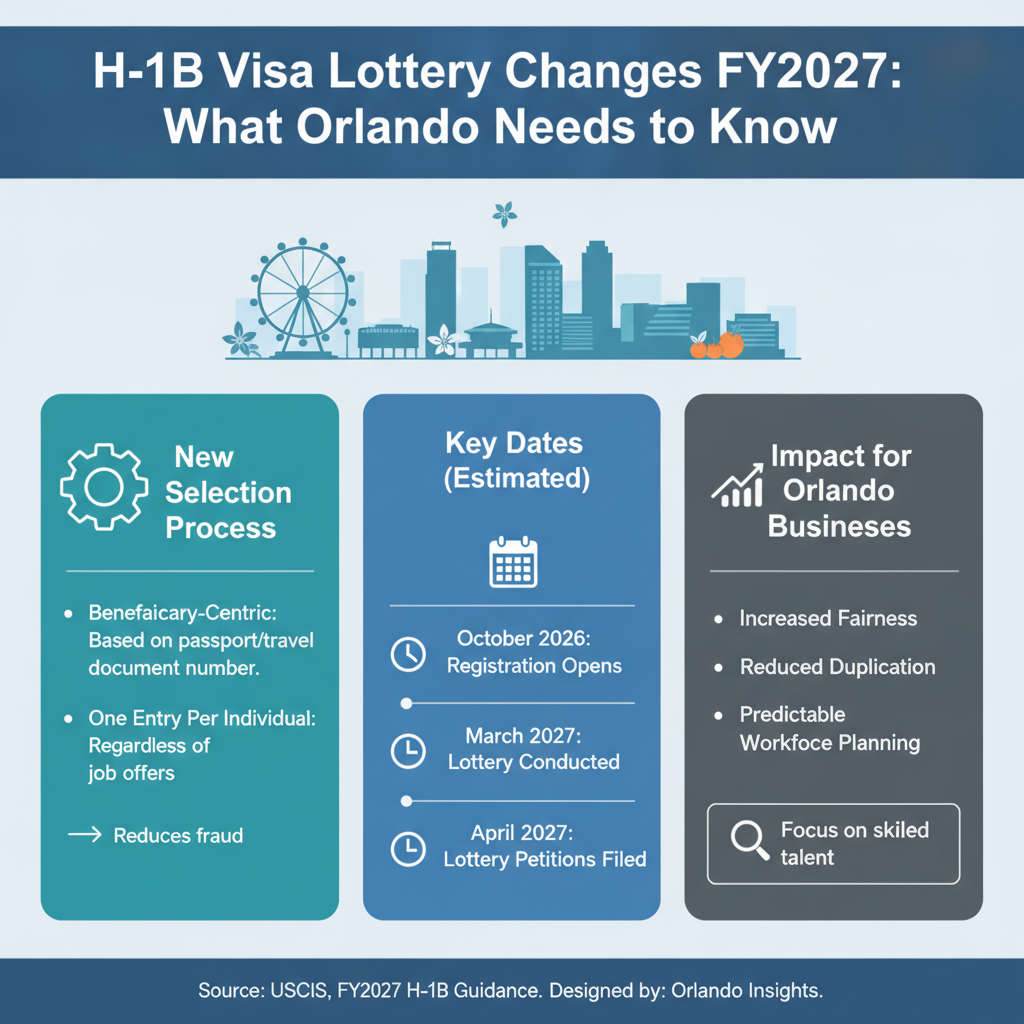
The landscape of U.S. immigration law is constantly evolving, and few changes impact skilled workers and their employers as significantly as those affecting the **H-1B visa** program. As we look towards the **Fiscal Year 2027 (FY2027)** H-1B lottery, the U.S. Citizenship and Immigration Services (**USCIS**) has announced crucial modifications that aim to enhance the integrity of the registration process and ensure fairness for all applicants. For immigrants and businesses in Orlando, Central Florida, and across the nation, understanding these changes is not just important – it's critical for successful planning.
Why this news is showing up now
Immigration news, especially concerning popular visa categories like the **H-1B**, tends to surface and trend well in advance of the actual application periods. This proactive communication from **USCIS** and the Department of Homeland Security (**DHS**) is designed to give stakeholders – employers, beneficiaries, and legal representatives – ample time to understand new rules, adjust their strategies, and prepare thoroughly. The H-1B lottery registration for **FY2027** is anticipated to open in March 2026, with petitions filed for selected registrants starting April 1, 2026, for an October 1, 2026, start date. The changes for **FY2027** are a direct response to concerns about fraud and gaming of the system, where some entities would submit multiple registrations for the same individual through related companies, artificially inflating the individual's chances of selection. The new rules, particularly the shift to a "beneficiary-centric" selection process, are part of a broader effort by **USCIS** to strengthen the integrity of the H-1B program and ensure that every legitimate applicant has an equitable opportunity.
How it can affect Florida residents
Florida, particularly the bustling I-4 corridor encompassing Orlando, Tampa, and Daytona Beach, is a hub for innovation, technology, healthcare, and tourism. These industries heavily rely on the talent brought in through the **H-1B visa** program. Companies in Orlando's burgeoning tech sector, healthcare providers, and even major theme park operators frequently sponsor foreign professionals for specialty occupations. The **FY2027** H-1B lottery changes will have several key effects on Florida residents:
- For Prospective H-1B Beneficiaries in Florida: If you are an international student graduating from a Florida university (like UCF or UF) or a professional already working in Florida on another visa (e.g., OPT, L-1, TN) and seeking an H-1B, the new rules mean a fairer playing field. Your chance of selection will no longer be diluted by fraudulent multiple entries for others. However, it also means you must ensure your passport or travel document information is impeccable and unique across all registrations, even if multiple employers legitimately register you.
- For Florida Employers: Businesses across Central Florida, from startups in Orlando's tech parks to established corporations in Orange County, must adapt their H-1B sponsorship strategies. They need to understand the beneficiary-centric approach to avoid potential issues with **USCIS** and ensure compliance. While they can still register multiple beneficiaries, and a beneficiary can still have multiple legitimate employers register them, the selection mechanism has fundamentally changed.
- Reduced Fraud and Increased Integrity: The changes are designed to reduce the "noise" of fraudulent or duplicative registrations, potentially leading to more accurate lottery statistics and a more transparent process for everyone involved in Florida's competitive job market.
At Imigrar, we are closely monitoring these developments to provide the most accurate and up-to-date guidance to our clients in Orlando and throughout Florida. Our goal is to ensure that both employers and beneficiaries navigate these changes successfully.
Need Help Navigating the H-1B Lottery Changes? Our Orlando immigration team is ready to assist. Call +1 786-791-3106 for a free consultation, or message us online. Se Habla Español.
What H-1B Visa Lottery Changes for FY2027 Is (and Why It Matters)
A plain-English definition
The **H-1B visa** is a nonimmigrant visa that allows U.S. employers to temporarily employ foreign workers in specialty occupations. These occupations generally require a bachelor's degree or higher in a specific field, such as IT, engineering, medicine, education, or business. Due to high demand, **USCIS** conducts an annual lottery to select petitions for the limited number of available **H-1B visas** each fiscal year. The statutory annual cap for H-1B visas is 65,000, with an additional 20,000 visas reserved for those holding a U.S. master's degree or higher (the "master's cap").
The "H-1B Visa Lottery Changes for **FY2027**" refers to the new rules implemented by **USCIS** specifically for the registration process leading up to the **FY2027** H-1B cap. The most significant change is the shift to a **beneficiary-centric selection process**. Previously, if multiple employers registered the same foreign national, each registration counted as a separate entry in the lottery, effectively giving that individual a higher chance of being selected. Under the **FY2027** rules, selection will be based on each unique **beneficiary**, identified by their passport or travel document. This means that regardless of how many employers register a single individual, that individual will only have one chance in the lottery. If selected, **USCIS** will notify all employers who registered that specific **beneficiary**, who can then choose which employer's petition to proceed with. This change is designed to create a fairer and more equitable lottery, reducing the incentive for fraudulent multiple registrations.
Key terms you need to know
Navigating the H-1B process requires understanding specific terminology. Here are the essential terms for the **FY2027** changes:
- H-1B Visa: A nonimmigrant visa that allows U.S. employers to temporarily employ foreign workers in specialty occupations.
- USCIS (U.S. Citizenship and Immigration Services): The government agency responsible for administering immigration and naturalization benefits. USCIS official website
- DHS (Department of Homeland Security): The federal department that oversees **USCIS** and other agencies related to homeland security.
- Beneficiary: The foreign national (individual) who is seeking the **H-1B visa**.
- Petitioner: The U.S. employer sponsoring the **beneficiary** for the **H-1B visa**.
- Specialty Occupation: An occupation that requires theoretical and practical application of a body of highly specialized knowledge and a bachelor's or higher degree in the specific specialty (or its equivalent) as a minimum for entry into the occupation in the United States.
- Annual Cap: The statutory limit on the number of **H-1B visas** issued each **Fiscal Year**. Currently, it's 65,000 for the regular cap and an additional 20,000 for the U.S. master's degree cap.
- H-1B Cap-Subject Petition: A petition filed for an **H-1B visa** that is subject to the annual cap.
- Cap-Exempt: Certain employers or positions that are not subject to the annual **H-1B cap**, such as institutions of higher education, non-profit organizations affiliated with higher education, or government research organizations.
- Registration Period: The designated window (typically in March) during which employers submit electronic registrations for the **H-1B lottery**.
- Selection Process: The lottery conducted by **USCIS** when the number of registrations exceeds the annual cap.
- Beneficiary-Centric Selection: The new **FY2027** process where the lottery selection is based on unique **beneficiaries** rather than individual registrations. Each **beneficiary** is entered once, regardless of how many employers register them.
- Legitimate Job Offer: A genuine, bona fide offer of employment from a U.S. employer to the **beneficiary** for a specialty occupation position.
- Fiscal Year (FY): The U.S. government's accounting year, which runs from October 1 to September 30. **FY2027** begins on **October 1, 2026**.
- LCA (Labor Condition Application): **Form ETA-9035**, filed with the Department of Labor, confirming that the employer will pay the **H-1B** worker the prevailing wage or actual wage, whichever is higher, and will provide working conditions that will not adversely affect other workers. An approved LCA is required before filing an **H-1B petition**.
These changes matter immensely because they aim to level the playing field. By focusing on the unique individual, **USCIS** hopes to prevent fraudulent schemes and ensure that the H-1B program serves its intended purpose: bringing highly skilled foreign professionals to fill critical labor needs in the U.S. economy, including in places like Orlando and across Florida.
Current Immigration Law: The Foundation
The **H-1B visa** program is rooted in the Immigration and Nationality Act (**INA**), specifically Section 101(a)(15)(H)(i)(b), which defines the nonimmigrant classification for individuals coming temporarily to the United States to perform services in a specialty occupation. The regulations governing the H-1B program are found in 8 CFR Part 214.2(h).
Federal requirements
To qualify for an **H-1B visa**, both the employer (petitioner) and the foreign worker (beneficiary) must meet specific federal requirements:
- For the Beneficiary:
- Hold a bachelor's degree or its equivalent, or a higher degree required by the specialty occupation, from an accredited college or university.
- Possess a state license, if required for the occupation, or have specialized training, or have work experience equivalent to a bachelor's degree.
- Be engaged in a "specialty occupation" as defined by **USCIS**.
- For the Petitioner (Employer):
- Offer a job in a "specialty occupation."
- Pay the **H-1B** worker at least the prevailing wage for the occupation in the area of employment, or the actual wage paid to other employees with similar experience and qualifications, whichever is higher. This is attested to in the **Labor Condition Application (LCA)**.
- Have an approved **LCA** from the Department of Labor before filing the **H-1B petition**.
- Establish a valid employer-employee relationship with the **beneficiary**.
The annual cap for **H-1B visas** is 85,000 (65,000 regular cap + 20,000 U.S. master's cap). When the number of registrations exceeds this cap, **USCIS** conducts a lottery. The key form used for filing an **H-1B petition** after selection is Form I-129, Petition for a Nonimmigrant Worker. Employers may also opt for expedited processing by filing Form I-907, Request for Premium Processing.
For detailed information on all forms and requirements, always refer to the USCIS official website.
Florida-specific considerations
While the **H-1B visa** program is a federal initiative, its impact is felt keenly at the state and local levels. Florida, particularly its major metropolitan areas like Orlando, benefits significantly from the program. There are no Florida-specific immigration laws that directly govern the **H-1B visa**, as it falls under federal jurisdiction. However, employers in Florida must still adhere to all federal and state labor laws, which are indirectly linked to the H-1B process through the **LCA** requirements. For instance, the Department of Labor (DOL) wage determinations for prevailing wages are locality-specific, meaning the required wage for an H-1B worker in Orlando, Florida, will reflect the local market conditions.
The Orlando **USCIS Field Office**, located at 5449 South Semoran Boulevard, primarily handles interviews for family-based petitions, adjustment of status, and naturalization applications. H-1B petitions themselves are processed at designated **USCIS** Service Centers (currently California and Vermont Service Centers), not directly at local field offices. However, if an H-1B worker residing in Orlando needs to interact with **USCIS** for other immigration matters (e.g., green card application after H-1B), the Orlando Field Office would be their point of contact. For Central Florida residents, understanding this distinction is important for managing their immigration journey.
Concerned About H-1B Compliance? Imigrar's experienced attorneys help Orlando employers and workers navigate complex immigration regulations. Call +1 786-791-3106 for a free consultation. Se Habla Español.
How to Navigate the H-1B Visa Lottery Changes for FY2027: A Complete Step-by-Step Guide
The **FY2027** H-1B lottery introduces a fundamental shift in how selections are made. This guide outlines the updated process, emphasizing the new beneficiary-centric approach.


