The reporting that sparked this guide: H-1B Visa Lottery Changes for FY2027 (Legal News)
What This News Means for Immigrants in Orlando and Across Florida
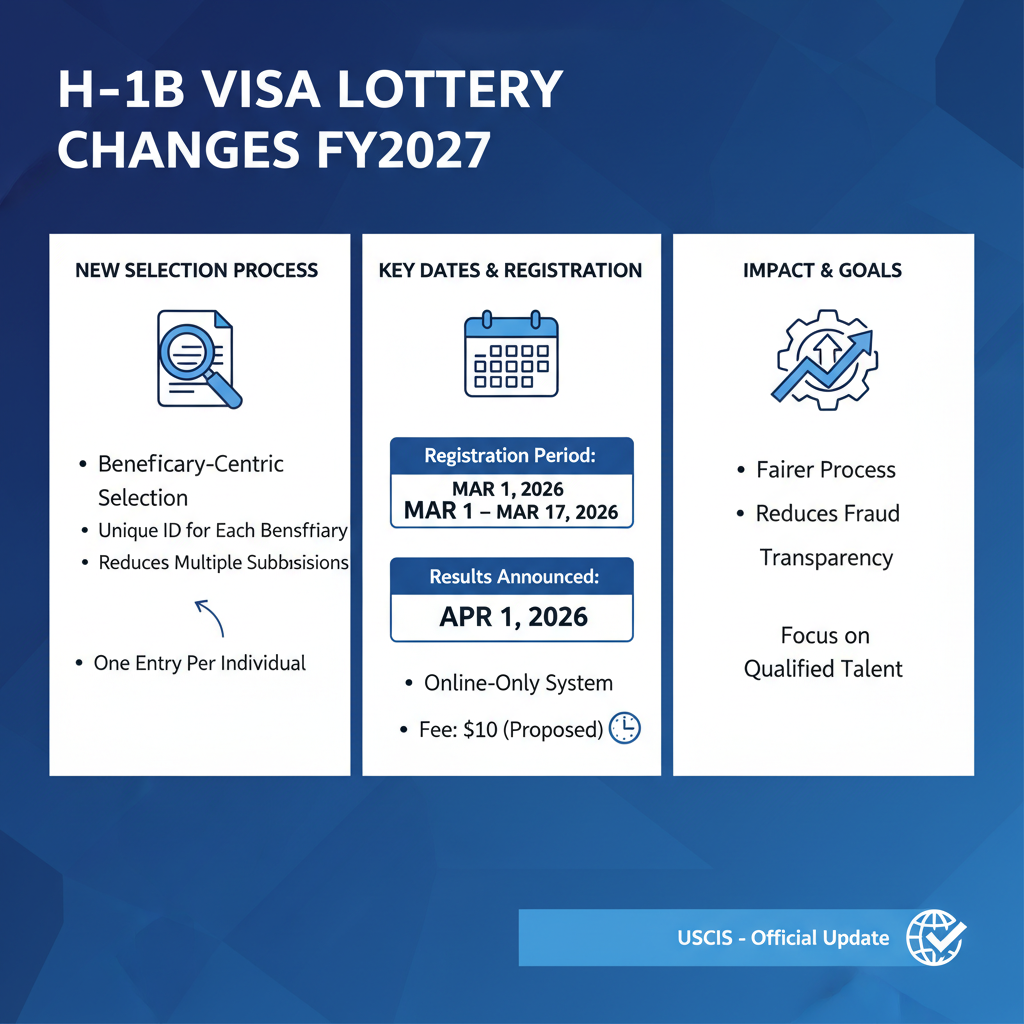
For skilled professionals seeking to work in the United States, the H-1B visa program represents a crucial pathway. Each year, thousands of talented individuals and their prospective employers navigate a complex system, often culminating in a high-stakes lottery. As we approach the registration period for Fiscal Year 2027 (FY2027), new rules and heightened scrutiny from U.S. Citizenship and Immigration Services (USCIS) are set to significantly impact this process. At Imigrar, your trusted immigration law firm in Orlando, Florida, we understand the anxieties and opportunities these changes present. Our goal is to provide clarity, practical advice, and unwavering support to help you achieve your American dream.
Why this news is showing up now
The H-1B visa program operates on a U.S. government fiscal year, which begins on October 1st. For FY2027, employers will typically submit registrations for the lottery in March 2026, with petitions filed for selected beneficiaries in April 2026, aiming for an October 1, 2026 start date. The news of "changes" arises because USCIS frequently updates its procedures, fees, and enforcement priorities. For FY2027, these changes are largely a continuation and expansion of efforts to combat fraud and ensure fairness in the lottery selection process, particularly building on the significant shifts introduced for FY2025 and FY2026. These changes often involve stricter registration guidelines, increased data validation, and a fundamental shift in how lottery selections are made.
How it can affect Florida residents
Florida is a dynamic and growing state, boasting thriving sectors in technology, healthcare, aerospace, hospitality, and education. Cities like Orlando, Miami, Tampa, and Jacksonville are magnets for innovation and require a steady influx of skilled professionals. Consequently, many Florida-based companies, from tech startups along the I-4 corridor to major healthcare systems and universities, rely heavily on the H-1B program to fill critical positions. For immigrants residing in Florida or those looking to secure employment with a Florida-based company, these changes mean:
- Increased Scrutiny: USCIS is enhancing its ability to detect and deter fraudulent registrations, particularly those involving multiple registrations for the same individual by different employers without legitimate job offers.
- A More Level Playing Field: The shift to a beneficiary-centric selection process (as implemented for FY2025) means each eligible beneficiary is entered into the lottery only once, regardless of how many employers register them. This aims to give every individual a fairer chance of selection.
- Heightened Employer Due Diligence: Florida employers must be meticulously compliant with all H-1B regulations, ensuring legitimate job offers and accurate registration data.
- Urgency in Preparation: Understanding and adapting to the new rules quickly will be paramount for both prospective H-1B workers and their sponsoring employers in Central Florida and beyond.
Navigating these evolving regulations requires expert legal guidance. Imigrar is strategically located in Orlando, perfectly positioned to assist individuals and businesses throughout Florida and nationwide with their H-1B needs. We are committed to keeping families together and helping talented individuals contribute to our state's vibrant economy.
Need Help Navigating H-1B Changes? Our Orlando immigration team is ready to assist. Call +1 786-791-3106 for a free consultation, or message us online. Se Habla Español.
What the H-1B Visa Is (and Why It Matters)
A plain-English definition
The H-1B visa is a non-immigrant visa that allows U.S. employers to temporarily employ foreign workers in specialty occupations. These are jobs that generally require a bachelor's degree or higher in a specific field. Think of it as a temporary work permit for highly skilled individuals, often in fields like technology, engineering, medicine, education, and finance. The H-1B visa is crucial for many U.S. industries that face shortages of qualified domestic workers, allowing them to attract top global talent. For immigrants, it's a vital pathway to professional growth and often a step towards permanent residency in the United States.
Key terms you need to know
Understanding the H-1B visa process requires familiarity with several key terms:
- Specialty Occupation: A job that requires theoretical and practical application of a body of highly specialized knowledge, and a bachelor's or higher degree in the specific specialty (or its equivalent) as a minimum for entry into the occupation.
- H-1B Cap: The annual limit on the number of H-1B visas issued. Congress currently sets this at 65,000 visas, with an additional 20,000 for those holding a U.S. master's degree or higher (the "master's cap").
- Cap-Exempt: Certain employers are exempt from the annual cap, including institutions of higher education, non-profit organizations affiliated with higher education, and non-profit research organizations or governmental research organizations.
- Petitioner: The U.S. employer filing the H-1B petition on behalf of the foreign worker.
- Beneficiary: The foreign worker for whom the H-1B petition is being filed.
- Labor Condition Application (LCA): Form ETA 9035, a document filed with the U.S. Department of Labor (DOL) by the employer, attesting that the employer will pay the H-1B worker at least the prevailing wage for the occupation in the area of employment and will provide working conditions that do not adversely affect other workers.
- H-1B Lottery (or Selection Process): Due to demand often exceeding the annual cap, USCIS conducts an electronic lottery to select enough registrations to meet the cap.
- Registration Period: The designated window (typically in March) during which employers must electronically register prospective H-1B beneficiaries with USCIS.
- Fiscal Year (FY): The U.S. government's accounting period, running from October 1st to September 30th. H-1B visas are allocated for a specific fiscal year.
- Premium Processing: An optional service offered by USCIS for an additional fee, guaranteeing processing of certain petitions (including H-1B) within a specified timeframe, usually 15 calendar days.
Current Immigration Law: The Foundation of the H-1B Visa
The H-1B visa program is rooted in federal immigration law, primarily the Immigration and Nationality Act (INA). Specifically, Section 101(a)(15)(H)(i)(b) of the INA defines the H-1B non-immigrant classification. Further regulations are found in 8 Code of Federal Regulations (CFR) 214.2(h). These laws and regulations govern everything from eligibility criteria to the application process and duration of stay.
Federal requirements
To qualify for an H-1B visa, both the employer and the prospective employee must meet strict federal requirements:
For the Employer (Petitioner):
- The employer must offer a job in a specialty occupation.
- The employer must file a certified Labor Condition Application (LCA), Form ETA 9035, with the Department of Labor, attesting to prevailing wages and working conditions.
- The employer must agree to pay the H-1B employee at least the higher of the actual wage paid to other employees with similar experience and qualifications, or the prevailing wage for the occupational classification in the area of intended employment.
- The employer must have an Employer Identification Number (EIN).
- The employer must have a bona fide job offer for the beneficiary.
For the Employee (Beneficiary):
- The individual must possess a bachelor's degree or its equivalent, or a higher degree required by the specialty occupation, from an accredited college or university.
- Alternatively, the individual may hold a license in a specialty occupation field, or have work experience equivalent to a bachelor's degree (generally, three years of specialized experience for every one year of college education not completed).
- The individual must meet the qualifications for the specific specialty occupation position offered by the employer.
- The individual must maintain valid non-immigrant status if currently in the U.S.
The primary form used for an H-1B petition is Form I-129, Petition for a Nonimmigrant Worker. This form, along with supporting documentation, is submitted to USCIS. You can find detailed instructions and all official forms on the USCIS official website.
Florida-specific considerations
While H-1B laws are federal, their application impacts states differently based on their economic landscape. In Florida, industries that heavily utilize H-1B visas include:
- Technology: Orlando's "Silicon Swamp" and other tech hubs across the state attract software developers, data scientists, and IT professionals.
- Healthcare: Hospitals and medical research facilities in cities like Gainesville, Tampa, and Orlando frequently sponsor doctors, nurses, and medical researchers.
- Aerospace & Engineering: Florida's Space Coast and manufacturing sectors employ engineers and scientists.
- Hospitality & Tourism Technology: Given Orlando's status as a global tourism destination, there's a growing demand for tech professionals to innovate within this industry.
- Higher Education: Florida's numerous universities and colleges sponsor professors, researchers, and other academic staff under the cap-exempt category.
For employers in Florida, understanding the local prevailing wage for specific occupations is critical for LCA compliance. Our team at Imigrar, based in Orlando, has extensive experience working with Florida businesses and professionals, ensuring their H-1B petitions meet all federal and local employment requirements.
Confused by H-1B Regulations? Let Imigrar simplify the process. Contact our Orlando office today at +1 786-791-3106 for expert legal guidance. Se Habla Español.
How to Navigate the H-1B Visa Process (with FY2027 Changes in Mind): A Complete Step-by-Step Guide
The H-1B process is multi-faceted, requiring careful planning and execution. The FY2027 changes, especially the beneficiary-centric selection, underscore the need for precision at every stage. Here’s a detailed guide:
1) Employer-Employee Relationship & Specialty Occupation Assessment
Before anything else, the employer must identify a legitimate job opening that qualifies as a specialty occupation. This means the job duties must be complex enough to require a bachelor's degree or higher in a specific field. The employer must also establish a genuine employer-employee relationship with the prospective H-1B worker.
- Required Documents (Initial Assessment):
- Detailed job description outlining duties and minimum educational requirements.
- Beneficiary's resume and academic transcripts/degrees.
- Any relevant professional licenses or certifications.
2) Labor Condition Application (LCA) Filing
Once a specialty occupation is confirmed, the employer must file Form ETA 9035, Labor Condition Application (LCA), with the U.S. Department of Labor (DOL). This form attests that the employer will pay the H-1B worker at least the prevailing wage for the occupation in the geographic area of employment (e.g., Orlando, Florida) and that the employment will not adversely affect the working conditions of U.S. workers. The DOL must certify the LCA before an H-1B petition can be filed.
- Key Considerations:
- Accurate job title and duties.
- Correct Standard Occupational Classification (SOC) code.
- Determination of the prevailing wage using DOL's Online Wage Library.
- Posting of the LCA notice at the employer's worksite.
3) H-1B Registration for the Lottery (The New Frontier for FY2027)
This is the most critical stage where the FY2027 changes have a profound impact. USCIS now uses an electronic registration system. Each prospective H-1B beneficiary must be registered by a sponsoring employer. For FY2027, USCIS continues to use the beneficiary-centric selection process introduced for FY2025. This means:
- Each prospective beneficiary is entered into the lottery only once, regardless of how many employers register them.
- If selected, the selection is tied to the beneficiary, and any of the employers who registered that beneficiary may then file a petition on their behalf.
- This system aims to reduce fraud from multiple registrations by the same individual and give all beneficiaries a fairer chance.
The registration period typically opens in early March and lasts for a few weeks. Employers create a USCIS online account, pay a small registration fee (currently $10), and provide basic information about the company and the prospective employee.
- Required Information for Registration:
- Employer's legal name, address, and EIN.
- Beneficiary's full name, date of birth, country of birth, country of citizenship.
- Beneficiary's passport number.
- Beneficiary's highest degree attained.
- Whether the beneficiary has a U.S. master's degree or higher.
- Timeline Expectation:
- March 2026: H-1B electronic registration period opens.
- Late March 2026: H-1B electronic registration period closes.
- Late March/Early April 2026: USCIS announces lottery results.
Important: Fraudulent registrations, including those with false job offers or multiple registrations for the same beneficiary by related entities without a legitimate employer-employee relationship, will be investigated and could lead to severe penalties, including denial of current and future petitions.
4) Petition Filing (Form I-129) for Selected Registrants
If a beneficiary's registration is selected in the lottery, the employer then has a specific window (typically from April 1st to June 30th) to file the full H-1B petition, Form I-129, Petition for a Nonimmigrant Worker, with USCIS. This petition must include the certified LCA and extensive supporting documentation.
- Required Documents (for Form I-129):
- Certified LCA (Form ETA 9035).
- Copy of the H-1B registration selection notice.
- Beneficiary's academic credentials (diplomas, transcripts, foreign degree evaluations).
- Beneficiary's resume and letters of experience.
- Employer's support letter detailing the job offer, specialty occupation nature, and why the beneficiary is qualified.
- Organizational charts, business licenses, and tax documents for the petitioning employer.
- Copies of beneficiary's passport, visa, I-94 record (if in U.S.), and previous immigration documents.
- Any contracts or agreements between employer and beneficiary.
- Photos (if applicable for change of status).
5) USCIS Processing & Decision
Once the Form I-129 petition is filed, USCIS reviews the application. Processing times can vary significantly. Employers may opt for Premium Processing (for an additional fee, currently $2,805) to get a decision within 15 calendar days. During processing, USCIS may issue a Request for Evidence (RFE) if they need more information or clarification on specific aspects of the petition, such as the specialty occupation qualification or the employer-employee relationship. A strong RFE response is critical to avoid denial.
- Possible Outcomes:
- Approval: The H-1B petition is approved, allowing the beneficiary to work for the petitioning employer.
- Request for Evidence (RFE): USCIS requests additional documentation or clarification.
- Denial: The petition is denied, often due to insufficient evidence, failure to meet requirements, or fraud concerns.
- Check Processing Times: Always refer to the USCIS Processing Times page for the most up-to-date information.
6) Visa Interview (for those outside U.S.) or Change of Status (within U.S.)
If the beneficiary is outside the U.S. when the petition is approved, they must attend a visa interview at a U.S. embassy or consulate in their home country. This involves completing Form DS-160, Online Nonimmigrant Visa Application, and paying the visa application fee. If the beneficiary is already in the U.S. in a different non-immigrant status (e.g., F-1 OPT), the approved H-1B petition may include a Change of Status, allowing them to begin H-1B employment on October 1st.
- For Visa Interview:
- Valid passport.
- DS-160 confirmation page.
- Appointment confirmation page.
- Receipt for visa application fee.
- Original H-1B approval notice (Form I-797).
- Employer's support letter and other supporting documents from the I-129 petition.
- Academic documents.
7) Maintaining H-1B Status
Once an H-1B visa is issued or a change of status is approved, the beneficiary can begin working on October 1st of the fiscal year. H-1B status is generally granted for an initial period of up to three years and can be extended for a maximum total stay of six years. It is crucial to comply with all H-1B regulations, including working only for the sponsoring employer in the approved position, maintaining a valid passport, and notifying USCIS of any material changes (e.g., new work location, significant change in job duties).
- Important: Any change in employment (e.g., new employer) requires a new H-1B petition to be filed by the new employer.
Practical Steps You Can Take Today for Your FY2027 H-1B Journey
The H-1B process, especially with the FY2027 changes emphasizing integrity and fairness, demands proactive preparation. Here are practical steps for both prospective beneficiaries and employers:
Actionable Checklist:
- Start Early and Communicate: If you are a prospective H-1B beneficiary, identify potential employers now. If you are an employer, begin assessing your needs and identifying potential H-1B candidates. The earlier you start, the more time you have to prepare for the March 2026 registration window.
- Verify Eligibility Rigorously: Ensure the job truly qualifies as a specialty occupation and that the beneficiary meets the educational requirements. Obtain foreign degree evaluations if necessary.
- Gather Academic Documents: Collect all diplomas, transcripts, and course descriptions. For foreign degrees, initiate the credential evaluation process with a reputable evaluation service.
- Prepare Your Resume & Experience Letters: Ensure your resume clearly highlights skills and experience relevant to the target specialty occupation. Obtain letters from previous employers detailing your duties and duration of employment.
- Understand the New Lottery Rules: Familiarize yourself with the beneficiary-centric selection process. As a beneficiary, ensure you provide accurate passport information to all potential employers to avoid issues with duplicate entries (which are now consolidated). As an employer, ensure you have a legitimate job offer for each beneficiary you register.
- Consult with an Experienced Immigration Attorney: This is perhaps the most crucial step. An attorney can assess eligibility, guide through documentation, ensure compliance with the latest USCIS regulations (including FY2027 changes), and represent you in the process.
- Plan for Potential RFEs: Proactively gather documentation that supports the specialty occupation, employer-employee relationship, and beneficiary qualifications. This saves time if an RFE is issued.
- Review Employer's Financial Health: For employers, ensure your financial documentation is in order to demonstrate the ability to pay the required wage.
Document Preparation Guidance:
- Academic: Official transcripts, diplomas, detailed course descriptions, and professional evaluations for foreign degrees.
- Professional: Comprehensive resume, letters of experience from previous employers, professional licenses, and certifications.
- Personal: Copy of passport, birth certificate, marriage certificate (if applicable), previous visa stamps, Form I-94 arrival/departure record, EAD card (if applicable), and any previous USCIS notices.
- Employer-Specific: Employer's federal EIN, business license, financial statements, tax returns, office lease, and a detailed letter of support describing the job, why it's a specialty occupation, and the beneficiary's qualifications.
Timeline Expectations:
- Now (April 2026 - February 2027): Employer identifies need, prospective beneficiary prepares documents, legal consultation, LCA preparation (can take weeks).
- Early March 2027: H-1B electronic registration period (for FY2027).
- Late March / Early April 2027: Lottery results announced.
- April 1, 2027 - June 30, 2027: Petition filing window for selected registrations.
- Spring/Summer 2027: USCIS processing (can take several months, or 15 days with Premium Processing). RFEs may be issued.
- October 1, 2027: H-1B status becomes active for approved petitions.
Reminder: This timeline is an estimate. USCIS processing times can fluctuate. Always refer to the USCIS Processing Times page.