


The landscape of U.S. immigration law is constantly evolving, and for foreign professionals aspiring to work in the United States, few changes are as impactful as those affecting the H-1B visa program. As we look towards the Fiscal Year 2027 (FY2027) H-1B cap season, new rules implemented by U.S. Citizenship and Immigration Services (USCIS) are set to significantly reshape how the annual lottery is conducted. At Imigrar, your trusted immigration law firm in Orlando, Florida, we believe in keeping families together by providing clear, timely, and actionable guidance. This comprehensive guide is designed to help you understand these crucial updates and prepare effectively for the upcoming H-1B lottery.
The reporting that sparked this guide:
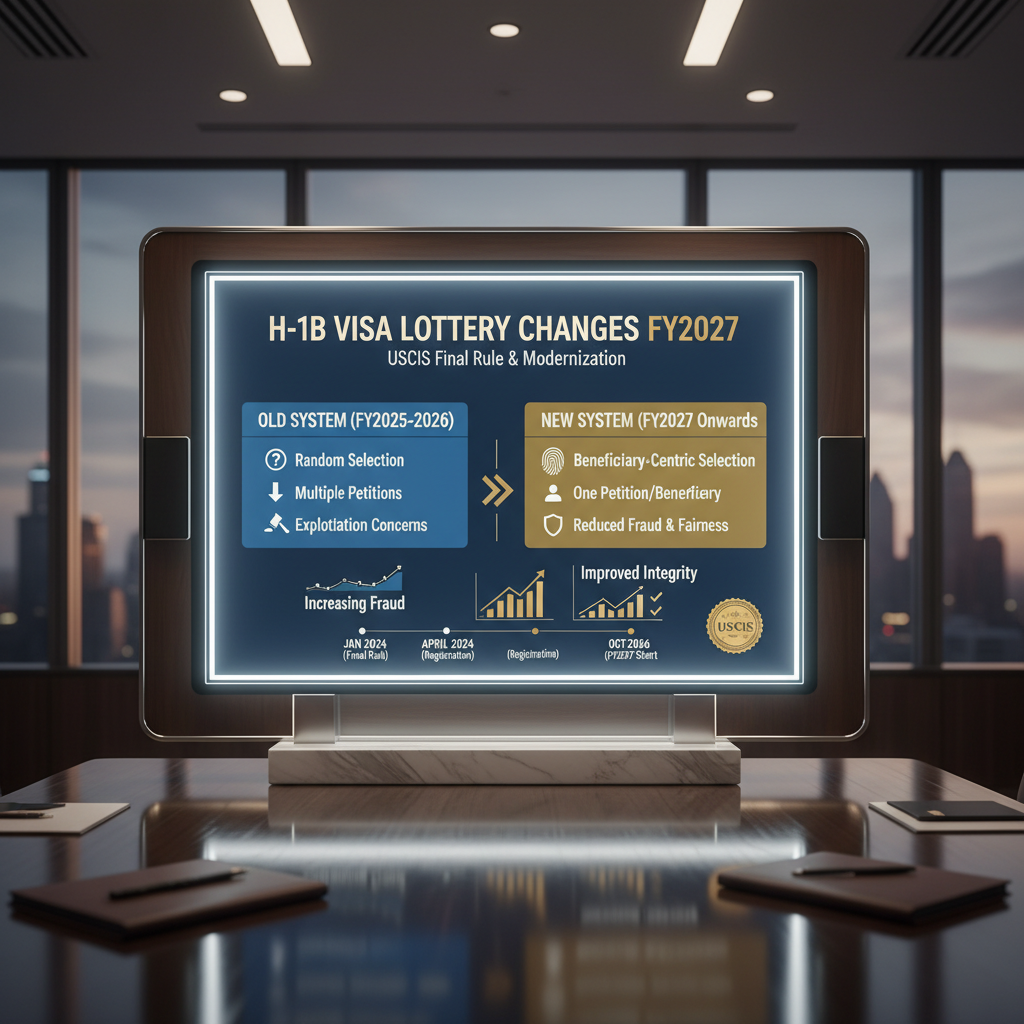
H-1B Visa Lottery Changes for FY2027 (Legal News)
What This News Means for Immigrants in Orlando and Across Florida
The H-1B visa program is a lifeline for many skilled foreign workers and the U.S. companies that rely on their expertise. For immigrants and businesses in Orlando and throughout Florida, understanding the latest changes to the H-1B lottery process is not just helpful—it’s absolutely essential for strategic planning and successful outcomes.
Why this news is showing up now
The news regarding H-1B visa lottery changes for FY2027 is surfacing now because USCIS has been actively implementing reforms to the H-1B cap registration process. While some of these changes, particularly the shift to a **beneficiary-centric selection process**, were initially announced and implemented for the FY2025 cap season (meaning the lottery conducted in March 2024), their full impact and implications are continually being analyzed and refined. As we approach the typical H-1B registration period for **FY2027** (which is expected to open in March 2026), it's crucial for prospective petitioners and beneficiaries to be fully aware of these current rules and how they will govern the upcoming lottery. USCIS aims to reduce fraud, improve fairness, and streamline the process, and these ongoing discussions and clarifications ensure that all stakeholders are prepared for the next cycle.
How it can affect Florida residents
Florida, particularly Central Florida with its booming tech, aerospace, healthcare, and tourism industries, is a significant hub for H-1B visa holders. Many companies along the **I-4 corridor**, from Tampa to Orlando and beyond, depend on highly skilled foreign talent to fill critical roles. For Florida residents, both employers and prospective employees, these changes have profound implications:
- For Employers: Florida businesses, especially those in the technology sector (like those in Orlando's "Medical City" or research parks), engineering, and specialized services, must adapt their H-1B sponsorship strategies. The **beneficiary-centric selection** means they can no longer gain an advantage by having multiple related entities submit registrations for the same individual. This levels the playing field but demands meticulous internal coordination.
- For Prospective H-1B Beneficiaries: Individuals living in Orlando, Miami, or other Florida cities who are seeking H-1B sponsorship will find the lottery process potentially fairer. The new system is designed to give each unique beneficiary an equal chance, regardless of how many employers register them. This reduces the previously observed advantage of those with multiple job offers. However, it also places a greater emphasis on ensuring their personal information is accurately and consistently provided across all registrations.
- Increased Scrutiny: USCIS has intensified efforts to detect and deter fraud. This means that H-1B petitions, especially those from Florida employers, will likely face greater scrutiny, requiring robust documentation and strong legal counsel to ensure compliance.
- Strategic Planning is Key: For both Florida-based employers and individuals, proactive planning and consultation with an experienced immigration attorney are more critical than ever to navigate these updated rules successfully and maximize the chances of selection and approval.
Need Help? Our Orlando immigration team is ready to assist. Navigating H-1B changes can be complex, but you don't have to do it alone. Call +1 786-791-3106 for a free consultation, or message us online. Se Habla Español.
What the H-1B Visa Is (and Why It Matters)
The H-1B visa is one of the most sought-after non-immigrant work visas in the United States. It plays a pivotal role in allowing U.S. employers to hire foreign professionals in **specialty occupations**. Understanding its core definition and associated terminology is the first step toward successfully navigating its complexities.
A plain-English definition
Simply put, the **H-1B visa** is a temporary work visa that allows U.S. employers to temporarily employ foreign workers in occupations that require a theoretical and practical application of a body of highly specialized knowledge and a bachelor's degree or higher in the specific specialty (or its equivalent). These are often referred to as **specialty occupations**. The visa is typically granted for an initial period of up to three years and can be extended for a maximum of six years. Some exceptions allow for extensions beyond six years, particularly for those with pending green card applications.
The H-1B program is crucial because it helps U.S. companies, including many innovative firms in Orlando and across Florida, fill critical skill gaps when qualified U.S. workers are not available. It enables global talent to contribute to the American economy, fostering innovation, economic growth, and cultural exchange. For many foreign professionals, the H-1B visa is a vital pathway to career development and, potentially, permanent residency in the U.S.
Key terms you need to know
To fully grasp the H-1B process and the recent changes, familiarity with specific terminology is essential:
- Specialty Occupation: An occupation that normally requires a bachelor's or higher degree (or its equivalent) in a specific specialty as a minimum for entry into the occupation. Examples include IT professionals, engineers, scientists, architects, doctors, and certain types of analysts.
- H-1B Cap: Congress sets an annual limit on the number of H-1B visas issued each fiscal year. Currently, the annual regular cap is 65,000 visas.
- U.S. Master's Cap (or Advanced Degree Exemption): An additional 20,000 visas are reserved for beneficiaries who have earned a U.S. master's degree or higher from an accredited U.S. institution. These petitions are selected before the regular cap.
- Cap-Exempt: Certain employers and beneficiaries are exempt from the annual H-1B cap. This includes institutions of higher education, non-profit organizations affiliated with higher education, and non-profit research organizations or governmental research organizations. Beneficiaries already holding an H-1B visa who are changing employers are also generally cap-exempt.
- Petitioner: The U.S. employer who files the H-1B petition on behalf of the foreign worker.
- Beneficiary: The foreign worker for whom the H-1B petition is being filed.
- Lottery / Registration Period: Due to the high demand often exceeding the annual cap, USCIS conducts an electronic lottery to select eligible registrations. The **H-1B registration period** is the short window (typically in March) when employers must register their prospective H-1B employees electronically.
- Labor Condition Application (LCA) (Form ETA-9035/9035E): A certification filed by the employer with the U.S. Department of Labor (DOL) before filing the H-1B petition. It attests that the employer will pay the H-1B worker at least the **prevailing wage** or the actual wage paid to other employees with similar qualifications, whichever is higher, and will provide working conditions that will not adversely affect other workers.
- Prevailing Wage: The average wage paid to similarly employed workers in a specific occupation in the area of intended employment. This is determined by the DOL.
- USCIS Online Account: A secure online platform used by petitioners, beneficiaries, and legal representatives to manage immigration applications, including the H-1B electronic registration. This account is central to the new beneficiary-centric selection process.
Current Immigration Law: The Foundation of the H-1B Visa
The H-1B visa program is rooted in specific sections of the Immigration and Nationality Act (INA) and is governed by regulations established by the Department of Homeland Security (DHS) through USCIS, and the Department of Labor (DOL). Understanding these legal underpinnings is crucial for compliance.
Federal requirements
The H-1B visa category is defined under **INA § 101(a)(15)(H)(i)(b)**. The annual cap is mandated by **INA § 214(g)**. Key federal requirements for the H-1B program include:
- Specialty Occupation Requirement: The job must meet the definition of a specialty occupation, meaning it typically requires at least a U.S. bachelor's degree or its foreign equivalent in a specific field. The beneficiary must possess this degree or its equivalent through a combination of education and work experience.
- Employer-Employee Relationship: A valid employer-employee relationship must exist, meaning the petitioner (employer) has the right to control the work of the beneficiary (employee).
- Labor Condition Application (LCA): The employer must obtain a certified **Form ETA-9035/9035E** from the Department of Labor (DOL) before filing the H-1B petition. This form requires the employer to attest to several conditions, including paying the **prevailing wage** (or actual wage, whichever is higher) and providing working conditions that will not adversely affect U.S. workers. The LCA must be publicly posted at the work site.
- Annual Cap: As mentioned, the H-1B program is subject to an annual cap of 65,000 visas, with an additional 20,000 visas reserved for those with a U.S. master's degree or higher. Petitions are selected via a lottery if demand exceeds the cap.
- Fraud Prevention and Detection Fee: A fee of $1,500 for employers with 26 or more full-time equivalent employees, or $750 for employers with 25 or fewer employees, is required for initial H-1B petitions.
- American Competitiveness and Workforce Improvement Act (ACWIA) Fee: An additional fee of $750 or $1,500, depending on the employer's size, is required.
Florida-specific considerations
While H-1B laws are federal, their application has practical considerations in Florida. The state's diverse economy means H-1B professionals are found in a wide array of fields:
- Industry Demand: Florida's growing technology sector, particularly in the Orlando, Tampa, and Miami areas, drives significant demand for H-1B workers in software development, data analytics, cybersecurity, and IT consulting. The aerospace and defense industries on the Space Coast also heavily utilize H-1B talent.
- Healthcare Needs: With a large and aging population, Florida's healthcare system relies on foreign medical professionals. H-1B visas are often sponsored for doctors, nurses, physical therapists, and other healthcare specialists, especially in underserved rural areas or specialized urban facilities.
- Prevailing Wage Challenges: The prevailing wage requirement can be a nuanced aspect in Florida, as wages vary significantly by metropolitan area (e.g., Orlando vs. a smaller town) and specific industry sectors. Accurate prevailing wage determination is critical to avoid issues with the DOL and USCIS.
- Local Talent Pool: While Florida has a robust university system producing graduates, there are still specific skill gaps that H-1B workers help fill, particularly in niche high-tech areas or advanced research.
For more detailed information on H-1B requirements and other immigration matters, please visit the USCIS official website.
Considering H-1B for your business or career in Florida? The attorneys at Imigrar understand the local market and federal regulations. Call us at +1 786-791-3106 for expert guidance. Se Habla Español.

How to Navigate the H-1B Visa Lottery Changes for FY2027: A Complete Step-by-Step Guide
The H-1B lottery process for FY2027 will operate under the new beneficiary-centric selection rules. This means the focus is on the individual beneficiary, not the number of registrations submitted on their behalf. This guide outlines the key steps and how these changes impact them.
1) Understand the New Beneficiary-Centric Selection Process
For FY2027, USCIS will select registrations based on the unique beneficiary, rather than the number of registrations submitted by employers. This is a significant change aimed at preventing fraud and ensuring fairness. Instead of each registration (potentially multiple for one beneficiary) having an equal chance, now each unique beneficiary is entered into the lottery only once, regardless of how many employers register them. If a beneficiary is selected, all employers who registered them for the selected fiscal year will be notified of the selection. This dramatically reduces the incentive for employers to collaborate or for related entities to submit multiple registrations for the same individual.
- Key Action: Ensure accurate and consistent beneficiary information across all registrations. If multiple employers register you, your personal details (name, date of birth, passport number, country of birth) must match exactly on each **USCIS online account** registration. Inconsistent data could lead to disqualification.
- Required Details for Registration:
- Beneficiary's full legal name
- Beneficiary's date of birth
- Beneficiary's country of birth
- Beneficiary's country of citizenship
- Beneficiary's passport number
- Beneficiary's highest degree attained
- Whether the beneficiary has a U.S. master's or higher degree
2) Employer Due Diligence and LCA Filing
Before an employer can even register for the H-1B lottery, they must undertake significant preparatory steps. This involves determining the appropriate wage for the position and filing the **Labor Condition Application (LCA)** with the Department of Labor (DOL).
- Determine Prevailing Wage: The employer must research and determine the appropriate prevailing wage for the specific occupation in the geographic area of intended employment. This ensures that the H-1B worker is paid fairly and that the employment does not adversely affect U.S. workers.
- File LCA (Form ETA-9035/9035E): The employer must electronically file **Form ETA-9035/9035E, Labor Condition Application**, with the DOL. This form attests that the employer will meet specific wage and working condition requirements. The DOL typically certifies LCAs within 7 business days. Without a certified LCA, an H-1B petition cannot be filed.
- Required Documents for LCA:
- Employer's Federal Employer Identification Number (FEIN)
- Company contact information
- Detailed job description and requirements
- Proposed wage for the H-1B worker
- Prevailing wage determination (often obtained from DOL's Foreign Labor Certification Data Center)
- Location(s) of employment
3) H-1B Registration Period (March 2026 for FY2027)
Once the LCA is certified, or at least concurrently, the employer (or their authorized representative) must submit an electronic registration for each prospective H-1B beneficiary during the designated registration period. For FY2027, this period is expected to be in **March 2026**.
- Create/Access USCIS Online Account: The employer must have a registrant account with USCIS. This is where registrations are submitted.
- Submit Registration Electronically: For each beneficiary, the employer provides the required beneficiary information (as listed in Step 1) and employer information.
- Pay Registration Fee: A non-refundable **$10 registration fee** is required for each submission.
- Important: Registrations must be submitted accurately and completely within the specified window. Late submissions or incomplete information will result in rejection.
- Reference: H-1B Electronic Registration Process
4) Lottery Selection and Notification
After the registration period closes, USCIS conducts the lottery to select the number of registrations needed to meet the annual H-1B cap. This usually occurs within a few days of the registration closing, with notifications typically sent out by the end of March.
- Selection Process: USCIS first conducts a lottery for the **U.S. Master's Cap (20,000 visas)**. Any unselected U.S. master's degree beneficiaries are then included in the lottery for the **regular cap (65,000 visas)**. Under the new beneficiary-centric system, if a beneficiary is selected, all employers who registered them will receive a "Selected" notification.
- Notification: Employers (and their legal representatives) will receive electronic notifications through their USCIS online accounts. Statuses will change from "Submitted" to "Selected," "Not Selected," or "Denied."
- What "Selected" Means: A "Selected" status means the employer is eligible to file an H-1B petition on behalf of that beneficiary. It does NOT guarantee visa approval.
5) Filing the H-1B Petition (Form I-129)
If a registration is selected, the employer has a specific window (typically 90 days, starting April 1st) to file the full H-1B petition with USCIS. This involves submitting **Form I-129, Petition for a Nonimmigrant Worker**, along with extensive supporting documentation.
- Prepare Form I-129: Complete **Form I-129** accurately, ensuring all sections pertaining to the H-1B classification are filled out.
- Gather Supporting Documents: This is a critical step requiring meticulous attention to detail.
- Certified LCA (Form ETA-9035/9035E)
- Evidence of beneficiary's qualifications: academic transcripts, diplomas, foreign degree evaluations, professional licenses, letters of experience.
- Evidence of specialty occupation: detailed job description, organizational charts, expert opinion letters if necessary.
- Employer's documentation: business license, articles of incorporation, financial statements, tax returns, office lease, client contracts (if applicable).
- Beneficiary's personal documents: copy of passport, visa, I-94 record, resume/CV, previous U.S. immigration documents (if any).
- Letter of support from the employer explaining the job, the need for the H-1B worker, and how the beneficiary qualifies.
- Pay Filing Fees:
- **Form I-129** filing fee.
- ACWIA Fee (American Competitiveness and Workforce Improvement Act).
- Fraud Prevention and Detection Fee.
- Public Law 114-113 Fee (for employers with 50 or more employees, with more than 50% of their U.S. workforce in H-1B or L-1 status).
- Consider Premium Processing: For an additional fee, employers can file **Form I-907, Request for Premium Processing Service**, to receive an adjudication decision within 15 calendar days. This can be beneficial for urgent needs.
- Reference:
Related Articles
You may also be interested in:
-
TPS Extensions & Redesignations: Your Guide for Florida
Stay informed on Temporary Protected Status (TPS) extensions and redesignations. This guide from Imigrar provides crucial updates, eligibility require...
-
Family Petition Guide: Keep Your Loved Ones Together in Florida
Navigate the complexities of family-based immigration petitions with our comprehensive guide. Learn requirements, timelines, and how Imigrar helps fam...
-
Green Card Interview: Your Ultimate Prep Guide for Success in
Navigate your Green Card interview with confidence. This comprehensive guide from Imigrar provides step-by-step preparation tips, document checklists,...
-
H-1B Visa Lottery Changes FY2027: Your Guide to New Rules &
Navigate the H-1B visa lottery changes for FY2027 with Imigrar's expert guide. Understand new rules, timelines, and how to prepare your petition for s...
-
TPS Extensions & Redesignations: Your Guide for Florida


