


The landscape of U.S. immigration is ever-evolving, and for skilled foreign workers and their sponsoring employers, few topics command as much attention as the H-1B visa program. As we approach the registration period for Fiscal Year 2027 (FY2027), significant changes to the H-1B lottery process, building on recent reforms, are poised to impact thousands of individuals and businesses, particularly here in Florida.
At Imigrar, an immigration law firm based in Orlando, Florida, we understand the profound importance of the H-1B visa in helping talented individuals contribute to the U.S. economy and, ultimately, in keeping families together. Our mission is to provide clear, actionable guidance through complex legal pathways. This comprehensive guide will break down the latest H-1B lottery changes for FY2027, offering practical advice, timelines, and expert insights to help you navigate this critical period successfully.
Need Help Navigating H-1B Changes? Don't face the complexities of the H-1B lottery alone. Our Orlando immigration team is ready to assist skilled workers and employers nationwide. Call +1 786-791-3106 for a free consultation, or message us online. Se Habla Español.
The reporting that sparked this guide:
H-1B Visa Lottery Changes for FY2027 (Legal News)
What This News Means for Immigrants in Orlando and Across Florida
The H-1B visa program is a lifeline for U.S. employers seeking to hire highly skilled foreign professionals in specialty occupations, and for those professionals dreaming of contributing their talents in the United States. Changes to this program, especially regarding the annual lottery, carry immense weight. For FY2027, these changes are not entirely new but represent a solidification and refinement of reforms introduced in previous years, specifically aimed at enhancing fairness and reducing fraud.
Why this news is showing up now
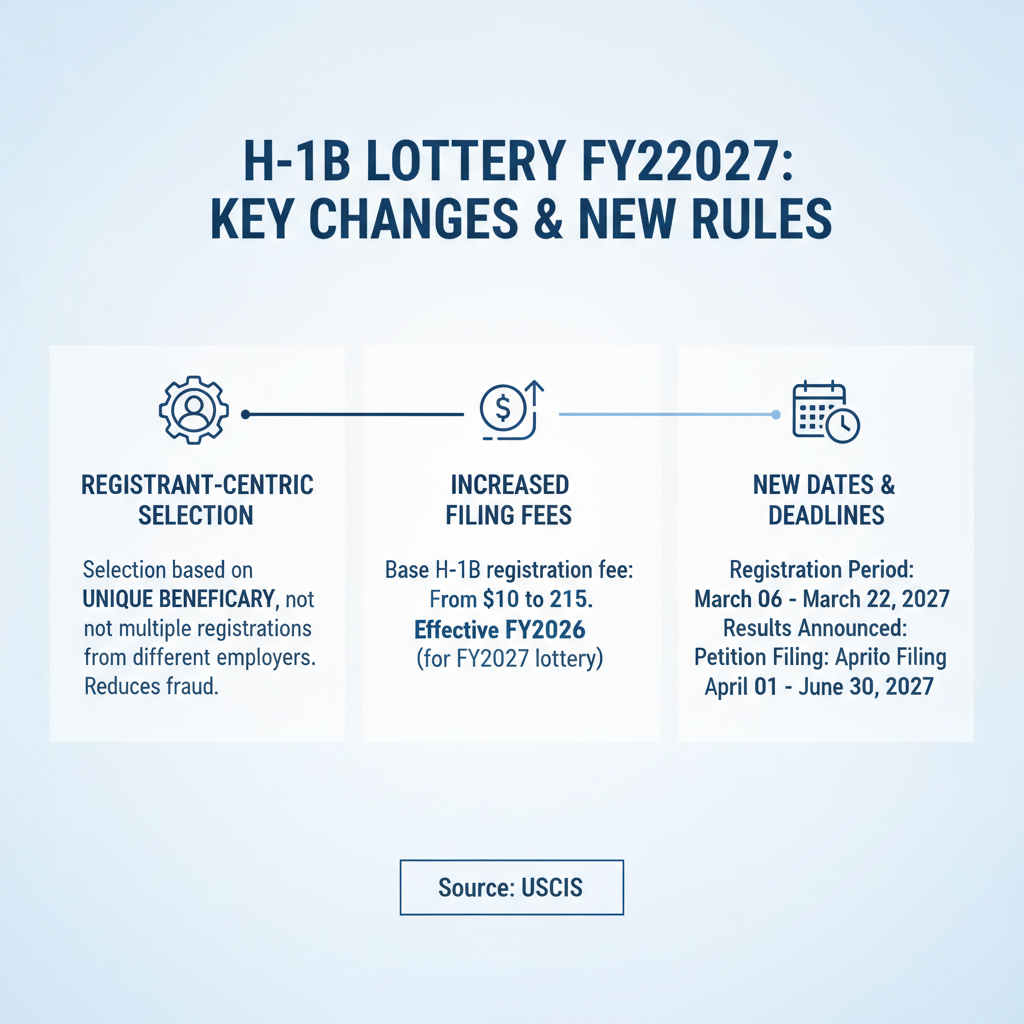
As of August 16, 2026, discussions around H-1B visa lottery changes for FY2027 are paramount because the annual cycle for this coveted visa is fast approaching. Each year, U.S. Citizenship and Immigration Services (USCIS) conducts a lottery to select H-1B registrations due to demand far exceeding the statutory cap. The reforms enacted for FY225 and FY2026, particularly the shift to a beneficiary-centric selection process and increased registration fees, are now firmly established and will govern the FY2027 lottery. This period leading up to the registration window (typically in March of the preceding fiscal year, so March 2027 for FY2027) is crucial for employers and prospective H-1B workers to understand and prepare for these refined rules. The news reflects ongoing efforts by USCIS to modernize the H-1B program, combat fraud, and ensure a more equitable selection process.
How it can affect Florida residents
Florida, with its booming tech industry, robust tourism and hospitality sectors, burgeoning aerospace and aviation fields, and numerous universities, is a significant hub for H-1B talent. Cities like Orlando, Tampa, Miami, and Jacksonville attract skilled professionals in IT, engineering, healthcare, finance, and more. The H-1B program is vital for Florida businesses looking to fill critical skill gaps and for international graduates from Florida universities (like UCF, UF, USF) seeking to remain in the state and contribute to its economy.
- For Employers in Central Florida: Businesses along the I-4 corridor, from Orlando’s simulation and tech companies to Tampa’s financial services, rely on H-1B visas. The beneficiary-centric selection process means that employers sponsoring the same individual will no longer inadvertently increase that individual’s chances of selection. This levels the playing field and emphasizes legitimate job offers. Increased registration fees, while a minor component of overall costs, still add to the administrative burden.
- For Skilled Workers and Graduates in Florida: If you are an international student on F-1 OPT working in Orlando or a professional on another nonimmigrant visa, these changes impact your strategy. The shift to beneficiary-centric selection is designed to prevent fraud, meaning your legitimate registration has a fairer chance. However, it also means you cannot rely on multiple employers to register you to artificially boost your odds. You must ensure your sponsoring employer is fully compliant with all new regulations and prepared for the H-1B registration process. Understanding the refined "specialty occupation" definitions will also be critical for job alignment.
- Increased Scrutiny: USCIS is actively investigating fraudulent multiple registrations. This means a greater emphasis on the legitimacy of each registration, which ultimately benefits those who follow the rules.
Understanding these impacts is the first step toward a successful H-1B application for FY2027. Imigrar is here to guide you through every nuance, ensuring your family’s future in Florida is secure.
What H-1B Visa Lottery Changes for FY2027 Is (and Why It Matters)
The H-1B visa program is a cornerstone of U.S. immigration for skilled nonimmigrant workers. It allows U.S. employers to temporarily employ foreign workers in specialty occupations. These occupations generally require a bachelor's degree or higher in a specific field. Due to high demand, the number of H-1B visas available each fiscal year is capped by Congress, necessitating an annual lottery process.
A plain-English definition
Simply put, the H-1B visa is a temporary work visa for foreign professionals who possess specialized knowledge and skills, typically holding at least a bachelor's degree, to work in a "specialty occupation" in the U.S. The employer must sponsor the worker. Because there are more applicants than available visas each year, USCIS conducts an electronic lottery, or "cap lottery," to select which registrations can proceed to filing a full petition. The "changes" for FY2027 primarily refer to the refined rules governing this lottery, particularly how individuals are selected and the measures taken to ensure fairness and prevent abuse.
Key terms you need to know
- H-1B Cap: The annual limit on the number of H-1B visas issued. Congress sets this at 65,000 regular visas and an additional 20,000 for those with a U.S. master's degree or higher (the "master's cap"). Certain organizations like universities and non-profits are cap-exempt.
- Fiscal Year (FY): The U.S. government's fiscal year runs from October 1 to September 30. H-1B petitions are filed for the upcoming fiscal year (e.g., FY2027 starts October 1, 2026).
- H-1B Registration: The electronic process where prospective H-1B petitioners (employers) submit basic information about the company and the prospective H-1B worker (beneficiary) to USCIS. This registration is a prerequisite for participating in the lottery.
- Beneficiary: The foreign national worker whom the employer intends to hire and for whom the H-1B petition is filed.
- Petitioner: The U.S. employer filing the H-1B registration and later, if selected, the H-1B petition.
- Specialty Occupation: An occupation that requires theoretical and practical application of a body of highly specialized knowledge, and a bachelor's or higher degree in the specific specialty (or its equivalent) as a minimum for entry into the occupation in the United States.
- Lottery Selection: When the number of registrations exceeds the annual H-1B cap, USCIS conducts a random selection process. For FY2025 and subsequent years, this became a beneficiary-centric selection process, meaning selection is based on unique beneficiaries, regardless of how many registrations are submitted on their behalf.
- Labor Condition Application (LCA): Form ETA-9035. An application filed by the employer with the U.S. Department of Labor (DOL) attesting that they will pay the H-1B worker the prevailing wage or the actual wage, whichever is higher, and provide working conditions that will not adversely affect other workers. This must be certified before filing the H-1B petition.
- Form I-129: Petition for a Nonimmigrant Worker: The primary form filed with USCIS by a U.S. employer on behalf of a foreign worker to obtain H-1B status.
These terms are critical to understanding the H-1B process and the significance of the FY2027 changes. The shift to a beneficiary-centric lottery system, in particular, is a fundamental change designed to enhance integrity and fairness in the selection process.
Current Immigration Law: The Foundation
The H-1B visa program is governed by the Immigration and Nationality Act (INA), specifically INA §101(a)(15)(H)(i)(b), which defines the H-1B nonimmigrant classification, and INA §214(g), which establishes the annual numerical limitations (the cap). These federal statutes, along with regulations promulgated by USCIS (part of the Department of Homeland Security) and the Department of Labor, form the legal framework for the H-1B program.
Federal requirements
To qualify for an H-1B visa, both the employer (petitioner) and the foreign worker (beneficiary) must meet specific federal criteria:
- For the Beneficiary:
- Hold a bachelor's degree or its equivalent, or a license in a specialty occupation field, or work experience equivalent to a bachelor's degree.
- Possess specialized knowledge required for the specialty occupation.
- The job offered must be in a specialty occupation, meaning it typically requires a bachelor's degree or higher in a specific field.
- For the Petitioner (Employer):
- Must have an Employer Identification Number (EIN).
- Must offer a job that qualifies as a specialty occupation.
- Must pay the H-1B worker at least the prevailing wage for the occupation in the geographic area of employment, or the actual wage paid to similarly qualified workers, whichever is higher.
- Must file a certified Labor Condition Application (LCA) (Form ETA-9035) with the Department of Labor before filing the H-1B petition.
- Must comply with all attestations made on the LCA.
- The Cap: The H-1B cap is set at 65,000 visas annually, with an additional 20,000 visas reserved for those with a U.S. master's degree or higher. Employers seeking to sponsor H-1B workers subject to the cap must participate in the annual electronic registration process.
- USCIS Final Rule on H-1B Modernization: Effective March 4, 2024, this rule (which will apply to FY2027) introduced several key provisions:
- Beneficiary-Centric Selection: The lottery now selects unique beneficiaries, not registrations. This significantly reduces the incentive for fraudulent multiple registrations.
- Increased Registration Fees: The H-1B cap registration fee increased from $10 to $215, effective April 1, 2024.
- Clarified "Specialty Occupation" Criteria: Provides more clarity on how USCIS evaluates whether a position qualifies as a specialty occupation.
- Extended Petition Validity: For certain beneficiaries, the rule allows for longer petition validity periods.
- Automatic Extension of Status: Provides for automatic extension of status for H-1B workers with timely filed extension petitions.
For detailed information on current H-1B laws and regulations, please refer to the USCIS official website.
Florida-specific considerations
While H-1B law is federal, its impact is felt locally. Florida's diverse economy creates a high demand for H-1B workers. The Orlando area, for instance, is a hub for theme park technology, modeling and simulation, and healthcare, requiring specialized engineers, IT professionals, and medical staff. The growing startup ecosystem across the state also contributes to this demand.
- Local Demand: Employers in Orange County and across Central Florida actively seek H-1B talent for roles that are hard to fill with domestic workers.
- University Graduates: Florida's extensive university system produces a large pool of international graduates (many on F-1 visas and OPT) who are prime candidates for H-1B sponsorship. They often contribute significantly to local economies after graduation.
- Orlando USCIS Field Office: While H-1B petitions are processed centrally, local USCIS field offices may handle related interviews for H-1B workers seeking to adjust status or for specific inquiries. Knowing your local resources is always beneficial.
Understanding the interplay of federal law and local economic realities is crucial for both employers and beneficiaries in Florida. Imigrar has deep roots in the Orlando community and understands these local dynamics.
How to Navigate the New H-1B Lottery Rules for FY2027: A Complete Step-by-Step Guide
The H-1B lottery process, with its annual cap and fierce competition, requires meticulous preparation and strategic planning. With the refined rules for FY2027 emphasizing beneficiary-centric selection and increased integrity measures, following each step precisely is more critical than ever.
1) Employer and Beneficiary Preparation (Ongoing – Typically August to February preceding Registration)
This initial phase is about laying the groundwork. Employers must identify the need for a skilled foreign worker, and the worker must ensure they meet the basic eligibility criteria.
- Employer Actions:
- Identify Business Need: Determine if a specialty occupation position cannot be filled by a qualified U.S. worker.
- Job Qualification Assessment: Ensure the position genuinely qualifies as a specialty occupation, requiring at least a bachelor's degree in a specific field. This is a common area of RFE (Request for Evidence) if not clearly demonstrated.
- Wage Determination: Research prevailing wages for the specific occupation in the intended area of employment (e.g., Orlando, FL) to ensure compliance with DOL requirements. This can be done through the DOL's Foreign Labor Certification Data Center.
- Counsel with Immigration Attorneys: Engage with an experienced firm like Imigrar early to assess eligibility, strategize, and understand the full process and costs.
- Beneficiary Actions:
- Degree Evaluation: Obtain foreign degree evaluations if applicable, confirming equivalency to a U.S. bachelor's or master's degree.
- Resume and Transcripts: Prepare an updated resume, academic transcripts, and professional licenses.
- Passport Validity: Ensure your passport is valid for at least six months beyond your intended H-1B period.
- Gather Information: Be ready to provide personal details, educational history, and work experience to your prospective employer and their legal counsel.
- Required Documents for Preparation:
- Employer's EIN
- Job description and requirements
- Beneficiary's passport biographical page
- Beneficiary's educational degrees and transcripts (with certified English translations if applicable)
- Beneficiary's curriculum vitae (CV) or resume
- Any previous U.S. visa documents (e.g., I-20 for F-1, I-797 for previous H-1B)
2) H-1B Electronic Registration (Typically March 1st – March 17th for FY2027)
This is the critical window for entering the lottery. Employers, or their authorized representatives (like Imigrar), must submit an electronic registration for each prospective H-1B worker.
- Employer Actions:
- Create/Access USCIS Online Account: Employers must have a "registrant" account with USCIS.
- Submit Registrations: For each prospective H-1B beneficiary, submit a separate electronic registration through the USCIS online system. Each registration requires basic information about the employer and the beneficiary.
- Pay Registration Fee: Pay the non-refundable H-1B registration fee ($215 for FY2027, increased from $10).
- Understand Beneficiary-Centric Selection: Be aware that USCIS will only count each unique beneficiary once, even if multiple employers submit registrations on their behalf. This makes the selection process fairer.
- Required Information for Registration:
- Employer's name, address, and EIN
- Employer's authorized signatory information
- Beneficiary's full name, date of birth, country of birth, country of citizenship
- Beneficiary's passport number
- Whether the beneficiary holds a U.S. master's degree or higher
- Important: Do NOT submit multiple registrations for the same beneficiary by the same employer. This is considered fraud and can lead to denial or revocation.
3) Lottery Selection and Notification (Late March for FY2027)
After the registration period closes, USCIS conducts the random lottery selection. Employers are notified of the results through their USCIS online accounts.
- USCIS Actions:
- Conduct the lottery, first for the master's cap, then for the regular cap.
- Notify selected registrants (employers) via their online accounts. Notifications typically state "Selected."
- For unselected registrations, the status will show "Not Selected" or "Denied" (if found to be a duplicate or fraudulent).
- Employer/Beneficiary Actions:
- Monitor USCIS online account for notifications.
- If selected, proceed to the next step: preparing and filing the H-1B petition.
- If not selected, explore alternative visa options with Imigrar.
4) Prepare and File the H-1B Petition (Typically April 1st – June 30th for FY2027)
If your registration is selected, the employer has a specific filing window to submit the complete Form I-129, Petition for a Nonimmigrant Worker, along with all supporting documentation.
- Employer Actions:
- File LCA: Immediately file the Labor Condition Application (Form ETA-9035) with the Department of Labor. This must be certified before the H-1B petition can be filed. This process can take 7-10 business days.
- Prepare Form I-129: Complete Form I-129 accurately, detailing the employer, beneficiary, and job.
- Gather Supporting Documents: Compile all necessary evidence to prove the employer's legitimacy, the beneficiary's qualifications, and that the job is a specialty occupation.
- Pay Filing Fees: Submit all required USCIS fees, including the base filing fee, ACWIA fee, fraud prevention and detection fee, and (if applicable) the public law 114-113 fee and premium processing fee. These fees can range from approximately $1,710 to over $4,000, depending on the employer's size and requested services.
- Mail Petition: File the complete petition package with USCIS at the designated service center within the specified filing window (e.g., April 1, 2027, to June 30, 2027, for FY2027 selected petitions).
- Required Documents for I-129 Petition (Bullet list):
- Copy of the H-1B registration selection notice
- Certified Labor Condition Application (LCA) (Form ETA-9035)
- Completed and signed Form I-129, Petition for a Nonimmigrant Worker
- Employer's letter of support describing the job, specialty occupation nature, and beneficiary's qualifications
- Beneficiary's educational documents (degrees, transcripts, foreign degree evaluations)
- Beneficiary's resume/CV
- Copies of beneficiary's passport, visa, I-94 record, and previous U.S. immigration documents
- Employer's business documents (e.g., articles of incorporation, tax returns, financial statements, office lease, client contracts) to establish legitimacy and ability to pay the wage
- Evidence that the position qualifies as a specialty occupation (e.g., industry standards, similar job requirements)
- Any other supporting evidence requested or deemed relevant by legal counsel.
- Reminder: The petition must be filed by the employer, not the beneficiary.
Overwhelmed by H-1B Paperwork? Imigrar's experienced team handles all aspects of H-1B petition preparation and filing for clients in Orlando, across Florida, and nationwide. Let us simplify the process for you. Call +1 786-791-3106 for a free consultation. Se Habla Español.
5) USCIS Processing and Adjudication (Months following filing)
After filing, USCIS reviews the petition. This stage can involve Requests for Evidence (RFEs) and can take several months, or even longer, without premium processing.
- USCIS Actions:
- Issue a receipt notice (Form I-797C) confirming receipt of the petition.
- Review the petition and supporting documents.
- May issue a Request for Evidence (RFE) if more information is needed to make a decision. This is common, especially regarding specialty occupation criteria or employer-employee relationship.
- Adjudicate the petition: Approve, deny, or issue a Notice of Intent to Deny (NOID).
- Employer/Beneficiary Actions:
- Monitor Case Status: Track the petition's progress online using the receipt number on the USCIS Case Status website.
- Respond to RFE: If an RFE is issued, work immediately with your attorney to gather and submit compelling evidence within the deadline (usually 60-90 days).
- Premium Processing (Optional): For an additional fee ($2,805 for FY2027, subject to change), USCIS guarantees a decision or RFE within 15 calendar days. This is highly recommended for those who need a quicker decision.
6) Petition Approval and Status Change / Visa Stamping (October 1st for FY2027)
Upon approval, the beneficiary's status changes, or they can apply for an H-1B visa at a U.S. consulate abroad.
- If "Change of Status" (COS) was requested (for beneficiaries already in the U.S.):
- If approved, the beneficiary's status automatically changes to H-1B on October 1st (the start of FY2027).
- They will receive an approval notice (Form I-797A).
- They can begin working for the sponsoring employer on October 1st.
- If "Consular Processing" was requested (for beneficiaries outside the U.S. or those who will travel):
- The beneficiary receives an approval notice (Form I-797B).
- They must then apply for an H-1B visa stamp at a U.S. embassy or consulate in their home country. This involves completing Form DS-160, attending an interview, and providing biometric data.
- Upon visa stamp approval, they can enter the U.S. no more than 10 days before October 1st.
- Required Documents for Visa Stamping (Consular Processing):
- Valid passport
- Form DS-160 confirmation page
- Appointment confirmation page
- Passport-style photographs
- Form I-797B (H-1B approval notice)
- H-1B LCA and petition documents (copy of entire I-129 petition)
- Original educational documents and transcripts
- Employer's support letter
- Evidence of ties to home country (if applicable)
- Warning: Always consult with your attorney before traveling abroad if your H-1B petition is pending or if you are awaiting a change of status.
Practical Steps You Can Take Today
The H-1B lottery is a high-stakes process. Proactive preparation is key to maximizing your chances of success, especially with the refined rules for FY2027.


