


The H-1B visa program is a cornerstone for many skilled foreign professionals seeking to contribute their talents to the U.S. economy, particularly in high-demand sectors like technology, healthcare, and engineering. For businesses in vibrant hubs like Orlando and across Florida, it’s a vital tool for attracting top global talent. However, the demand for H-1B visas consistently outstrips the annual supply, leading to a highly competitive lottery system. As we move into the FY2027 cycle, significant changes announced by U.S. Citizenship and Immigration Services (USCIS) are set to reshape this landscape, aiming for greater fairness and integrity.
At Imigrar, an immigration law firm based in Orlando, Florida, we understand the profound impact these changes have on individuals and families striving to build a future in the United States. Our mission, "Keep Families Together," drives us to provide clear, actionable guidance through every immigration challenge. This comprehensive guide will break down the H-1B visa lottery changes for Fiscal Year 2027, explain what they mean for you, and outline the critical steps to navigate this evolving process successfully.
Whether you’re a prospective H-1B beneficiary, an employer looking to sponsor talent, or simply seeking to understand the implications of these new rules, Imigrar is here to help. Our team of experienced attorneys, fluent in English and Spanish, is dedicated to ensuring you have the most accurate and up-to-date information.
Navigating H-1B changes can be complex. Don't face it alone. Our Orlando immigration team is ready to assist. Call +1 786-791-3106 for a free consultation, or message us online. Se Habla Español.
NEWS SOURCE REFERENCE SECTION
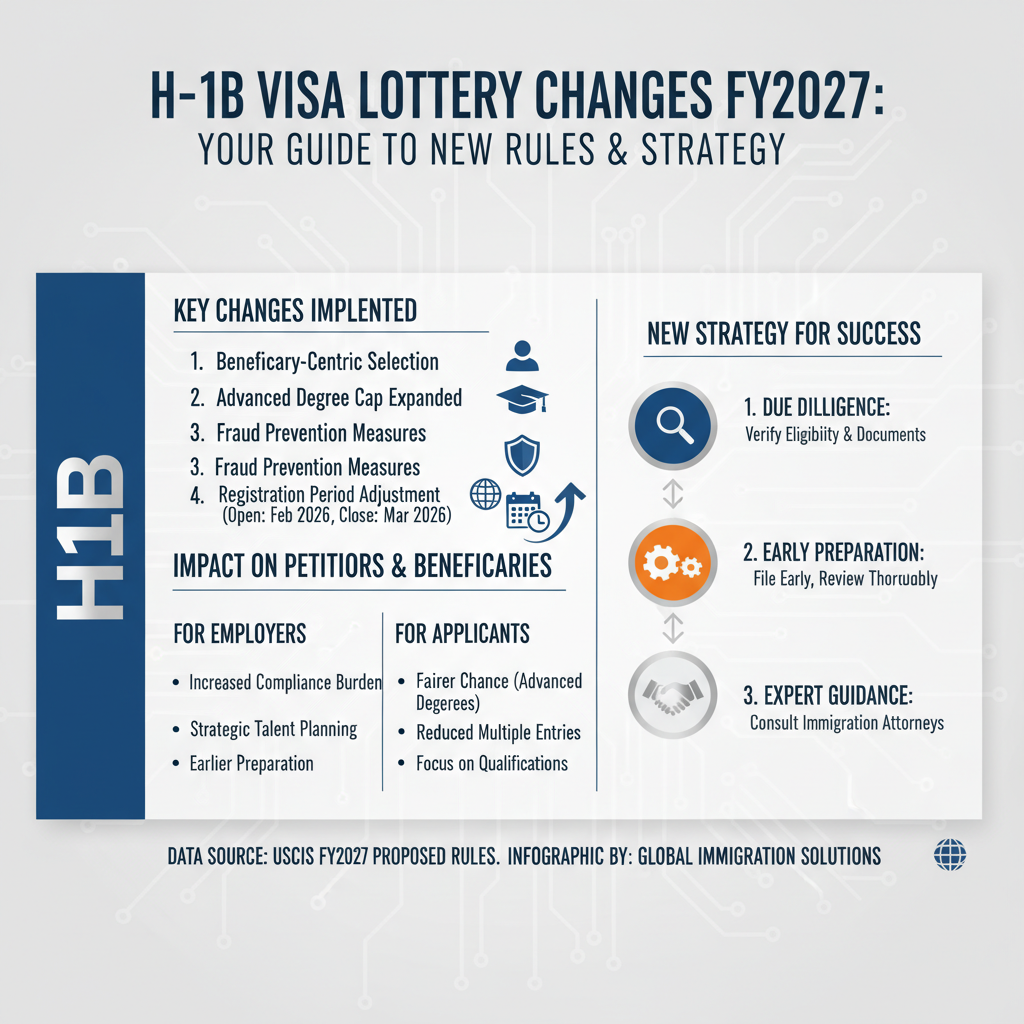
The reporting that sparked this guide: H-1B Visa Lottery Changes for FY2027 (Legal News)
What This News Means for Immigrants in Orlando and Across Florida
The H-1B visa program is a critical pathway for highly skilled foreign workers to live and work in the U.S. For those hoping to build a career in the dynamic job markets of Florida, particularly in innovation hubs like Orlando, Tampa, and Miami, the annual H-1B lottery represents a pivotal opportunity. The recent changes announced by USCIS for the FY2027 lottery cycle are not just procedural adjustments; they represent a fundamental shift in how selections are made, designed to combat fraud and ensure a fairer process for genuine petitioners and beneficiaries.
Why this news is showing up now
USCIS typically announces changes to major immigration programs well in advance of their implementation. For the H-1B lottery, which dictates who can file petitions for the fiscal year starting October 1st, the registration period usually occurs in March of the preceding calendar year. As of today, April 27, 2026, the registration period for FY2027 has already concluded, and selections have been made. The news of these changes, therefore, is highly relevant now as selected petitioners prepare to file their **Form I-129** petitions, and those not selected evaluate alternative options. These new rules, which were initially proposed and finalized for the FY2025 lottery, are fully in effect for FY2027, making it crucial for everyone involved to understand their implications. The intent behind these rules is to enhance the integrity of the H-1B program, specifically by addressing concerns about multiple registrations submitted for the same beneficiary by different employers, a practice that previously inflated selection chances and led to unfair outcomes.
How it can affect Florida residents
Florida, with its booming tech, tourism, healthcare, and aerospace industries, is a significant destination for H-1B workers. Cities like Orlando, often referred to as "Medical City" or a growing tech hub along the **I-4 corridor**, rely heavily on skilled foreign talent to fill critical gaps and drive innovation. These H-1B changes will have several key impacts on Florida residents:
- For Prospective H-1B Beneficiaries in Florida: If you are currently in Florida on another visa (e.g., F-1 OPT) and hoped to secure an H-1B, or if you are abroad and eyeing opportunities in the Sunshine State, the new "beneficiary-centric" selection process means your chances are no longer amplified by having multiple employers register on your behalf. While multiple employers can still register you, you only get one entry into the lottery. This levels the playing field, making it more about the quality of the job offer and less about how many employers are willing to submit a registration for you. For those selected, the focus shifts immediately to preparing a robust **Form I-129** petition. For those not selected, exploring alternative visa options or planning for the next lottery cycle becomes paramount.
- For Florida Employers: Companies in Orlando, Tampa, and other Florida cities that frequently sponsor H-1B visas will find the process more streamlined in terms of lottery selection. They no longer need to contend with a system where competitors might gain an unfair advantage by submitting multiple registrations for the same individual. The emphasis now is on securing a legitimate job offer and preparing a strong, compliant petition if their prospective employee is selected. This change promotes genuine employment relationships and discourages speculative registrations.
- Increased Integrity and Fairness: The changes are designed to reduce fraud and ensure that every eligible beneficiary has an equal chance in the lottery. This benefits the entire immigration system and fosters trust in the H-1B program, which is vital for Florida's diverse workforce and economy.
Understanding these shifts is not just about compliance; it's about strategizing effectively. Imigrar, located centrally in Orlando, is uniquely positioned to assist both individuals and employers in navigating these new rules, ensuring they are prepared for every step of the H-1B process.
What H-1B Visa Lottery Changes for FY2027 Is (and Why It Matters)
The H-1B visa program is a cornerstone of U.S. immigration for skilled foreign workers, allowing U.S. employers to temporarily employ foreign workers in specialty occupations. However, the program is subject to an annual cap, which means demand often far exceeds supply. This necessitates a lottery system, and for Fiscal Year 2027, USCIS has implemented significant changes to how this lottery is conducted.
A plain-English definition
At its core, the H-1B visa allows U.S. employers to hire foreign professionals for jobs that require a bachelor's degree or higher in a specific field. Think of it as a temporary work permit for highly skilled individuals. Because there are more applicants than available visas each year (the annual **H-1B cap**), USCIS uses a lottery system to select which employers can proceed with filing petitions. For FY2027, the biggest change is that the lottery now focuses on the **beneficiary** (the foreign worker) rather than the **petitioner** (the U.S. employer). This means that even if multiple employers register the same individual, that individual only gets one chance in the lottery. If selected, USCIS then randomly picks one of the employers who registered for that individual to proceed with filing the H-1B petition. This change aims to make the lottery fairer by preventing fraud and ensuring each person has an equal shot, regardless of how many companies registered them.
Key terms you need to know
To fully grasp the H-1B process and the impact of these changes, it's essential to understand the following terms:
- H-1B Visa: A nonimmigrant visa that allows U.S. employers to temporarily employ foreign workers in specialty occupations.
- Specialty Occupation: An occupation that requires theoretical and practical application of a body of highly specialized knowledge, and a bachelor's or higher degree in the specific specialty (or its equivalent) as a minimum for entry into the occupation in the United States.
- H-1B Cap: The annual statutory limit on the number of H-1B visas issued each fiscal year. Currently, it's 65,000 for the regular cap and an additional 20,000 for those with a U.S. master's degree or higher (the "Master's cap").
- USCIS: U.S. Citizenship and Immigration Services, the government agency responsible for processing immigration benefits, including H-1B petitions. You can find more information on the USCIS official website.
- Beneficiary: The foreign national who is seeking the H-1B visa.
- Petitioner: The U.S. employer who is sponsoring the foreign national for the H-1B visa.
- H-1B Cap Registration: The electronic process where prospective petitioners (employers) submit basic information about themselves and the beneficiary to USCIS during a designated period. This is the first step before the lottery.
- Selection Notice: The notification sent by USCIS to selected petitioners, indicating that their registration has been chosen in the lottery and they are eligible to file an H-1B petition.
- Form I-129, Petition for a Nonimmigrant Worker: The primary form filed by the employer on behalf of the beneficiary after a successful lottery selection.
- Labor Condition Application (LCA): A form (ETA Form 9035) filed with the U.S. Department of Labor (DOL) by the employer, attesting to specific conditions regarding wages and working conditions. This must be certified before filing **Form I-129**.
- Prevailing Wage: The average wage paid to similarly employed workers in a specific occupation in the geographic area of intended employment. Employers must pay at least the prevailing wage or the actual wage paid to other employees with similar experience and qualifications, whichever is higher.
- FY2027: Fiscal Year 2027, which begins on October 1, 2026, and ends on September 30, 2027. H-1B visas are issued for this fiscal year.
- Beneficiary-Centric Selection: The new rule for FY2027 and subsequent years, where the lottery selection is based on unique beneficiaries rather than unique registrations. This means each unique beneficiary is entered into the lottery only once, regardless of the number of registrations submitted on their behalf.
These changes matter significantly because they aim to level the playing field, making the lottery process more equitable and transparent. For legitimate employers and skilled foreign workers, this means a fairer shot at securing an H-1B visa, free from the manipulation of previous lottery cycles. It underscores the importance of a strong, genuine job offer and meticulous petition preparation, rather than relying on multiple, potentially fraudulent, registrations.
Got questions about H-1B eligibility or the new lottery system? Imigrar has answers. Contact our Orlando office at +1 786-791-3106 for a free consultation. Se Habla Español.
Current Immigration Law: The Foundation
The H-1B visa program operates under the authority of the Immigration and Nationality Act (INA), specifically Section 101(a)(15)(H)(i)(b), which defines the H-1B nonimmigrant classification. The regulations governing its implementation are found in Title 8 of the Code of Federal Regulations (8 CFR). Understanding these foundational legal frameworks is crucial for navigating the H-1B process, especially with the recent changes in the lottery system.
Federal requirements
To qualify for an H-1B visa, both the petitioner (employer) and the beneficiary (employee) must meet specific federal requirements:
- For the Position (Specialty Occupation):
- The job must require a bachelor's degree or higher in a specific field as a minimum for entry.
- The employer must demonstrate that the job duties are sufficiently complex or unique to necessitate a specialist.
- The position must be professional in nature, not merely technical or vocational.
- For the Beneficiary (Employee):
- Possess a U.S. bachelor's or higher degree required by the specialty occupation from an accredited college or university.
- Hold a foreign degree equivalent to a U.S. bachelor's or higher degree in the specialty occupation.
- Hold an unrestricted state license, if applicable, which authorizes the beneficiary to fully practice the specialty occupation and is required for the occupation.
- Have work experience equivalent to a bachelor's degree in the specialty occupation. USCIS generally uses a "3-for-1" rule, where three years of progressive work experience in the specialty field can be counted as one year of college education.
- For the Petitioner (Employer):
- Must have an IRS Employer Identification Number (EIN).
- Must demonstrate a valid employer-employee relationship with the beneficiary.
- Must agree to pay the H-1B worker at least the **prevailing wage** for the occupation in the area of intended employment, or the actual wage paid to other employees with similar experience and qualifications, whichever is higher. This is attested to in the **Labor Condition Application (LCA)**, filed with the Department of Labor.
- Must provide a genuine job offer for a specialty occupation.
The core USCIS form for the H-1B process is **Form I-129, Petition for a Nonimmigrant Worker**. This form, along with various supplements and extensive supporting documentation, is filed by the employer after a successful lottery selection. USCIS also frequently issues a **Form I-797, Notice of Action**, to communicate approvals, denials, or Requests for Evidence (RFEs).
Florida-specific considerations
While federal law dictates the H-1B program, the economic landscape of Florida plays a significant role in its utilization and impact. There are no Florida-specific H-1B laws, but the state's robust and diverse economy creates a high demand for skilled workers in specialty occupations. For example:
- Technology Sector: Central Florida, particularly the Orlando and Lake Nona regions, is experiencing rapid growth in tech, simulation, aerospace, and defense industries. Companies along the **I-4 corridor** are actively seeking software developers, engineers, data scientists, and IT professionals, many of whom are H-1B beneficiaries.
- Healthcare: Florida's large and aging population drives a constant need for healthcare professionals, including doctors, nurses, and medical researchers. Many hospitals and clinics in **Orange County** and across Florida rely on H-1B visas to fill these critical roles.
- Tourism and Hospitality Management: While often associated with lower-skilled jobs, the tourism industry in Orlando also creates demand for H-1B professionals in areas like financial management, advanced analytics, and specialized IT support for large resort operations.
- Education and Research: Florida's extensive university system and research institutions attract professors, researchers, and post-doctoral scholars on H-1B visas.
The **Orlando USCIS Field Office** handles many local immigration matters, but H-1B petitions are processed at specific USCIS service centers nationwide. However, local considerations, such as the prevailing wage in the Orlando metropolitan area, are crucial components of the LCA and H-1B petition. Imigrar's deep understanding of both federal requirements and the local Florida job market allows us to provide tailored advice and support.
For more detailed information on H-1B policies and regulations, always refer to the USCIS official website and the Executive Office for Immigration Review for legal interpretations.
How to Navigate the H-1B Visa Lottery Changes for FY2027: A Complete Step-by-Step Guide
The H-1B visa process, particularly with the new beneficiary-centric lottery rules for FY2027, requires meticulous planning and execution. This guide outlines the essential steps for employers and beneficiaries, assuming the registration period for FY2027 has concluded and selections have been announced (as of April 27, 2026).
1) Employer & Beneficiary Prepare for Registration (Completed for FY2027)
Although the registration period for FY2027 has passed, this initial preparation is vital for future cycles and understanding the foundation of the current process. Employers must first identify a need for a specialty occupation worker and ensure the prospective beneficiary meets the H-1B eligibility criteria. This involves reviewing the beneficiary's educational background and work experience against the job requirements.
- Employer Tasks: Determine the specialty occupation, establish the need for a foreign worker, and ensure the company can meet prevailing wage requirements.
- Beneficiary Tasks: Provide accurate personal and educational details, including passport information, degree, and transcript details. Ensure any foreign degrees are properly evaluated for U.S. equivalency.
- Required Documents (for registration):
- Beneficiary's full legal name, date of birth, country of birth, country of citizenship, and passport number.
- Employer's legal name, EIN, and U.S. mailing address.
- Employer's authorized signatory information.
2) H-1B Registration Period (Employer's Role - Completed for FY2027)
During the designated registration period (typically in March for the following fiscal year), the employer (or their authorized representative, like Imigrar) creates or accesses a **USCIS online account** and submits an electronic registration for each prospective beneficiary. This is where the FY2027 changes are critical.
- New Rule Impact: Under the beneficiary-centric selection process, each unique beneficiary is entered into the lottery only once, regardless of how many employers submit registrations on their behalf. This significantly reduces the incentive for multiple employers to register the same individual purely to increase their chances of selection.
- Action: Employers submit one registration per beneficiary. If a beneficiary has multiple registrations from different employers, USCIS pools these under the beneficiary's unique passport number (or other valid travel document number) for the lottery.
- Important: USCIS has also increased the non-refundable registration fee to $10 for FY2027 to help cover administrative costs.
3) Lottery Selection and Notification (Completed for FY2027)


