


The landscape of U.S. work visas is constantly evolving, and for those aspiring to work in specialty occupations in the United States, the H-1B visa program is often the primary pathway. Each year, demand far outstrips the available supply, necessitating a lottery system. For Fiscal Year 2027, significant changes have been implemented that aim to enhance fairness and integrity in the H-1B lottery process. As an expert immigration law firm, Imigrar is committed to keeping our clients in Orlando, across Florida, and nationwide, informed and prepared for these critical updates.
The reporting that sparked this guide
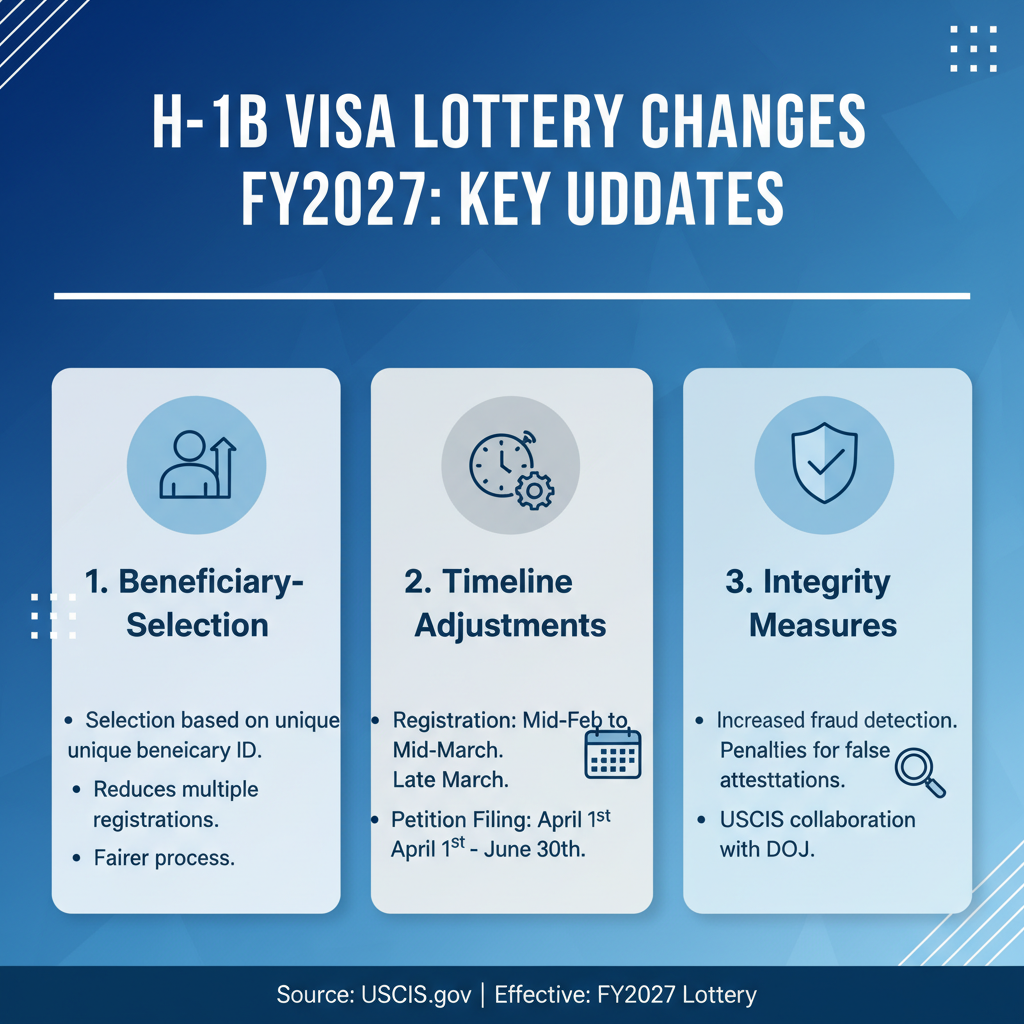
This comprehensive guide is prompted by recent developments and widespread discussions regarding the H-1B Visa Lottery Changes for FY2027 (Legal News). These changes, enacted by U.S. Citizenship and Immigration Services (USCIS), are designed to reform the selection process, primarily by shifting to a beneficiary-centric model. Understanding these new rules is paramount for both employers and prospective H-1B visa holders.
What This News Means for Immigrants in Orlando and Across Florida
For skilled professionals and employers in Orlando and throughout Florida, these H-1B lottery changes are not just bureaucratic updates; they represent a fundamental shift in strategy for securing one of the most coveted nonimmigrant work visas. Florida, with its burgeoning tech industry, growing healthcare sector, and diverse economy, is a hotbed for H-1B talent. From the bustling innovation corridors in Orlando to the biotech hubs in Gainesville and the financial centers in Miami, companies rely on the H-1B program to attract and retain top-tier international talent. These changes will directly impact how employers recruit and how foreign nationals pursue their professional dreams in the Sunshine State.
Why this news is showing up now
The H-1B visa program operates on a fiscal year basis, with each new fiscal year (FY) beginning on October 1st. The FY2027 H-1B lottery registration period is typically held in March of the calendar year 2026. USCIS usually announces significant policy changes well in advance to allow petitioners and beneficiaries to prepare. The recent announcements regarding the H-1B lottery changes for FY2027 are surfacing now because USCIS has finalized rules aimed at improving the integrity of the H-1B program, specifically targeting issues like the submission of multiple registrations for the same beneficiary by different employers, a practice that previously inflated selection odds for some individuals while disadvantaging others. These changes are part of a broader effort to modernize immigration processes and combat fraud, ensuring a more equitable system for all participants.
How it can affect Florida residents
For Florida residents, both employers and potential H-1B beneficiaries, these changes have significant implications:
- For Employers in Florida: Companies across Florida, from startups in Orlando's tech parks to established corporations along the I-4 corridor, must now adjust their H-1B recruitment and sponsorship strategies. The new beneficiary-centric selection means that if multiple related entities register the same individual, all registrations for that individual will be invalidated. This requires greater coordination and understanding of the rules to avoid disqualification. Employers will need to focus on submitting one strong, legitimate offer per candidate, rather than relying on multiple registrations.
- For Prospective H-1B Beneficiaries in Florida: Individuals currently in Florida on other nonimmigrant visas (like F-1 OPT or L-1) hoping to transition to H-1B status will find a more level playing field. The new rules aim to prevent a single individual from having multiple registrations submitted on their behalf by different employers, which previously gave an unfair advantage. This means that every eligible beneficiary now has a more genuinely equal chance in the lottery. However, it also means that if an individual has multiple job offers, they must choose which employer will submit their single registration, or risk having all registrations invalidated. This requires careful consideration and communication with prospective employers.
- Increased Scrutiny: USCIS is enhancing its ability to detect and deter fraud. This means that all registrations and subsequent petitions, particularly for those in Florida's competitive job market, will face increased scrutiny. Accurate and verifiable information is more critical than ever.
The Imigrar team, based in Orlando, understands the unique challenges and opportunities these changes present for the Florida community. We are here to guide you through every step of this evolving process.
Need Help? Our Orlando immigration team is ready to assist. Call +1 786-791-3106 for a free consultation, or message us online. Se Habla Español.
What H-1B Visa Lottery Changes for FY2027 Is (and Why It Matters)
The H-1B visa program allows U.S. employers to temporarily employ foreign workers in specialty occupations. These occupations generally require a bachelor's degree or higher in a specific field. Due to a statutory annual cap (currently 65,000 regular H-1B visas and an additional 20,000 for those with a U.S. master's degree or higher), USCIS conducts a lottery if the number of eligible registrations exceeds the available visas. The "H-1B Visa Lottery Changes for FY2027" refer to the new regulations implemented by USCIS, primarily focusing on how individuals are selected in this lottery.
A plain-English definition
Imagine a raffle where everyone wants to win a prize. Before, if you knew three different people organizing the raffle, each could put your name in, increasing your chances. The new H-1B rule says: "No, only ONE person can put your name in, no matter how many people want to nominate you." This means that instead of multiple employers registering the same person, each person (the "beneficiary") can only have one registration submitted on their behalf in the lottery. If USCIS finds that multiple employers tried to register the same person, all those registrations for that person will be thrown out. The goal is to make the lottery fairer, giving everyone a more equal shot, and reducing fraud where some individuals tried to game the system by having many employers register them.
Key terms you need to know
Understanding the following terms is crucial for navigating the H-1B lottery and its new changes:
- H-1B Visa: A nonimmigrant visa that allows U.S. employers to temporarily employ foreign workers in specialty occupations.
- Specialty Occupation: An occupation that requires a theoretical and practical application of a body of highly specialized knowledge, and a bachelor's or higher degree in the specific specialty (or its equivalent) as a minimum for entry into the occupation in the United States.
- Beneficiary: The foreign national seeking the H-1B visa. This is a key term for the new rules, as selection is now beneficiary-centric.
- Petitioner: The U.S. employer filing the H-1B petition on behalf of the beneficiary.
- Cap-Subject H-1B: H-1B petitions that are subject to the annual numerical limits (the "cap").
- Cap-Exempt H-1B: H-1B petitions that are not subject to the annual cap, typically for employment with institutions of higher education, non-profit organizations affiliated with higher education, or governmental research organizations.
- H-1B Registration: The mandatory electronic process where prospective petitioners (employers) submit basic information about the company and the beneficiary to USCIS before the lottery. This is usually done in March.
- Lottery Selection: If USCIS receives more registrations than available H-1B visas, it conducts a random lottery to select which beneficiaries are eligible to have a full H-1B petition filed on their behalf.
- Master's Cap: The additional 20,000 H-1B visas reserved for beneficiaries who have earned a U.S. master's degree or higher. These beneficiaries participate in a separate, initial lottery before being entered into the regular cap lottery if not selected.
- Petition Filing Period: The window during which selected petitioners can file their full Form I-129, Petition for a Nonimmigrant Worker, with USCIS. This typically begins on April 1st.
- Prevailing Wage: The average wage paid to similarly employed workers in a specific occupation in the area of intended employment. Employers must pay H-1B workers at least the prevailing wage or the actual wage paid to other employees with similar experience and qualifications, whichever is higher.
- Labor Condition Application (LCA): Form ETA-9035, certified by the U.S. Department of Labor (DOL), which must be filed by the employer before filing the H-1B petition. It attests to compliance with wage and working condition requirements.
- Request for Evidence (RFE): A notice from USCIS asking for additional documentation or information to support an H-1B petition.
- Change of Status: Applying to change from one nonimmigrant status (e.g., F-1 student) to another (e.g., H-1B worker) while remaining in the U.S.
- Consular Processing: Applying for a visa stamp at a U.S. embassy or consulate abroad to enter the U.S. in H-1B status.
Current Immigration Law: The Foundation
The H-1B visa program is governed primarily by the Immigration and Nationality Act (INA), specifically sections 101(a)(15)(H)(i)(b) and 214(g). These sections define the H-1B classification, establish the annual cap, and outline the general requirements for both employers and beneficiaries. The new FY2027 lottery changes are implemented under the authority granted to USCIS to manage the program effectively and ensure its integrity. You can always refer to the USCIS official website for the most up-to-date regulations and policy manuals.
Federal requirements
To qualify for an H-1B visa, both the employer (petitioner) and the foreign national (beneficiary) must meet specific federal criteria:
- For the Beneficiary:
- Must hold a bachelor's degree or its equivalent, or possess a license in a specialty occupation field, or have work experience equivalent to a bachelor's degree.
- Must be coming to the U.S. to perform services in a specialty occupation.
- Must meet any state licensing requirements for the occupation.
- For the Petitioner (Employer):
- Must offer employment in a specialty occupation.
- Must agree to pay at least the prevailing wage for the occupation in the area of employment, or the actual wage paid to employees with similar experience, whichever is higher.
- Must obtain a certified Labor Condition Application (LCA) from the U.S. Department of Labor (DOL) before filing the H-1B petition.
- Must have a genuine job offer for the beneficiary.
The annual cap for H-1B visas is 65,000, with an additional 20,000 for those with a U.S. master's degree or higher. Certain employers (universities, non-profits related to universities, government research organizations) are exempt from this cap.
Florida-specific considerations
While H-1B law is federal, its application has practical implications for Florida residents and businesses. The demand for H-1B visas is particularly high in Florida's growing sectors, such as:
- Technology: Orlando, Tampa, and Miami are emerging tech hubs with a high demand for software developers, IT professionals, and engineers.
- Healthcare: Florida's large and aging population creates a constant need for doctors, nurses, and medical researchers.
- Hospitality and Tourism: While less common for H-1B, certain highly specialized roles in management or niche technology within the tourism sector can qualify.
- Aerospace & Aviation: The Space Coast and areas around Orlando have a strong aerospace presence requiring specialized engineering and scientific talent.
Employers in these industries, and the foreign national professionals they seek to hire, will be directly affected by the FY2027 lottery changes. Ensuring compliance with all federal requirements, coupled with an understanding of the competitive landscape in Central Florida and beyond, is key to a successful H-1B process. The Orlando USCIS Field Office primarily handles adjustment of status applications and interviews, but understanding the local context and the types of employers in Orange County and the surrounding areas that commonly sponsor H-1Bs is valuable.
How to Navigate the H-1B Visa Lottery Changes for FY2027: A Complete Step-by-Step Guide
The H-1B lottery process, especially with the new FY2027 changes, requires meticulous attention to detail and strict adherence to timelines. Here’s a comprehensive step-by-step guide:
1) Employer Decision and Initial Assessment
The process begins with a U.S. employer identifying a need for a foreign national in a specialty occupation. This is a critical stage where the employer assesses the job role, the candidate's qualifications, and determines if the position meets the definition of a specialty occupation.
- Employer Actions:
- Determine if the position is a specialty occupation requiring a bachelor's degree or higher in a specific field.
- Verify the beneficiary's educational qualifications and experience.
- Confirm eligibility for H-1B sponsorship.
- Begin discussions with an experienced immigration attorney, like Imigrar, to understand the new beneficiary-centric rules and strategize.
- Beneficiary Actions:
- Provide all academic credentials, transcripts, degree certificates, and professional experience letters to the employer for evaluation.
- If multiple employers are interested, carefully choose which employer will submit the single registration, understanding that only one can be submitted for FY2027.
- Required Documents (Initial Review):
- Beneficiary's resume/CV
- Educational degrees, diplomas, and transcripts (with official English translations if applicable)
- Foreign degree evaluations (if applicable)
- Professional licenses (if applicable)
- Experience letters from previous employers
2) H-1B Registration Period (Crucial for New Rules)
This is the first major hurdle and where the FY2027 changes are most impactful. USCIS typically opens the electronic registration period in March. For FY2027, the key change is that selection will be based on each unique beneficiary. This means only one registration per beneficiary is allowed. If multiple registrations are submitted by different employers for the same beneficiary, all of them will be denied for that beneficiary.
- Employer Actions:
- Work with legal counsel to prepare and submit an electronic H-1B registration for the beneficiary via the USCIS online portal.
- Pay the required H-1B registration fee (for FY2027, this fee is expected to be higher than previous years, potentially increasing from $10 to $215).
- Ensure all information is accurate and consistent with the beneficiary's documents.
- Important: Verify that no other employer has submitted a registration for the same beneficiary to avoid invalidation. Coordinate carefully if the beneficiary has multiple offers.
- Beneficiary Actions:
- Communicate clearly with the chosen employer(s) to ensure only one registration is submitted on your behalf.
- Provide necessary personal details accurately to the employer for registration.
- Required Documents (for Registration):
- Beneficiary's full legal name, date of birth, country of birth, country of citizenship.
- Beneficiary's gender.
- Passport number.
- Beneficiary's U.S. Master's degree information (if applicable, for the Master's cap).
- Employer's legal name, EIN, and address.
- Attorney or representative information (if applicable).
3) Lottery Selection and Notification
After the registration period closes, USCIS conducts the lottery. First, selections are made for the 20,000 Master's cap visas. Then, unselected Master's cap registrations and all regular cap registrations are pooled for the 65,000 regular cap visas. USCIS typically notifies selected petitioners electronically by the end of March.
- Employer Actions:
- Monitor the USCIS online account for selection notifications.
- Upon selection, notify the beneficiary immediately and begin preparing the full Form I-129 petition.
- Beneficiary Actions:
- Await notification from the employer.
- If selected, prepare to gather all necessary personal and educational documents for the full petition.
4) Petition Filing (Form I-129)
If selected in the lottery, the employer has a specific window (usually from April 1st for 90 days) to file the complete H-1B petition (Form I-129) with USCIS. This step involves extensive documentation and detailed information about the employer, the beneficiary, and the specialty occupation.
- Employer Actions:
- File and obtain a certified Labor Condition Application (LCA) (Form ETA-9035) from the Department of Labor. This is a prerequisite for filing Form I-129.
- Prepare and file Form I-129, Petition for a Nonimmigrant Worker, along with all supporting documentation and required fees (which have also seen increases for FY2027).
- Include the H-1B lottery selection notice.
- For those in Florida, ensure the petition clearly outlines the job duties, the beneficiary's qualifications, and how the position meets the specialty occupation criteria, especially in competitive fields.
- Beneficiary Actions:
- Provide all requested documents to the employer/attorney promptly.
- Review the petition details for accuracy.
- Required Documents (for Form I-129 filing):
- Certified LCA (Form ETA-9035).
- H-1B lottery selection notice.
- Beneficiary's academic credentials (degrees, transcripts, evaluations).
- Beneficiary's resume/CV.
- Copies of all pages of the beneficiary's passport.
- Copy of current U.S. visa and I-94 Arrival/Departure Record (if in the U.S.).
- Employer's business license, federal tax ID, and financial statements.
- Company brochures, website printouts, and other evidence of business operations.
- Detailed job description, including duties, responsibilities, and required qualifications.
- Organizational chart.
- Employer support letter.
- Any previous immigration filings for the beneficiary.
5) USCIS Processing and RFE Responses
Once filed, USCIS reviews the petition. Processing times can vary (check USCIS Processing Times). It is common for USCIS to issue a Request for Evidence (RFE) if they need more information or clarification. Responding to an RFE accurately and thoroughly within the given deadline is crucial.
- Employer Actions:
- Monitor petition status.
- If an RFE is issued, work immediately with legal counsel to gather the requested evidence and formulate a strong response.
- Beneficiary Actions:
- Be prepared to provide additional documents or information quickly if an RFE is issued.
6) Visa Interview (Consular Processing) or Change of Status (Adjustment)
If the H-1B petition is approved, the next step depends on whether the beneficiary is inside or outside the U.S.
- If in the U.S. (Change of Status): If the beneficiary is already in the U.S. in a valid nonimmigrant status (e.g., F-1 OPT) and the petition requested a Change of Status, their status automatically changes to H-1B on October 1st (the start of the fiscal year) or the petition's start date, whichever is later.
- If outside the U.S. (Consular Processing): The beneficiary must attend a visa interview at a U.S. embassy or consulate in their home country. Upon approval, they receive an H-1B visa stamp in their passport to enter the U.S.
- Required Documents (for Consular Interview):
- H-1B Approval Notice (Form I-797).
- DS-160 Confirmation Page.
- Appointment confirmation page.
- Valid passport.
- Passport-style photos.
- Original educational documents.
- Resume/CV.
- Employer letter and job offer letter.
- LCA.
- Financial documents.
- Evidence of intent to return to home country (though H-1B is dual intent, it's good to be prepared).
7) H-1B Approval and Start of Employment
Once the petition is approved and the visa is obtained (or status changed), the beneficiary can begin working for the petitioning employer in H-1B status on the effective start date (typically October 1st).
- Employer Actions:
- Ensure the beneficiary starts work on the correct date.
- Maintain public access files and compliance records.
- Beneficiary Actions:
- Begin employment.
- Understand the terms of your H-1B status, including validity period and employer-specific nature.
Navigating the H-1B changes can be complex. Don't risk your future. Our dedicated team at Imigrar offers expert guidance. Call +1 786-791-3106 for your free consultation today. Se Habla Español.
Practical Steps You Can Take Today
Even though the FY2027 lottery registration is still some time away, proactive preparation is key, especially with the new rules in place. Here's an actionable checklist:
- Understand the Beneficiary-Centric Rule: If you are a foreign national, ensure you only have ONE registration submitted on your behalf. If you have multiple job offers, you must communicate clearly with your prospective employers and choose which one will register you. This is the most critical change for FY2027.
- Gather All Educational and Professional Documents: Start compiling your degrees, transcripts, professional licenses, and letters of experience. Ensure they are translated into English by certified translators if necessary. Foreign degree evaluations should be obtained well in advance.
- Review Your Resume/CV: Make sure your resume accurately reflects your qualifications and experience, aligning with the specialty occupation requirements.
- Employer Due Diligence: If you are an employer, verify that the job truly qualifies as a specialty occupation and that you can meet the prevailing wage requirements. Begin the process of determining the appropriate prevailing wage for the position.
- Consult an Immigration Attorney: This is perhaps the most crucial step. An experienced attorney can assess your eligibility, advise on the new rules, ensure compliance, and guide you through the entire process, minimizing errors that could lead to denial. Our team at Imigrar specializes in H-1B petitions for clients in Orlando and across the U.S.
- Monitor USCIS Announcements: Keep an eye on the USCIS official website for the exact dates of the FY2027 registration period and any further updates or clarifications on the new rules.
- Plan for Fees: Be aware of the increased H-1B registration and petition fees for FY2027. Budget accordingly.
- Consider Alternatives: While H-1B is popular, discuss other potential visa options (e.g., O-1 for extraordinary ability, L-1 for intracompany transfers) with your attorney, especially if H-1B seems particularly challenging for your situation.
Document preparation guidance
Accuracy and completeness are paramount. Ensure all documents are:
- Legible: Clear copies of all documents.
- Translated: Any document not in English must be accompanied by a certified English translation.
- Organized: Keep all documents in an organized folder, both physically and digitally.
- Consistent: Ensure names, dates, and other details are consistent across all documents. Discrepancies can lead to RFEs or denials.
Timeline expectations
Understanding the typical H-1B timeline is vital, especially with the FY2027 changes:
- October - February (Pre-Registration): Employer assessment, beneficiary document gathering, legal consultation.
- Early March (e.g., March 6-22, 2026): H-1B electronic registration period. This is the 90-day window when the single beneficiary registration must be submitted.
- Late March (e.g., March 27, 2026): USCIS announces lottery results.
- April 1st - June 30th (2026): Petition filing period for selected registrations (typically a 90-day window).
- April - September (2026): USCIS processes petitions. RFEs may be issued during this time.
- October 1st, 2026: The earliest date H-1B status can begin for approved petitions for FY2027.
Warning: These dates are estimates based on previous years. Always refer to official USCIS announcements for precise dates for FY2027.
How Imigrar Helps Immigrants in Orlando
At Imigrar, we understand that the H-1B visa process, especially with new regulations, can be a source of anxiety and confusion. Our firm, based in Orlando, Florida, is dedicated to "Keep Families Together


