


The reporting that sparked this guide: H-1B Visa Lottery Changes for FY2027 (Legal News)
What This News Means for Immigrants in Orlando and Across Florida
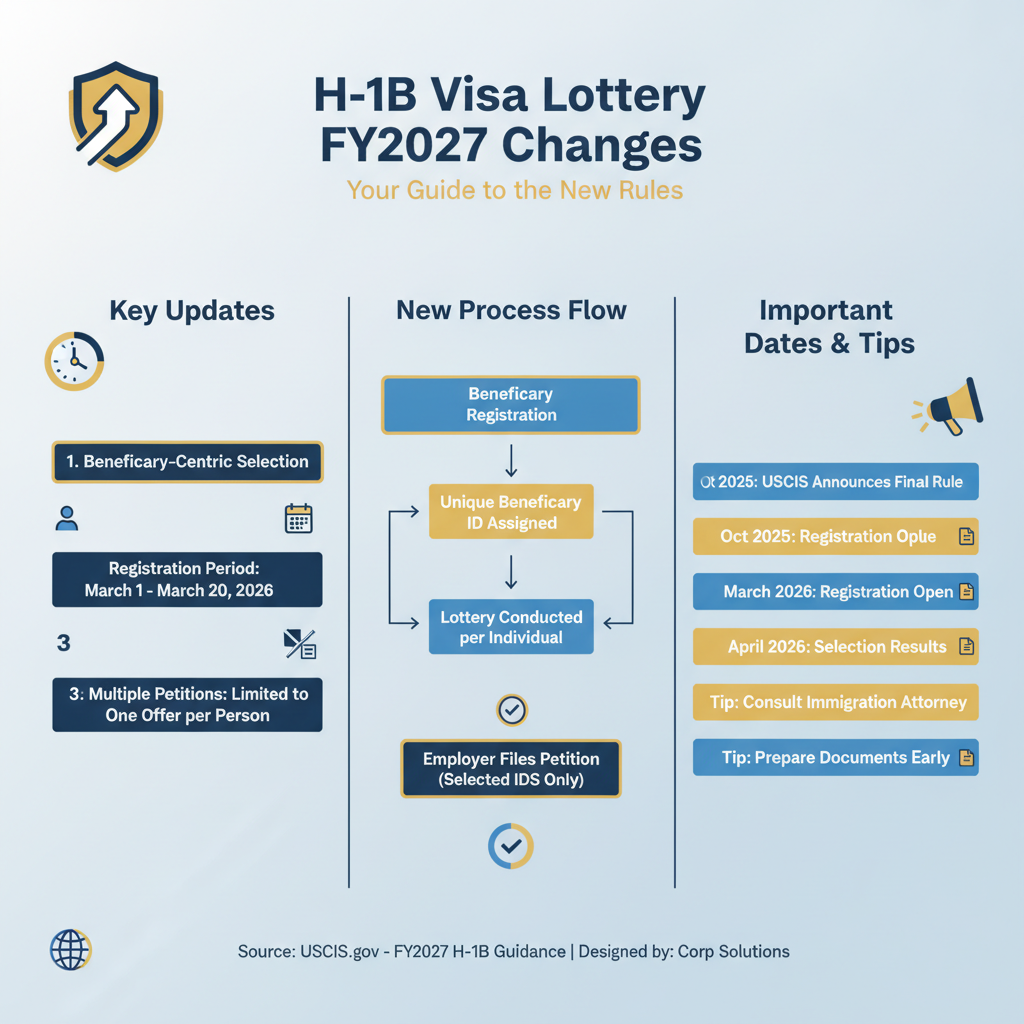
The landscape of U.S. immigration law is constantly evolving, and few areas see as much attention and change as the H-1B visa program. For Fiscal Year 2027 (FY2027), which began on October 1, 2026, the United States Citizenship and Immigration Services (USCIS) implemented significant modifications to the H-1B visa lottery process. These changes, primarily focused on combating fraud and ensuring a fairer selection process, have had a profound impact on foreign professionals and U.S. employers alike.
Why this news is showing up now
While the H-1B lottery registration period for FY2027 concluded in March 2026, and selections were announced shortly thereafter, the ripple effects of these new rules are still very much present. Today, on July 10, 2026, we are well into the period where selected employers are filing Form I-129, Petition for a Nonimmigrant Worker, and beneficiaries are preparing for their new roles or adjusting their status. The "news" isn't just about the initial announcement; it's about understanding the practical implications, the lessons learned from the FY2027 cycle, and how these established changes will likely shape future H-1B lotteries for FY2028 and beyond. USCIS introduced these changes to address concerns about the integrity of the lottery system, particularly regarding the submission of multiple registrations for the same beneficiary by different employers, a practice that inflated selection odds and disadvantaged legitimate applicants.
How it can affect Florida residents
Florida, with its booming tech sector, growing healthcare industry, and vibrant tourism and hospitality economy, is a significant hub for H-1B visa holders. Cities like Orlando, Miami, and Tampa attract a diverse pool of skilled foreign workers. For residents in Orlando and across the Sunshine State, these H-1B lottery changes directly impact several key groups:
- Prospective H-1B Beneficiaries: If you are a foreign national residing in Florida on another nonimmigrant visa (like an F-1 OPT or J-1 visa) and aspire to obtain an H-1B, the new "beneficiary-centric" selection process significantly alters your strategy. It means that regardless of how many employers register on your behalf, you only get one chance in the lottery, making the quality and legitimacy of your employer-sponsor more crucial than ever.
- Florida Employers: Companies in Orlando and throughout Florida seeking to hire highly skilled foreign talent must now navigate a revised registration and petitioning process. The emphasis on unique beneficiary registration places a greater responsibility on employers to ensure compliance and avoid any appearance of fraud, which could lead to severe penalties. Businesses along the I-4 corridor, particularly in the tech and simulation industries, are keenly affected.
- Immigration Attorneys and Consultants: Legal professionals in Central Florida, including the team at Imigrar, have adapted their counsel to guide clients through these updated regulations, ensuring adherence to the new beneficiary-centric approach and minimizing risks.
Understanding these changes is not just about compliance; it's about strategy, fairness, and securing your future in the U.S. It underscores the importance of legitimate employer-employee relationships and a transparent application process.
Navigating the New H-1B Rules? The FY2027 lottery changes are complex. Our Orlando immigration team at Imigrar specializes in H-1B visas and can help you understand your options and ensure compliance. Call +1 786-791-3106 for a free consultation, or message us online. Se Habla Español.
What H-1B Visa Lottery Changes for FY2027 Is (and Why It Matters)
The H-1B visa program is a nonimmigrant visa category that allows U.S. employers to temporarily employ foreign workers in specialty occupations. These occupations generally require a bachelor's degree or higher in a specific field. Due to high demand, the number of H-1B petitions far exceeds the annual cap set by Congress, necessitating a lottery system for selection. The changes implemented for FY2027 are a direct response to integrity concerns within this lottery system.
A plain-English definition
For FY2027, USCIS fundamentally altered how it conducts the H-1B lottery. Previously, if multiple employers registered the same prospective employee (beneficiary) for the lottery, each registration effectively gave that individual an additional "ticket" in the lottery. This practice led to a significant increase in the number of registrations per beneficiary, artificially inflating selection odds and reducing the overall integrity of the process. The new rule, often termed "beneficiary-centric selection," means that now, regardless of how many employers submit a registration on behalf of a single foreign national, that individual will only be entered into the lottery once. USCIS now conducts the selection based on the unique beneficiary's passport or travel document number, rather than on the number of registrations submitted by employers. If a beneficiary is selected, all employers who registered that beneficiary are notified, and only one of them can proceed with filing the H-1B petition.
This shift is monumental. It aims to level the playing field, reduce fraud, and ensure that each eligible individual has an equal chance of selection, rather than those with multiple employer offers gaining an unfair advantage.
Key terms you need to know
Navigating the H-1B process requires familiarity with specific terminology. Here are some key terms, especially relevant with the new FY2027 changes:
- H-1B Visa: A nonimmigrant visa allowing U.S. employers to temporarily employ foreign workers in specialty occupations.
- Specialty Occupation: An occupation that requires theoretical and practical application of a body of highly specialized knowledge, and a bachelor's or higher degree in the specific specialty.
- Annual Cap: The congressionally mandated limit on the number of H-1B visas issued each fiscal year. The current annual cap is 65,000 for the regular cap and an additional 20,000 for the U.S. master's degree exemption (the "master's cap").
- Cap-Subject: Refers to H-1B petitions that are subject to the annual numerical limits.
- Cap-Exempt: Certain employers (e.g., institutions of higher education, non-profit research organizations) are exempt from the annual cap.
- Beneficiary: The foreign national who will be employed in the specialty occupation.
- Petitioner: The U.S. employer filing the H-1B petition on behalf of the beneficiary.
- H-1B Registration: The online process where prospective petitioners (employers) submit basic information about the beneficiary and the job offer to USCIS during a specific window, prior to the lottery. This is a mandatory step before filing a full petition.
- Unique Beneficiary Registration: The core of the FY2027 changes. This means each beneficiary is entered into the lottery only once, regardless of how many employers register them. Selection is based on the unique individual.
- Duplicate Registrations: Under the old system, multiple employers could register the same beneficiary, leading to duplicate entries. The new system aims to eliminate the advantage gained from this.
- Fraud Detection and Prevention: USCIS's efforts to identify and penalize fraudulent registrations, such as those submitted by shell companies or without a legitimate job offer, which has intensified with the new rules.
- Form I-129, Petition for a Nonimmigrant Worker: The primary form filed by a U.S. employer to request H-1B classification for a foreign worker. This form is only filed if the registration is selected in the lottery.
- Employer Identification Number (EIN): A nine-digit number assigned by the IRS to businesses, required for H-1B registration.
Understanding these terms is crucial for anyone involved in the H-1B process, especially as USCIS continues to prioritize integrity and fairness. The FY2027 changes represent a clear move towards a more transparent and equitable system.
Current Immigration Law: The Foundation
The H-1B visa program is rooted in the Immigration and Nationality Act (INA), specifically Section 101(a)(15)(H)(i)(b) and Section 214(g). These sections define the H-1B classification and establish the annual numerical limits (the cap). While the specific lottery *process* can be modified by regulation, the underlying legal framework for the H-1B visa remains constant.
Federal requirements
To be eligible for an H-1B visa, both the employer (petitioner) and the foreign worker (beneficiary) must meet specific federal requirements:
- For the Beneficiary:
- Hold a bachelor's degree or its equivalent, or possess a license in a specialty occupation field, or have work experience equivalent to a bachelor's degree.
- The position offered must be a "specialty occupation."
- Meet any state licensing requirements for the occupation (e.g., for doctors, nurses, engineers).
- For the Petitioner (Employer):
- Offer a job in a specialty occupation.
- Pay the H-1B worker at least the prevailing wage for the occupation in the area of intended employment, or the actual wage paid to other employees with similar experience and qualifications, whichever is higher.
- File a Labor Condition Application (LCA), Form ETA-9035, with the U.S. Department of Labor (DOL) and receive certification before filing the H-1B petition. This form attests to the employer's compliance with wage and working condition requirements.
- Have a valid Employer Identification Number (EIN).
The primary form for requesting H-1B classification is Form I-129, Petition for a Nonimmigrant Worker. This form, along with supporting documentation, is submitted to USCIS only after a registration has been selected in the lottery. USCIS has comprehensive guidance available on its USCIS official website.
Florida-specific considerations
While H-1B requirements are federal, their application can have state-specific nuances, particularly concerning prevailing wages and licensing. For employers in Florida:
- Prevailing Wage: The Department of Labor determines prevailing wages based on the geographical area of employment. Wages for specialty occupations in Orlando, Tampa, or Miami may differ significantly from those in other states or even other parts of Florida. Employers must ensure they meet the prevailing wage for their specific Florida location.
- State Licensing: Certain professions, such as healthcare, engineering, or architecture, require state licensure. If a foreign national is coming to Florida for one of these roles, they must meet the Florida state licensing requirements before they can legally practice. This is a critical step that often needs to be initiated well in advance.
- Local Industry Needs: Florida's diverse economy means H-1B demand spans various sectors. The Orlando area, for instance, has a strong presence in simulation, aerospace, and hospitality, leading to H-1B needs in related IT, engineering, and management fields. Understanding the local job market helps both employers and beneficiaries prepare competitive applications.
Important: Staying updated on both federal and state regulations is crucial for a successful H-1B application in Florida.
How to Navigate the H-1B Visa Lottery Changes: A Complete Step-by-Step Guide
The FY2027 H-1B lottery changes fundamentally altered the initial registration and selection phase. This guide outlines the process, incorporating the "beneficiary-centric" selection approach, from the perspective of an employer and prospective employee in 2026-2027.
1) Understand the New Lottery Rules (Beneficiary-Centric Selection)
Before any action is taken, both employers and beneficiaries must grasp the core change: each unique beneficiary receives only one entry into the H-1B lottery, regardless of how many employers register them. USCIS uses the beneficiary's valid passport or travel document information to identify unique individuals. This means:
- For Beneficiaries: Focus on securing legitimate job offers from employers genuinely interested in sponsoring you. There is no longer an advantage to having multiple employers submit registrations for you.
- For Employers: Ensure your registration is legitimate and based on a bona fide job offer. USCIS is actively cracking down on fraudulent registrations.
Required Documents (for understanding): Review USCIS official announcements and FAQs regarding the FY2027 H-1B lottery changes, typically found on the USCIS official website under H-1B program updates.
2) Employer-Sponsored H-1B Petition: The Foundation
The H-1B visa is employer-sponsored. The beneficiary cannot self-petition. The process begins with a U.S. employer identifying a need for a specialty occupation worker and offering a position to a qualified foreign national.
- Employer Responsibilities:
- Confirm the position qualifies as a specialty occupation.
- Determine the prevailing wage for the position in the specific geographic area (e.g., Orlando, FL).
- Ensure the beneficiary meets the educational and experiential requirements for the role.
- Beneficiary Responsibilities:
- Provide all necessary personal and professional documents to the prospective employer.
- Maintain their current immigration status in the U.S. (if applicable).
Required Documents (for employer evaluation):
- Beneficiary's academic credentials (diplomas, transcripts, degree evaluations).
- Beneficiary's resume/CV.
- Job description and requirements.
- Employer's business license and EIN.
3) H-1B Registration Process
The first formal step for cap-subject H-1B petitions is the electronic registration process, which typically opens in March for the fiscal year starting October 1st. For FY2027, this happened in March 2026.
- Employer Action: The prospective petitioner (employer), often through their legal counsel, creates a registrant account on the USCIS H-1B registration website.
- Information Submission: For each beneficiary they wish to sponsor, the employer submits:
- Employer's name, address, and EIN.
- Beneficiary's full name, date of birth, country of birth, country of citizenship.
- Beneficiary's gender.
- Beneficiary's passport or travel document number (crucial for unique identification under new rules).
- Indication of whether the beneficiary is eligible for the master's cap.
- Registration Fee: A small, non-refundable fee (e.g., $10 for FY2027) is paid for each registration.
Warning: Under the new rules, if USCIS finds that multiple entities conspired to submit registrations on behalf of the same beneficiary to increase the odds of selection, all registrations for that beneficiary will be deemed invalid, and the employers may face fraud investigations and penalties.
4) The Lottery Selection and Notification
After the registration period closes, USCIS conducts the lottery. For FY2027, this occurred shortly after the March 2026 registration window.
- Lottery Conduct: USCIS first selects registrations for the master's cap (20,000) and then for the regular cap (65,000). Under the new rules, the selection is randomized based on the unique beneficiary, not on the number of registrations associated with them.
- Notification: USCIS notifies selected employers (and their legal representatives) through their online accounts. The status will change from "Submitted" to "Selected." Non-selected registrations will show "Not Selected" or "Denied" (if found to be invalid).
- Beneficiary Notification: If selected, all employers who registered that unique beneficiary will receive a "Selected" notification. The beneficiary then works with one chosen employer to proceed.
Timeline Expectation: For FY2027, selections were typically announced in late March or early April 2026. Employers then had a specific window (e.g., April 1, 2026, to June 30, 2026) to file the full H-1B petition.
5) Filing the H-1B Petition (Form I-129)
Only employers with a selected registration can proceed to this step.
- Labor Condition Application (LCA): The employer must file and receive certification for Form ETA-9035 from the Department of Labor. This process ensures compliance with wage and working conditions.
- Form I-129 Preparation: The employer, usually with the help of an immigration attorney, prepares and files Form I-129, Petition for a Nonimmigrant Worker, with USCIS.
- Supporting Documents (examples):
- Certified LCA (Form ETA-9035).
- Copies of beneficiary's educational degrees, transcripts, and any required evaluations.
- Beneficiary's resume/CV.
- Copies of beneficiary's passport, visa, and I-94 record (if applicable).
- Employment offer letter and detailed job description.
- Company financial statements, tax returns, and organizational charts to demonstrate ability to pay the H-1B wage and legitimacy of the business.
- Employer's letter of support outlining the specialty occupation and beneficiary's qualifications.
- Any required state licenses for the occupation in Florida.
- Filing Fees: Various fees are required, including the base filing fee for Form I-129, ACWIA fee, fraud prevention and detection fee, and potentially a Public Law 114-113 fee (for employers with 50+ employees and 50%+ H-1B/L-1 workers).
Reminder: The petition must be filed within the designated filing window specified in the selection notice (e.g., April 1 – June 30, 2026, for FY2027). Late submissions will be rejected.
Don't Risk Rejection! Filing an H-1B petition correctly, especially with the new rules, is critical. Let Imigrar's experienced attorneys in Orlando handle your case. Call +1 786-791-3106 for a free consultation. Se Habla Español.
6) Premium Processing and Adjudication
Once filed, USCIS reviews the petition.
- Regular Processing: Processing times can vary significantly. You can check current estimates on the USCIS Processing Times page.
- Premium Processing: Employers can opt for premium processing by filing Form I-907, Request for Premium Processing Service, for an additional fee. This guarantees USCIS will take action on the petition within 15 calendar days (e.g., approval, RFE, denial).
- Request for Evidence (RFE): USCIS may issue an RFE if they require more information or clarification. Prompt and thorough responses are essential.
- Approval/Denial: If approved, USCIS issues an I-797 Approval Notice. If denied, the reasons will be stated, and options for appeal or reconsideration may be available.
7) Visa Interview (Outside U.S.) / Change of Status (Inside U.S.)
The final step depends on the beneficiary's location.
- If Outside the U.S.: The beneficiary will attend a visa interview at a U.S. embassy or consulate in their home country. They will need the original I-797 Approval Notice, passport, visa application (Form DS-160), and supporting documents. Upon approval, an H-1B visa stamp is placed in their passport, allowing them to enter the U.S. no earlier than 10 days before the October 1 start date.
- If Inside the U.S.: If the beneficiary is already in the U.S. on a valid nonimmigrant status (e.g., F-1 OPT) and the H-1B petition included a request for a Change of Status (COS), the I-797 Approval Notice will indicate the change of status and the effective start date (October 1). The beneficiary does not need to leave the U.S. to get a visa stamp.
Important: Ensure continuous maintenance of legal status throughout the process. Consult an attorney if there are any gaps or expiring statuses.

Practical Steps You Can Take Today
Even though the FY2027 lottery registration is over, understanding these changes is vital for anyone planning to apply for an H-1B visa in the future. Here are practical steps you can take today to prepare for future cycles or manage your current FY2027 petition:
- Review Your Eligibility: Ensure you (as a beneficiary) meet the educational requirements for a specialty occupation and have a genuine job offer from a U.S. employer. Employers, verify the position qualifies and you can meet wage requirements.
- Gather and Organize Documents: Start compiling all necessary personal and professional documents. This includes academic records, degree evaluations, passport, visa history, and any professional licenses. Having these ready streamlines the process for your prospective employer.
- Communicate Clearly with Your Employer: If you are a beneficiary, discuss the H-1B process and the new beneficiary-centric rules with your potential employer. Ensure they understand their obligations and the importance of a single, legitimate registration.
- Understand Prevailing Wages in Florida: Employers, research the prevailing wage for the specific occupation and location in Florida. This is a critical compliance point. The DOL's Foreign Labor Certification Data Center is an excellent resource.
- Monitor USCIS Updates: H-1B rules can be updated. Regularly check the USCIS official website for the latest announcements, policy memos, and FAQs related to H-1B visas.
- Seek Expert Legal Counsel: The H-1B process is complex, and the new rules add another layer of intricacy. Consulting with an experienced immigration attorney, especially one familiar with the Orlando USCIS Field Office procedures, is invaluable. They can help ensure compliance, avoid mistakes, and navigate any challenges.
Document Preparation Guidance
- Academic Credentials: Ensure all foreign degrees are evaluated by a credential evaluation service to determine their U.S. equivalent. Keep original documents and certified translations handy.
- Passport/Travel Documents: Make sure your passport is valid for at least six months beyond your intended period of stay. The passport number is now critical for unique beneficiary identification.
- Employment Verification: Obtain letters from previous employers detailing your job duties, dates of employment, and qualifications.
- Company Documents (for employers): Have your company's


