


The landscape of U.S. immigration is ever-evolving, and for skilled professionals aspiring to work in the United States, few processes are as critical and competitive as the H-1B visa lottery. Today, as we stand on March 24, 2026, the discussion around the H-1B visa for Fiscal Year 2027 (FY2027) is more intense than ever, especially with significant new rules coming into play. These changes, designed to enhance fairness and combat fraud, demand careful attention from both prospective beneficiaries and sponsoring employers.
At Imigrar, an immigration law firm based right here in Orlando, Florida, we understand the profound impact these updates have on individuals and families striving to build their futures in the U.S. Our mission, "Keep Families Together," drives us to provide clear, actionable guidance through complex legal challenges. We serve clients nationwide, and we are fluent in both English and Spanish (Se Habla Español), ensuring everyone has access to expert legal support.
NEWS SOURCE REFERENCE SECTION
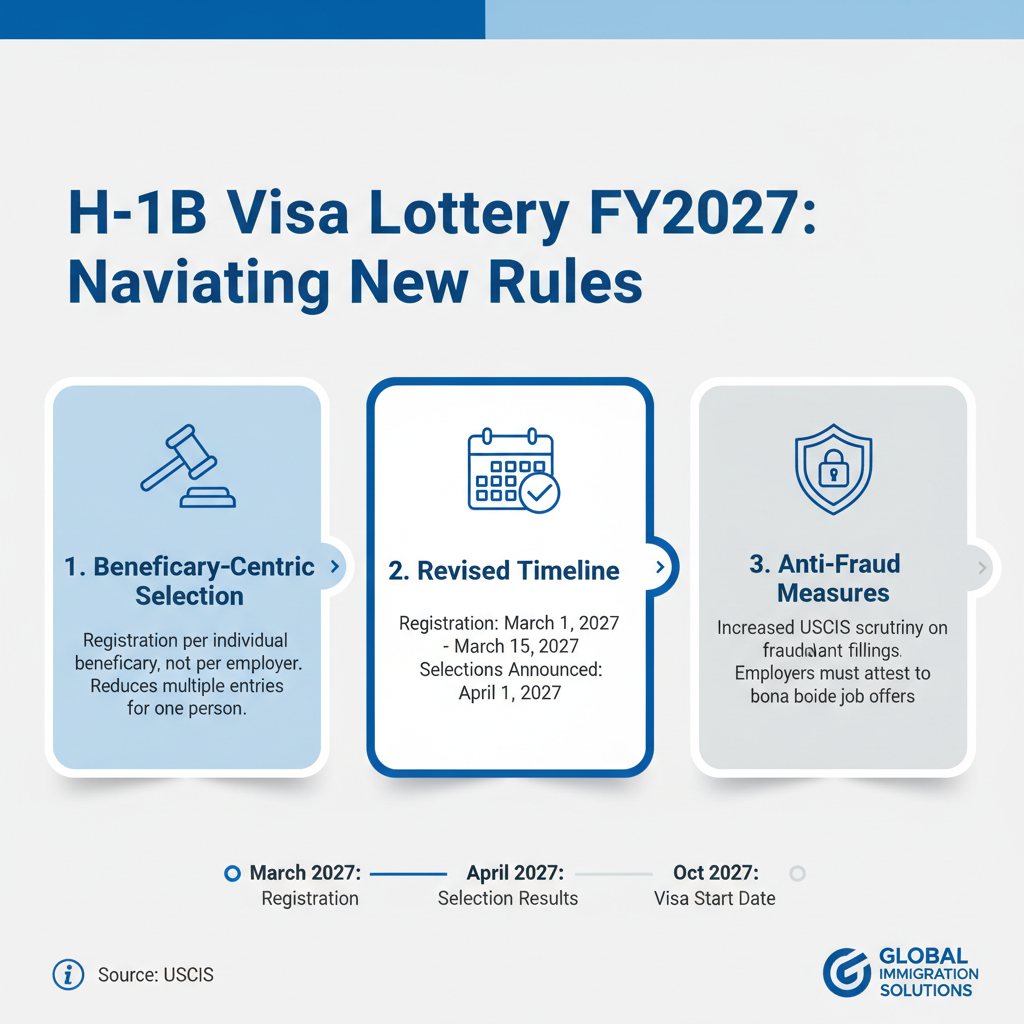
The reporting that sparked this guide: H-1B Visa Lottery Changes for FY2027 (Legal News)
What This News Means for Immigrants in Orlando and Across Florida
For countless skilled professionals, entrepreneurs, and graduates in Orlando, Central Florida, and throughout the Sunshine State, the H-1B visa represents a vital pathway to career growth and a stable future in the United States. The recent announcements from U.S. Citizenship and Immigration Services (USCIS) regarding the H-1B visa lottery for FY2027 are not just administrative updates; they are critical developments that directly affect thousands of lives and the economic landscape of our communities.
Why this news is showing up now
The H-1B visa program operates on a fiscal year basis, which begins on October 1st. To allow sufficient time for processing and the start of employment by October, USCIS conducts the lottery registration well in advance. For FY2027, the registration period typically opens in early March of 2026. As of today, March 24, 2026, the registration period has just concluded, and USCIS is either in the process of conducting the lottery or has recently announced the selections. This makes the news exceptionally timely for those who have just registered, are awaiting results, or are planning for future H-1B applications. The changes themselves stem from a "Final Rule" published by USCIS, aimed at addressing long-standing concerns about fraud and enhancing the integrity of the lottery system. These rules were finalized to be in effect for the FY2027 cap season, making their impact immediate and significant.
How it can affect Florida residents
Florida is a vibrant hub for technology, healthcare, tourism, and aerospace industries, all of which heavily rely on skilled foreign talent. Cities like Orlando, Tampa, and Miami attract a diverse pool of professionals seeking H-1B sponsorship. The new H-1B lottery rules for FY2027 have several key implications for Florida residents:
- Increased Fairness for Beneficiaries: Under the previous system, employers could submit multiple registrations for the same beneficiary, increasing their chances in the lottery. The new rule shifts to a "beneficiary-centric" selection process, meaning each unique beneficiary will only be entered once, regardless of how many employers register them. This significantly levels the playing field, giving every eligible individual a fairer shot.
- Reduced Fraud: The previous system was susceptible to abuse, with some entities submitting numerous registrations for the same individual without genuine job offers, solely to game the lottery. This new rule aims to curb such practices, ensuring that only legitimate job opportunities are considered. This benefits honest employers and applicants.
- Impact on Sponsoring Employers: Florida-based companies, especially in the tech corridor along I-4 in Orlando, or those associated with Central Florida's growing industries, must adjust their H-1B sponsorship strategies. They can still register multiple beneficiaries, but they must ensure each registration is for a unique individual. Employers must also be prepared to demonstrate a legitimate job offer for each sponsored worker.
- Planning for Future Years: Even if you participated in the FY2027 lottery, understanding these changes is crucial for future applications or if you need to advise colleagues. The shift in methodology sets a new precedent for how H-1B visas will be allocated going forward.
For those in Orlando and the surrounding areas, navigating these changes can be complex. Imigrar is strategically located to serve the needs of Central Florida's diverse immigrant community, offering expert guidance tailored to your unique situation.
Concerned about the H-1B changes? Don't face the new rules alone. Our Orlando immigration team is ready to assist. Call +1 786-791-3106 for a free consultation, or message us online. Se Habla Español.
What H-1B Visa Lottery Changes for FY2027 Is (and Why It Matters)
The H-1B visa is a nonimmigrant visa that allows U.S. employers to temporarily employ foreign workers in specialty occupations. These occupations generally require a bachelor's degree or higher in a specific field. Due to high demand, the number of H-1B petitions often exceeds the annual cap set by Congress, necessitating a lottery system. The changes for FY2027 specifically target how this lottery is conducted.
A plain-English definition
Imagine a highly sought-after concert where tickets are distributed via a lottery because demand far outstrips supply. Previously, if you wanted a ticket, you could have multiple friends enter the lottery on your behalf, each increasing your chances. The new H-1B rule for FY2027 is like saying, "From now on, no matter how many friends try to get you a ticket, your name only goes into the lottery *once*."
In simple terms, the H-1B visa lottery changes for FY2027 mean that USCIS will now select registrations based on each unique beneficiary (the foreign worker), rather than each registration submitted by an employer. This beneficiary-centric approach aims to eliminate the advantage gained by submitting multiple registrations for the same individual, thereby ensuring a more equitable chance for all eligible applicants. It's a direct response to concerns about fraud and the manipulation of the lottery system.
Key terms you need to know
Understanding the H-1B process requires familiarity with specific terminology. Here are some essential terms, especially relevant to the FY2027 changes:
- H-1B Visa: A nonimmigrant visa that allows U.S. employers to temporarily employ foreign workers in specialty occupations. These occupations generally require a bachelor's degree or higher in a specific field.
- USCIS (U.S. Citizenship and Immigration Services): The government agency that oversees lawful immigration to the United States. USCIS is responsible for administering the H-1B program and conducting the lottery. USCIS official website
- Beneficiary: The foreign national worker who is seeking the H-1B visa. Under the new rules, the lottery selection is now centered around the beneficiary.
- Petitioner: The U.S. employer sponsoring the foreign national for the H-1B visa.
- Cap-Subject H-1B: H-1B petitions that are subject to the annual statutory cap. This excludes certain employers like universities, non-profit research organizations, and government research organizations.
- Annual Cap: Congress limits the number of H-1B visas issued each fiscal year. The current annual cap is 65,000, with an additional 20,000 visas reserved for those with a U.S. master's degree or higher (the "Master's Cap").
- H-1B Registration Period: The designated timeframe (typically in March) during which prospective petitioners (employers) must electronically register their beneficiaries with USCIS for the upcoming fiscal year's lottery. For FY2027, this period just concluded.
- Lottery Selection Process (New for FY2027): Previously, selections were based on unique registrations. Now, selections are based on unique beneficiaries. If a beneficiary has multiple registrations submitted on their behalf by different employers, they are still only entered into the lottery once. If selected, all eligible petitioners who registered that beneficiary will receive a selection notice, and any one of them can proceed with filing an H-1B petition on behalf of that beneficiary.
- Final Rule: The official regulation published by USCIS that details these new changes. It went into effect for the FY2027 cap season, making these updates legally binding.
- Duplicate Filings/Registrations: Submitting more than one registration for the same beneficiary by the same employer, or under the old system, multiple employers submitting for the same beneficiary to inflate chances. The new rule specifically targets the latter to prevent fraud.
- Specialty Occupation: An occupation that requires a theoretical and practical application of a body of highly specialized knowledge, and a bachelor's or higher degree in the specific specialty (or its equivalent) as a minimum for entry into the occupation in the United States.
Understanding these terms is fundamental to navigating the H-1B process, especially with the strategic shift in the FY2027 lottery mechanics. The core takeaway is the move towards fairness and integrity, prioritizing the individual beneficiary over the number of employer submissions.
Current Immigration Law: The Foundation
The H-1B visa program is rooted in the Immigration and Nationality Act (INA), specifically 8 U.S.C. § 1101(a)(15)(H)(i)(b). This statute outlines the legal framework for nonimmigrant workers in specialty occupations. While the recent changes focus on the *selection process* for cap-subject H-1B visas, the fundamental eligibility criteria and statutory requirements remain largely the same. It's crucial for both employers and beneficiaries to understand these foundational laws.
Federal requirements
To qualify for an H-1B visa, both the employer (petitioner) and the foreign worker (beneficiary) must meet specific federal requirements:
- For the Beneficiary (Foreign Worker):
- Specialty Occupation Qualification: The beneficiary must hold a bachelor's degree or its equivalent, or possess a license in a specialty occupation field, or have work experience equivalent to a bachelor's degree. This is a critical requirement, as the H-1B is specifically for "specialty occupations."
- Job Offer: The beneficiary must have a job offer from a U.S. employer for a position that qualifies as a specialty occupation.
- Licensure: If the occupation requires a state license to practice (e.g., doctors, nurses, architects), the beneficiary must possess that license.
- For the Petitioner (U.S. Employer):
- Specialty Occupation Position: The employer must demonstrate that the offered position qualifies as a specialty occupation. This typically means the job duties are so complex or unique that they require a bachelor's degree or higher in a specific field.
- Wage Requirements: The employer must agree to pay the beneficiary at least the actual wage paid to other employees with similar experience and qualifications, or the prevailing wage for the occupation in the area of intended employment, whichever is higher. This is critical for preventing wage depression.
- Employer-Employee Relationship: A valid employer-employee relationship must exist, meaning the employer has the right to control the work of the beneficiary.
- Labor Condition Application (LCA): Before filing the H-1B petition, the employer must file a Form ETA-9035, Labor Condition Application, with the Department of Labor (DOL). The LCA attests that the employer will meet wage and working condition requirements.
The annual cap for H-1B visas is 65,000, with an additional 20,000 visas reserved for those with a U.S. master's degree or higher. This "Master's Cap" significantly increases the chances for graduates of U.S. advanced degree programs. Both caps are subject to the lottery if demand exceeds supply, which it almost always does.
Florida-specific considerations
While federal law governs the H-1B program, the implications for Florida are significant due to the state's economic landscape:
- Tech Sector Growth: Florida, particularly the Orlando-Kissimmee-Sanford metropolitan area and the I-4 corridor, has a booming tech sector. This includes modeling and simulation, aerospace, software development, and cybersecurity. These industries are major consumers of H-1B talent.
- Healthcare Demand: With a growing and aging population, Florida's healthcare industry is constantly seeking skilled professionals, including doctors, specialized nurses, and medical researchers, many of whom come to the U.S. on H-1B visas.
- Academic Institutions: Florida is home to numerous prestigious universities (e.g., University of Central Florida in Orlando, University of Florida, Florida State University). Graduates from these institutions often seek H-1B sponsorship. Furthermore, these institutions themselves can sponsor H-1B workers who are cap-exempt.
- Orlando USCIS Field Office: While H-1B petitions are generally processed at USCIS service centers, local field offices like the one in Orlando handle other immigration matters that may arise for H-1B holders (e.g., adjustment of status if transitioning to a green card).
The primary form used for filing an H-1B petition is Form I-129, Petition for a Nonimmigrant Worker. This form is complex and requires extensive documentation. You can find this and other forms on the USCIS Forms page.
Navigating these federal requirements and understanding their local impact is crucial. Imigrar assists employers and beneficiaries across Florida, ensuring compliance with all legal stipulations and increasing the chances of a successful H-1B application.
Need expert guidance on H-1B compliance? Our Orlando immigration team is ready to assist. Call +1 786-791-3106 for a free consultation, or message us online. Se Habla Español.
How to Navigate the New H-1B Lottery Process: A Complete Step-by-Step Guide
The H-1B lottery process for FY2027, with its new beneficiary-centric selection method, requires careful planning and execution. This guide outlines the essential steps, from understanding the new rules to potential visa stamping.
1) Understand the New Rules & Eligibility (Beneficiary-centric focus)
Before any action, both the beneficiary and the prospective employer must thoroughly understand the new regulations. The shift to a "beneficiary-centric" selection means:
- One Entry Per Beneficiary: Regardless of how many employers register a beneficiary, that individual will only have one entry in the lottery. This aims to prevent fraud and multiple registrations from gaming the system.
- Multiple Employers Can Register: Employers can still register the same beneficiary. If that beneficiary is selected, all employers who registered them will be notified. Any one of those employers can then proceed to file a petition.
- What to Do:
- Beneficiaries: Ensure all potential employers are aware of this rule. Focus on securing legitimate job offers from employers committed to your sponsorship.
- Employers: Verify the beneficiary's identity carefully to avoid issues. Ensure your job offer is genuine and that you intend to employ the beneficiary if selected.
- Required Documents (for understanding eligibility):
- Beneficiary's full legal name, date of birth, country of birth, country of citizenship.
- Passport number.
- Highest education degree and field of study.
- Copies of diplomas, transcripts, and any professional licenses.
- Resume/CV detailing work experience relevant to the specialty occupation.
- Job description from the prospective employer.
2) Employer Registration and Preparation
This is the first formal step in the H-1B cap lottery process. For FY2027, the registration period typically opens in early March 2026.
- Employer Action: The prospective employer (petitioner) must create a USCIS online account and electronically register the beneficiary. Each registration requires a fee.
- Information Required for Registration:
- Employer's legal name, EIN, and U.S. mailing address.
- Employer's authorized signatory information.
- Beneficiary's full legal name, date of birth, country of birth, country of citizenship, and passport number.
- Beneficiary's highest level of education (U.S. Master's or higher for Master's Cap consideration).
- Attorney or representative information (if applicable).
- Important: The registration fee is non-refundable, even if the beneficiary is not selected or the petition is not filed.
- Timeline: The registration period usually lasts about two to three weeks. For FY2027, this period has just concluded or is in its final days (as of March 24, 2026).
3) The H-1B Lottery Selection
After the registration period closes, USCIS conducts the lottery. For FY2027, selections are expected to be announced in late March 2026.
- USCIS Process: USCIS first conducts the lottery for the Master's Cap (20,000 visas) from the pool of U.S. advanced degree holders. Unselected Master's Cap registrations then join the regular cap pool (65,000 visas), and a second lottery is conducted.
- Notification: USCIS will notify selected registrants (employers/attorneys) through their online accounts. If a beneficiary was registered by multiple employers and selected, all employers who registered that beneficiary will receive a selection notice.
- Next Steps: Only those with a "Selected" status can proceed to file an H-1B petition. Those with "Not Selected" status cannot file for the current fiscal year unless they are cap-exempt. "Denied" status means the registration was invalid.
- Warning: Do not attempt to file an H-1B petition without a selection notice. It will be rejected.
4) Petition Filing (Form I-129)
If selected, the employer must file the H-1B petition (Form I-129, Petition for a Nonimmigrant Worker) within the designated filing window, which typically begins April 1st for the fiscal year starting October 1st.
- Filing Window: USCIS provides a specific 90-day window for filing the petition. Missing this deadline will result in rejection.
- Required Documents for Form I-129 (Employer):
- Certified Labor Condition Application (LCA) from DOL.
- Employer's IRS Tax ID (EIN).
- Company's financial statements, tax returns, and business license.
- Detailed job description, including duties, responsibilities, and required qualifications.
- Employer's letter of support outlining the job offer and need for the beneficiary.
- Company brochures, website printouts, and other evidence of business operations.
- Required Documents for Form I-129 (Beneficiary):
- Copies of all educational degrees, diplomas, and transcripts (with certified English translations if applicable).
- Evaluation of foreign degrees to U.S. equivalency (if applicable).
- All previous I-20s, EADs, I-94s, and visa stamps (if already in the U.S.).
- Resume/CV.
- Letters of experience from previous employers.
- Copy of passport biographical page.
- Any professional licenses.
- Important: All supporting documents must be accurate, consistent, and clearly demonstrate that both the beneficiary and the position meet H-1B requirements.
5) Premium Processing (Optional)
Employers can opt for premium processing for an additional fee to expedite the adjudication of the Form I-129 petition.
- Benefits: USCIS guarantees a 15-calendar-day processing time for petitions filed with Form I-907, Request for Premium Processing Service. If USCIS fails to meet this deadline, it refunds the premium processing fee.
- Cost: The current fee for premium processing is significant and is in addition to the regular filing fees.
- Consideration: While it speeds up adjudication, it does not guarantee approval. It's often used when there's a critical need for the worker to start or when responding to Requests for Evidence (RFEs).
6) Responding to RFEs (Requests for Evidence)
It's common for USCIS to issue an RFE if they need more information or clarification regarding the petition.
- Purpose: An RFE indicates that USCIS requires additional evidence to determine eligibility. It could relate to the specialty occupation nature of the job, the beneficiary's qualifications, the employer-employee relationship, or wage requirements.
- Action: Respond promptly and thoroughly to all points raised in the RFE within the given deadline. This often requires submitting additional documents, expert opinion letters, or detailed explanations.
- Warning: A weak or incomplete response to an RFE can lead to a denial. This is where an experienced immigration attorney is invaluable.
7) Visa Interview / Adjustment of Status
Once the H-1B petition is approved, the beneficiary's next steps depend on their current location and immigration status.
- Consular Processing (Outside U.S.): If the beneficiary is outside the U.S., they will attend an H-1B visa interview at a U.S. embassy or consulate in their home country. They will need their approval notice (Form I-797), passport, DS-160 confirmation, and other supporting documents. The U.S. Department of State website provides specific consulate requirements.
- Change of Status (Inside U.S.): If the beneficiary is already in the U.S. in a valid nonimmigrant status (e.g., F-1 OPT) and the H-1B petition requested a change of status, their status will automatically change to H-1B on October 1st (or the petition's start date). No consular interview is typically required.
- Adjustment of Status: If the beneficiary is already in the U.S. and has a path to a green card (e.g., through family or employment-based sponsorship), they might later file Form I-485, Application to Register Permanent Residence or Adjust Status.
Each step in this process is critical, and a misstep can lead to delays or denial. Professional legal guidance is highly recommended to ensure compliance and maximize your chances of success.
Practical Steps You Can Take Today for the FY2027 H-1B Lottery
Even though the FY2027 registration period has just concluded, proactive steps are essential, whether you're awaiting results, planning for a future lottery, or navigating the post-selection phase. For those in Orlando and across Florida, preparedness is key.
Actionable Checklist:
- Verify Your FY2027 Registration Status: If you or your employer registered, check your USCIS online account for selection notifications (expected late March 2026). Important: Act immediately if selected.
- Gather All Required Documents (Even if Not Selected Yet): If selected, you'll have a limited window to file the Form I-129 petition. Start compiling all personal and educational documents, employment history, and any professional licenses now. This includes original diplomas, transcripts, and foreign credential evaluations.
- Communicate with Your Sponsoring Employer: Ensure clear communication regarding deadlines, document submission, and the strategy for filing the petition if selected. Understand their commitment to the H-1B process and the new beneficiary-centric rule.
- Understand the Job Offer in Detail: Review your job description to confirm it aligns with a "specialty occupation" definition. This is critical for the H-1B petition's approval.
- Consult an Experienced Immigration Attorney: This is perhaps the most crucial step. An attorney can review your eligibility, prepare the comprehensive petition, advise on RFE responses, and represent you throughout the process. This is especially vital with the new rules.
- Review Previous Immigration History: Compile all previous visa stamps, I-94 records, and USCIS notices. Any past immigration issues or overstays must be disclosed and addressed by your attorney.
- Plan for Potential Consular Processing: If you are outside the U.S. or will need to travel, research the visa interview process at your local U.S. embassy or consulate.
Document Preparation Guidance
- Organize Digitally: Scan all documents clearly and organize them into labeled folders. This makes sharing with your attorney and employer efficient.
- Certified Translations: Any documents not in
Have Questions About Your Case?
Schedule a free consultation with our attorney-reviewed team today


