


The landscape of U.S. immigration law is constantly evolving, and for those seeking to live and work in the United States, staying informed is not just helpful – it’s essential. One of the most highly anticipated and competitive processes is the annual H-1B visa lottery. For Fiscal Year 2027 (FY2027), prospective H-1B visa holders and their employers must be keenly aware of significant changes, primarily the **beneficiary-centric selection process**, designed to foster fairness and combat fraud.
At Imigrar, an immigration law firm based in Orlando, Florida, our mission is to "Keep Families Together." We understand the dreams and challenges faced by immigrants, and we are dedicated to providing professional, accurate, and actionable legal guidance. This comprehensive guide will break down the latest H-1B visa lottery changes for FY2027, offering practical advice and step-by-step instructions to help you navigate this complex process successfully. Se Habla Español.
Need Expert H-1B Guidance? The H-1B lottery is highly competitive, and the new rules add another layer of complexity. Don't risk your future. Our Orlando immigration team is ready to assist you and your employer. Call +1 786-791-3106 for a free consultation, or message us online. Se Habla Español.
The reporting that sparked this guide:
H-1B Visa Lottery Changes for FY2027 (Legal News)
What This News Means for Immigrants in Orlando and Across Florida
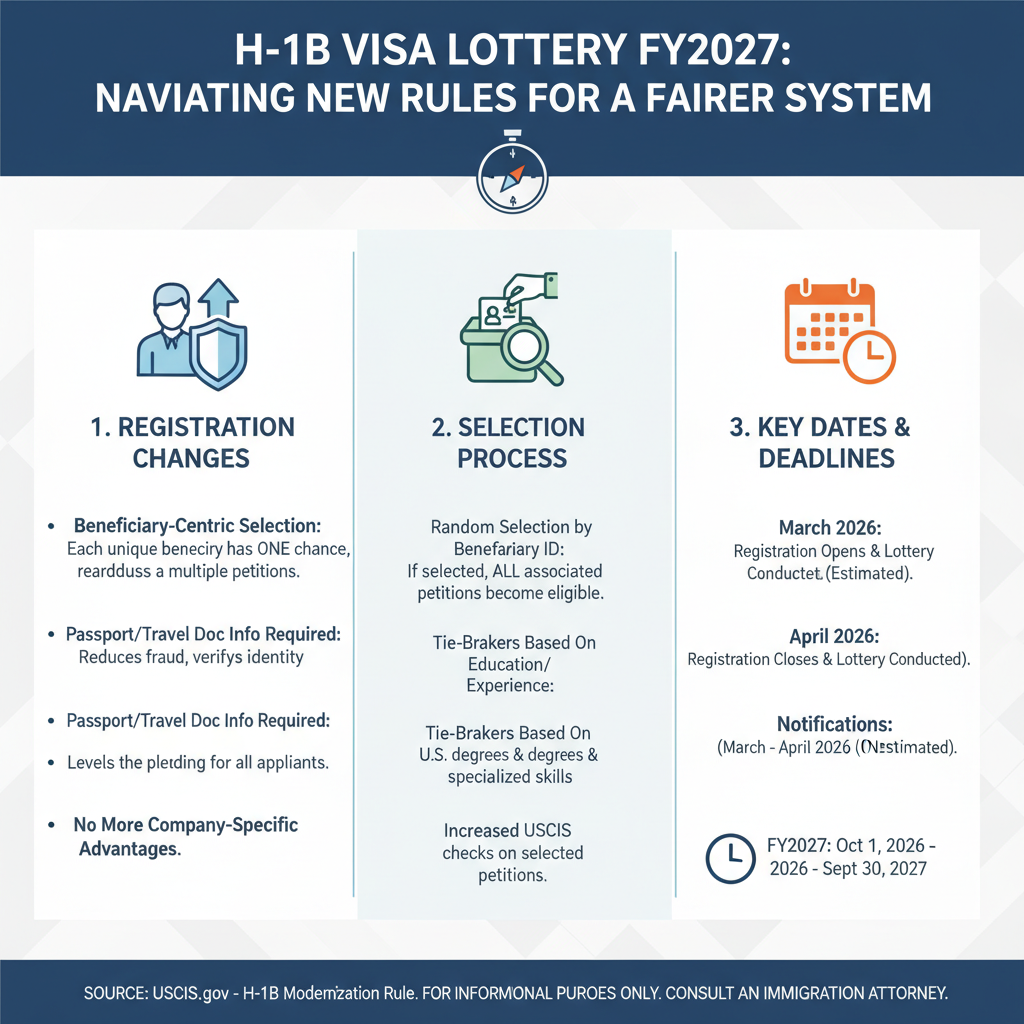
The news of H-1B visa lottery changes for FY2027 carries significant weight for skilled professionals and the businesses that seek to employ them, particularly here in Florida. As a growing economic hub with diverse industries, Florida relies heavily on a skilled workforce, and the H-1B program is a critical pathway for many.
Why this news is showing up now
Today, 2026-04-11, we are several months away from the typical H-1B electronic registration period for Fiscal Year 2027, which usually takes place in March of 2026. However, immigration news, especially concerning substantial policy shifts, often emerges well in advance to allow time for preparation and adaptation. The key "new rule" impacting FY2027 is the **beneficiary-centric selection process**, which was first implemented for the FY2025 lottery. This change fundamentally altered how registrations are submitted and selected, moving away from an employer-centric model to one focused on the individual beneficiary.
The U.S. Citizenship and Immigration Services (USCIS) introduced this rule to combat fraud and abuse, specifically the practice of multiple employers submitting registrations for the same individual to increase their chances of selection. By focusing the selection on the unique beneficiary, USCIS aims to create a fairer and more equitable lottery. While this rule technically debuted for FY2025, its continued application and refinement for FY2027 means that it remains "new" in terms of its ongoing impact and the need for all stakeholders to fully understand and comply with its implications. Planning for the FY2027 lottery, therefore, begins now, especially for employers and potential H-1B beneficiaries who need to align their strategies with these updated regulations.
How it can affect Florida residents
Florida, particularly the Orlando metropolitan area, is a dynamic economic landscape. Industries like technology, healthcare, aerospace, advanced manufacturing, and tourism are constantly seeking highly skilled talent. Universities like the University of Central Florida (UCF) in Orange County produce a large number of international graduates who often seek H-1B sponsorship.
For individuals residing in Orlando, along the I-4 corridor, or anywhere in Central Florida, these changes are critical:
- Increased Fairness, Intense Competition: While the beneficiary-centric selection aims for fairness by eliminating duplicate entries for a single individual, it doesn't reduce the overall demand. The H-1B cap remains fixed, meaning competition will continue to be fierce. Florida residents, whether international students graduating from local universities or professionals working on Optional Practical Training (OPT), must ensure their applications are impeccable.
- Employer Due Diligence: Florida employers, from tech startups in Orlando to healthcare providers across the state, must understand that they can still register multiple beneficiaries, but each beneficiary can only have one registration submitted on their behalf. This requires careful coordination between employers and potential employees to avoid disqualification.
- Early Preparation is Key: Given the competitive nature and the strict adherence required to the new rules, early preparation is more important than ever. This means gathering academic documents, professional credentials, and coordinating with potential sponsoring employers well in advance of the registration period.
- Impact on Local Industries: Florida's booming tech sector, particularly in areas like simulation and modeling, IT, and software development, heavily relies on H-1B visas. Any changes that streamline or complicate the process directly affect the ability of these companies to attract and retain global talent, impacting innovation and growth within the state.
The Orlando USCIS Field Office primarily handles adjustment of status interviews and naturalization applications, not H-1B petition processing itself. However, for those already in Florida on different statuses (like F-1 OPT) hoping to change status to H-1B, understanding these federal changes is paramount to ensuring a smooth transition.
What H-1B Visa Lottery Changes for FY2027 Are (and Why They Matter)
The H-1B visa program is a cornerstone of U.S. immigration for skilled foreign workers. It allows U.S. employers to temporarily employ foreign workers in specialty occupations. However, because the demand for H-1B visas far exceeds the annual supply, a lottery system is often necessary. The "changes" for FY2027 refer to the evolution and continued application of rules designed to enhance the integrity of this crucial program.
A plain-English definition
Imagine a highly sought-after concert where tickets are limited. In the past, people might have had multiple friends try to buy tickets for them, increasing their individual chances. The H-1B visa lottery used to operate somewhat similarly, where multiple employers could register the same person (beneficiary) for the lottery, each hoping to get a spot. While this was not explicitly illegal for the employers, it led to concerns about fraud and unfairly inflated selection rates for certain individuals.
The **H-1B Visa Lottery Changes for FY2027** primarily mean that the lottery selection process is now **beneficiary-centric**. This is the core "new rule" that was introduced for FY2025 and is now firmly established. In simple terms, regardless of how many eligible employers want to sponsor a particular individual, that individual (the beneficiary) will only have one entry in the lottery. If that individual is selected, any employer who submitted a registration for them can then proceed to file the H-1B petition. This change aims to ensure that each unique individual has an equal chance of selection, preventing potential abuse and making the lottery genuinely fairer for everyone.
Key terms you need to know
Navigating the H-1B process requires understanding specific terminology. Here are the key terms you'll encounter:
- H-1B Cap: The annual limit on the number of H-1B visas issued. Currently, Congress sets the cap at 65,000 visas each fiscal year, with an additional 20,000 visas reserved for those with a U.S. master's degree or higher (the "Master's Cap").
- Specialty Occupation: An occupation that requires theoretical and practical application of a body of highly specialized knowledge, and a bachelor's degree or higher in the specific specialty (or its equivalent) as a minimum for entry into the occupation.
- Beneficiary: The foreign national individual who is seeking the H-1B visa. Under the new rules, the lottery selection is now centered around this individual.
- Petitioner: The U.S. employer filing the H-1B petition on behalf of the beneficiary.
- LCA (Labor Condition Application): A form (Form ETA-9035) that an employer must file with the U.S. Department of Labor (DOL) before filing an H-1B petition. It attests that the employer will pay the H-1B worker at least the prevailing wage or the actual wage paid to similarly employed workers, whichever is higher, and provide working conditions that will not adversely affect other workers.
- Registration Period: The designated window (typically in March) during which employers electronically submit registrations for prospective H-1B beneficiaries.
- Selection Period: The time after the registration period when USCIS conducts the lottery (if needed) and notifies selected registrants.
- Petition Filing Period: The window (typically April 1 to June 30) during which employers whose registrations were selected can file the full H-1B petition (Form I-129) with USCIS.
- Cap-Exempt: Certain H-1B petitions are not subject to the annual cap. This includes petitions filed on behalf of beneficiaries who will be employed at institutions of higher education, non-profit organizations affiliated with higher education, or governmental research organizations.
- Master's Cap: The additional 20,000 visas reserved for beneficiaries who have earned a U.S. master's degree or higher. These are drawn before the regular cap.
The core of the FY2027 changes hinges on the **beneficiary-centric selection process**. This means that if multiple employers register the same individual, that individual still only gets one entry in the lottery pool. If that individual's single entry is selected, then any employer who registered them can proceed with filing the full H-1B petition. This significantly reduces the incentive for employers to collaborate on multiple registrations for one individual, thereby leveling the playing field and increasing the integrity of the lottery system. It matters because it directly impacts the chances of selection and streamlines the process by discouraging manipulative practices.
Confused by H-1B Terminology? Our legal team simplifies complex immigration language. Get clear answers and strategic advice. Contact Imigrar in Orlando for a free consultation at +1 786-791-3106. Se Habla Español.
Current Immigration Law: The Foundation
The H-1B visa program is authorized under the Immigration and Nationality Act (INA), specifically Section 101(a)(15)(H)(i)(b), which defines "H-1B nonimmigrant" as an alien coming temporarily to the United States to perform services in a specialty occupation. The regulations governing the H-1B program are found in Title 8 of the Code of Federal Regulations (8 CFR), particularly at 8 CFR 214.2(h).
Federal requirements
To qualify for an H-1B visa, both the petitioner (employer) and the beneficiary (employee) must meet specific federal requirements:
- Specialty Occupation: The job must qualify as a specialty occupation, meaning it requires a bachelor's degree or higher in a specific field as a minimum entry requirement. The beneficiary must possess this degree or its equivalent. This is a critical point that USCIS scrutinizes heavily.
- Employer-Employee Relationship: A valid employer-employee relationship must exist between the petitioning U.S. employer and the H-1B beneficiary.
- Prevailing Wage: The employer must agree to pay the H-1B employee at least the prevailing wage for the occupational classification in the area of employment, or the actual wage paid to other employees with similar experience and qualifications, whichever is higher. This is attested to in the **Labor Condition Application (LCA)**.
- H-1B Cap: As mentioned, the annual cap is 65,000, with an additional 20,000 for those with a U.S. master's degree or higher. Petitions are typically filed for an October 1 start date.
- Electronic Registration Requirement: Before filing an H-1B cap-subject petition, prospective petitioners must electronically register the beneficiary with USCIS during a designated period. This is where the **beneficiary-centric selection process** for FY2027 becomes crucial. Each beneficiary can only be the subject of one registration in a given fiscal year's lottery. Multiple registrations for the same beneficiary will result in the disqualification of all registrations for that individual.
- Required Forms: The primary form for an H-1B petition is **Form I-129, Petition for a Nonimmigrant Worker**. This form is filed with USCIS only after a registration has been selected in the lottery. Before filing Form I-129, the employer must have a certified **Form ETA-9035, Labor Condition Application (LCA)** from the Department of Labor.
For the most up-to-date information on H-1B requirements and regulations, always refer to the USCIS official website.
Florida-specific considerations
While immigration law is federal, its impact is felt locally. Florida does not have its own H-1B visa laws; the federal regulations apply uniformly across all states. However, the economic landscape and specific needs of Florida's industries shape the demand for H-1B visas and how these federal laws are experienced by residents and businesses.
- High Demand in Key Sectors: Florida's robust economy, especially in Orlando, Tampa, and Miami, generates significant demand for H-1B talent in sectors like information technology, healthcare (e.g., medical technologists, physical therapists), hospitality management (for certain specialty roles), and engineering.
- University Graduates: Florida is home to many excellent universities, including the University of Central Florida (UCF), University of Florida (UF), and Florida International University (FIU), which attract a large international student population. Many of these graduates pursue H-1B visas after completing their studies and Optional Practical Training (OPT).
- Local Legal Expertise: For Central Florida residents and businesses, having access to an immigration law firm like Imigrar in Orlando, which understands the local job market and can provide tailored advice, is invaluable. While the Orlando USCIS Field Office typically handles family-based petitions and adjustment of status interviews, our firm helps clients navigate the H-1B process from end-to-end, regardless of where the petition is physically adjudicated by USCIS service centers.
Understanding these federal requirements and their local implications is the first step toward a successful H-1B application for FY2027.

How to Navigate the FY2027 H-1B Visa Lottery: A Complete Step-by-Step Guide
The H-1B lottery process for FY2027, incorporating the beneficiary-centric selection, demands meticulous planning and execution. Here’s a detailed, step-by-step guide to help you and your employer navigate it.
1) Employer Assessment & LCA Filing
Before any H-1B petition can be considered, the employer must determine if the position qualifies as a **specialty occupation** and commit to paying the appropriate wage. This is the foundational step.
- Job Qualification: The employer analyzes the job duties to ensure they require a bachelor's degree or higher in a specific field.
- Prevailing Wage Determination: The employer must research and determine the prevailing wage for the position in the specific geographic area of employment.
- File LCA (Form ETA-9035): The employer files a **Labor Condition Application (LCA)** with the U.S. Department of Labor (DOL). This form attests to the employer's compliance with wage and working condition requirements. The LCA must be certified by the DOL before an H-1B petition can be filed.
- Required Documents (for LCA):
- Detailed job description, including duties, responsibilities, and minimum education/experience requirements.
- Employer's Federal Employer Identification Number (FEIN).
- Prevailing wage data source.
- Timeline Expectation: LCA processing typically takes 7-10 business days, but can vary. It’s crucial to file this well in advance of the H-1B registration period.
2) H-1B Electronic Registration
This is the gateway to the H-1B lottery. For FY2027, this step will happen in March 2026 (exact dates to be announced by USCIS). The **beneficiary-centric selection process** is paramount here.
- Create USCIS Online Account: The petitioning employer (or their authorized representative, like Imigrar) must create a USCIS online account.
- Submit Registrations: During the designated registration period (historically March 1-20), the employer submits an electronic registration for each prospective H-1B beneficiary. A registration fee (currently $10, but subject to change) is paid for each entry.
- Crucial New Rule Impact: Each unique beneficiary can only have ONE registration submitted on their behalf in a given fiscal year. If multiple employers wish to sponsor the same individual, they can each submit a registration, but USCIS will consolidate these into a single entry for that beneficiary in the lottery pool. If USCIS identifies multiple registrations for the same beneficiary from different employers, all registrations for that beneficiary will be disqualified unless they are legitimate registrations from bona fide employers.
- Required Documents (for Registration):
- Beneficiary's full legal name, date of birth, country of birth, country of citizenship, passport number.
- Beneficiary's gender.
- Beneficiary's highest degree earned.
- Employer's legal name, FEIN, and address.
- Employer’s attorney or representative information (if applicable).
3) Lottery Selection & Notification
After the registration period closes, USCIS conducts the lottery if the number of eligible registrations exceeds the annual cap.
- Lottery Conducted: USCIS randomly selects registrations, starting with the Master’s Cap, then the Regular Cap.
- Notification: USCIS typically notifies registrants of selection (or non-selection) by the end of March. Employers (or their representatives) will see the status update in their USCIS online accounts.
- Selection Notice: If selected, the employer will receive a selection notice that includes a unique **USCIS receipt number**. This notice is essential for the next step.
- Timeline Expectation: Results are usually released within a week or two after the registration window closes.
4) Petition Preparation & Filing (Form I-129)
Only if a registration is selected can the employer proceed to file the full H-1B petition.
- Assemble Petition: The employer, often with legal counsel from firms like Imigrar, prepares the complete H-1B petition packet, centered around **Form I-129, Petition for a Nonimmigrant Worker**.
- Filing Window: The petition must be filed within the designated filing


