


The landscape of U.S. immigration is constantly evolving, and for those aspiring to work in a specialty occupation, few changes are as impactful as those affecting the H-1B visa program. As of today, March 6, 2026, we are on the cusp of the H-1B Cap Registration for Fiscal Year 2027, and with it comes significant regulatory updates. Imigrar, your trusted immigration law firm in Orlando, Florida, is here to break down these crucial developments, ensuring you and your family are fully prepared to navigate the path ahead.
The reporting that sparked this guide
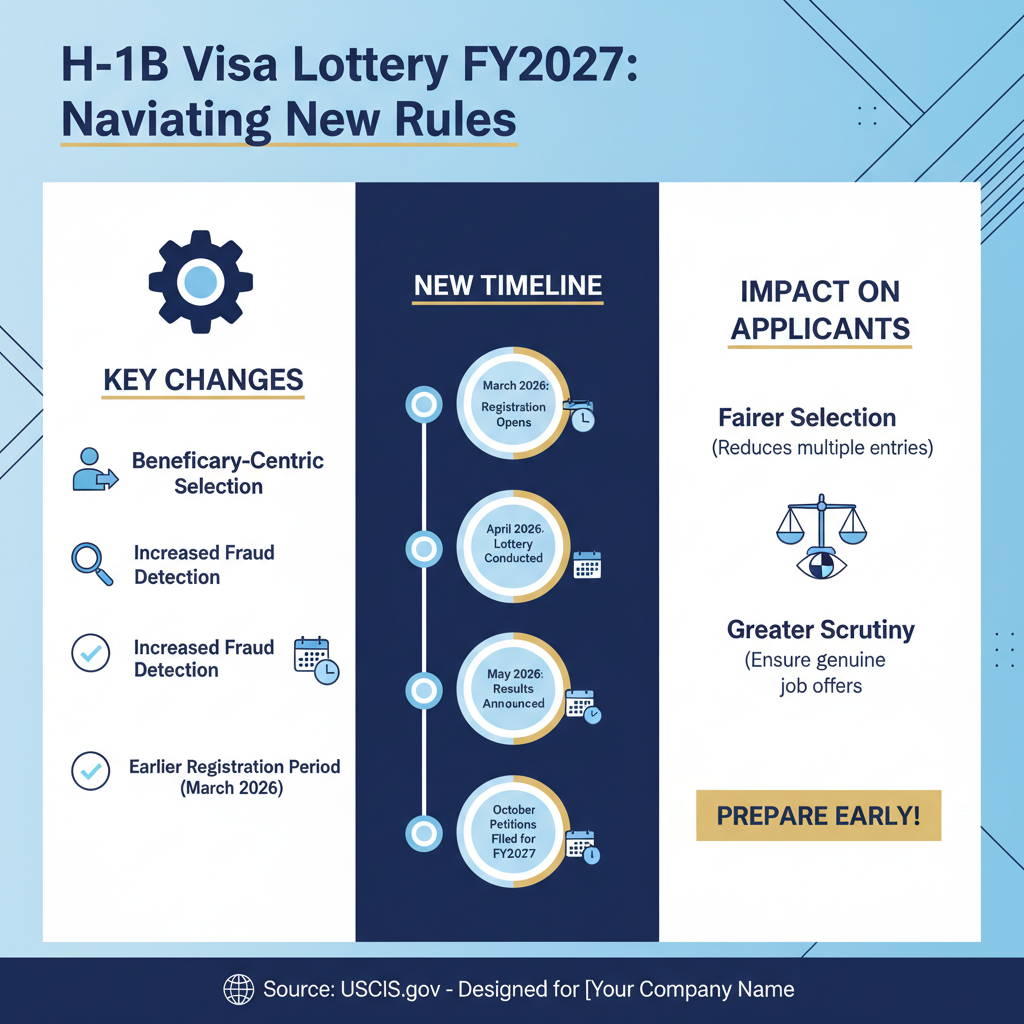
The recent discussions and official announcements concerning the H-1B visa lottery changes for FY2027 have generated considerable buzz within legal and professional circles. Our comprehensive analysis stems from these important updates, ensuring you have the most current and actionable information at your fingertips.
H-1B Visa Lottery Changes for FY2027 (Legal News)
What This News Means for Immigrants in Orlando and Across Florida
For skilled professionals, employers, and their families residing in Orlando, across Florida, and indeed nationwide, the H-1B visa program represents a vital pathway to career growth and a stable future in the United States. The H-1B visa is a nonimmigrant visa that allows U.S. employers to temporarily employ foreign workers in specialty occupations. These occupations generally require a bachelor's degree or higher in a specific field.
Why this news is showing up now
The U.S. government operates on a fiscal year that runs from October 1st to September 30th. For Fiscal Year 2027 (FY2027), which begins on October 1, 2026, U.S. Citizenship and Immigration Services (USCIS) is implementing a series of significant changes to the H-1B cap registration process. These changes were officially announced in late 2023 and early 2024, providing a crucial window for employers and prospective beneficiaries to understand and prepare. The timing of this news is critical because the annual H-1B cap registration period typically opens in early March for the fiscal year starting six months later. Therefore, as of March 6, 2026, the H-1B FY2027 cap registration period is either imminent or has just begun, making these new rules immediately relevant for anyone planning to participate.
The primary driver for these changes is USCIS's commitment to improving the integrity of the H-1B program, combating fraud, and ensuring a more equitable and efficient lottery selection process. Specifically, the new rules aim to address issues related to multiple registrations submitted on behalf of the same beneficiary by different employers, a practice that previously skewed the lottery odds. This proactive approach by USCIS is a direct response to past challenges and reflects an effort to streamline the system for all legitimate participants.
How it can affect Florida residents
Florida, particularly the Orlando metropolitan area, is a hub for diverse industries including technology, tourism, healthcare, aerospace, and finance. These sectors frequently rely on the H-1B program to fill specialty occupation roles that require highly skilled foreign workers. From the burgeoning tech scene along the I-4 corridor to the medical research facilities in Lake Nona, and the engineering firms across Orange County, many employers sponsor H-1B visas.
For Florida residents who are international students on F-1 visas (especially those on Optional Practical Training - OPT), or those on other nonimmigrant visas seeking to transition to H-1B status, these changes are profoundly important. The new beneficiary-centric selection process directly impacts their chances of being selected in the lottery. Instead of multiple employers registering the same individual, which theoretically increased their selection odds, the new system focuses on the individual beneficiary. This means that regardless of how many employers register a single beneficiary, that individual will only have one chance in the lottery. This aims to level the playing field and give every eligible beneficiary a fairer shot.
Employers in Central Florida must also adapt quickly. They need to understand their obligations under the new system, particularly regarding the attestation that they have a legitimate job offer for the beneficiary. The process of coordinating with potential H-1B employees, verifying their eligibility, and ensuring compliance with the new registration rules becomes even more critical. Failure to adhere to these new regulations could lead to disqualification or even accusations of fraud, impacting future H-1B petitions. Imigrar is deeply familiar with the nuances of immigration law as it applies to the unique economic landscape of Orlando and Florida, and we are ready to assist both employers and beneficiaries in navigating these complex changes.
Need Help? Our Orlando immigration team is ready to assist. Call +1 786-791-3106 for a free consultation, or message us online. Se Habla Español.
What H-1B Visa Lottery Changes for FY2027 Is (and Why It Matters)
The H-1B visa program is a cornerstone of U.S. immigration for skilled foreign workers, allowing them to fill critical roles in American industries. However, demand consistently outstrips supply, necessitating an annual lottery system. The changes for FY2027 aim to refine this lottery, making it fairer and more secure.
A plain-English definition
The H-1B visa is a special type of work visa for people who have at least a bachelor's degree (or its equivalent work experience) and want to work in a "specialty occupation" in the U.S. A specialty occupation is one that typically requires a specific higher education degree, like engineering, IT, medicine, or finance. Because there are many more qualified applicants than available visas each year, USCIS runs a lottery. The "changes" for FY2027 mean that the rules for entering this lottery have been updated, primarily to stop people from trying to game the system by having multiple companies register them, thereby increasing their chances unfairly. Now, the lottery selection is based on the individual person (the beneficiary), not how many companies registered for them. This means each person gets one fair chance, no matter how many job offers they have.
This change is a significant shift from previous years, where a beneficiary could have multiple H-1B registrations submitted on their behalf by different prospective employers. While each employer had to have a genuine job offer, the system inadvertently created an advantage for individuals with multiple offers, as each registration counted as an entry in the lottery. The new system aims to eliminate this perceived unfairness and ensure that every unique beneficiary has an equal chance of selection.
Key terms you need to know
Understanding the H-1B process requires familiarity with specific terminology:
- H-1B Visa: A nonimmigrant visa that permits U.S. employers to temporarily employ foreign workers in specialty occupations.
- Specialty Occupation: An occupation that requires a theoretical and practical application of a body of highly specialized knowledge, and a bachelor's or higher degree in the specific specialty (or its equivalent) as a minimum for entry into the occupation in the U.S.
- H-1B Cap: The annual numerical limit on the number of H-1B visas issued. Congress currently sets the annual regular cap at 65,000 and an additional 20,000 for those with a U.S. master's degree or higher (the "Master's Cap").
- Beneficiary: The foreign national worker who is seeking the H-1B visa.
- Petitioner: The U.S. employer who files the H-1B petition on behalf of the beneficiary.
- H-1B Cap Registration: The electronic process by which prospective petitioners (employers) submit basic information about the company and the beneficiary to USCIS during a specific period. This is the first step to enter the lottery.
- Selection Process (Lottery): If USCIS receives more registrations than available visas under the annual cap, it conducts a random lottery to select registrations.
- Master's Cap: The additional 20,000 visas reserved for beneficiaries who have earned a U.S. master's degree or higher from a qualifying educational institution.
- USCIS: U.S. Citizenship and Immigration Services, the government agency responsible for administering immigration and naturalization benefits. Link: USCIS official website
- LCA (Labor Condition Application): Form ETA-9035. An application filed with the U.S. Department of Labor (DOL) by an employer seeking to hire an H-1B nonimmigrant. It attests that the employer will pay the H-1B worker the prevailing wage or the actual wage, whichever is higher, and will provide working conditions that do not adversely affect other workers. This form is required *before* filing the H-1B petition (Form I-129).
- Beneficiary-Centric Selection: The core of the new FY2027 changes. This means that selections in the lottery will now be based on unique beneficiaries, rather than unique registrations. If a beneficiary has multiple registrations submitted on their behalf, they will only be entered into the lottery once.
These definitions are crucial for understanding the procedural and substantive shifts in the H-1B program for FY2027. The move to a beneficiary-centric selection method is a game-changer, emphasizing fairness and reducing the incentive for employers to submit multiple registrations for the same individual.
Current Immigration Law: The Foundation for H-1B Visas
The H-1B visa program is rooted in federal immigration statutes and regulations. Understanding these legal underpinnings is essential for compliance and successful petitioning.
Federal requirements
The H-1B visa program is authorized under the Immigration and Nationality Act (INA), specifically Section 101(a)(15)(H)(i)(b) and Section 214(g). These sections establish the framework for nonimmigrant visas for specialty occupations and define the annual numerical limitations (the cap).
Key federal requirements for an H-1B visa include:
- Specialty Occupation: The job offered must qualify as a specialty occupation, meaning it generally requires a bachelor's degree or higher in a specific field. USCIS examines the job duties, the nature of the employer's business, and industry standards to determine if the position meets this criterion.
- Educational Qualification: The beneficiary must hold a bachelor's degree or its equivalent, or possess a license that allows them to practice in a specialty occupation, or have work experience equivalent to a bachelor's degree. Foreign degrees must be evaluated to determine their U.S. equivalency.
- Employer-Employee Relationship: A valid employer-employee relationship must exist between the petitioner and the beneficiary, meaning the employer has the right to control the beneficiary's work.
- Prevailing Wage: Employers must pay the H-1B worker at least the prevailing wage for the occupational classification in the area of intended employment or the actual wage paid by the employer to other employees with similar experience and qualifications, whichever is higher. This is attested to in the Labor Condition Application (LCA).
- H-1B Cap Compliance: Unless exempt (e.g., working for a cap-exempt institution like a university or non-profit research organization), all H-1B petitions are subject to the annual cap and must go through the lottery process if demand exceeds supply.
The primary form used for an H-1B petition is Form I-129, Petition for a Nonimmigrant Worker. This form is filed by the U.S. employer on behalf of the foreign national beneficiary. Before filing Form I-129, the employer must first file and receive certification for a Labor Condition Application (LCA) from the U.S. Department of Labor (DOL), using Form ETA-9035.
For detailed information on these requirements and forms, always refer to the USCIS official website and the U.S. Department of State.
Florida-specific considerations
While H-1B laws are federal, their practical application varies by state and region due to local economic landscapes and enforcement priorities. In Florida, particularly the Orlando area, we see a high concentration of industries that frequently utilize H-1B visas. The technology sector, especially in areas like simulation and software development, is a significant employer of H-1B professionals. Healthcare systems, engineering firms, and financial services also frequently sponsor these visas.
For employers in Central Florida, understanding the prevailing wage for specific occupations in the Orlando-Kissimmee-Sanford metropolitan area is crucial for LCA compliance. The U.S. Department of Labor provides wage data specific to geographic areas, which employers must consult. The Orlando USCIS Field Office primarily handles interviews for Adjustment of Status and other benefits, but its presence underscores the active immigration community in the region. While the H-1B petition itself is processed at USCIS service centers, local counsel is invaluable for understanding regional employment trends, connecting with local employers, and ensuring all aspects of the H-1B process are handled meticulously, especially for those transitioning from F-1 OPT programs at Florida universities like UCF or UF.
The new beneficiary-centric lottery system means that employers in Florida who might have previously submitted multiple registrations for a single candidate (perhaps due to multiple departments or affiliated companies offering positions) must now adjust their strategy. They need to coordinate carefully to ensure only one registration per beneficiary is submitted, or at least understand that only one will count. This emphasizes the need for strong internal policies and legal guidance.
Need Help? Our Orlando immigration team is ready to assist. Call +1 786-791-3106 for a free consultation, or message us online. Se Habla Español.
How to Navigate the H-1B Visa Lottery Changes for FY2027: A Complete Step-by-Step Guide
The H-1B cap registration and petition process can be intricate, and the FY2027 changes add another layer of complexity. Here's a detailed, step-by-step guide to help you navigate it.
1) Understand the New Lottery Rules and Beneficiary-Centric Selection
The most significant change for FY2027 is the shift to a beneficiary-centric selection process. This means that each unique beneficiary, identified by their valid passport or travel document, will only be entered into the lottery once, regardless of how many employers submit registrations on their behalf. If multiple employers register the same beneficiary, USCIS will select that beneficiary once, and all employers who registered for them will be notified of the selection. Any of those selected employers can then proceed to file a petition.
- Action: If you are a beneficiary with multiple job offers, inform all prospective employers of this new rule. If you are an employer, verify with your potential H-1B employee if other employers are also registering for them.
- Required Documents (for understanding): None specific, but understanding the USCIS policy guidance on the final rule is crucial.
Important: This change aims to prevent potential fraud and ensure fairness. Employers must attest that the job offer is bona fide and that they intend to employ the beneficiary if the H-1B petition is approved.
2) Employer and Beneficiary Preparation
Before the registration window opens, both the employer (petitioner) and the foreign national (beneficiary) must gather necessary information and documents.
- For the Beneficiary:
- Valid passport or travel document (critical for unique identification).
- Educational degrees, diplomas, and transcripts (bachelor's or higher, U.S. or foreign equivalent).
- Foreign degree evaluations (if applicable, to prove U.S. equivalency).
- Resumes/CVs detailing work experience.
- Professional licenses or certifications (if required for the occupation).
- Any previous U.S. visa documents (e.g., F-1, OPT EAD, I-20s).
- For the Employer:
- Detailed job description for the specialty occupation.
- Wage information for the position and location (to determine prevailing wage).
- Employer's Federal Employer Identification Number (FEIN).
- Company contact information and authorized signatory details.
- Evidence of a legitimate job offer to the beneficiary.
- Action: Begin compiling these documents well in advance. For foreign degrees, initiate the evaluation process early, as this can take time.
3) H-1B Cap Registration Submission
This is the critical initial step to enter the lottery. The registration period typically occurs in early March.
- Timeline: The H-1B FY2027 cap registration period is expected to run from early March 2026 to mid-March 2026 (e.g., March 6 - March 22, 2026, though specific dates are announced by USCIS).
- Process:
- The prospective petitioner (employer), or their authorized representative (like Imigrar), creates a USCIS online account (or uses an existing one).
- They then submit a registration for each beneficiary they wish to sponsor, providing basic information about the company and the beneficiary, including the beneficiary’s valid passport or travel document number.
- A $10 non-refundable registration fee is paid for each registration.
- Required Documents (for registration):
- Beneficiary's full legal name, date of birth, country of birth, country of citizenship.
- Beneficiary's valid passport or travel document number.
- Beneficiary's gender.
- Whether the beneficiary has a U.S. master's or higher degree.
- Employer's legal name, FEIN, and mailing address.
- Employer's authorized signatory information.
- Action: Ensure all information is accurate and consistent with the beneficiary's passport. Double-check for typos. Multiple registrations for the *same beneficiary* are now processed differently, so employers must be aware that submitting multiple registrations for one individual does not increase their lottery chances, but rather ensures the beneficiary is entered once.
Reminder: Under the new rules, each beneficiary will be selected *once* in the lottery, even if multiple employers submit registrations for them. This means the individual beneficiary has one chance of selection, not one chance per employer.
4) Lottery Selection and Petition Filing
If selected in the lottery, USCIS will notify petitioners, who then have a specific window to file the full H-1B petition.
- Timeline: Selection notifications are typically sent by late March or early April (e.g., March 27 - April 1, 2026). The filing window for selected petitions usually extends for 90 days from the notification date (e.g., April 1 - June 30, 2026).
- Process (if selected):
- USCIS conducts the lottery, prioritizing the Master's Cap first, then the regular cap.
- Selected petitioners receive a "Selection Notice" in their USCIS online account.
- The employer (petitioner) must then prepare and file a complete H-1B petition (Form I-129) with all supporting documents within the designated filing window.
- Required Documents (for H-1B Petition - Form I-129):
- Certified Labor Condition Application (LCA) - Form ETA-9035.
- Evidence of the beneficiary's educational qualifications (degrees, transcripts, evaluations).
- Expert opinion letters (if specialty occupation qualification is ambiguous).
- Employment offer letter and detailed job description.
- Employer's financial statements or tax returns to demonstrate ability to pay the wage.
- Beneficiary's resume and immigration documents (I-94, previous visa stamps, EADs, I-20s).
- Organizational charts, company brochures, and other evidence of a legitimate business.
- Copies of any previous H-1B approval notices (if applicable).
- Client letters or work orders if the beneficiary will be placed at a third-party worksite.
- Action: If selected, immediately begin preparing the Form I-129 and all supporting documentation. This is where legal expertise from Imigrar is invaluable, as a well-prepared petition significantly increases the chances of approval.
5) Premium Processing (Optional)
For an additional fee, petitioners can opt for expedited processing of their H-1B petition.
- Timeline: USCIS guarantees a response (approval, denial, Request for Evidence - RFE, or Notice of Intent to Deny - NOID) within 15 calendar days for petitions filed with premium processing.
- Process: File Form I-907, Request for Premium Processing Service, along with the Form I-129 or separately after filing.
- Cost: As of October 2023, the fee for H-1B premium processing is $2,805. This fee is in addition to the regular filing fees.
- Action: Discuss with your employer whether premium processing is necessary, considering the cost and the urgency of the beneficiary starting work.
6) Visa Interview (If Consular Processing)
If the beneficiary is outside the U.S. or needs to travel abroad, they will undergo consular processing to obtain the H-1B visa stamp.
- Process:
- After I-129 approval, the case is sent to the National Visa Center (NVC).
- The beneficiary schedules an interview at a U.S. Embassy or Consulate in their home country.
- They attend the interview, where a consular officer reviews the petition and supporting documents, and determines eligibility.
- Required Documents (for interview):
- Valid passport.
- DS-160 confirmation page.
- Interview appointment confirmation.
- H-1B approval notice (Form I-797).
- LCA (Form ETA-9035).
- Employment offer letter.
- Academic credentials.
- Proof of previous employment.
- Photographs meeting visa requirements.
- Receipts for visa fees.
- Action: Prepare thoroughly for the interview. Our team at Imigrar can provide guidance and mock interviews to help you feel confident.
7) Maintaining H-1B Status
Once approved, it's crucial to maintain compliance with H-1B regulations.
- Key Requirements:
- Work only for the sponsoring employer in the approved specialty occupation.
- If changing employers, a new H-1B petition must be filed by the new employer.
- Report any material changes in employment (e.g., significant change in job duties or worksite location) to USCIS.
- Maintain valid passport and I-94 record.
- Do not engage in unauthorized employment.
- Action: Always consult with an immigration attorney before making any significant changes to your employment or personal circumstances that might impact your H-1B status.

Practical Steps You Can Take Today
Preparation is key, especially with the new beneficiary-centric rules. Here’s an actionable checklist:
- Consult an Immigration Attorney NOW: Whether you are an employer or a prospective H-1B beneficiary in Orlando or elsewhere, the first and most critical step is to seek expert legal advice. Imigrar can help you understand the nuances of the new rules and strategize your approach.
- Verify Beneficiary Eligibility: For beneficiaries, ensure your degree and work experience align with specialty occupation requirements. For employers, confirm your candidate meets the educational and experiential criteria for the role.
- Gather All Required Documents: Start compiling educational documents, passport copies, previous visa information, and detailed job descriptions. For foreign degrees, initiate the evaluation process immediately.
- Employer Internal Coordination: If your organization has multiple departments or affiliated entities, ensure clear internal communication to avoid submitting more than one registration for the same beneficiary. Remember, only one entry per beneficiary will be counted.
- Understand the New Beneficiary ID: USCIS will now use the beneficiary's valid passport or travel document number as the


