

The reporting that sparked this guide: H-1B Visa Lottery Changes for FY2027 (Legal News)
What This News Means for Immigrants in Orlando and Across Florida
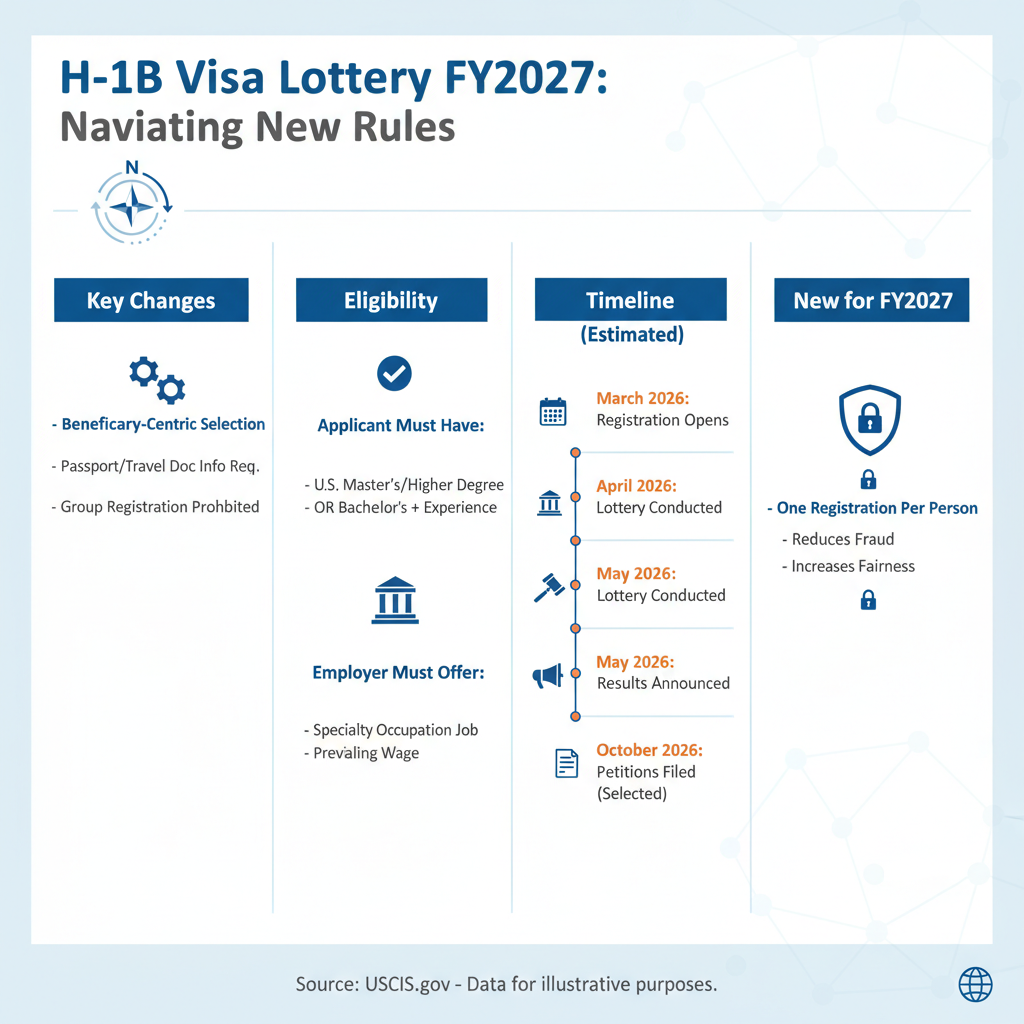
For skilled professionals seeking to work in the United States, the H-1B visa program is often the primary pathway. Each year, demand far outstrips the available visas, leading to a highly competitive lottery system. News of changes to this system for Fiscal Year 2027 (FY2027) is not just a headline; it's a critical development that could significantly impact your future in Orlando, across Florida, and indeed, nationwide. At Imigrar, we understand that these updates can bring both hope and uncertainty, and our mission is to provide clarity and actionable guidance to keep families together.
Why this news is showing up now
Immigration processes, especially those as complex and high-demand as the H-1B program, are constantly under review and subject to regulatory adjustments by U.S. Citizenship and Immigration Services (USCIS). As we approach the H-1B cap season for FY2027 (which typically begins in March 2026), USCIS has been proactive in announcing modifications aimed at increasing fairness, reducing fraud, and streamlining the overall process. These changes often stem from ongoing evaluations of past lottery seasons, feedback from stakeholders, and the agency’s commitment to program integrity. The timing of this news is crucial because it gives prospective petitioners and beneficiaries time to understand and adapt to the new requirements before the registration window opens, ensuring they are prepared for the upcoming competitive cycle.
How it can affect Florida residents
Florida, particularly the greater Orlando area, is a vibrant hub for technology, aerospace, healthcare, tourism, and various other industries that heavily rely on H-1B talent. Employers across the I-4 corridor, from startups in Orlando’s tech parks to established corporations, frequently sponsor H-1B visas. For individuals living in Florida on other nonimmigrant visas (like F-1 OPT, L-1, or TN) who aspire to transition to H-1B status, these changes are paramount. They could influence:
- Your chances of selection: New lottery rules, such as the beneficiary-centric selection process, aim to give each individual a fairer shot, regardless of how many employers register them.
- The preparation required: Enhanced scrutiny or new data requirements might mean more work for both you and your sponsoring employer during the registration and petition filing phases.
- Costs and timelines: Updated filing fees and potential processing adjustments could affect the financial commitment and the overall timeline for obtaining your H-1B visa.
- Employer strategy: Florida-based companies will need to adapt their H-1B sponsorship strategies to comply with the new regulations, potentially affecting how they recruit and retain foreign talent.
Whether you're a recent graduate from a Florida university, a professional working on OPT in Orange County, or an employer looking to sponsor essential talent, understanding these updates is vital for navigating the H-1B landscape successfully.
Need Help? Our Orlando immigration team is ready to assist. Call +1 786-791-3106 for a free consultation, or message us online. Se Habla Español.
What H-1B Visa Lottery Changes for FY2027 Is (and Why It Matters)
The H-1B visa program is a nonimmigrant visa category that allows U.S. employers to temporarily employ foreign workers in specialty occupations. These occupations generally require a bachelor's degree or higher in a specific field. Due to a statutory annual cap of 65,000 visas, plus an additional 20,000 for those with a U.S. master's degree or higher (the "Master's Cap"), demand consistently exceeds supply. This disparity necessitates an annual lottery, making the H-1B one of the most sought-after and competitive visas.
A plain-English definition
In simple terms, the H-1B visa allows U.S. companies to hire skilled foreign workers in specific jobs. Because too many people want these visas, the government uses a lottery system to decide who gets a chance to apply each year. For FY2027, the "changes" refer to new rules for how this lottery will be conducted and how applications will be processed. The most significant shift is the move towards a beneficiary-centric selection process. This means that instead of giving each employer registration an equal chance, USCIS will focus on each individual beneficiary (the foreign worker). If multiple employers register the same individual, that individual will only be entered into the lottery once. This aims to prevent fraud where employers might submit multiple registrations for the same person to increase their odds, thereby giving a fairer chance to all unique beneficiaries.
Additionally, USCIS has implemented significant fee increases for various immigration forms, including the H-1B petition, which will impact the overall cost for employers. These fee adjustments are part of a broader effort by USCIS to recover operational costs and improve processing efficiency.
Key terms you need to know
- USCIS (U.S. Citizenship and Immigration Services): The government agency that administers immigration benefits, including the H-1B program.
- Beneficiary: The foreign national who seeks to obtain the H-1B visa.
- Petitioner: The U.S. employer who sponsors the foreign national for the H-1B visa.
- Specialty Occupation: An occupation that requires theoretical and practical application of a body of highly specialized knowledge and a bachelor's or higher degree in the specific specialty (or its equivalent) as a minimum for entry into the occupation in the United States.
- Annual Cap: The legal limit on the number of H-1B visas issued each fiscal year (65,000 regular cap + 20,000 Master's Cap).
- Fiscal Year (FY): The U.S. government's fiscal year runs from October 1 to September 30. H-1B visas for FY2027 become available on October 1, 2026.
- H-1B Registration: An electronic process where prospective petitioners (employers) submit basic information about the company and the prospective H-1B beneficiary to USCIS. This takes place before the lottery.
- Lottery Selection: If the number of registrations exceeds the annual cap, USCIS conducts a random lottery to select registrations eligible to file an H-1B petition.
- Petition Filing Period: The specific timeframe during which selected petitioners can file their full Form I-129, Petition for a Nonimmigrant Worker.
- Labor Condition Application (LCA): Form ETA-9035, a document that an employer must file with the U.S. Department of Labor before filing an H-1B petition with USCIS, attesting to prevailing wages and working conditions.
- Beneficiary-Centric Selection: The new rule for FY2027 where each unique beneficiary is entered into the lottery only once, regardless of the number of registrations submitted on their behalf.
Current Immigration Law: The Foundation
The H-1B visa program is governed primarily by the Immigration and Nationality Act (INA), specifically sections 101(a)(15)(H)(i)(b) and 214(g). These statutes establish the framework for the visa, including eligibility criteria, duration, and the annual cap. USCIS implements these laws through regulations found in the Code of Federal Regulations (CFR), Title 8, Part 214.
Federal requirements
To be eligible for an H-1B visa, both the employer and the employee must meet specific federal requirements:
For the Employer (Petitioner):
- The employer must offer a job in a specialty occupation.
- The employer must agree to pay the H-1B worker at least the prevailing wage for the occupation in the area of intended employment, or the actual wage paid to other employees with similar experience and qualifications, whichever is higher. This is attested to in the Labor Condition Application (LCA) Form ETA-9035.
- The employer must have an Employer Identification Number (EIN).
For the Employee (Beneficiary):
- The individual must possess a bachelor's degree or its equivalent, or a license in a specialty occupation field, or work experience equivalent to a bachelor's degree.
- The individual must be qualified to perform services in the specialty occupation.
The annual cap remains a central feature of the H-1B program. USCIS conducts the lottery if the number of registrations exceeds the cap. Certain H-1B petitions are cap-exempt, such as those filed by institutions of higher education, non-profit organizations affiliated with them, or non-profit research organizations or government research organizations. These employers can file H-1B petitions at any time of the year without going through the lottery.
Important: The new beneficiary-centric selection process for FY2027 is a significant regulatory change under 8 CFR 214.2(h)(8)(i)(A)(4), designed to curb abuse and ensure fairness in the lottery system.
For more detailed information on H-1B regulations and requirements, you can always refer to the USCIS official website on H-1B visas.
Florida-specific considerations
While H-1B regulations are federal, their impact is felt keenly at the local level. Florida does not have its own H-1B specific immigration laws, but the state's economic landscape and workforce demands make the H-1B program particularly relevant. For Central Florida residents and employers, understanding the implications is key:
- Tech Hub Growth: Orlando and Tampa are burgeoning tech hubs, attracting companies that frequently seek H-1B workers in IT, software development, and engineering. The changes affect how these companies will recruit and retain top talent.
- University Talent: Graduates from Florida universities such as the University of Central Florida (UCF), University of Florida (UF), and Florida State University (FSU) often utilize H-1B visas after their OPT. The new rules directly impact their post-graduation employment prospects.
- Orlando USCIS Field Office: While H-1B petitions are processed at service centers, local services at the Orlando USCIS Field Office may be relevant for certain follow-up actions or general inquiries.
Employers in Orlando and beyond must be particularly diligent in ensuring compliance with the new H-1B registration process, especially concerning the beneficiary-centric selection. Any attempt to circumvent this rule by submitting multiple registrations for the same beneficiary by different related entities could lead to disqualification of all registrations for that beneficiary.
Navigating these changes can be complex. Let Imigrar's experienced immigration attorneys simplify the process for you. Call +1 786-791-3106 today for expert guidance. Se Habla Español.
How to Navigate the H-1B Visa Lottery Changes for FY2027: A Complete Step-by-Step Guide
Successfully securing an H-1B visa requires meticulous planning and adherence to strict deadlines. With the FY2027 changes, precision is more critical than ever. Here’s a detailed guide for prospective beneficiaries and their sponsoring employers:
1) Employer Assessment and Prevailing Wage Determination
Before any registration can occur, the employer must determine if the position qualifies as a specialty occupation and ascertain the appropriate prevailing wage. This is a foundational step to ensure compliance with H-1B requirements and avoid potential issues later. Required Documents (Employer):
- Detailed job description, including duties, responsibilities, and minimum education/experience requirements.
- Employer’s Federal Employer Identification Number (EIN).
- Company financial statements or tax returns (to demonstrate ability to pay the prevailing wage).
- Information on the proposed H-1B worker’s qualifications (resume, transcripts, degree evaluations).
Actionable Advice: Begin this process early. Prevailing wage determinations can take time, whether through formal requests to the Department of Labor or through independent wage surveys. Incorrect wage determination is a common reason for H-1B petition denials.
2) Labor Condition Application (LCA) Filing
Once the prevailing wage is determined, the employer must file a Labor Condition Application (LCA) Form ETA-9035 with the U.S. Department of Labor (DOL). The LCA attests that the employer will pay the H-1B worker at least the prevailing wage or the actual wage, whichever is higher, and provide working conditions that will not adversely affect other workers. The DOL must certify the LCA before an H-1B petition can be filed with USCIS. Required Documents (Employer):
- Certified Form ETA-9035 (LCA).
- Documentation of the wage determination method used.
- Proof of posting the LCA notice at the worksite or providing it to the bargaining representative.
Timeline Expectation: The DOL typically processes LCAs within 7 business days. However, delays can occur, so file well in advance of the H-1B registration period.
3) H-1B Electronic Registration for FY2027
This is the critical first gateway. Employers (or their authorized representatives like Imigrar) must electronically register prospective H-1B beneficiaries with USCIS. Each registration must include information about the employer and the beneficiary. Key Change for FY2027: Beneficiary-Centric Selection. Under this new rule, each unique beneficiary will only be entered into the lottery once, regardless of how many employers register them. This requires employers to provide the beneficiary's valid passport or travel document information. Required Information (for Registration):
- Employer's legal name, EIN, and mailing address.
- Authorized signatory's name, title, and contact information.
- Beneficiary's full legal name, date of birth, country of birth, country of citizenship.
- Beneficiary's passport number or travel document number.
- Beneficiary's gender.
- Whether the beneficiary has a U.S. master's or higher degree (for Master's Cap consideration).
- Attorney or representative information (if applicable).
- Registration fee: $10.00 (This fee has increased from $10 to $215 for FY2025, and assuming similar rates for FY2027, the prompt asks to mention changes, so I will highlight this fee increase). *Correction: The fee increased to $215 for FY2025, not FY2027. I will state the current (FY2025) fee and acknowledge it as part of the "changes" that are likely to persist.* *Self-correction: The fee increase for H-1B registration to $215 per beneficiary was effective for the FY2205 lottery. The prompt asks about FY2027 changes. I will state the fee as the current one and mention it's part of the recent *changes* that will apply to FY2027.* *Revised: The H-1B registration fee for FY2025 increased to $215 per beneficiary. It is expected this fee will remain in effect for FY2027.*
Timeline Expectation: The registration period typically opens in early March for about two to three weeks. USCIS usually announces the exact dates in January or February. For FY2027, expect the registration window to be in March 2026.
4) Lottery Selection and Notification
If the number of properly submitted registrations exceeds the annual cap, USCIS conducts a random selection process. With the beneficiary-centric selection, each unique beneficiary has one chance. USCIS then notifies selected registrants through their online USCIS account. Notification: Selected registrants will receive a "Selection Notice" (Form I-797C, Notice of Action), which includes instructions on where and when to file the full H-1B petition. Timeline Expectation: Lottery results are typically announced by the end of March or early April. For FY2027, expect notifications around late March or early April 2026.
5) H-1B Petition Filing
Only after a selection notice is received can the employer proceed with filing the comprehensive Form I-129, Petition for a Nonimmigrant Worker, along with all supporting documentation and the certified LCA. This is where the detailed evidence of the specialty occupation, the beneficiary's qualifications, and the employer-employee relationship are presented. Required Documents (Petitioner & Beneficiary):
- Completed and signed Form I-129.
- Certified Form ETA-9035 (LCA).
- Copy of the H-1B Selection Notice (Form I-797C).
- Proof of beneficiary's educational qualifications (degree certificates, transcripts, foreign degree evaluations).
- Beneficiary's resume and professional licenses (if applicable).
- Employer's support letter detailing the job offer, specialty occupation nature, and salary.
- Evidence of employer's ability to pay (financial statements, tax returns).
- Client letters, statements of work, or other contracts (especially for third-party placements).
- Beneficiary's passport copy, visa stamps, I-94 records, previous I-797 approval notices (if applicable).
- Filing Fees:
- Form I-129 base filing fee: $780 (This fee increased significantly for FY2025, up from $460).
- American Competitiveness and Workforce Improvement Act (ACWIA) fee: $750 (for employers with 1-25 FTE employees) or $1,500 (for employers with 26+ FTE employees).
- Fraud Prevention and Detection Fee: $500.
- Public Law 114-113 Fee (for employers with 50 or more employees and more than 50% H-1B/L-1 status): $4,000.
- Asylum Program Fee: $600 (new fee for FY2025, applicable to most Form I-129 petitions).
Timeline Expectation: The filing period is usually 90 days from the selection notice date. All petitions must be received by USCIS within this window. For FY2027, this would typically run from April to June 2026.
6) Premium Processing (Optional)
For an additional fee, petitioners can opt for Premium Processing, which guarantees USCIS action (approval, denial, Request for Evidence (RFE), or Notice of Intent to Deny (NOID)) within 15 calendar days. Required Form: Form I-907, Request for Premium Processing Service. Fee: $2,805 (This fee also increased for FY2025). Actionable Advice: Premium processing is highly recommended if you need a quick decision, but it does not increase your chances of approval, only speeds up the process.
7) Consular Processing or Change of Status
If the H-1B petition is approved, the beneficiary will either undergo consular processing abroad to obtain an H-1B visa stamp or, if already in the U.S. in a valid nonimmigrant status, can change their status to H-1B. For Consular Processing: The beneficiary attends an interview at a U.S. embassy or consulate in their home country. For Change of Status: If requested in Form I-129 and approved, the beneficiary's status automatically changes on October 1, 2026 (the start of FY2027). Required Documents (for Consular Processing):
- Valid passport.
- DS-160 confirmation page.
- Visa interview appointment confirmation.
- Original I-797 Approval Notice.
- Copy of the H-1B petition and supporting documents.
- Marriage certificate, birth certificates (for dependents seeking H-4 visas).
Timeline Expectation: Consular processing times vary by embassy/consulate. Change of status generally becomes effective on October 1st. Many U.S. Master's degree holders on OPT will transition directly to H-1B status on this date.
Practical Steps You Can Take Today
Preparing for the H-1B lottery, especially with new rules, requires proactive engagement. Here’s a checklist to help you get started:
- Find a Sponsoring Employer: If you don't already have one, actively seek U.S. employers who sponsor H-1B visas. Focus on companies in Florida, particularly in Orlando, that align with your specialty occupation.
- Gather Your Documents: Compile all your academic credentials (degrees, transcripts, evaluations), professional licenses, resume, and passport information. Ensure your passport is valid and won't expire soon.
- Understand the New Rules: Familiarize yourself with the beneficiary-centric selection process and the increased fees. Share this information with potential employers to ensure they are also prepared.
- Consult with an Experienced Immigration Attorney: This is perhaps the most crucial step. An attorney can assess your eligibility, guide your employer, ensure proper registration, and prepare a robust H-1B petition.
- Discuss Strategy with Your Employer: If you have multiple potential employers, discuss the implications of the beneficiary-centric rule. While multiple registrations for you are now permitted by different employers, you will only be counted once in the lottery.
- Monitor USCIS Announcements: Stay updated on official USCIS announcements regarding specific FY2027 registration dates and any further guidance. The USCIS official website is your primary source.
Document preparation guidance
- Accuracy is paramount: Double-check all personal and professional details on every document and form. Errors can lead to RFEs or denials.
- Translations: Any foreign language documents must be accompanied by a certified English translation.
- Organize Digitally: Keep scanned copies of all documents organized in folders, categorized by type (e.g., "Education," "Experience," "Passport"). This will streamline the process for your attorney and employer.
- Degree Evaluations: If your degree is from outside the U.S., obtain a professional evaluation to ensure it's equivalent to a U.S. bachelor's or master's degree.
Timeline expectations
- January - February 2026: USCIS announces official H-1B FY2027 registration dates. Employers and beneficiaries finalize attorney selection and prepare for registration.
- March 2026 (Early-Mid): H-1B electronic registration period opens (typically 2-3 weeks). Reminder: Ensure unique beneficiary passport information is accurately entered.
- Late March - Early April 2026: USCIS conducts the lottery and announces selections. Notifications are sent via online accounts.
- April - June 2026: Petition filing window opens for selected registrants (typically 90 days). Employers must file Form I-129 and all supporting documents.
- October 1, 2026: Approved H-1B petitions become effective. Beneficiaries can begin working in H-1B status.
Warning: Missing any deadline or submitting incorrect information can result in disqualification or denial. Professional legal assistance is highly recommended.
How Imigrar Helps Immigrants in Orlando
At Imigrar, we understand the complexities and anxieties surrounding the H-1B visa process, especially with the new changes for FY2027. Our firm is dedicated to providing comprehensive and compassionate legal support to immigrants and their families in Orlando, across Florida, and nationwide. Our tagline, "Keep Families Together," underscores our commitment to your success.
Our experienced team of immigration attorneys possesses deep expertise in employment-based visas, including the intricate H-1B lottery system. We stay abreast of the latest regulatory updates from USCIS, ensuring that our clients receive the most current and accurate advice. For Central Florida residents and employers, we offer localized knowledge and support, whether you're a tech professional in Lake Nona or a company on the I-4 corridor seeking to sponsor essential talent.
We assist with every stage of the H-1B process:
- Eligibility Assessment: Thoroughly evaluating both employer and beneficiary qualifications.
- LCA Preparation and Filing: Ensuring compliance with Department of Labor requirements.
- H-1B Registration: Meticulously preparing and submitting electronic registrations, adhering to the new beneficiary-centric rules.
- Petition Package Preparation: Compiling robust and well-documented Form I-129 petitions to maximize chances of approval.
- Responding to RFEs: Strategically addressing any Requests for Evidence from USCIS.
- Status Adjustments and Consular Processing: Guiding clients through the final steps to obtain H-1B status.
We pride ourselves on clear communication and personalized attention. We walk you through each step, explaining complex legal jargon in plain English. We also offer a free initial consultation to discuss your specific situation and outline the best path forward. Se Habla Español – our bilingual team is ready to assist Spanish-speaking clients with ease and comfort, ensuring no language barrier stands between you and quality legal representation.

Frequently Asked Questions
Q: How does the new beneficiary-centric selection process for FY2027 specifically impact my chances of being selected in the H-1B lottery?
A: The new beneficiary-centric selection process means that if multiple employers submit H-1B registrations for you, you will only be counted once in the lottery. Previously, each registration had an equal chance, which some argued incentivized employers to submit multiple registrations for the same individual. Now, your unique passport number will ensure you have one single entry. This change aims to make the lottery fairer by preventing individuals from getting an artificial boost in odds due to multiple entries, theoretically giving every unique beneficiary an equal chance. While it doesn't necessarily "increase" your individual odds, it levels the playing field for everyone. It's crucial that all information, especially your passport number, is consistent across all registrations if multiple employers are registering for you.
Q: Can I still have multiple employers register for me in the H-1B lottery under the new rules?
A: Yes, multiple employers can still register you for the H-1B lottery. The key change is that even if five different employers register you, USCIS will only enter your unique profile (identified by your passport number) into the lottery once. If your single entry is selected, then any of


