Immigration Law

H-1B Visa Lottery FY2027: Navigating New Rules for Skilled

Published July 6, 2026Leer en Español
William J. Vasquez, Esq.
Reviewed by William J. Vasquez, Esq.
H-1B Visa Lottery FY2027: Navigating New Rules for Skilled
H-1B Visa Lottery Changes for FY2027 (Legal News) ## What This News Means for Immigrants in Orlando and Across Florida The landscape of U.S. immigration law is constantly evolving, and few areas generate as much attention and anxiety as the **H-1B visa** program. As an essential pathway for skilled foreign workers to contribute to the American economy, any changes to its core processes can have profound implications. Recent legal news highlighting significant **H-1B visa lottery changes for FY2027** signals a crucial update for individuals and employers alike. At Imigrar, we understand the importance of staying ahead of these developments to ensure our clients in Orlando, across Florida, and nationwide are well-informed and prepared. Our mission is to "Keep Families Together" by providing expert legal guidance through complex immigration challenges. ### Why this news is showing up now The U.S. government, primarily through U.S. Citizenship and Immigration Services (USCIS), frequently reviews and updates its immigration regulations to address evolving economic needs, curb potential fraud, and streamline administrative processes. The **H-1B visa** program, with its annual cap and overwhelming demand, is particularly susceptible to these adjustments. The **FY2027** designation refers to the fiscal year for which these visas will be allocated, starting October 1, 2026. While the primary **H-1B lottery** registration period typically occurs in March of the calendar year *preceding* the fiscal year (meaning March 2026 for FY2027), USCIS often announces proposed or final rules months in advance. This allows time for public comment, implementation, and for petitioners to adjust their strategies. The news emerging now, in July 2026, likely pertains to either: * **Refinements or clarifications** of the significant beneficiary-centric selection process that was largely implemented for FY2025 and continued for FY2026. This process aimed to reduce the likelihood of fraud through multiple registrations for the same individual. * **New fee structures** for the **H-1B** registration or petition filing, which USCIS routinely updates to align with operational costs. * **Additional data requirements** or stricter validation processes during the initial registration phase to enhance program integrity. * **Post-lottery analysis and adjustments** based on the FY2026 season, leading to further modifications for FY2027. **Important:** These changes are not merely administrative tweaks; they can fundamentally alter how employers register prospective employees and how beneficiaries are selected, making expert legal counsel more critical than ever. ### How it can affect Florida residents Florida's economy is vibrant and diverse, with thriving sectors in technology, healthcare, tourism, and aerospace – all of which rely heavily on skilled foreign talent often sponsored through the **H-1B visa** program. Cities like Orlando, Miami, Tampa, and Jacksonville are magnets for innovation and growth, attracting companies that frequently utilize **H-1B visas** to fill specialized roles. For Florida residents who are prospective **H-1B beneficiaries**, these changes mean: * **Increased Scrutiny:** If the changes focus on fraud prevention, individuals and their sponsoring employers in Florida may face more rigorous checks during registration and petition filing. * **Strategic Planning:** Employers, particularly those in the tech corridor of Central Florida or the healthcare systems across the state, will need to adapt their recruitment and sponsorship strategies well in advance of the **FY2027** registration period. * **Impact on Job Prospects:** For foreign nationals residing in Florida on other nonimmigrant visas (like F-1 OPT or L-1) hoping to transition to **H-1B status**, the new rules could influence their chances of selection and ultimately their ability to continue working and living in the state. * **Legal Complexities:** Navigating these new regulations without experienced legal guidance can lead to costly errors and delays. For Central Florida residents, understanding the specific requirements and timelines will be paramount. At Imigrar, located in Orlando, we are uniquely positioned to assist individuals and businesses across Florida. We understand the local economic landscape and the specific needs of our community, ensuring that our advice is tailored and effective.

Need Help? Our Orlando immigration team is ready to assist. Call +1 786-791-3106 for a free consultation, or message us online. Se Habla Español.
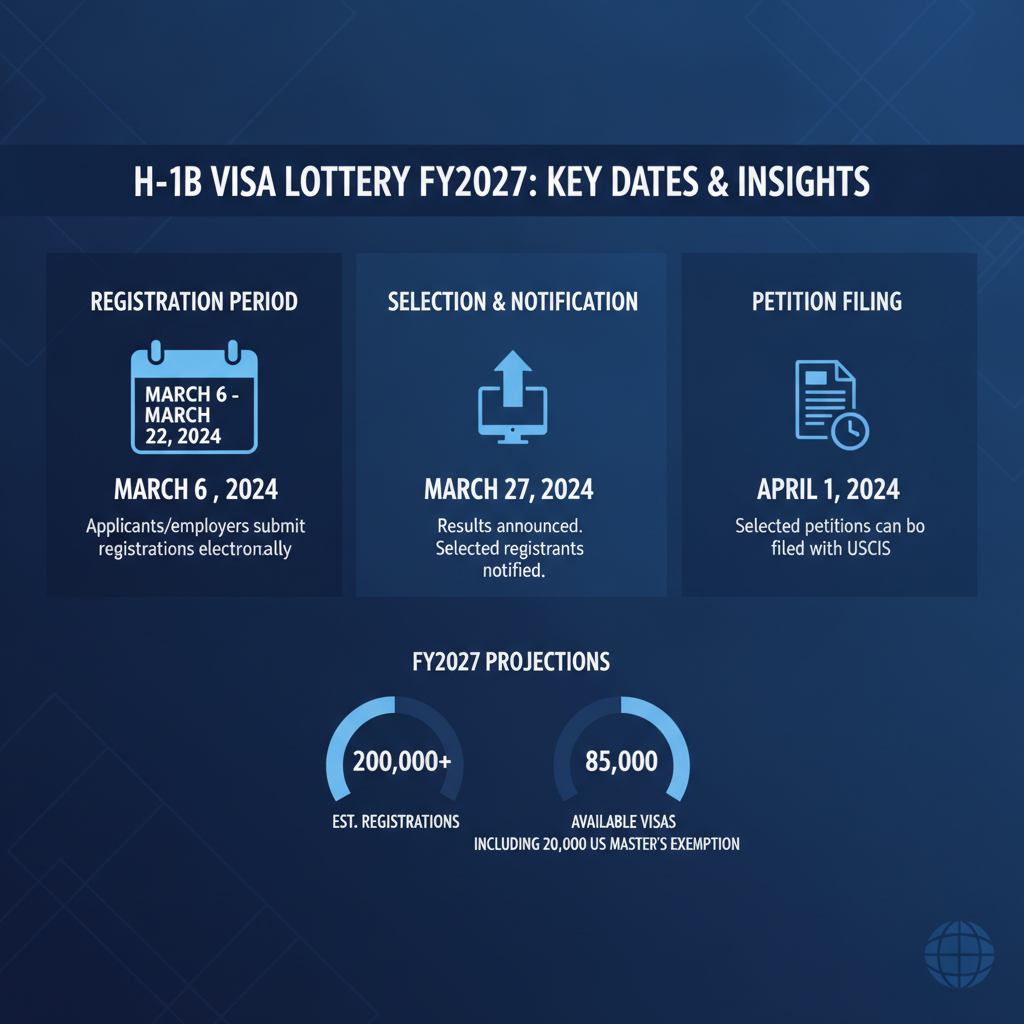
H-1B Visa Lottery FY2027: Navigating New Rules for Skilled - Key Statistics

Call Us Now: +1 786-791-3106

## What H-1B Visa Lottery Changes for FY2027 Is (and Why It Matters) The **H-1B visa** program is a cornerstone of U.S. immigration policy, enabling U.S. employers to temporarily employ foreign workers in specialty occupations. A "specialty occupation" generally requires a bachelor's degree or higher in a specific field. Due to overwhelming demand, the number of petitions often far exceeds the annual cap set by Congress, necessitating a lottery system. The recent **H-1B visa lottery changes for FY2027** address how this lottery will be conducted, aiming to make the selection process fairer and more efficient. ### A plain-English definition Imagine a highly competitive job opening where hundreds of qualified people apply, but only a few dozen spots are available. To make the selection fair, everyone's name is put into a hat, and names are drawn randomly. That's essentially the **H-1B lottery**. The "changes for FY2027" refer to new rules about *whose names* go into the hat and *how many times*. Historically, an individual could have multiple employers submit registrations on their behalf, effectively putting their name in the hat multiple times and increasing their chances. The significant shift, which started for FY2025 and is being reinforced/refined for **FY2027**, is to move to a **beneficiary-centric selection** model. This means that *each individual* (the beneficiary) will only have one chance in the lottery, regardless of how many employers register them. If selected, all employers who registered that individual will be notified, and any one of them can then proceed with filing the **H-1B petition**. **Why does this matter?** This change is a direct response to concerns about fraud and gaming the system. It aims to create a level playing field, ensuring that every unique individual has an equal chance, rather than those with multiple employer registrations having an unfair advantage. It also means employers must be truly committed to sponsoring a candidate, as they can no longer rely on a numbers game. ### Key terms you need to know Understanding the **H-1B process** requires familiarity with specific terminology: * **H-1B Visa:** A nonimmigrant visa that allows U.S. employers to temporarily employ foreign workers in specialty occupations. * **Specialty Occupation:** An occupation that requires theoretical and practical application of a body of highly specialized knowledge, and a bachelor's or higher degree (or its equivalent) in the specific specialty as a minimum for entry into the occupation in the United States. * **Beneficiary:** The foreign national employee for whom the H-1B visa is being sought. * **Petitioner:** The U.S. employer seeking to hire the foreign national. * **USCIS:** U.S. Citizenship and Immigration Services, the government agency responsible for processing H-1B petitions. * **Annual Cap:** The congressionally mandated limit on the number of **H-1B visas** issued each fiscal year. Currently, it's 65,000 for the regular cap and an additional 20,000 for those with a U.S. master's degree or higher (the "Master's Cap"). * **Cap-Subject:** Petitions subject to the annual cap. * **Cap-Exempt:** Certain employers (e.g., universities, non-profit research organizations) are exempt from the annual cap. * **H-1B Registration:** The initial electronic process where prospective employers submit information about themselves and the beneficiary to USCIS to enter the lottery. This is usually done in March. * **Lottery Selection:** The random process by which USCIS selects registrations from the pool when the number of registrations exceeds the annual cap. * **Petition Filing Period:** The window during which selected petitioners can submit their full **Form I-129** H-1B petition. * **LCA (Labor Condition Application):** **Form ETA-9035**, filed with the Department of Labor, confirming the employer will pay the H-1B worker the prevailing wage and provide working conditions that will not adversely affect other workers. This must be certified before filing the **Form I-129**. * **Prevailing Wage:** The average wage paid to similarly employed workers in a specific occupation in the area of intended employment. * **Change of Status:** Applying to change from one nonimmigrant visa status (e.g., F-1 student) to **H-1B** while remaining in the U.S. * **Consular Processing:** Applying for the **H-1B visa** stamp at a U.S. consulate or embassy abroad. Understanding these terms is vital for anyone navigating the **H-1B process**, especially with the new **FY2027** changes emphasizing the individual beneficiary. ## Current Immigration Law: The Foundation The **H-1B visa** program operates under the authority of the Immigration and Nationality Act (INA), specifically Section 101(a)(15)(H)(i)(b) and Section 214(g) (8 U.S.C. § 1101(a)(15)(H)(i)(b) and 8 U.S.C. § 1184(g)). These statutes define the **H-1B** category, its requirements, and the annual numerical limitations (the cap). The statutory framework dictates that a foreign national must be coming to the U.S. temporarily to perform services in a specialty occupation. This requires the theoretical and practical application of a body of highly specialized knowledge, and typically a bachelor’s degree or higher in a specific specialty. ### Federal requirements The core federal requirements for an **H-1B petition** include: 1. **Specialty Occupation:** The job offered must meet the definition of a specialty occupation. This is often the most scrutinized aspect of an **H-1B** petition. 2. **Educational Attainment:** The beneficiary must hold a bachelor's degree or its equivalent, or possess a license in a specialty occupation field, or have work experience equivalent to a bachelor's degree. 3. **Employer-Employee Relationship:** A valid employer-employee relationship must exist between the petitioner and the beneficiary, as defined by USCIS. 4. **LCA Certification:** The employer must obtain a certified **Labor Condition Application (Form ETA-9035)** from the U.S. Department of Labor (DOL) before filing the **Form I-129** with USCIS. The LCA ensures the employer will pay the prevailing wage and meet working condition standards. 5. **Non-Immigrant Intent:** While **H-1B** is a nonimmigrant visa, it is considered a "dual intent" visa, meaning the beneficiary can simultaneously harbor immigrant intent (i.e., desire to become a lawful permanent resident) without jeopardizing their **H-1B** status. The annual cap for **H-1B visas** is 65,000, with an additional 20,000 for those holding a U.S. master's degree or higher. Petitions are selected through a lottery when demand exceeds supply. The recent **FY2027** changes primarily impact the lottery *selection process*, moving to a **beneficiary-centric** model to curb potential abuses and ensure fairness. This means multiple registrations for the same individual by different employers will no longer increase their chances of selection; the individual is entered only once. ### Florida-specific considerations While federal law governs the **H-1B program**, practical considerations for Florida residents often involve local USCIS operations and the state's economic landscape. * **Orlando USCIS Field Office:** For any in-person interviews or document submissions (though rare for initial **H-1B** petitions unless a change of status involves other forms), the Orlando USCIS Field Office serves many Central Florida residents. However, **H-1B** petitions are typically processed by USCIS service centers, not local field offices. * **Key Industries:** Florida’s booming tech industry, particularly along the I-4 corridor connecting Orlando and Tampa, and its robust healthcare and tourism sectors, means a high concentration of employers seeking **H-1B** talent. This makes competition for **H-1B visas** particularly fierce for those seeking employment in these areas. * **Prevailing Wage:** The **prevailing wage** for an occupation can vary significantly by geographic area. For employers in Orange County or other parts of Florida, ensuring compliance with the local prevailing wage determined by the DOL for the specific occupation and skill level is critical for the LCA. **Reminder:** The **H-1B** process is complex. Relying on accurate, up-to-date information from official sources like USCIS is paramount. USCIS official website is your primary resource. ## How to Navigate the New H-1B Lottery Process for FY2027: A Complete Step-by-Step Guide The **H-1B visa lottery changes for FY2027**, particularly the beneficiary-centric selection, underscore the importance of meticulous preparation and adherence to new protocols. This guide outlines the typical steps involved, incorporating the latest adjustments. ###

1) Employer Registers Beneficiary for the H-1B Lottery

This is the initial, crucial step. The employer, not the beneficiary, initiates this electronic registration process with USCIS. **Timeline:** Typically in March of the calendar year preceding the fiscal year (e.g., March 2026 for FY2027). The exact dates are announced annually by USCIS. **Required Documents (for employer):** * Employer's Federal Employer Identification Number (FEIN). * Employer's legal name, address, and authorized signatory information. * Beneficiary's full legal name, date of birth, country of birth, country of citizenship, passport number. * Beneficiary's gender. * Beneficiary's highest level of education and institution. * Whether the beneficiary qualifies for the U.S. Master's cap (if applicable). * **Important:** Under the **FY2027** changes, each beneficiary can only be included in *one* registration entry, even if multiple employers register them. USCIS will use the beneficiary's passport information to identify duplicate entries. Any attempt by employers to submit multiple registrations for the *same beneficiary* will result in *all* registrations for that beneficiary being invalidated. ###

2) USCIS Conducts the Lottery and Notifies Selections

Once the registration period closes, if the number of eligible registrations exceeds the annual cap, USCIS conducts a random lottery. **Timeline:** Typically by the end of March. USCIS will announce the specific notification date. **Process:** * First, USCIS selects enough registrations to meet the Master's Cap. * Then, unselected Master's cap registrations are combined with regular cap registrations, and additional selections are made to meet the regular cap. * **New for FY2027 (based on beneficiary-centric model):** If a beneficiary is selected, *all* employers who submitted a registration for that individual will receive a selection notification. The beneficiary only occupies one "slot" in the cap. * USCIS updates the online registration accounts of selected employers to "Selected." Unselected employers will see "Not Selected" or "Denied" (if found to be a duplicate or invalid). **Action:** Employers must check their online USCIS accounts for status updates. ###

3) Petitioner Files the Labor Condition Application (LCA)

Before an **H-1B petition (Form I-129)** can be filed, the employer must obtain a certified **Labor Condition Application (Form ETA-9035)** from the U.S. Department of Labor (DOL). **Timeline:** This process can take 7-10 business days for DOL certification. It must be certified *before* the **Form I-129** is filed. **Required Documents (for employer):** * Detailed job description, duties, and minimum requirements. * Prevailing wage determination for the specific occupation and geographic area (e.g., Orlando, FL). * Employer's FEIN and contact information. * Beneficiary's name and details (though not publicly disclosed on the LCA). **Warning:** Any inaccuracies or non-compliance with LCA requirements can lead to serious penalties for the employer and denial of the **H-1B petition**. ###

4) Petitioner Files Form I-129, Petition for a Nonimmigrant Worker

If the registration is selected and the LCA is certified, the employer can then file the full **H-1B petition** with USCIS. **Timeline:** Typically from April 1st through June 30th of the calendar year (e.g., April 1, 2026 – June 30, 2026, for FY2027). USCIS provides specific filing window dates. **Required Documents (for employer and beneficiary):** * **Form I-129**, Petition for a Nonimmigrant Worker. * Certified **Form ETA-9035**, Labor Condition Application. * Copy of the **H-1B** registration selection notice. * Company documents: business license, articles of incorporation, financial statements, tax returns, office lease, client contracts, organizational charts. * Letter of support from the employer detailing the specialty occupation, beneficiary's qualifications, proposed terms of employment, and employer's need. * Beneficiary's academic credentials: degrees, transcripts, evaluations of foreign degrees. * Beneficiary's professional licenses (if applicable). * Beneficiary's resume/CV. * Beneficiary's passport biographical page, previous U.S. visas, I-94 records, EADs, I-20s (if applicable). * Photographs (if required for related forms like **Form I-539** for dependents). * **Form G-28**, Notice of Entry of Appearance as Attorney or Accredited Representative (if represented by an attorney like Imigrar). * Filing fees (check current USCIS fee schedule). **Reminder:** USCIS filing fees were updated in April 2024. For **FY2027**, fees are likely to be similar or potentially further adjusted. It’s crucial to verify the latest fee schedule on the USCIS Forms page. ###

5) USCIS Processes the Petition and Issues a Decision

USCIS reviews the filed **Form I-129** and supporting documents. This may involve requests for additional evidence (RFEs). **Timeline:** Processing times vary significantly by service center. You can check current processing times on the USCIS Processing Times page. Premium Processing is available for an additional fee, guaranteeing a decision or RFE within 15 calendar days. **Possible Outcomes:** * **Approval:** USCIS approves the petition. If the beneficiary is in the U.S. and applied for Change of Status, their status automatically changes to **H-1B** effective October 1st. * **Request for Evidence (RFE):** USCIS requires more information or documentation to make a decision. A prompt and thorough response is critical. * **Denial:** USCIS denies the petition. This can happen for various reasons, including failing to prove specialty occupation, employer-employee relationship, or beneficiary qualifications. ###

6) Visa Stamping (for Consular Processing)

If the beneficiary is outside the U.S. or opted for consular processing instead of change of status, they must attend a visa interview at a U.S. embassy or consulate abroad to obtain the **H-1B visa** stamp in their passport. **Timeline:** After **Form I-129** approval, appointment wait times vary by embassy/consulate. **Required Documents:** * Valid passport. * **Form DS-160**, Online Nonimmigrant Visa Application confirmation page. * Receipt for visa application fee. * Approved **Form I-797** (Approval Notice for **Form I-129**). * Original LCA. * Original academic diplomas and transcripts. * Letters from previous employers. * Employment verification letter from the sponsoring employer. * Photographs meeting U.S. visa requirements. * Any other documents requested by the embassy/consulate. **Note:** For individuals in Orlando or anywhere in Florida, if they choose to leave the U.S. for visa stamping, they must be aware of re-entry procedures and potential travel restrictions.

Need Help? Our Orlando immigration team is ready to assist. Call +1 786-791-3106 for a free consultation, or message us online. Se Habla Español.

Call Us Now: +1 786-791-3106

## Practical Steps You Can Take Today Navigating the **H-1B visa lottery changes for FY2027** requires proactive planning. Here are practical steps you can take right now to prepare for the upcoming cycle, whether you are a prospective beneficiary or an employer in Orlando or elsewhere in Florida. ### Actionable checklist: 1. **Consult an Experienced Immigration Attorney:** This is the most critical first step. The **FY2027** changes, especially the beneficiary-centric model, add layers of complexity. An attorney can assess eligibility, advise on strategy, and ensure compliance. 2. **Verify Beneficiary Information:** For employers, confirm all beneficiary details (passport number, date of birth, etc.) are accurate and consistent across all potential registrations if multiple employers are considering sponsoring the same individual (though only one registration will count per beneficiary). 3. **Secure Educational Credential Evaluations:** If the beneficiary's degree is from a foreign institution, obtain an official evaluation to determine its U.S. equivalency *now*. This is often a critical document for the **Form I-129**. 4. **Gather Employer Documentation:** Employers should start compiling necessary company documents (FEIN, business licenses, financials, etc.) and be prepared to articulate the specialty nature of the position. 5. **Understand Prevailing Wage Requirements:** Research the prevailing wage for the specific occupation and geographic location (e.g., Orlando, FL). This is essential for the LCA. 6. **Review Prior Immigration History:** Beneficiaries should compile all their immigration documents: passports, visas, I-94 records, EADs, I-20s, previous **Form I-797** approval notices. 7. **Budget for Fees:** Be aware of the various fees: **H-1B** registration fee, **Form I-129** filing fee, Public Law 114-113 fee, Fraud Prevention and Detection Fee, American Competitiveness and Workforce Improvement Act (ACWIA) fee, and potentially Premium Processing fees. These can total several thousand dollars. ### Document preparation guidance Start organizing your documents early. Create digital copies and keep physical copies organized. * **For Beneficiaries:** * **Passport:** Ensure it's valid for at least six months beyond your intended period of stay. * **Educational Documents:** Degrees, transcripts, and foreign credential evaluations. * **Resume/CV:** Keep it updated and tailored to the specialty occupation. * **Previous Immigration Records:** I-94 records, visa stamps, prior **Form I-797** approval notices, EAD cards, I-20s (for F-1 students). * **For Employers:** * **Company Financials:** Tax returns, profit & loss statements to demonstrate ability to pay the proffered wage. * **Business Structure:** Articles of incorporation, business licenses, organizational charts. * **Job Description:** Detailed and clear description of the specialty occupation duties and requirements. * **Evidence of Employer-Employee Relationship:** Offer letter, employment contract, supervision structure. ### Timeline expectations The **H-1B** process is lengthy and follows a strict annual timeline: * **September – February (Pre-Registration):** Employers and beneficiaries prepare documents, consult with attorneys, and strategize. * **March (H-1B Registration):** USCIS typically opens the electronic registration window for approximately two weeks. **This is for FY2027, occurring in March 2026.** * **Late March (Lottery Selection):** USCIS conducts the lottery and announces selections. * **April 1 – June 30 (Petition Filing):** Selected petitioners can file their **Form I-129** petitions. * **April – September (Petition Processing):** USCIS processes petitions. RFEs may be issued. * **October 1 (H-1B Start Date):** Approved **H-1B** petitions become effective. **Important:** These are general timelines. Always refer to official USCIS announcements for the exact dates for **FY2027**. The Orlando USCIS Field Office does not handle initial **H-1B** petitions, but understanding the overall federal timeline is crucial for anyone in Central Florida. ## How Imigrar Helps Immigrants in Orlando At Imigrar, our dedicated immigration law firm in Orlando, Florida, is committed to guiding individuals and families through the complexities of the U.S. immigration system. We understand that the **H-1B visa lottery changes for FY2027** introduce new challenges, and our expertise is precisely what you need to navigate them successfully. Our tagline, "Keep Families Together," reflects our core philosophy and commitment to our clients. ### Our experience and expertise Our team of experienced immigration attorneys brings a wealth of knowledge and a proven track record to every case. We specialize in employment-based visas, including the **H-1B**, and are intimately familiar with the intricate requirements of USCIS and the Department of Labor. We stay abreast of the latest regulatory changes, like those impacting the **H-1B lottery for FY2027**, ensuring that our advice is always current and compliant. We assist both employers and beneficiaries with: * **Eligibility Assessment:** Thoroughly evaluating your qualifications and the specialty occupation requirements. * **Strategic Planning:** Developing a robust strategy for **H-1B** registration and petition filing, especially under the new beneficiary-centric rules. * **Document Preparation:** Meticulously preparing all necessary forms and supporting documentation, including the LCA and **Form I-129**. * **RFE Response:** Crafting comprehensive and persuasive

Have Questions About Your Case?

Schedule a free consultation with our attorney-reviewed team today