


The landscape of U.S. immigration law is constantly evolving, and for those aspiring to work in a specialty occupation, few developments are as significant as changes to the H-1B visa lottery. As we approach the registration period for Fiscal Year 2027, recent announcements from U.S. Citizenship and Immigration Services (USCIS) signal critical adjustments that will impact petitioners and beneficiaries nationwide, including here in Florida.
Need Expert Guidance on the H-1B Lottery? The new rules can be complex. Our experienced Orlando immigration team at Imigrar is here to help you understand the changes and prepare a robust application. Call +1 786-791-3106 for a free consultation, or message us online. Se Habla Español.
The reporting that sparked this guide:
H-1B Visa Lottery Changes for FY2027 (Legal News)
What This News Means for Immigrants in Orlando and Across Florida
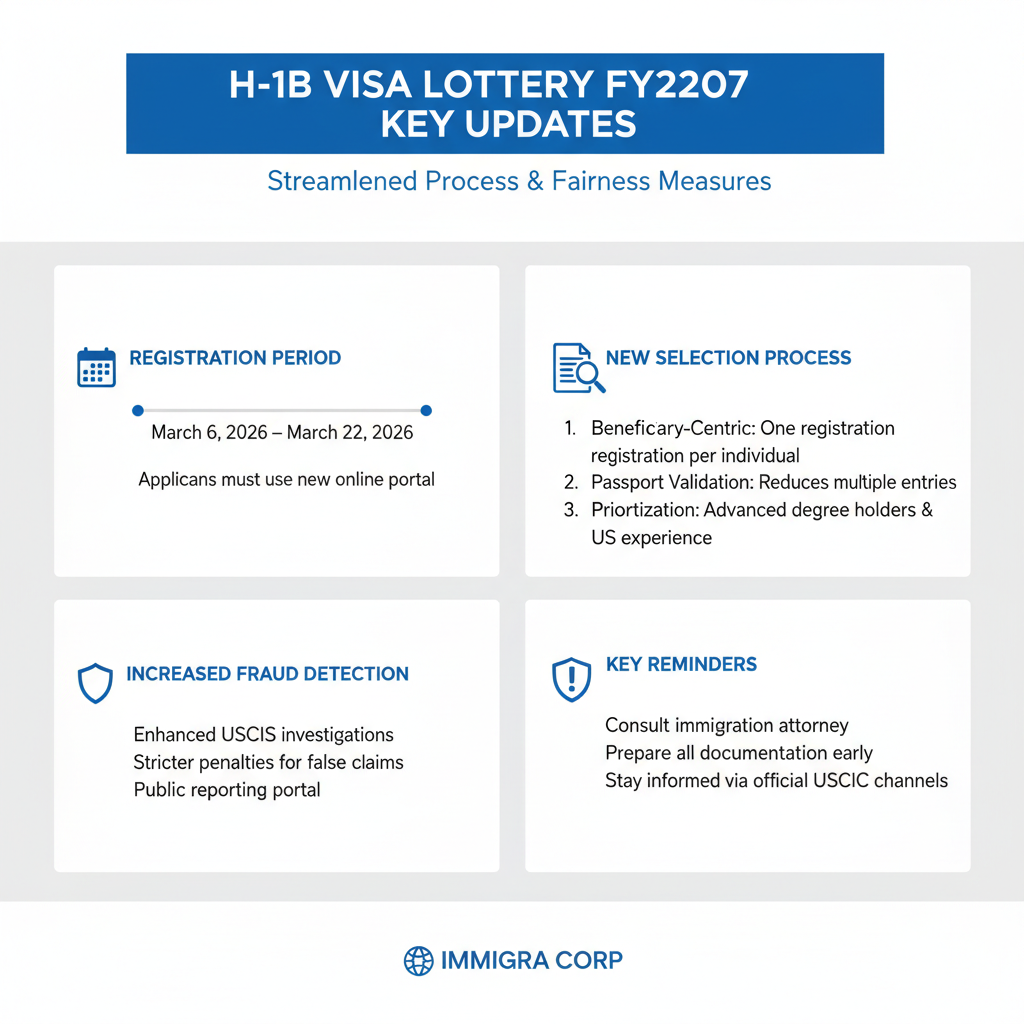
The H-1B visa program is a cornerstone for U.S. employers seeking to hire highly skilled foreign workers in specialty occupations, and for international professionals aspiring to contribute their talents to the American economy. With an annual cap on available visas, the demand consistently far outstrips supply, necessitating an annual lottery system. Any changes to this system carry immense weight for thousands of individuals and businesses.
Why this news is showing up now
USCIS typically announces changes to major immigration programs, like the H-1B lottery, well in advance of the registration period to allow petitioners and beneficiaries time to prepare. These announcements often come after an analysis of previous lottery cycles, stakeholder feedback, and efforts to improve program integrity and efficiency. For the FY2027 cycle, which will begin with registrations in March 2026, USCIS has indicated a move towards greater fairness and a reduction in fraudulent registrations. This proactive communication is crucial because the H-1B registration period is notoriously short and unforgiving.
The specific changes for FY2027 are primarily focused on reinforcing the integrity of the lottery process and ensuring that each beneficiary has an equal chance of selection, regardless of how many employers register them. This addresses concerns about multiple registrations for the same individual, which in previous years may have inadvertently inflated selection odds for some while diminishing them for others.
How it can affect Florida residents
Florida, particularly the Orlando and Central Florida region, is a rapidly growing hub for technology, aerospace, healthcare, tourism, and various other industries that rely heavily on H-1B talent. Companies along the I-4 corridor, from startups in Orlando to established corporations in Tampa, frequently sponsor H-1B visas. Universities like the University of Central Florida (UCF) and the University of Florida (UF) produce a steady stream of international graduates who often seek H-1B sponsorship.
For individuals currently living in Orlando, working on an Optional Practical Training (OPT) visa, or studying at a local university, these changes directly impact their future career prospects. For employers in Orange County and beyond, understanding the new rules is paramount to successfully securing talent and remaining competitive. The changes aim to level the playing field, which means that while the overall cap remains the same, the *method* of selection could significantly alter the odds for individual beneficiaries. This could mean a more equitable chance for those who previously felt disadvantaged by widespread multiple registrations.
Important: These changes necessitate a renewed focus on compliance and strategic planning for both employers and prospective H-1B workers in Florida. Staying informed and preparing meticulously will be more critical than ever.
Confused by the H-1B Changes? Our Orlando-based immigration attorneys are experts in U.S. work visas and can guide you through the FY2027 H-1B lottery process. Contact Imigrar today for a free consultation at +1 786-791-3106. Se Habla Español.
What H-1B Visa Lottery Changes for FY2027 Is (and Why It Matters)
The H-1B visa program allows U.S. employers to temporarily employ foreign workers in specialty occupations. A specialty occupation generally requires a bachelor's degree or higher in a specific field. Due to high demand, the number of H-1B petitions often exceeds the annual cap set by Congress, leading to a lottery system for selection.
A plain-English definition
The "H-1B Visa Lottery Changes for FY2027" refers to new rules or modifications implemented by USCIS for the upcoming H-1B cap-subject petition filing season. These changes specifically affect the *registration process* and the *selection methodology* used to determine which employers will be eligible to file H-1B petitions for their prospective employees. In essence, USCIS is adjusting how they pick who gets a chance to apply for an H-1B visa, with a strong emphasis on reducing fraud and ensuring that each individual beneficiary has a fair and equal shot at selection.
Historically, the lottery selected registrations, and if a beneficiary had multiple registrations submitted by different employers, their chances were statistically higher. The new rules, effective for the FY2027 lottery, shift the selection focus to the *beneficiary*. This means that each unique beneficiary will be entered into the lottery only once, regardless of how many eligible employers submit a registration on their behalf. If a beneficiary is selected, all employers who registered for that beneficiary will be notified and will be eligible to file a petition on their behalf.
Why it matters: This is a monumental shift. For beneficiaries, it means a truly equal chance. For employers, it means they can no longer rely on multiple registrations for the same individual to increase their odds. It emphasizes the genuine employer-employee relationship and the integrity of the process, making it fairer for everyone involved.
Key terms you need to know
- H-1B Visa: A nonimmigrant visa that allows U.S. employers to temporarily employ foreign workers in specialty occupations.
- Specialty Occupation: An occupation that requires theoretical and practical application of a body of highly specialized knowledge, and a bachelor's degree or higher in the specific specialty (or its equivalent) as a minimum for entry into the occupation in the United States.
- Cap-Subject H-1B: H-1B petitions that are subject to the annual statutory limit (cap) of 65,000 visas, plus an additional 20,000 for those with a U.S. master's degree or higher (the "master's cap").
- Cap-Exempt H-1B: H-1B petitions filed by certain employers, such as institutions of higher education, non-profit organizations affiliated with higher education, or governmental research organizations, which are not subject to the annual cap.
- Beneficiary: The foreign worker for whom the H-1B visa is being sought.
- Petitioner: The U.S. employer filing the H-1B petition on behalf of the beneficiary.
- H-1B Registration: An electronic process where prospective petitioners (employers) submit basic information about the company and the prospective H-1B worker (beneficiary) during a specified window. This registration is then entered into the lottery.
- Lottery/Selection Process: If USCIS receives more registrations than available cap numbers, a random selection process is conducted. For FY2027, this process will now be based on unique beneficiaries.
- Labor Condition Application (LCA): Form ETA-9035, certified by the U.S. Department of Labor (DOL), attesting that the employer will pay the H-1B worker at least the prevailing wage or the actual wage, whichever is higher, and provide working conditions that will not adversely affect other workers. This must be certified *before* filing the H-1B petition.
- Petition: The formal application submitted to USCIS (Form I-129) after a registration has been selected in the lottery.
- Fiscal Year (FY): The U.S. government's fiscal year runs from October 1 to September 30. The H-1B lottery for FY2027 means the visas become available starting October 1, 2026.
Current Immigration Law: The Foundation
The H-1B visa program is authorized under the Immigration and Nationality Act (INA), specifically Section 101(a)(15)(H)(i)(b), which defines the H-1B nonimmigrant classification. The annual numerical limitations (the cap) are established under INA Section 214(g). These foundational laws govern the existence and basic parameters of the H-1B program, while USCIS regulations and policy memoranda provide the operational details, including how the lottery is conducted.
Federal requirements
To qualify for an H-1B visa, both the employer (petitioner) and the foreign worker (beneficiary) must meet specific federal requirements:
For the Employer (Petitioner):
- The employer must offer a job in a specialty occupation.
- The employer must file and have certified a Labor Condition Application (LCA) (Form ETA-9035) with the Department of Labor. This attests to paying the prevailing wage and providing suitable working conditions.
- The employer must demonstrate the ability to pay the offered wage.
- The employer must be a legitimate U.S. entity.
For the Employee (Beneficiary):
- The beneficiary must possess a bachelor's degree or its equivalent, or a license in a specialty occupation field, or work experience equivalent to a bachelor's degree.
- The beneficiary must be qualified to perform services in the specialty occupation.
- The beneficiary must meet the minimum requirements for the specific specialty occupation position.
The H-1B cap is legislatively set at 65,000 visas annually, with an additional 20,000 visas reserved for those holding a U.S. master’s degree or higher. This "master's cap" is drawn first, and any unselected master's cap registrations are then entered into the regular cap lottery. The new FY2027 rules apply to this entire cap-subject process.
You can find comprehensive information regarding H-1B requirements and regulations on the USCIS official website.
Florida-specific considerations
While H-1B laws are federal, their impact is felt locally. Florida's economy is diverse, with high demand for H-1B workers in various sectors. For instance, the growing tech sector in Orlando and Tampa Bay means a strong need for software developers, IT specialists, and engineers. The healthcare industry across the state requires medical professionals and researchers. Florida's robust tourism and hospitality sector also sometimes utilizes H-1B visas for specialized management roles.
Employers in Florida must ensure their job offers meet the "specialty occupation" criteria and adhere strictly to prevailing wage requirements for their specific geographic area within the state. For example, prevailing wages for a software engineer in Orlando (Orange County) might differ from those in Miami or Jacksonville. Additionally, the Orlando USCIS Field Office, while not directly involved in H-1B petition adjudication (which is handled by service centers), can be a point of contact for other immigration matters related to beneficiaries, such as biometric appointments or interviews if there's an associated Adjustment of Status application.
Reminder: Employers sponsoring H-1B visas for positions in Florida must be diligent in their compliance with both federal and state labor laws, ensuring fair wages and working conditions.
Relevant USCIS forms for the H-1B process include: Form I-129, Petition for a Nonimmigrant Worker, and Form I-907, Request for Premium Processing Service (if expedited processing is desired and available).
How to Navigate the New H-1B Visa Lottery Process: A Complete Step-by-Step Guide
The FY2027 H-1B lottery changes emphasize preparation and integrity. Here's a detailed guide to help both employers and beneficiaries navigate the updated process.
1) Employer Assessment & LCA Filing
Before any lottery registration can occur, the employer must determine if the position qualifies as a specialty occupation and if the prospective employee meets the requirements. This initial assessment is critical.
- Employer Actions:
- Job Analysis: Determine if the job duties require theoretical and practical application of a body of highly specialized knowledge and a bachelor's degree or higher in a specific specialty.
- Beneficiary Qualification: Assess if the prospective employee meets the educational and experience requirements for the specialty occupation.
- Prevailing Wage Determination: Obtain a prevailing wage determination for the position in the specific geographic area (e.g., Orlando, FL) from the Department of Labor (DOL) or an accepted private wage survey.
- LCA Filing: Prepare and electronically file Form ETA-9035, Labor Condition Application (LCA), with the DOL. This form attests that the employer will pay the H-1B worker at least the prevailing wage or the actual wage paid to similarly qualified U.S. workers, and that working conditions will not adversely affect other workers. The LCA must be certified by the DOL before the H-1B petition (Form I-129) can be filed.
- Required Documents (for LCA):
- Employer's Federal Employer Identification Number (EIN)
- Job title and duties
- Proposed salary and work location
- Prevailing wage data
2) H-1B Registration Under New Rules
This is where the most significant FY2027 changes come into play. The registration period typically opens in early March. Under the new rules, the focus shifts to the beneficiary.
- Employer Actions:
- Create/Access USCIS Online Account: Employers must have a USCIS online account (registrant account) to submit registrations.
- Beneficiary-Centric Registration: For each prospective H-1B employee, the employer will submit one electronic registration. Critically, this registration must include the beneficiary's valid passport or travel document information. USCIS will use this information to identify unique beneficiaries.
- One Registration Per Beneficiary Per Lottery: Even if multiple employers wish to sponsor the same beneficiary, each employer will submit their own registration for that beneficiary. However, the lottery selection will now be based on the unique beneficiary, not on individual registrations. This means a beneficiary will only be selected once, regardless of how many registrations are submitted on their behalf.
- Registration Fee: Pay the required non-refundable H-1B registration fee for each submission.
- Required Information (for Registration):
- Employer's legal name, EIN, and mailing address.
- Employer's authorized signatory information.
- Beneficiary's full legal name, date of birth, country of birth, country of citizenship.
- Beneficiary's valid passport or travel document number.
- Beneficiary's gender.
- Whether the beneficiary has a U.S. master's degree or higher.
Warning: The new beneficiary-centric selection process aims to crack down on fraudulent multiple registrations designed to artificially inflate selection odds. Any attempt to circumvent this rule could lead to denial of petitions or even investigations.
3) Selection Notification & Petition Preparation
After the registration period closes, USCIS conducts the lottery. Notifications are typically issued by the end of March.
- Employer Actions:
- Check Selection Status: Employers will log into their USCIS online account to view the status of their registrations.
- Notification to Beneficiary: If a beneficiary is selected, *all* employers who submitted a registration for that selected beneficiary will receive a selection notice. This notice will indicate that the beneficiary has been selected and will include a specific filing period during which an H-1B cap-subject petition may be filed for that beneficiary.
- Choose a Petitioner: The beneficiary, in consultation with the selected employers, must decide which employer will proceed with filing the H-1B petition. Only one employer can file a cap-subject H-1B petition for a selected beneficiary.
- Gather Documents: Begin compiling all necessary supporting documents for the Form I-129 petition.
- Required Documents (Post-Selection):
- H-1B Selection Notice.
- Certified LCA (Form ETA-9035).
- Beneficiary's educational documents (degrees, transcripts, evaluations).
- Beneficiary's resume/CV.
- Beneficiary's passport, visa, I-94 records, previous EADs (if applicable).
- Employer's business documents (company profile, financial statements, contracts, etc.).
- Detailed job description, organizational chart.
- Letters of support from the employer.
4) Filing the H-1B Petition (Form I-129)
Once a registration is selected, the employer has a specific window (usually 90 days) to file the full H-1B petition.
- Employer Actions:
- Prepare Form I-129: Complete Form I-129, Petition for a Nonimmigrant Worker, along with all required supplements and addendums specific to H-1B petitions.
- Assemble Supporting Documentation: Organize all gathered documents, ensuring they directly support the claims made in the petition regarding the specialty occupation, the beneficiary's qualifications, and the employer's legitimacy.
- Pay Filing Fees: Include all required USCIS filing fees, which typically include the base filing fee, ACWIA fee, fraud prevention and detection fee, and if applicable, the Public Law 114-113 fee. Premium processing fee (Form I-907) can be added if available.
- Mail Petition: File the complete petition package with the correct USCIS Service Center as indicated in the H-1B selection notice.
- Required Documents (for Petition Filing - in addition to post-selection docs):
- Form I-129 with H-1B Classification Supplement.
- Certified Form ETA-9035 (LCA).
- H-1B Selection Notice.
- Checks for all applicable USCIS filing fees.
- G-28 (Notice of Entry of Appearance as Attorney or Accredited Representative) if represented by legal counsel.
- Any additional evidence requested by USCIS or deemed necessary by legal counsel to strengthen the petition.
5) USCIS Processing & Adjudication
After filing, USCIS reviews the petition. Processing times can vary significantly based on the service center and whether premium processing was requested.
- USCIS Actions:
- Receipt Notice: USCIS will issue a receipt notice (Form I-797C) confirming receipt of the petition.
- Request for Evidence (RFE): USCIS may issue an RFE if they require more information or clarification. Responding to an RFE accurately and promptly is crucial.
- Adjudication: USCIS will review all submitted evidence and make a decision on the petition.
- Approval/Denial: If approved, USCIS will issue an approval notice (Form I-797A/B). If denied, a denial letter will be issued explaining the reasons.
- Beneficiary Actions:
- Maintain Status: If the beneficiary is already in the U.S., they must maintain their current nonimmigrant status until the H-1B petition is approved and the change of status becomes effective (October 1st for cap-subject petitions).
- Respond to RFE: Provide any requested documents or information to the employer/attorney promptly.
Reminder: You can check estimated processing times on the USCIS Processing Times page.
6) Visa Interview (if applicable) / Change of Status
The final step depends on whether the beneficiary is inside or outside the U.S. when the H-1B petition is approved.
- For Beneficiaries Outside the U.S. (Consular Processing):
- Visa Interview: The beneficiary will attend an interview at a U.S. embassy or consulate in their home country. They will need to present their approval notice, passport, and other supporting documents.
- Visa Stamping: If approved, the H-1B visa will be stamped in their passport, allowing them to enter the U.S. in H-1B status.
- Entry to U.S.: They can enter the U.S. up to 10 days before the H-1B validity start date (typically October 1st).
- For Beneficiaries Inside the U.S. (Change of Status):
- If the H-1B petition requested a "change of status" (COS) from another nonimmigrant status (e.g., F-1 OPT, L-1), and it is approved, the beneficiary's status automatically changes to H-1B on the validity start date (October 1st). They will receive an Form I-797A approval notice with an attached Form I-94 record indicating H-1B status.
- Beneficiaries can begin working for the H-1B petitioner on the H-1B start date.
Important: Timely communication with your attorney and adherence to all instructions are vital at this stage.
Don't Risk Your H-1B Application! The FY2027 changes make expert legal advice indispensable. Imigrar is dedicated to keeping families together by securing work visas. Call us for a free consultation: +1 786-791-3106. Se Habla Español.
Practical Steps You Can Take Today
Proactive preparation is the best defense against the complexities of the H-1B lottery, especially with new rules in play. Here’s how you can get started:
Actionable Checklist:
- Educate Yourself (and Your Employer): Understand the new beneficiary-centric selection process. Ensure both you and your sponsoring employer are aware of how this impacts registration strategy.
- Verify Beneficiary Information: Confirm that the beneficiary’s passport or travel document is valid and that all personal information (name, date of birth, country of citizenship) matches exactly across all documents. This is critical for the unique beneficiary identification under the new rules.
- Identify Potential Employers: If you are a beneficiary, actively network and secure potential job offers from employers willing to sponsor you. Remember, multiple employers can register you, but you will only be selected once.
- Initiate LCA Process Early: Employers should begin the Labor Condition Application (LCA) process as soon as possible. DOL certification can take several days or weeks, and a certified LCA is required before filing the H-1B petition, not the registration.
- Gather Educational and Professional Documents: Beneficiaries should compile all academic transcripts, diplomas, degree evaluations (if applicable), and professional experience letters. These will be needed if selected.
- Consult with an Immigration Attorney: This is perhaps the most crucial step. An experienced attorney can advise on eligibility, review documents, ensure compliance with new rules, and strategize the best approach.
Document Preparation Guidance:
- For Beneficiaries:
- Valid passport and any previous U.S. visas.
- Birth certificate.
- All academic degrees, diplomas, and official transcripts (undergraduate and graduate).
- Foreign degree evaluations (if applicable, from a NACES-approved service).
- Resumes/CVs detailing work experience.
- Professional licenses or certifications.
- Previous I-20s, EADs, I-94 records (if already in the U.S.).
- For Employers:
- Employer Identification Number (EIN).
- Business license/registration.
- Financial statements or tax returns to prove ability to pay.
- Detailed job description for the specialty occupation.
- Organizational chart showing the position within the company.
- Company brochures, website information, or other marketing materials.
Timeline Expectations (Approximate for FY2027):
- Early 2026 (Now): Employer assessment, LCA preparation, beneficiary document gathering, legal consultation.
- March 2026: H-1B electronic registration period opens (typically first two to three weeks of March). Employers submit registrations for unique beneficiaries.
- Late March 2026: USCIS conducts the lottery and announces selections. Notifications are sent to all employers who registered a selected beneficiary.
- April 1, 2026 - June 30, 2026 (approx.): 90-day window for selected employers to file the full H-1B petition (Form I-129) with USCIS.
- April 2026 - September 2026: USCIS processes petitions. RFEs may be issued. Premium processing (if requested) ensures a 15-calendar day response.
- October 1, 2026: H-1B cap-subject visas become active. Beneficiaries can begin H-1B employment or enter the U.S. in H-1B status.
Important: These timelines are estimates. USCIS announces exact dates annually. Always refer to official USCIS announcements for precise deadlines.

How Imigrar Helps Immigrants in Orlando and Nationwide with H-1B Visas
Navigating the H-1B visa lottery has always been challenging, and the FY2027 changes add another layer of complexity. At Imigrar, we understand the immense stakes involved for both employers seeking skilled talent and individuals pursuing their professional dreams in the U.S. Based in Orlando, Florida, we proudly serve clients nationwide, offering comprehensive legal support for all aspects of the H-1B process.
Our experience and expertise:
- Up-to-Date Knowledge: Our attorneys are constantly monitoring USCIS announcements and policy changes, ensuring we are fully informed about the latest H-1B regulations, including the new beneficiary-centric selection process for FY2027. We translate this complex legal jargon into clear, actionable advice for you.
- Strategic Guidance: We work closely with employers to assess job eligibility, determine prevailing wage requirements, and prepare robust


