


At Imigrar, we understand the profound impact that immigration policies have on individuals, families, and businesses across the United States. Our mission, "Keep Families Together," extends to helping skilled professionals and their employers navigate complex visa processes, ensuring that talent can contribute to our nation’s growth while maintaining family unity.
The reporting that sparked this guide
The H-1B visa program is a cornerstone of U.S. immigration for skilled workers, and changes to its lottery system are always significant. We're closely monitoring developments, including those reported by:
What This News Means for Immigrants in Orlando and Across Florida
The H-1B visa program is a lifeline for many highly skilled foreign professionals seeking to work in the United States, particularly in specialty occupations. With the U.S. Citizenship and Immigration Services (USCIS) implementing significant changes to the H-1B lottery process for Fiscal Year 2027 (FY2027), understanding these updates is critical for both employers and prospective employees in Orlando, throughout Florida, and nationwide.
Why this news is showing up now
The H-1B visa program, governed primarily by the Immigration and Nationality Act (INA), has an annual cap of 65,000 visas, with an additional 20,000 for those holding a U.S. master’s degree or higher. Demand consistently far outstrips supply, necessitating a lottery system to select eligible registrations. Over the past few years, USCIS has observed a dramatic increase in registrations, raising concerns about potential fraud and multiple submissions for the same beneficiary by different employers, artificially inflating selection odds.
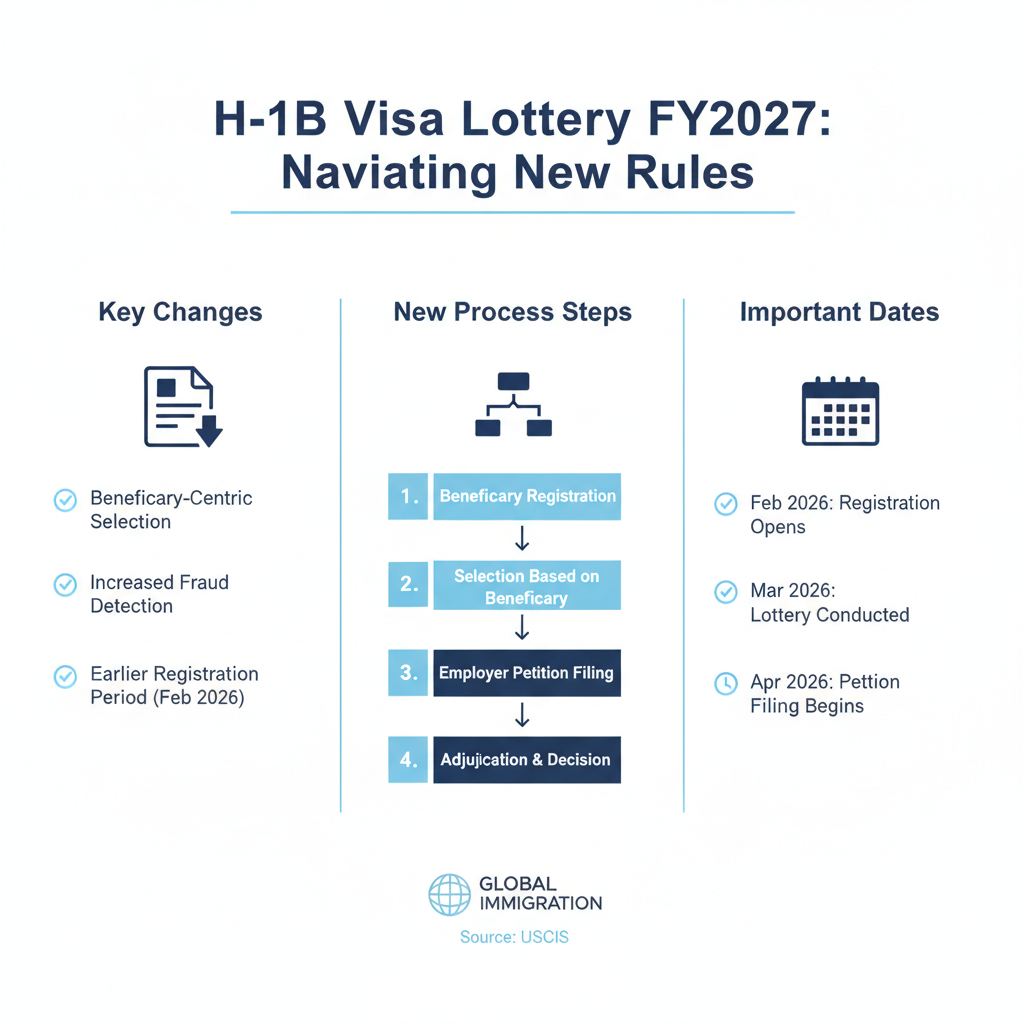
In response to these integrity concerns and to ensure a fairer process, USCIS has finalized new rules, specifically implementing a beneficiary-centric selection process. While discussions and proposed rules have been ongoing, the formalization and implementation of these changes for the FY2027 cycle mean that the lottery conducted in March 2026 (for petitions to be filed starting April 1, 2026, for an October 1, 2026 start date) operated under these new parameters. This news is "showing up now" because the results of that lottery have been announced, and selected registrants and their employers are currently in the crucial phase of preparing and filing their Form I-129, Petition for a Nonimmigrant Worker. For those not selected, or for future applicants, understanding these new rules is paramount for preparing for the next cycle, FY2028.
How it can affect Florida residents
Florida, with its booming tech industry, healthcare sector, hospitality giants, and world-class universities, is a significant hub for H-1B professionals. Cities like Orlando, Tampa, Miami, and Jacksonville attract a diverse pool of talent. The new H-1B lottery changes will have several key impacts:
- Increased Fairness and Reduced Fraud: For legitimate employers and highly qualified beneficiaries in Central Florida, the beneficiary-centric system aims to level the playing field. It reduces the advantage gained by individuals who previously had multiple employers submit registrations on their behalf, ensuring that each unique beneficiary has an equal chance of selection, regardless of the number of job offers.
- Enhanced Due Diligence for Employers: Florida employers, from tech startups in the I-4 corridor to established corporations in Orlando, must now exercise even greater scrutiny during the registration phase. They need to confirm that a prospective employee has not had another employer register them, as duplicate beneficiary registrations will be denied and could lead to penalties.
- Strategic Planning for Beneficiaries: If you are a prospective H-1B beneficiary residing in Florida, perhaps a graduate from the University of Central Florida or a professional working on Optional Practical Training (OPT), you must now coordinate carefully with your potential employers. While you can have multiple job offers, only one employer can submit a registration on your behalf. This requires strategic decision-making and clear communication.
- Potential Impact on Florida's Workforce: While the goal is fairness, the H-1B cap remains unchanged. The competitive nature of the lottery will persist. Florida businesses must continue to attract and retain top global talent, and these new rules reinforce the need for robust immigration strategies.
Navigating the H-1B changes can be complex. Our Orlando immigration team at Imigrar is here to help you understand your options and ensure compliance. Call +1 786-791-3106 for a free consultation, or message us online. Se Habla Español.
What H-1B Visa Lottery Changes for FY2027 Is (and Why It Matters)
The H-1B visa is a nonimmigrant visa that allows U.S. employers to temporarily employ foreign workers in specialty occupations. These occupations generally require a bachelor's degree or higher in a specific field. The H-1B program is vital for U.S. companies to fill critical skill gaps and remain competitive globally.
A plain-English definition
Think of the H-1B visa as a special work permit for highly skilled individuals. If you have a degree in a specialized field (like engineering, IT, medicine, or architecture) and a U.S. employer wants to hire you for a job that requires that degree, they can sponsor you for an H-1B visa. Because there are many more applicants than available visas each year, USCIS uses a lottery system to select who gets a chance to apply. The "changes for FY2027" refer to new rules put in place by USCIS to make this lottery fairer and prevent fraud, primarily by ensuring that each individual (beneficiary) gets only one chance in the lottery, no matter how many job offers they have. This is a significant shift from previous years and impacts how both employers and prospective employees approach the H-1B process.
Key terms you need to know
- H-1B Visa: A nonimmigrant visa that permits U.S. employers to temporarily employ foreign workers in specialty occupations.
- Specialty Occupation: An occupation that requires theoretical and practical application of a body of highly specialized knowledge, and a bachelor's degree or higher in the specific specialty, or its equivalent, as a minimum for entry into the occupation in the United States.
- Cap-Subject: Refers to H-1B petitions that are subject to the annual numerical limit (cap) set by Congress. Currently, this is 65,000 regular cap visas and an additional 20,000 for those with a U.S. master's degree or higher (the "master's cap").
- H-1B Lottery (Registration): The electronic process managed by USCIS where employers submit registrations for prospective H-1B beneficiaries. If the number of registrations exceeds the annual cap, USCIS conducts a random lottery to select enough registrations to meet the cap. This lottery takes place annually, typically in March.
- Beneficiary: The foreign national worker who will be employed in the specialty occupation.
- Petitioner: The U.S. employer who files the H-1B petition on behalf of the foreign worker.
- FY (Fiscal Year): The U.S. government's fiscal year runs from October 1 to September 30. H-1B visas approved during a lottery typically have an effective start date of October 1 of the relevant fiscal year. For the FY2027 lottery, the earliest start date is October 1, 2026.
- USCIS: U.S. Citizenship and Immigration Services, the government agency responsible for adjudicating immigration petitions and applications. (USCIS official website)
- Beneficiary-Centric Selection: The new rule for FY2027 and beyond. Under this system, selections are based on unique beneficiaries rather than unique registrations. If multiple employers register the same beneficiary, that beneficiary is still entered into the lottery only once, giving them a single chance of selection. If selected, all employers who registered that beneficiary will be notified and can then proceed to file a petition. This aims to prevent the manipulation of the lottery by filing multiple registrations for the same individual.
- H-1B Registration Fee: The fee required for each electronic H-1B registration submission. For FY2027, this fee was $10, though USCIS has proposed increasing it significantly for future cycles.
Current Immigration Law: The Foundation
The H-1B visa program is authorized by the Immigration and Nationality Act (INA), specifically under INA §101(a)(15)(H)(i)(b). This section outlines the criteria for nonimmigrants coming temporarily to the United States to perform services in a specialty occupation.
Federal requirements
To qualify for an H-1B visa, both the employer (petitioner) and the employee (beneficiary) must meet specific federal requirements:
For the Employer (Petitioner):
- Offer of Employment: The employer must have a legitimate offer of employment in a specialty occupation.
- Labor Condition Application (LCA): Before filing an H-1B petition, the employer must file and obtain certification of a Labor Condition Application (Form ETA-9035) from the U.S. Department of Labor (DOL). The LCA attests that the employer will pay the H-1B worker at least the prevailing wage for the occupation in the area of intended employment or the actual wage paid to other employees with similar experience and qualifications, whichever is higher. It also ensures working conditions will not adversely affect other workers. U.S. Department of Labor (LCA information)
- Employer-Employee Relationship: USCIS must be satisfied that a valid employer-employee relationship will exist between the petitioner and the beneficiary, meaning the employer has the right to control the beneficiary’s work.
For the Employee (Beneficiary):
- Specialty Occupation Qualification: The beneficiary must meet one of the following criteria:
- Hold a U.S. bachelor's or higher degree required by the specialty occupation from an accredited college or university.
- Hold a foreign degree that is equivalent to a U.S. bachelor's or higher degree in a specialty occupation.
- Hold a state license that is required to practice the specialty occupation and is in the field of specialization.
- Have authorization to practice the specialty occupation in a state and have work experience in the specialty equivalent to a bachelor's degree.
- Have experience in the specialty equivalent to a bachelor's degree through a combination of education, training, or progressively responsible experience.
- Licensure: If the occupation requires a state license (e.g., doctors, nurses, architects), the beneficiary must possess this license or be eligible to obtain it.
Key USCIS forms involved in the H-1B process include:
- Form I-129, Petition for a Nonimmigrant Worker: The primary form filed by the employer.
- Form I-907, Request for Premium Processing Service: Optional form to expedite processing for an additional fee.
- Form G-28, Notice of Entry of Appearance as Attorney or Accredited Representative: Filed by an attorney representing the petitioner or beneficiary.
For official forms and detailed instructions, always refer to the USCIS Forms page.
Florida-specific considerations
While H-1B laws are federal, their application has localized nuances. Florida's economy is incredibly diverse, leading to a high demand for H-1B workers in various sectors:
- Technology: Orlando, Tampa, and Miami are rapidly growing tech hubs, attracting software developers, data scientists, and IT professionals. Companies along the I-4 corridor frequently sponsor H-1B visas.
- Healthcare: Florida's large and aging population drives demand for doctors, nurses, physical therapists, and medical researchers in hospitals and clinics across the state.
- Hospitality and Tourism: While less common for the H-1B's "specialty occupation" requirement, certain roles in management, marketing analytics, or specialized IT within large tourism companies in Orlando may qualify.
- Education and Research: Florida boasts numerous universities, including the University of Central Florida in Orlando, the University of Florida, and Florida State University, which frequently sponsor H-1B visas for professors, researchers, and post-doctoral fellows.
- Regional USCIS Offices: Petitions filed by employers in Florida are typically processed by USCIS service centers, but local field offices, such as the Orlando USCIS Field Office, handle certain aspects like interviews for adjustment of status, if applicable.
Florida-based employers must ensure that prevailing wage determinations for their specific geographical area (e.g., Orlando-Kissimmee-Sanford MSA for Central Florida) are accurate when filing their LCA, as these can vary significantly from national averages.

How to Navigate the New H-1B Lottery System for FY2027: A Complete Step-by-Step Guide
For employers and beneficiaries aiming for an H-1B visa under the new FY2027 rules, the process demands careful planning and strict adherence to regulations. Given that the FY2027 lottery registration period has concluded (March 2026), this guide primarily focuses on the steps for those whose registrations were selected and are now in the petition filing stage (April 1 - June 30, 2026), as well as preparing for future cycles.
1) Understand the New Beneficiary-Centric Registration Rules and Prepare
This is the most critical change for FY2027. Employers must now register a unique beneficiary for the lottery. If multiple employers register the same individual, USCIS will consider only one entry for that beneficiary in the random selection pool. If selected, all employers who submitted a valid registration for that beneficiary will be notified. This aims to eliminate the advantage of multiple entries.
Action: Employers must conduct due diligence to confirm if a prospective beneficiary has other employers intending to register them. Beneficiaries must communicate clearly with potential employers about who will register them and consolidate efforts.
Required Documents (for registration):
- Employer's legal name, address, and Employer Identification Number (EIN).
- Beneficiary's full legal name, date of birth, country of birth, country of citizenship, and passport number.
- Attorney or representative information (if applicable).
2) Employer Creates/Accesses USCIS Online Account and Registers Beneficiary
The H-1B registration process is entirely electronic, conducted through the myUSCIS online portal. The registration period typically opens in early March and lasts for several weeks. For FY2027, this period was March 2026.
Action: The employer (or their authorized representative) must create a registrant account or log in to an existing one. They then enter the required information for each beneficiary and pay the non-refundable $10 H-1B registration fee per beneficiary.
Reminder: For FY2027, each unique beneficiary should only have ONE registration submitted on their behalf. Duplicate beneficiary registrations will be denied by USCIS and could lead to severe penalties for the employer if found to be fraudulent.
Required Documents (for registration - digital entry):
- Employer's legal name, address, and EIN.
- Beneficiary's full legal name, date of birth, country of birth, country of citizenship, and passport number.
3) Await Lottery Results and Selection Notification
After the registration period closes, USCIS conducts the random lottery selection. This typically happens within a few weeks of the registration period closing. For FY2027, selection results were announced in late March 2026.
Action: Employers (and their legal representatives) will be notified of selection through their myUSCIS online accounts. The status of a registration will change to "Selected," "Not Selected," or "Denied." Only registrations with a "Selected" status can proceed to the next step.
Important: If a beneficiary was selected through multiple employers' registrations, USCIS will notify all petitioning employers. It is then up to the beneficiary and employers to decide which employer will proceed with filing the H-1B petition. Only ONE petition can be approved for a beneficiary in a given fiscal year.
Documents: No documents are submitted at this stage; it's a notification process.
4) File the H-1B Petition (Form I-129) for Selected Beneficiaries
If a registration is selected, the employer has a specific window to file the complete Form I-129, Petition for a Nonimmigrant Worker, along with all supporting documentation and fees. For FY2027, this filing window typically opens on April 1, 2026, and usually extends for 90 days, closing around June 30, 2026.
Action: The employer must prepare a comprehensive petition package. This includes obtaining a certified Labor Condition Application (LCA) (ETA Form 9035) from the Department of Labor, gathering the beneficiary's educational and professional credentials, and compiling detailed information about the job offer and the employer's business.
Required Documents (for I-129 petition):
- Certified LCA (ETA Form 9035).
- Evidence of the beneficiary's qualifications (e.g., academic degrees, transcripts, foreign degree evaluations, professional licenses, experience letters, resume).
- Evidence that the position is a specialty occupation (e.g., job description, organizational charts, industry information).
- Employer's financial documents (e.g., annual report, tax returns, bank statements).
- Offer letter and employment contract.
- Beneficiary's passport biographical page, visa, and Form I-94 (Arrival/Departure Record) (if already in the U.S.).
- Client letters/statements of work (for third-party placement cases), if applicable.
- Photographs of the beneficiary (if applying for a change of status).
- Attorney representation form (Form G-28), if applicable.
Fees (as of current knowledge, subject to change):
- Form I-129 filing fee: $460.
- American Competitiveness and Workforce Improvement Act (ACWIA) fee: $750 (for employers with 1-25 full-time employees) or $1,500 (for employers with 26+ full-time employees).
- Fraud Prevention and Detection fee: $500.
- Public Law 114-113 fee: $4,000 (for employers with 50 or more employees, where more than 50% are H-1B or L-1 nonimmigrants).
- Premium Processing fee (optional): $2,805 for a 15-calendar-day processing guarantee.
5) Respond to Requests for Evidence (RFEs) or Notices of Intent to Deny (NOIDs)
It is common for USCIS to issue a Request for Evidence (RFE) if they require more information or clarification on any aspect of the petition. Less commonly, a Notice of Intent to Deny (NOID) may be issued, indicating USCIS's intent to deny the petition unless compelling evidence is provided to overcome the issues.
Action: If an RFE or NOID is received,


