

The H-1B visa program is a cornerstone for U.S. employers seeking to hire highly skilled foreign professionals in specialty occupations, and for international talent looking to contribute their expertise in the United States. Each year, the demand for H-1B visas far outstrips the available supply, necessitating a lottery system. For Fiscal Year 2027, significant changes are being implemented to this crucial process, bringing new challenges and opportunities for both beneficiaries and petitioning employers.
At Imigrar, an immigration law firm based in Orlando, Florida, we understand the profound impact these changes can have on individuals and families striving to build a future in the U.S. Our mission is to "Keep Families Together," and navigating complex immigration laws, especially those as competitive as the H-1B lottery, is central to that mission. We are here to provide professional, accurate, and actionable guidance to help you understand and prepare for the FY2027 H-1B lottery changes.
Today is July 27, 2026, and as the FY2027 H-1B cap season approaches, understanding these new rules is paramount. These changes are designed to enhance the integrity of the H-1B cap lottery program and reduce the potential for fraud, but they also introduce new complexities that require careful attention.
Navigating the H-1B lottery can be daunting, especially with new rules. Our Orlando immigration team is ready to assist. Call +1 786-791-3106 for a free consultation, or message us online. Se Habla Español.
The reporting that sparked this guide:
H-1B Visa Lottery Changes for FY2027 (Legal News)
What This News Means for Immigrants in Orlando and Across Florida
The H-1B visa program is vital for Florida’s diverse economy, which relies on skilled professionals in sectors ranging from technology and aerospace to healthcare and tourism. From the bustling tech hubs of Orlando and Tampa to the medical centers of Gainesville and Miami, companies across the Sunshine State frequently sponsor H-1B visas for talented foreign workers. The recent announcements regarding significant changes to the H-1B lottery for Fiscal Year 2027 are therefore of critical importance to both prospective beneficiaries and employers throughout Florida.
Why this news is showing up now
Immigration regulations are dynamic, and U.S. Citizenship and Immigration Services (USCIS) regularly reviews and updates its processes to adapt to changing circumstances, address program vulnerabilities, and enhance efficiency. The H-1B program, in particular, has seen unprecedented demand in recent years, leading to concerns about lottery integrity and potential for abuse. The news about FY2027 changes stems from USCIS's ongoing efforts to refine the H-1B cap registration and selection process. These changes, often finalized months in advance, are designed to streamline the system, combat fraud, and ensure that the lottery serves its intended purpose of selecting the most qualified beneficiaries fairly. As of July 2026, details for the upcoming FY2027 cycle (which typically opens for registration in March 2027 for a start date of October 1, 2027) are being finalized and publicized to give employers and beneficiaries ample time to prepare.
How it can affect Florida residents
For individuals residing in Florida on other nonimmigrant visas (like F-1 OPT, L-1, or TN) who aspire to transition to H-1B status, these changes directly impact their future immigration plans. If you are working on Optional Practical Training (OPT) in Orlando, for instance, and your employer plans to sponsor you for an H-1B, understanding the new rules is essential for your continued employment and path to long-term residency. Similarly, Florida employers, from small tech startups along the I-4 corridor to large multinational corporations, must adapt their H-1B sponsorship strategies to comply with the new regulations. These changes can affect:
- Chances of Selection: The new beneficiary-centric selection process aims to level the playing field, potentially increasing the odds for truly unique beneficiaries but reducing the impact of multiple employer registrations.
- Employer Strategy: Companies, especially those in high-demand sectors like simulation and gaming in Orange County, will need to re-evaluate how they approach H-1B sponsorships, focusing on the quality and legitimacy of each candidate.
- Preparation Timeline: The updated requirements may necessitate earlier and more thorough preparation of documents and educational credentials.
- Cost Implications: Increased registration fees or other associated costs could impact both employers and, indirectly, beneficiaries.
- Fraud Prevention: Stricter measures mean that any past practices of multiple registrations by related entities for the same individual will be scrutinized, potentially leading to disqualification or legal repercussions.
For Central Florida residents and businesses, staying informed and working with experienced legal counsel like Imigrar is critical to successfully navigate these new H-1B visa lottery changes for FY2027.
What H-1B Visa Lottery Changes for FY2027 Is (and Why It Matters)
The H-1B visa is a nonimmigrant visa that allows U.S. employers to temporarily employ foreign workers in specialty occupations. A specialty occupation generally requires a bachelor's degree or higher in a specific specialty, or its equivalent. These occupations often include fields such as IT, engineering, medicine, architecture, finance, and various scientific research roles. The H-1B program is extremely popular, and due to an annual cap, the demand typically far exceeds the supply, leading to a lottery system to select eligible petitions.
A plain-English definition
The H-1B Visa Lottery Changes for FY2027 refer to a set of new rules and procedures implemented by USCIS specifically for the H-1B cap registration and selection process that will govern the H-1B visas issued for Fiscal Year 2027 (which begins October 1, 2027). The most impactful change is the shift to a beneficiary-centric selection process, meaning that each unique foreign national (the beneficiary) is entered into the lottery only once, regardless of how many employers register them. This is a significant departure from previous years where each registration, even if for the same individual, counted as a separate entry. These changes are designed to combat fraud, improve fairness, and ensure that the lottery genuinely reflects individual demand rather than multiple speculative registrations.
Key terms you need to know
- H-1B Visa: A nonimmigrant visa that permits U.S. employers to temporarily employ foreign workers in specialty occupations.
- Specialty Occupation: An occupation that requires theoretical and practical application of a body of highly specialized knowledge, and a bachelor's or higher degree in the specific specialty (or its equivalent) as a minimum for entry into the occupation in the U.S.
- Beneficiary: The foreign national who is seeking the H-1B visa.
- Petitioner: The U.S. employer who is sponsoring the H-1B visa for the beneficiary.
- Cap-Subject H-1B: H-1B petitions that are subject to the annual statutory cap of 65,000 visas, plus an additional 20,000 for those with a U.S. master's degree or higher (the "Master's Cap").
- Cap-Exempt H-1B: Certain employers, such as institutions of higher education, non-profit organizations affiliated with higher education, and government research organizations, are exempt from the annual cap.
- Electronic Registration Process: The online system employers use to register beneficiaries for the H-1B lottery before filing a full petition. This is typically conducted in March for the upcoming fiscal year.
- Beneficiary-Centric Selection: The new FY2027 lottery rule where selections are based on unique beneficiaries, not on the number of registrations submitted on their behalf. If a beneficiary has multiple registrations, they are still only entered once.
- Labor Condition Application (LCA): Form ETA-9035, filed with the U.S. Department of Labor (DOL) by the employer, attesting to specific conditions regarding wages and working conditions for H-1B employees.
- Form I-129, Petition for a Nonimmigrant Worker: The primary USCIS form filed by the employer after a beneficiary is selected in the lottery.
- Premium Processing: An expedited service offered by USCIS for certain petitions, including H-1B, for an additional fee, guaranteeing adjudication within a specific timeframe (currently 15 calendar days).
- Dual Intent: A legal concept allowing H-1B visa holders to lawfully seek permanent residency in the U.S. while maintaining their nonimmigrant H-1B status.
These changes matter because they represent a fundamental shift in how the H-1B lottery operates. For years, the system was vulnerable to abuse where multiple employers (sometimes related or fraudulent) would register the same individual, artificially inflating their chances of selection. The beneficiary-centric approach aims to eliminate this practice, making the lottery fairer for all legitimate applicants. It also means that employers must be more strategic and diligent in their registration efforts, as simply having multiple registrations will no longer confer an advantage.
Confused by the new H-1B terms or changes? Imigrar can clarify your options. Contact our Orlando office at +1 786-791-3106 for expert guidance. Se Habla Español.
Current Immigration Law: The Foundation
The H-1B visa program is authorized by the Immigration and Nationality Act (INA), specifically under INA §101(a)(15)(H)(i)(b) and INA §214(g). These statutes establish the legal framework for the visa, including its purpose, eligibility criteria, and annual limitations. Further regulations governing the H-1B program are found in Title 8 of the Code of Federal Regulations (8 CFR), particularly Part 214.2(h), which details the requirements for nonimmigrant workers in specialty occupations. The U.S. Department of Labor (DOL) also plays a critical role, primarily through the Labor Condition Application (LCA) process, ensuring that the employment of H-1B workers does not adversely affect U.S. workers' wages and working conditions.
Federal requirements
To qualify for an H-1B visa, both the petitioner (employer) and the beneficiary (foreign worker) must meet specific federal requirements:
- Specialty Occupation: The job offer must be in a specialty occupation, meaning it requires a theoretical and practical application of a body of highly specialized knowledge and a bachelor's degree or higher in a specific specialty (or its equivalent) as a minimum for entry.
- Beneficiary Qualifications: The beneficiary must possess at least a bachelor's degree or its equivalent, or hold an unrestricted state license, or have work experience equivalent to a bachelor's degree in the specialty occupation.
- Employer-Employee Relationship: A valid employer-employee relationship must exist between the petitioning U.S. employer and the H-1B worker. This is especially scrutinized for third-party placements.
- LCA Approval: The employer must obtain a certified Labor Condition Application (Form ETA-9035) from the DOL, attesting that they will pay the H-1B worker at least the prevailing wage for the occupation in the area of intended employment or the actual wage paid to other employees with similar experience and qualifications, whichever is higher.
- Annual Cap: Most H-1B petitions are subject to an annual numerical limit (cap). The current annual cap is 65,000 visas, with an additional 20,000 reserved for those who have earned a U.S. master's degree or higher.
Reminder: The H-1B visa is a "dual intent" visa, meaning that beneficiaries can pursue permanent residency (Green Card) while holding H-1B status without jeopardizing their nonimmigrant status.
Florida-specific considerations
While H-1B laws are federal, their impact and application can have specific nuances within a state like Florida. Florida is a rapidly growing state with significant demand for skilled labor across various industries. The Orlando metropolitan area, in particular, is a hub for technology, simulation, aerospace, healthcare, and tourism, all of which are sectors that frequently utilize the H-1B program. The presence of major universities, research institutions, and large corporations in Florida means there's a constant need for specialized talent. The competitive nature of the H-1B lottery means that Florida-based employers must be exceptionally well-prepared to secure talent, especially with the new FY2027 rules emphasizing beneficiary legitimacy.
The Orlando USCIS Field Office handles many immigration matters for Central Florida residents, though H-1B petitions are generally processed at USCIS Service Centers. However, local considerations, such as prevailing wage determinations for specific Florida regions, can influence the LCA process. Companies along the I-4 corridor, from Orlando to Tampa, often compete for the same pool of talent, making strategic H-1B planning even more crucial.
For official information and forms, always refer to the USCIS official website. Key forms related to the H-1B process include:
- Form I-129, Petition for a Nonimmigrant Worker: The core form for H-1B petitions.
- Form I-907, Request for Premium Processing Service: Used to expedite processing of Form I-129.
- Form G-28, Notice of Entry of Appearance as Attorney or Accredited Representative: Filed by your attorney.

How to Navigate the FY2027 H-1B Lottery Changes: A Complete Step-by-Step Guide
The H-1B cap season for FY2027 will incorporate significant changes designed to enhance fairness and reduce fraud. This step-by-step guide incorporates these new rules to help you prepare effectively.
1) Understand the New FY2027 Rules & Eligibility
Before anything else, it’s crucial for both the employer and the prospective H-1B beneficiary to thoroughly understand the new rules for FY2027. The most critical change is the beneficiary-centric selection process. This means that each unique beneficiary can only be entered into the lottery ONCE, regardless of how many employers register on their behalf. If multiple registrations are submitted for the same beneficiary, USCIS will consider them a single entry. This aims to prevent the artificial inflation of selection chances through numerous speculative registrations. Additionally, expect increased registration fees and enhanced fraud detection measures, which may include more stringent verification of employer-employee relationships and educational credentials. Ensure the beneficiary meets the basic eligibility criteria for a specialty occupation, including the required educational qualifications.
- Required Documents (Initial Assessment):
- Beneficiary’s resume and detailed educational transcripts/degree certificates.
- Any foreign degree evaluations (if applicable).
- Job offer letter from the U.S. employer, detailing the specialty occupation.
- Employer's Federal Employer Identification Number (EIN).
2) Employer Files Labor Condition Application (LCA)
Before an H-1B petition can be filed (or even registered in some cases, though the LCA is not strictly required *before* registration), the petitioning employer must file a Labor Condition Application (Form ETA-9035) with the U.S. Department of Labor (DOL). The LCA attests that the employer will pay the H-1B worker at least the prevailing wage for the occupation in the area of intended employment or the actual wage paid to other employees with similar experience and qualifications, whichever is higher. It also attests to safe working conditions and that the H-1B employment will not adversely affect U.S. workers. The DOL must certify the LCA before USCIS can approve an H-1B petition. This process typically takes 7-10 business days.
- Required Documents:
- Detailed job description, including duties and required qualifications.
- Information on the proposed H-1B wage and benefits.
- Prevailing wage determination for the specific occupation and geographic location (e.g., Orlando, FL).
- Employer’s EIN and other company details.
3) H-1B Electronic Registration Period
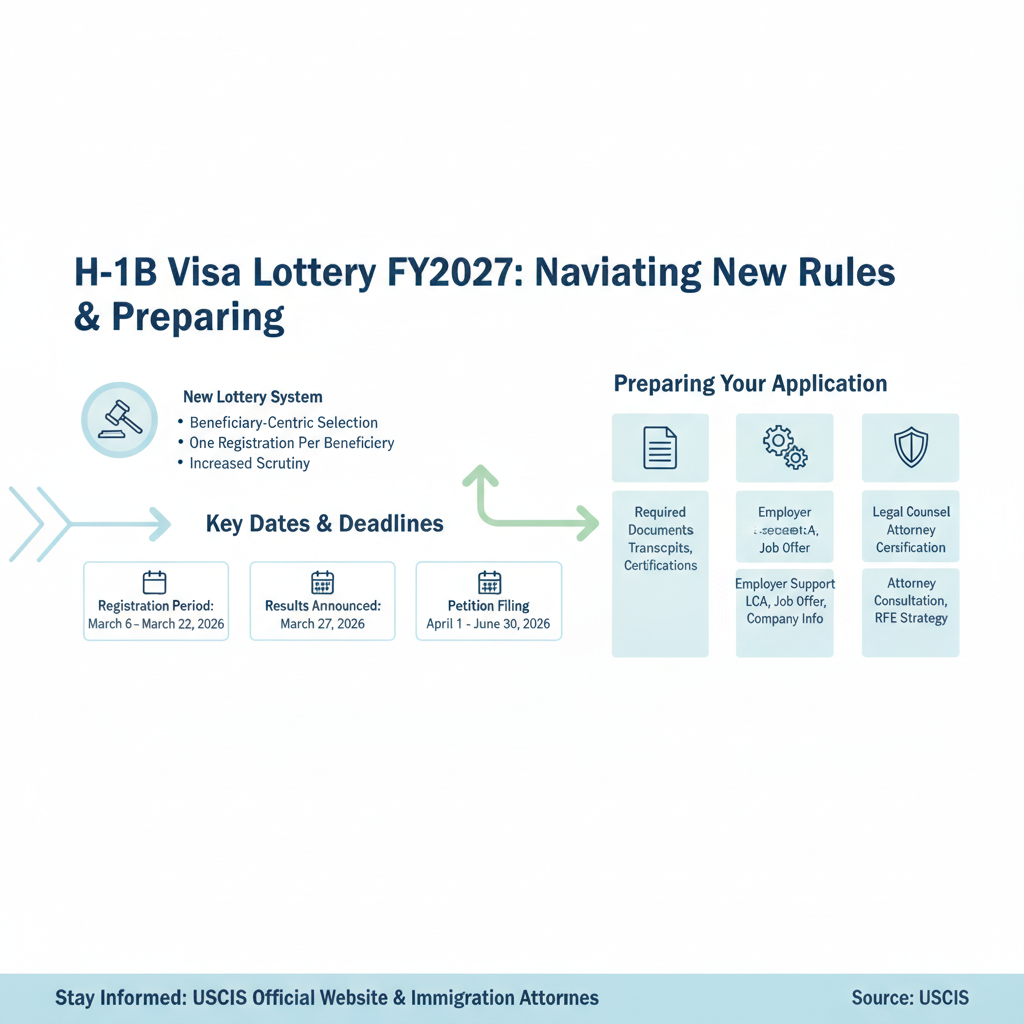
The H-1B electronic registration period is typically in March for the fiscal year starting October 1. For FY2027, this means March 2027. During this short window (usually 2-3 weeks), employers (or their attorneys) must electronically register each prospective H-1B beneficiary with USCIS. Under the new FY2027 rules, each unique beneficiary should only have ONE registration submitted. While multiple employers can *separately* register the same beneficiary, USCIS will de-duplicate these entries and only place the beneficiary into the lottery once. Each registration will require a fee, which has likely increased for FY2027 to help cover program costs and deter frivolous filings. It’s crucial to ensure all information is accurate and consistent across any potential registrations.
- Required Information/Documents for Registration:
- Beneficiary’s full legal name, date of birth, country of birth, country of citizenship, passport number.
- Beneficiary’s highest level of education.
- Employer’s legal name, Federal EIN, and mailing address.
- Attorney’s G-28 (if represented).
- Payment of the non-refundable registration fee.
4) Lottery Selection and Notification
After the registration period closes, USCIS conducts the H-1B lottery if the number of registrations exceeds the annual cap. The lottery is run electronically, first for the U.S. Master's Cap, and then for the regular cap. With the new beneficiary-centric system, USCIS selects unique beneficiaries, not individual registrations. USCIS then notifies registered employers and their legal representatives of the selection results. Typically, selection notices are issued by the end of March or early April. Only those beneficiaries whose registrations have been selected are eligible to have an H-1B petition filed on their behalf.
- Required Documents (Post-Selection):
- Official H-1B Selection Notice (Form I-797C) from USCIS.
5) File the H-1B Petition (Form I-129)
Once a beneficiary is selected, the petitioning employer has a specific window – typically 90 days from the selection date – to file the complete H-1B petition (Form I-129) with USCIS. This is a comprehensive submission that includes the certified LCA, extensive documentation about the employer, the beneficiary's qualifications, the specialty occupation, and the terms of employment. Accuracy and completeness are paramount to avoid Requests for Evidence (RFEs) or denials. This step requires meticulous attention to detail and a thorough understanding of H-1B regulations.
- Required Documents:
- Form I-129 and its various supplements (e.g., H Classification Supplement, H-1B Data Collection and Filing Fee Exemption Supplement).
- Certified LCA (Form ETA-9035).
- Employer support letter detailing the job, salary, and why the position qualifies as a specialty occupation.
- Beneficiary’s educational documents (degrees, transcripts, credential evaluations).
- Beneficiary’s resume and professional licenses (if applicable).
- Copies of beneficiary’s passport, visa, I-94 record, and previous U.S. immigration documents.
- Employer’s financial statements, business license, and other corporate documents to demonstrate ability to pay.
- Client letters or vendor agreements (for third-party placements).
- Photographs of the beneficiary (passport-style).
- Attorney’s Form G-28.
6) Processing and Adjudication
After filing, USCIS processes the H-1B petition. Processing times can vary significantly


