


The landscape of U.S. immigration law is constantly evolving, and for skilled foreign professionals, few changes are as impactful as those affecting the H-1B visa program. As we look towards the FY2027 H-1B visa lottery, new rules are in place that fundamentally alter the application process, aiming to enhance fairness and combat fraud. For individuals and employers across the nation, particularly in vibrant economic hubs like Orlando and Central Florida, understanding these updates is not just beneficial—it’s absolutely critical.
At Imigrar, an immigration law firm based in Orlando, Florida, our mission is to Keep Families Together by providing expert legal guidance and compassionate support. We serve clients nationwide, and with these significant changes to the H-1B lottery, we are dedicated to ensuring that you, your family, and your employer are fully prepared.
The reporting that sparked this guide
Our comprehensive guide is informed by recent developments and ongoing discussions within the legal community regarding the H-1B visa program. We track these vital updates to provide our clients with the most current and accurate information available, ensuring they are always ahead in their immigration journey.
H-1B Visa Lottery Changes for FY2027 (Legal News)
What This News Means for Immigrants in Orlando and Across Florida
The H-1B visa program is a cornerstone for many skilled foreign workers seeking opportunities in the U.S., allowing U.S. employers to temporarily employ foreign workers in specialty occupations. These occupations generally require a bachelor's degree or higher in a specific field. With a fixed annual cap on the number of H-1B visas available, demand consistently outstrips supply, necessitating a lottery system for selection. The changes implemented for the FY2027 H-1B lottery are designed to overhaul this selection process, bringing significant implications for prospective beneficiaries and sponsoring employers.
Why this news is showing up now
The United States Citizenship and Immigration Services (USCIS) regularly reviews and updates its immigration policies and procedures to address evolving challenges, improve efficiency, and prevent abuse of the system. The specific changes to the H-1B lottery process, particularly the shift to a beneficiary-centric selection process, were finalized earlier to combat widespread fraud observed in previous lottery cycles, where multiple employers might submit registrations for the same individual, artificially inflating their chances. While these changes were initially introduced for the FY2025 lottery, their full impact and implications are continuously being assessed and refined by USCIS. As we approach the registration period for the FY2027 H-1B lottery, these updated rules are now the established framework, making discussions and preparations critically important in August 2026.
The timing of this news is crucial because it gives employers and prospective H-1B beneficiaries ample time to understand the new requirements, gather necessary documentation, and strategize their approach before the official registration window opens in early 2027. USCIS aims for transparency and fairness, and these changes reflect a concerted effort to ensure that only legitimate job offers and qualified candidates participate in the lottery.
How it can affect Florida residents
Florida, and particularly the Orlando area, is a rapidly growing hub for technology, aerospace, healthcare, tourism, and various other industries that heavily rely on skilled foreign talent. Universities across Florida, such as the University of Central Florida, University of Florida, and University of South Florida, graduate thousands of international students each year who often seek H-1B sponsorship to begin their careers in the U.S.
- For Prospective H-1B Beneficiaries in Florida: If you are an international student on an F-1 visa with Optional Practical Training (OPT), or a professional on another nonimmigrant visa (e.g., L-1, TN) working in Orlando, Tampa, or Miami, these changes directly impact your path to an H-1B visa. The new beneficiary-centric system means that your unique passport or travel document information will be the primary identifier, preventing multiple entries by different employers for you. This potentially levels the playing field, but it also places a greater emphasis on securing a legitimate and committed sponsoring employer.
- For Florida Employers: Companies along the I-4 corridor, from Orlando to Tampa, and businesses in South Florida, frequently sponsor H-1B visas. The new rules require employers to be meticulously careful that only one registration is submitted per beneficiary. Any attempt to circumvent this rule can lead to disqualification and potentially severe penalties. This necessitates tighter internal controls and clear communication with prospective employees. The integrity of the process is now paramount, and any perceived attempt at fraud will be met with heightened scrutiny from USCIS.
The Orlando USCIS Field Office and immigration courts handle a significant volume of cases, and familiarity with local procedures, while not directly tied to the lottery selection, can be beneficial for subsequent petition processing and interviews. Imigrar, located in Orlando, is uniquely positioned to assist clients in Central Florida and beyond, providing localized expertise combined with nationwide service.
Need Help? Navigating complex H-1B lottery changes requires expert guidance. Our Orlando immigration team is ready to assist. Call +1 786-791-3106 for a free consultation, or message us online. Se Habla Español.
What H-1B Visa Lottery Changes for FY2027 Is (and Why It Matters)
The H-1B visa program is a nonimmigrant visa that allows U.S. employers to temporarily employ foreign workers in specialty occupations. These occupations require theoretical and practical application of a body of highly specialized knowledge, and a bachelor's degree or higher in the specific specialty (or its equivalent) as a minimum for entry into the occupation. The program is crucial for U.S. companies seeking to fill critical skill gaps and remain competitive globally.
A plain-English definition
For the FY2027 H-1B lottery, the biggest change is essentially a shift in who USCIS focuses on during the lottery selection. Previously, if multiple companies registered the same person, each registration counted as a separate entry, increasing that person's statistical chance of being selected (though USCIS would only approve one petition per person). This led to some abuse, where companies, sometimes without a genuine job offer, would submit registrations just to boost an individual's odds.
Now, for FY2027, the lottery selection is "beneficiary-centric." This means that regardless of how many employers register for you, you, the individual (the beneficiary), only get one chance in the lottery. USCIS will use your unique passport or travel document number to identify you. If you are selected, then *any* of the employers who registered for you can proceed to file an H-1B petition on your behalf. This change is designed to eliminate fraud, ensure fairness, and give every unique individual an equal chance at selection, regardless of how many employers are interested in sponsoring them.
Key terms you need to know
Understanding the jargon is essential for navigating the H-1B process, especially with new rules in play:
- H-1B Visa: A nonimmigrant visa that allows U.S. employers to temporarily employ foreign workers in specialty occupations.
- Specialty Occupation: An occupation that requires a theoretical and practical application of a body of highly specialized knowledge and a bachelor's degree or higher in the specific specialty (or its equivalent) as a minimum for entry into the occupation.
- Beneficiary: The foreign national who will be employed by the U.S. employer.
- Petitioner: The U.S. employer seeking to hire the foreign national.
- H-1B Cap: The statutory annual limit on the number of H-1B visas issued. Currently, Congress has set the annual regular H-1B cap at 65,000, with an additional 20,000 visas reserved for those with a U.S. master's degree or higher (the "master's cap").
- Cap-Subject: An H-1B petition that is subject to the annual cap. Most H-1B petitions fall into this category.
- Cap-Exempt: Certain employers (e.g., institutions of higher education, non-profit organizations affiliated with higher education, or non-profit research organizations) are exempt from the annual H-1B cap.
- H-1B Registration Period: The annual period, typically in March, during which prospective petitioners (employers) must electronically register beneficiaries for the lottery. This is the first step in the cap-subject H-1B process.
- H-1B Selection Period: The period immediately following the registration period when USCIS conducts the lottery to select enough registrations to meet the annual cap.
- Labor Condition Application (LCA) – Form ETA-9035: A document certified by the U.S. Department of Labor (DOL) that an employer must file before filing an H-1B petition. It attests that the employer will pay the H-1B worker at least the prevailing wage or the actual wage, whichever is higher, and will provide working conditions that will not adversely affect other workers.
- Form I-129, Petition for a Nonimmigrant Worker: The primary form filed by the employer with USCIS after a registration is selected in the lottery.
- Premium Processing: An optional service offered by USCIS for certain petition types, including H-1B, which guarantees processing within 15 calendar days for an additional fee.
- Request for Evidence (RFE): A notice from USCIS asking for additional documentation or information to support a petition.
- Notice of Intent to Deny (NOID): A notice from USCIS indicating their intention to deny a petition, offering an opportunity to submit a rebuttal.
- Consular Processing: The process of applying for an H-1B visa stamp at a U.S. embassy or consulate abroad after the petition is approved.
- Change of Status (COS): The process of changing from one nonimmigrant status (e.g., F-1, L-1) to H-1B status while remaining in the U.S.
Current Immigration Law: The Foundation
The H-1B visa program is governed by the Immigration and Nationality Act (INA), specifically Section 101(a)(15)(H)(i)(b), and further regulated by Title 8 of the Code of Federal Regulations (8 CFR). These legal frameworks establish the requirements for both the employer and the employee, the duration of stay, and the conditions under which an H-1B visa can be granted.
Federal requirements
To qualify for an H-1B visa, both the employer and the beneficiary must meet specific federal requirements:
- For the Beneficiary:
- Must hold a bachelor's degree or its equivalent, or a license in a specialty occupation field, or work experience equivalent to a bachelor's degree.
- Must be coming to the U.S. to perform services in a specialty occupation.
- Must have an employer-employee relationship with the petitioning U.S. employer.
- For the Employer (Petitioner):
- Must offer a job in a specialty occupation that requires a theoretical and practical application of a body of highly specialized knowledge.
- Must pay the H-1B worker at least the prevailing wage for that occupation in the area of employment or the actual wage paid to other employees with similar experience and qualifications, whichever is higher. This is attested to in the Labor Condition Application (LCA).
- Must file Form ETA-9035, Labor Condition Application, with the Department of Labor and receive certification before filing Form I-129 with USCIS.
- Must provide a valid Employer Identification Number (EIN).
The annual cap for H-1B visas remains 65,000 for the regular cap and an additional 20,000 for the master's cap. The changes for FY2027 primarily affect the *selection mechanism* for these cap-subject petitions, not the underlying eligibility criteria for the visa itself. USCIS is committed to upholding the integrity of the H-1B program, as detailed on their USCIS official website.
Florida-specific considerations
While federal law governs the H-1B program, the practical implications vary by location. Florida's dynamic economy means a high demand for H-1B talent:
- Tech Sector: Cities like Orlando, Tampa, and Miami are burgeoning tech hubs, attracting software engineers, data scientists, and IT professionals. Many companies in these areas are active H-1B sponsors.
- Healthcare: Florida's large and growing population fuels demand for doctors, nurses, and allied health professionals, many of whom may be sponsored for H-1B visas.
- Hospitality and Tourism: While less common for H-1B, certain specialized roles in large theme parks or international resorts in Orlando might qualify as specialty occupations.
- Universities and Research: Florida boasts numerous world-class universities (e.g., UCF in Orlando) that sponsor H-1B visas for researchers, professors, and post-doctoral fellows, often under the cap-exempt category.
For Central Florida residents, understanding the local job market and employer landscape can be advantageous when seeking H-1B sponsorship. It's also important to note that if your H-1B petition is approved and you seek a Change of Status while remaining in Orlando, the Orlando USCIS Field Office may have jurisdiction over related inquiries or interviews, though most H-1B petitions are processed at service centers.
Considering an H-1B? The new rules for FY2027 are complex. Let Imigrar guide you. Our Orlando-based team offers nationwide assistance. Call +1 786-791-3106 for a free consultation. Se Habla Español.
How to Navigate the New H-1B Visa Lottery Changes: A Complete Step-by-Step Guide
The H-1B lottery process, particularly for FY2027, has undergone significant changes aimed at reducing fraud and ensuring a fairer selection. Here’s a detailed, step-by-step guide to help you and your sponsoring employer navigate the new system effectively.
1) Understand the New Rules & Eligibility
Before anything else, both the prospective H-1B beneficiary and the sponsoring employer must thoroughly understand the new beneficiary-centric selection process. This is the most crucial change for FY2027.
- Beneficiary-Centric Selection: The lottery selection is now based on the unique beneficiary, identified by a valid passport or travel document number. This means that each beneficiary gets only one chance in the lottery, regardless of how many employers submit registrations on their behalf.
- Fraud Prevention: USCIS explicitly states that submitting multiple registrations for the same beneficiary (even by different employers) will not increase selection odds. Instead, it could lead to disqualification of all registrations submitted for that beneficiary, as well as potential criminal investigations for fraud against the individuals and entities involved.
- Eligibility Review: Ensure the beneficiary meets the educational and occupational requirements for a specialty occupation. The employer must confirm the job itself qualifies as a specialty occupation.
Required Documents (for initial assessment):
- Beneficiary's valid passport or travel document number.
- Beneficiary's educational degrees, transcripts, and evaluations of foreign degrees.
- Beneficiary's resume and work experience letters.
- Detailed job description from the employer.
2) Employer Sponsorship & Labor Condition Application (LCA)
The H-1B process is employer-driven. The employer must be genuinely committed to sponsoring the beneficiary.
- Secure a Sponsoring Employer: The beneficiary must have a job offer from a U.S. employer willing to sponsor an H-1B visa. The employer must be able to demonstrate the ability to pay the required wage.
- Determine Prevailing Wage: The employer must determine the appropriate prevailing wage for the occupation in the specific geographic area of employment. This is typically done by consulting Department of Labor (DOL) wage data.
- File Labor Condition Application (LCA): The employer must file a Form ETA-9035, Labor Condition Application, with the U.S. Department of Labor. The LCA attests that the employer will pay the H-1B worker at least the prevailing wage or the actual wage, whichever is higher, and that working conditions will not adversely affect other workers. The DOL typically processes LCAs within 7-10 business days.
Required Documents (for LCA):
- Employer's EIN.
- Employer's company details (name, address, industry).
- Beneficiary's job title, duties, and proposed wage.
- Worksite address(es).
3) H-1B Registration Process
Once the LCA is certified (or while it's pending, if confident), the employer prepares for the electronic registration for the lottery. This usually occurs in March.
- Create/Access USCIS Online Account: The employer (or their authorized representative, like Imigrar) must create or access a USCIS online account.
- Submit Electronic Registration: During the designated registration period, the employer submits an electronic registration for each beneficiary. For each beneficiary, the employer must provide:
- Beneficiary's full legal name, date of birth, country of birth, country of citizenship.
- Beneficiary's valid passport or travel document number (Important: This is the key identifier for the beneficiary-centric selection).
- Employer's name, address, and EIN.
- Employer's authorized signatory information.
- Pay Registration Fee: A non-refundable fee (typically $10) must be paid for each registration.
Required Information (for Registration):
- Beneficiary's passport details (as specified above).
- Employer's full legal name and EIN.
- Employer's authorized representative contact information.
4) Lottery Selection & Notification
After the registration period closes, USCIS conducts the lottery.
- Random Selection: USCIS conducts a random lottery to select enough registrations to meet the regular cap and the master's cap. The selection is now based on the unique beneficiary, not the number of registrations submitted on their behalf.
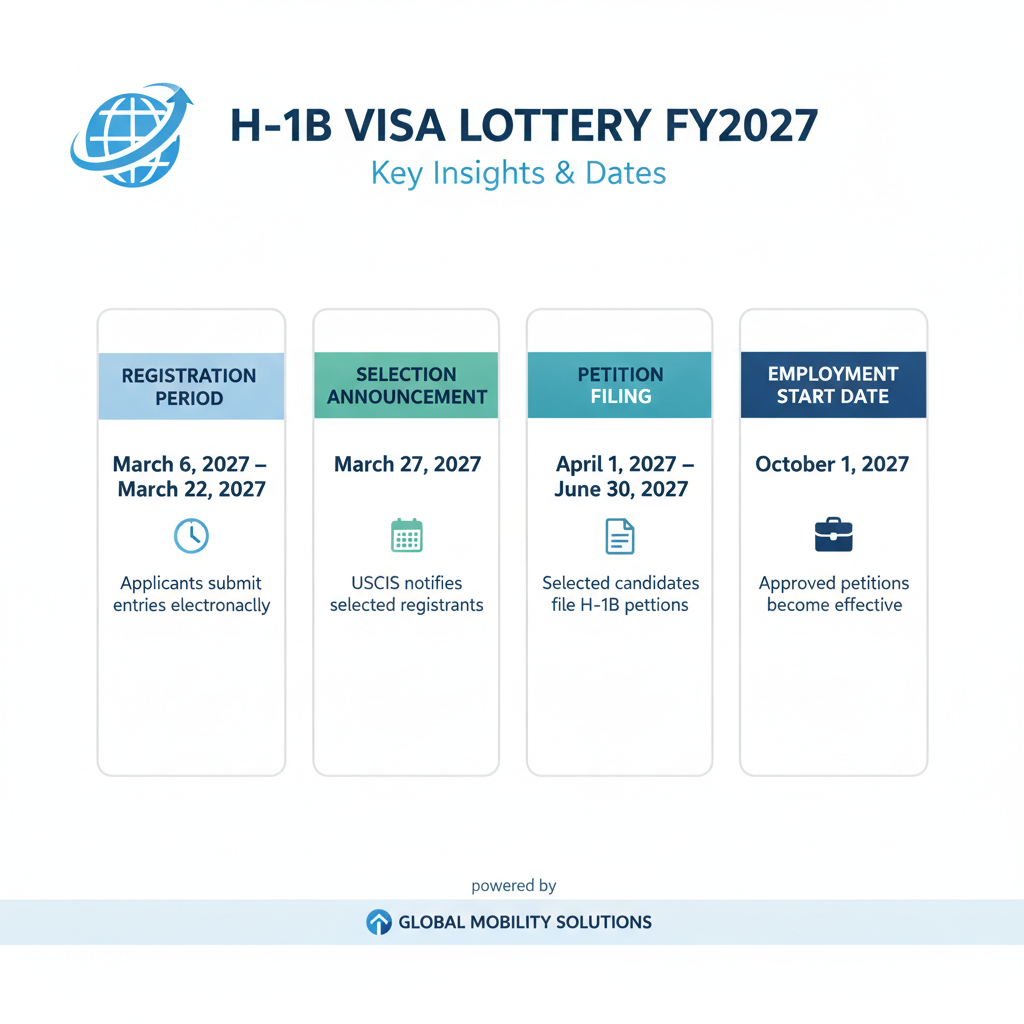
- Notification: USCIS notifies selected registrants (employers) through their online accounts. This typically happens by the end of March. Unselected registrants are also notified.
- Selection Confirmation: If selected, the employer will receive a selection notice that includes a unique USCIS receipt number. This receipt number is crucial for the next step.
Reminder: If a beneficiary is selected, *any* employer who submitted a valid registration for that beneficiary can proceed with filing an H-1B petition. The beneficiary should communicate with their preferred employer to move forward.
5) Petition Filing (Form I-129)
Only selected employers can proceed to file the full H-1B petition with USCIS.
- Prepare Form I-129: The employer, with the help of their legal counsel, prepares Form I-129, Petition for a Nonimmigrant Worker, and all supporting documentation. This is a comprehensive package that demonstrates the beneficiary's qualifications, the specialty occupation nature of the job, and the employer's ability to comply with H-1B regulations.
- Gather Supporting Documents: This is an extensive step requiring meticulous document preparation.
- File Petition within Filing Window: USCIS provides a specific 90-day window for filing the H-1B petition after selection. Missing this deadline will result in the forfeiture of the lottery selection.
Required Documents (for Form I-129 and supporting evidence):
- Certified Form ETA-9035, LCA.
- Form I-129 and H-1B supplement.
- Copy of the H-1B lottery selection notice.
- Employer's support letter explaining the job duties, specialty occupation nature, and salary.
- Beneficiary's educational documents (diplomas, transcripts, foreign degree evaluations).
- Beneficiary's resume and professional licenses (if applicable).
- Beneficiary's passport biographical page, visa stamps, and I-94 records.
- Company financial documents (e.g., tax returns, annual reports) to demonstrate ability to pay.
- Organizational charts, client contracts (for consulting firms), and other evidence to establish an employer-employee relationship and availability of work.
- Filing fees for Form I-129 and other applicable fees.
6) Premium Processing (Optional)
If speed is a concern, employers may opt for Premium Processing.
- File Form I-907: The employer can file Form I-907, Request for Premium Processing Service, along with the Form I-129 or at a later date.
- Pay Premium Processing Fee: An additional fee (currently $2,805, subject to change) ensures USCIS will adjudicate the petition within 15 calendar days. If USCIS issues an RFE or NOID, a new 15-day period begins once the response is received.
Required Documents (for Premium Processing):
- Form I-907.
- Premium Processing fee.
7) Approval & Visa Stamping/Change of Status
Once the H-1B petition is approved, the final step depends on the beneficiary's location.
- Approval Notice (Form I-797): USCIS issues an approval notice. If


