
The landscape of U.S. immigration law is constantly evolving, and for skilled foreign workers and their sponsoring employers, few changes are as impactful as those affecting the H-1B visa program. As an immigration law firm dedicated to "Keep Families Together" across Orlando, Florida, and nationwide, Imigrar is committed to keeping you informed and prepared for these crucial updates.
Today, we're diving deep into the significant H-1B visa lottery changes for Fiscal Year 2027 (FY2027), particularly the new beneficiary-centric selection process designed to enhance integrity and fairness in the system. These changes directly impact how employers in Florida, from burgeoning tech startups in Orlando to established healthcare systems, will navigate the path to sponsoring essential talent.
Navigating complex H-1B changes requires expert guidance. Our Orlando immigration team at Imigrar is ready to assist you. Call +1 786-791-3106 for a free consultation, or message us online. Se Habla Español.
The reporting that sparked this guide:
H-1B Visa Lottery Changes for FY2027 (Legal News)
What This News Means for Immigrants in Orlando and Across Florida
The H-1B visa program is a cornerstone for many U.S. employers seeking to fill highly skilled positions with foreign talent, and Florida is no exception. As a hub for technology, aerospace, healthcare, and tourism, Central Florida, particularly Orlando, relies heavily on this program to attract and retain specialized professionals. The recent announcements regarding changes to the H-1B visa lottery for FY2027 are therefore of paramount importance to businesses and individuals throughout the state.
Why this news is showing up now
Immigration regulations, especially those governing high-demand programs like the H-1B, are subject to continuous review and refinement by the U.S. government. The United States Citizenship and Immigration Services (USCIS), under the Department of Homeland Security (DHS), aims to ensure the integrity of the immigration system, combat fraud, and adapt to evolving economic and labor market needs. While the official lottery registration period for FY2027 will typically occur in March 2027, with successful petitions leading to employment start dates on October 1, 2027, USCIS often announces significant procedural changes well in advance. This allows employers, beneficiaries, and legal representatives ample time to understand and prepare for the new rules. These changes for FY2027 are a direct continuation of USCIS's efforts over recent years to improve the H-1B cap registration process, particularly by focusing on reducing fraudulent registrations and ensuring a fairer selection process for legitimate job offers.
The agency has observed patterns of abuse, such as multiple registrations being submitted for the same beneficiary by various employers, often without genuine job offers, simply to inflate lottery odds. The **beneficiary-centric selection process** is the latest, most significant measure to address these concerns head-on.
How it can affect Florida residents
Florida's economy is robust and diverse, with sectors like aerospace (think Cape Canaveral and companies along the I-4 corridor), information technology (Orlando's growing tech scene), healthcare (major medical centers throughout the state), and advanced manufacturing constantly seeking specialized talent. Many companies in Orlando, Tampa, Miami, and Jacksonville sponsor H-1B visas to bring in engineers, IT professionals, medical researchers, and other experts. These new rules will have a direct impact:
- For Employers: Florida employers must now meticulously vet their H-1B candidates and ensure they have a genuine, non-speculative job offer. The ability to submit multiple registrations for one individual no longer increases that individual's chances of selection. This could lead to a more streamlined and ethical registration process but also requires careful adherence to the new guidelines. Companies, particularly those in Orange County and surrounding areas, will need to adapt their H-1B sponsorship strategies.
- For Prospective H-1B Beneficiaries: Individuals hoping to secure an H-1B visa through a Florida employer will find that the playing field is more level. While competition remains fierce due to the fixed cap, the new system aims to prevent individuals from being disadvantaged by fraudulent multiple entries. This means focusing on securing a legitimate job offer from a strong, compliant employer is more critical than ever. If you are in Orlando on another visa status (e.g., F-1 OPT or L-1) and looking to transition to H-1B, understanding these changes is vital for your future planning.
The overall goal is to make the lottery selection process more equitable and less susceptible to manipulation, ensuring that the H-1B program serves its intended purpose: bringing highly skilled foreign workers to fill critical labor shortages in the U.S. economy, including right here in Florida.
Confused by the H-1B lottery changes? Don't risk your future. Imigrar offers clear, actionable advice. Contact us at +1 786-791-3106 for a free, confidential consultation. Se Habla Español.
What the H-1B Visa Lottery Changes for FY2027 Is (and Why It Matters)
The H-1B visa program is a critical component of U.S. immigration policy, allowing American employers to temporarily employ foreign workers in specialty occupations. However, due to overwhelming demand, the number of petitions typically far exceeds the annual cap set by Congress, necessitating a lottery system. The changes announced for FY2027 are a direct response to integrity concerns and aim to create a fairer, more transparent selection process.
A plain-English definition
At its core, the H-1B visa is a non-immigrant visa category that permits U.S. employers to temporarily hire foreign workers in "specialty occupations." A specialty occupation is generally one that requires a bachelor's degree or higher in a specific field as a minimum entry requirement. Examples include IT professionals, engineers, scientists, architects, accountants, and certain medical professionals.
Each fiscal year (which runs from October 1 to September 30), Congress sets an annual numerical limit, or "cap," on the number of H-1B visas available. Currently, this cap is 65,000 for the regular category and an additional 20,000 for beneficiaries who have earned a U.S. master's degree or higher (the "U.S. Master's cap"). Because the demand for H-1B visas almost always exceeds this supply, USCIS conducts an electronic registration-based lottery to select which petitions can be filed.
The significant change for FY2027 is the implementation of a **beneficiary-centric selection process**. Previously, if multiple employers registered the same foreign national, each registration was entered into the lottery, effectively increasing that individual's chances of selection. The new rule dictates that regardless of how many employers register a particular beneficiary, that individual will only be entered into the lottery *once*. If selected, all employers who registered that beneficiary will be notified, and any one of them can then proceed to file an H-1B petition on their behalf. This fundamental shift aims to eliminate the practice of submitting multiple registrations for a single individual to unfairly boost their odds of selection and instead prioritize legitimate job offers.
Key terms you need to know
Navigating the H-1B process requires understanding specific terminology. Here are the key terms you'll encounter, especially with the new changes:
- H-1B Visa: A non-immigrant visa that allows U.S. employers to temporarily employ foreign workers in specialty occupations.
- Specialty Occupation: A job that requires theoretical and practical application of a body of highly specialized knowledge, and a bachelor's degree or higher in a specific specialty (or its equivalent) as a minimum requirement.
- Annual Cap: The numerical limit on H-1B visas issued per fiscal year. For FY2027, it remains 65,000 for the regular cap and an additional 20,000 for the U.S. Master's cap.
- H-1B Lottery (Cap-Subject H-1B): The random selection process conducted by USCIS when the number of electronic registrations exceeds the annual cap. This is the primary hurdle for most H-1B hopefuls.
- Beneficiary: The foreign national worker who is seeking the H-1B visa and for whom the U.S. employer is submitting a registration.
- Petitioner: The U.S. employer sponsoring the H-1B visa on behalf of the beneficiary.
- Employer Registration: The initial, mandatory electronic process where U.S. employers register prospective H-1B beneficiaries with USCIS for the lottery. This typically occurs in March.
- FY2027 (Fiscal Year 2027): The U.S. government's fiscal year, which runs from October 1, 2026, to September 30, 2027. H-1B petitions approved under the FY2027 cap will have an earliest start date of October 1, 2027.
- Beneficiary-Centric Selection: The new rule for the FY2027 H-1B lottery. Instead of counting each registration, USCIS will count each *unique beneficiary*. If a beneficiary is registered by multiple employers, they still only get one entry in the lottery. This is a critical integrity measure.
- DHS (Department of Homeland Security): The federal department that oversees USCIS and U.S. immigration enforcement.
- USCIS (U.S. Citizenship and Immigration Services): The government agency responsible for administering immigration benefits, including H-1B visas. USCIS official website
- LCA (Labor Condition Application): A form (Form ETA-9035) certified by the U.S. Department of Labor (DOL) that an employer must file before submitting an H-1B petition. It attests to prevailing wages and working conditions.
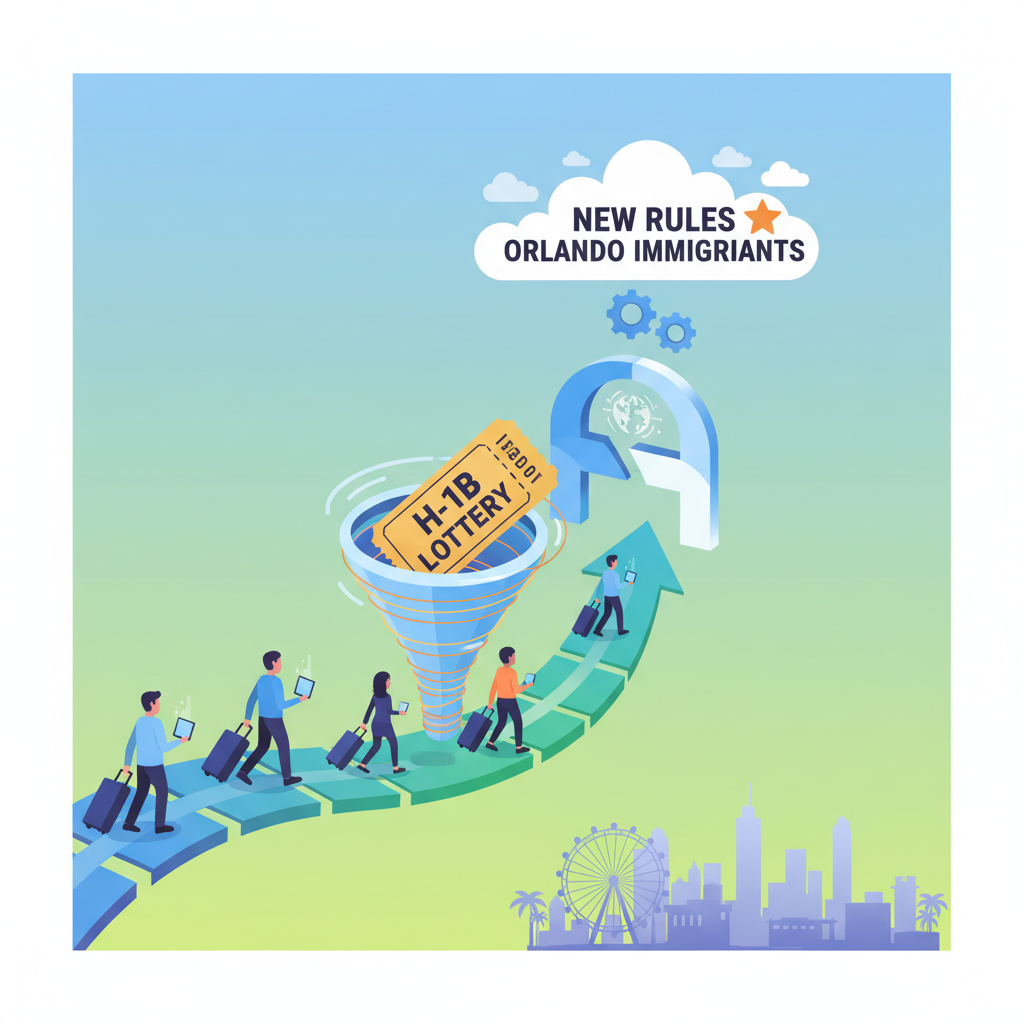
Current Immigration Law: The Foundation
The H-1B visa program is rooted in federal immigration statutes, primarily the Immigration and Nationality Act (INA). Understanding these foundational laws is crucial for both employers and beneficiaries navigating the process, especially in light of the new FY2027 lottery changes.
Federal requirements
The H-1B visa category is defined under **INA Section 101(a)(15)(H)(i)(b)**. The annual numerical cap is established by **INA Section 214(g)(1)(A)**. These sections, along with their associated regulations (found in 8 CFR Part 214.2(h)), outline the core requirements for the H-1B program:
- Specialty Occupation: The position offered by the employer must qualify as a specialty occupation. This means it requires a theoretical and practical application of a body of highly specialized knowledge, and a bachelor's degree or higher in a specific specialty (or its equivalent) for entry.
- Beneficiary Qualifications: The foreign national beneficiary must possess the required bachelor's degree or its equivalent. This can be demonstrated through a U.S. degree, a foreign degree evaluated as equivalent to a U.S. bachelor's, or licensure in a specialty occupation field, or through work experience equivalent to a bachelor's degree.
- Employer Attestations (LCA): Before filing an H-1B petition, the employer must file and have certified a Labor Condition Application (LCA) with the U.S. Department of Labor (DOL). On the LCA (Form ETA-9035), the employer attests that it will:
- Pay the H-1B worker at least the prevailing wage for the occupation in the area of employment or the actual wage paid to other employees with similar experience and qualifications, whichever is higher.
- Provide working conditions that will not adversely affect the working conditions of similarly employed U.S. workers.
- There is no strike or lockout at the place of employment.
- Notice of the LCA filing has been provided to employees or their bargaining representative.
- Annual Cap: As mentioned, there's a statutory annual cap of 65,000 H-1B visas, with an additional 20,000 for those with a U.S. Master's degree or higher. Certain employers are "cap-exempt," meaning they are not subject to the annual limit. These include institutions of higher education, non-profit organizations affiliated with institutions of higher education, and non-profit research organizations or governmental research organizations.
- The FY2027 Lottery Changes: The most critical recent federal change is the implementation of the **beneficiary-centric selection process** for the H-1B lottery. This rule, designed to increase fairness and reduce fraud, dictates that each unique beneficiary will only be counted once in the lottery, regardless of how many employers submit registrations on their behalf. If a beneficiary is selected, any employer who registered them can then proceed to file the H-1B petition. This directly impacts the strategy for both employers and beneficiaries.
- Primary Form: The core document filed with USCIS for an H-1B petition is **Form I-129, Petition for a Nonimmigrant Worker**. This form is extensive and requires significant supporting documentation. An optional form is **Form I-907, Request for Premium Processing Service**, which expedites the processing of the petition for an additional fee.
For detailed information on these federal requirements, always refer to the USCIS official website.
Florida-specific considerations
While immigration law is federal, applying uniformly across all U.S. states, there are practical considerations for Florida residents and businesses:
- No State-Specific H-1B Laws: Florida does not have its own state-level H-1B visa laws or regulations. All H-1B petitions for Florida-based employers are processed under federal law and USCIS guidelines.
- High Demand in Florida: The economic landscape of Florida, particularly in innovation hubs like Orlando, Tampa, and Miami, generates


