

The landscape of U.S. work visas is constantly evolving, and for those aspiring to work in a specialty occupation in the United States, the H-1B visa remains a primary pathway. As we approach the registration period for Fiscal Year 2027 (FY2027), significant changes are being implemented by U.S. Citizenship and Immigration Services (USCIS) that aim to enhance fairness and integrity in the H-1B lottery process.
At Imigrar, an immigration law firm based in Orlando, Florida, we understand the complexities and anxieties that these changes can bring. Our mission is to "Keep Families Together" by providing clear, accurate, and actionable legal guidance to immigrants and their families, whether you're in Orlando, across Florida, or anywhere nationwide. With these new rules, having expert legal counsel is more critical than ever.
The reporting that sparked this guide
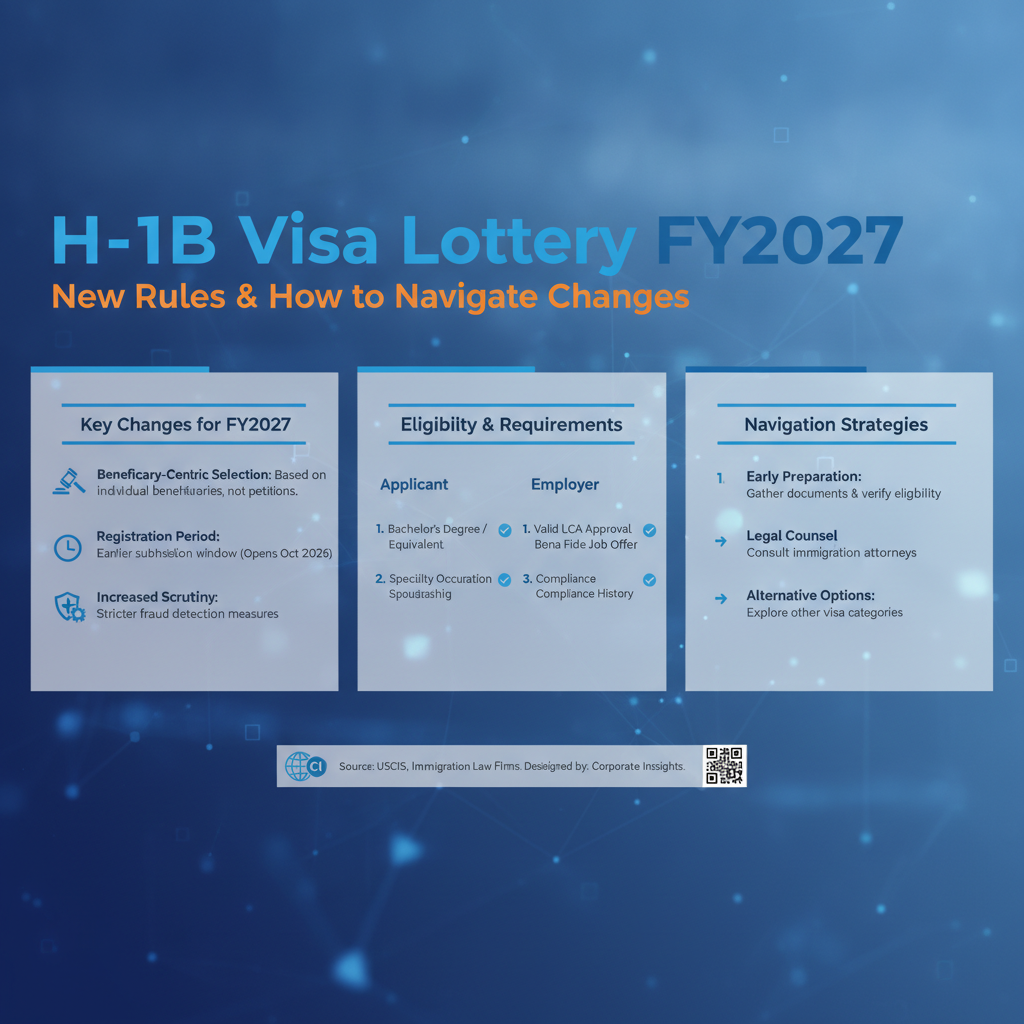
Our commitment to keeping you informed is driven by crucial updates in immigration policy. The recent discussions and policy announcements regarding the H-1B visa lottery changes for FY2027, as reported in various legal news outlets, highlight a pivotal shift in how these highly coveted visas will be allocated. This information is designed to help you understand and prepare for these significant updates.
H-1B Visa Lottery Changes for FY2027 (Legal News)
What This News Means for Immigrants in Orlando and Across Florida
The H-1B visa is a nonimmigrant visa that allows U.S. employers to temporarily employ foreign workers in specialty occupations. These occupations generally require a bachelor's degree or higher in a specific field. With an annual cap on the number of H-1B visas issued, demand often far outstrips supply, leading to a lottery system to select eligible petitions. The upcoming changes for FY2027 are designed to address past challenges and ensure a more equitable process.
Why this news is showing up now
USCIS is continually evaluating and refining its immigration processes, especially for high-demand visa categories like the H-1B. The agency's primary motivation for these changes stems from efforts to combat fraud and abuse observed in previous lottery seasons. In recent years, USCIS identified instances where multiple registrations were submitted on behalf of the same beneficiary by various employers, sometimes without genuine job offers, simply to increase the chances of selection. This practice undermined the integrity of the lottery and disadvantaged legitimate petitioners.
The new rules for FY2027 are a direct response to these concerns, aiming to shift the focus from the employer (petitioner) to the individual worker (beneficiary). By implementing a beneficiary-centric selection process, USCIS intends to level the playing field, ensuring that each unique individual has an equal chance of selection, regardless of how many employers register them.
These rules were finalized and announced to provide ample time for employers and prospective beneficiaries to understand and adapt to the new framework before the FY2027 registration period, which is expected to occur in March 2026 for an October 1, 2026 start date.
How it can affect Florida residents
Florida is a vibrant hub for innovation, technology, tourism, and healthcare, attracting a diverse international talent pool. Cities like Orlando, Tampa, Miami, and Jacksonville boast thriving industries that heavily rely on skilled foreign workers. The I-4 corridor, connecting Orlando and Tampa, is particularly known for its growing tech and simulation industries, making the H-1B visa a critical tool for many local businesses and international graduates from universities such as the University of Central Florida (UCF), University of South Florida (USF), and Florida International University (FIU).
For Florida residents, especially international students on F-1 visas (particularly those on Optional Practical Training, OPT, or STEM OPT) looking to transition to H-1B status, these changes are highly significant:
- Fairer Chances: If you are a prospective H-1B beneficiary, the new beneficiary-centric system means that whether one employer or multiple employers register you, your chances of being selected remain the same. This reduces the advantage previously held by individuals who had multiple, potentially non-genuine, registrations submitted on their behalf.
- Employer Strategy: Florida employers, particularly those in the tech, healthcare, and engineering sectors, will need to adjust their H-1B sponsorship strategies. While they can still register multiple beneficiaries, they should focus on authentic job offers and compliance, as the system now prioritizes the uniqueness of the beneficiary.
- Increased Competition (for legitimate cases): While fraud may decrease, the overall demand for H-1B visas is unlikely to diminish. This means that even with a fairer system, the lottery remains highly competitive. For Central Florida residents, particularly those graduating from local universities, securing a legitimate H-1B sponsoring employer and preparing a strong petition will be paramount.
- Focus on Quality: The new rules emphasize the importance of accurate and consistent information. For any applicant in Orlando or elsewhere in Florida, ensuring your educational credentials, work experience, and personal details are meticulously documented and verified will be crucial.
Understanding these changes is the first step. The next is to proactively prepare your application with expert legal guidance. Imigrar is here to help Florida's international talent navigate these new rules successfully.
Navigating New H-1B Rules? Don't face the FY2027 lottery alone. Our Orlando immigration team is ready to assist. Call +1 786-791-3106 for a free consultation, or message us online. Se Habla Español.
What H-1B Visa Lottery Changes for FY2027 Is (and Why It Matters)
The H-1B visa program is a cornerstone of the U.S. immigration system for skilled workers. The upcoming changes for FY2027 are a significant overhaul to the lottery selection process, designed to address systemic issues and improve the program's integrity.
A plain-English definition
The H-1B visa is a temporary, nonimmigrant visa that allows U.S. employers to hire foreign workers in "specialty occupations." A specialty occupation is defined as one that requires theoretical and practical application of a body of highly specialized knowledge, and a bachelor's degree or higher in the specific specialty (or its equivalent) as a minimum for entry into the occupation. Examples include roles in IT, engineering, medicine, education, and more.
Because there is an annual limit (cap) on the number of H-1B visas issued each fiscal year (which runs from October 1 to September 30), and demand consistently exceeds this cap, USCIS conducts an electronic lottery to select eligible registrations. The new rule for FY2027 primarily changes *how* this lottery selection is conducted.
Previously, each employer could submit a registration for a beneficiary, and if multiple employers registered the same beneficiary, that individual effectively had multiple entries in the lottery. The new system is "beneficiary-centric," meaning that regardless of how many employers register a single individual, that individual will only have one unique entry in the lottery pool. If that unique individual is selected, any employer who submitted a registration for them can then file a full H-1B petition on their behalf.
This change aims to prevent the manipulation of the lottery system by ensuring that each eligible beneficiary has an equal chance of selection, without artificial inflation of their odds through multiple employer registrations. It fosters a more level and fair competitive environment for all prospective H-1B workers.
Key terms you need to know
Understanding the jargon is crucial for navigating the H-1B process, especially with new rules in play:
- H-1B Cap: The annual statutory limit on the number of H-1B visas issued. Currently, this is 65,000 for the regular cap and an additional 20,000 for the U.S. Master's Cap.
- Cap-Exempt: Certain employers (e.g., institutions of higher education, non-profit research organizations, and government research organizations) are exempt from the annual H-11B cap.
- LCA (Labor Condition Application): Form ETA-9035, certified by the U.S. Department of Labor (DOL), which attests that the employer will pay the H-1B worker at least the prevailing wage for the occupation in the area of intended employment and will provide working conditions that will not adversely affect other workers. This must be certified *before* filing the Form I-129 petition.
- Petition: The formal application submitted to USCIS (specifically, Form I-129) by an employer on behalf of a foreign worker to request H-1B status.
- Beneficiary: The foreign worker who is the subject of the H-1B petition.
- Petitioner: The U.S. employer filing the H-1B petition on behalf of the beneficiary.
- Registration Period: The designated window, typically in March, when employers must electronically register prospective H-1B beneficiaries for the lottery. For FY2027, this is expected to be in March 2026.
- Selection: If the number of registrations exceeds the annual cap, USCIS conducts a lottery. "Selection" means a beneficiary's registration has been chosen, allowing an employer to proceed with filing a full H-1B petition.
- Premium Processing: An optional service (Form I-907) that allows petitioners to request expedited processing of certain forms, including Form I-129, for an additional fee. USCIS guarantees a 15-calendar-day processing time for premium-processed petitions.
- Master's Cap: The additional 20,000 H-1B visas reserved for beneficiaries who have earned a U.S. master's degree or higher. These registrations are selected first in a separate lottery before being entered into the regular cap lottery if not selected.
- Beneficiary-Centric Selection: The new rule for FY2027, where the lottery selection is based on the unique beneficiary rather than the number of registrations submitted on their behalf. Each unique beneficiary has one entry.
- Unique Beneficiary Identifier: A specific data point (e.g., passport number) used by USCIS to identify each individual beneficiary for the purpose of the lottery.
These changes are not merely administrative; they fundamentally alter the strategic approach for both employers and beneficiaries. For anyone in Orlando or across Florida considering an H-1B visa, understanding these terms and the implications of the new beneficiary-centric selection is paramount.
Current Immigration Law: The Foundation
The H-1B visa program is rooted in federal immigration law, primarily the Immigration and Nationality Act (INA). Understanding these foundational laws is essential to appreciating the significance of the FY2027 changes.
Federal requirements
The H-1B visa program is authorized under Section 101(a)(15)(H)(i)(b) of the Immigration and Nationality Act (INA). Further details regarding numerical limitations and eligibility are found in INA § 214(g) and other regulations at 8 CFR Part 214.2(h).
Key federal requirements for an H-1B visa include:
- Specialty Occupation: The job must qualify as a specialty occupation, meaning it requires a bachelor's degree or higher in a specific field.
- Educational Attainment: The beneficiary must hold a bachelor's degree or its equivalent, or possess an unrestricted state license, or have work experience equivalent to a bachelor's degree in the specialty occupation.
- Employer Sponsorship: A U.S. employer must sponsor the H-1B petition. Self-sponsorship is generally not permitted unless the beneficiary can establish a valid employer-employee relationship with their own company.
- Labor Condition Application (LCA): Before filing the H-1B petition with USCIS, the employer must obtain a certified LCA (Form ETA-9035) from the U.S. Department of Labor (DOL). This ensures that the employer will pay the H-1B worker at least the prevailing wage for the occupation in the area of employment and will provide working conditions that do not adversely affect U.S. workers.
- Annual Cap: As mentioned, the H-1B program is subject to an annual numerical limit. The statutory cap is 65,000 visas, with an additional 20,000 visas reserved for those with a U.S. master's degree or higher. This cap resets each fiscal year on October 1st.
- Period of Admission: An H-1B visa is initially granted for up to three years and can be extended for a maximum total of six years. In certain circumstances, extensions beyond six years are possible, particularly for those with pending green card applications.
The primary form used for H-1B petitions is Form I-129, Petition for a Nonimmigrant Worker. Employers seeking expedited processing can file Form I-907, Request for Premium Processing Service. All official forms and detailed instructions can be found on the USCIS official website.
Florida-specific considerations
While there are no Florida-specific immigration laws that directly impact the H-1B visa, the state's economic landscape and demographics create unique considerations for applicants and employers:
- High Demand in Tech and Healthcare: Florida, particularly the Orlando metropolitan area, is experiencing significant growth in technology, aerospace, healthcare, and tourism sectors. This translates to high demand for skilled professionals in these fields, making H-1B visas crucial for many businesses.
- International Student Population: Florida is home to numerous universities with large international student populations, many of whom pursue STEM fields. Graduates from institutions like UCF, USF, FIU, and UF are prime candidates for H-1B visas, often transitioning from OPT or STEM OPT. The Orlando USCIS Field Office processes many of these local applications.
- Competitive Job Market: Despite the demand, the job market in some sectors can be highly competitive. A strong academic background, relevant work experience, and a clear job offer from a reputable employer are essential for success.
- Attorney Expertise: Navigating the H-1B process, especially with new rules, requires specialized legal knowledge. An attorney familiar with both federal immigration law and the nuances of the Florida job market can provide invaluable guidance.
For Central Florida residents, the proximity to the Orlando USCIS Field Office and the prevalence of H-1B sponsoring companies along the I-4 corridor underscore the importance of staying informed about these changes and securing experienced legal representation.
Need Expert H-1B Guidance? The new FY2027 rules add complexity. Imigrar's Orlando team offers experienced legal support. Call +1 786-791-3106 for a free consultation, or message us online. Se Habla Español.

How to Navigate the FY2027 H-1B Lottery Changes: A Complete Step-by-Step Guide
Successfully obtaining an H-1B visa through the lottery is a multi-step process that requires meticulous attention to detail and adherence to strict timelines. With the beneficiary-centric selection process for FY2027, understanding each stage is more critical than ever.
1) Understand the New Beneficiary-Centric Lottery System
Explanation: This is the most significant change. For FY2027, USCIS will select H-1B registrations based on the unique beneficiary, regardless of the number of registrations submitted on their behalf. If a beneficiary has multiple registrations submitted by different employers, they will still only have one entry in the lottery. If that unique beneficiary is selected, any of the employers who registered them can then proceed to file an H-1B petition. This change aims to prevent fraud and ensure a fairer process for all applicants.
Action: If you are a prospective beneficiary, understand that your unique identity (typically linked to your valid passport or travel document number) will be the determining factor for selection. If you have multiple job offers, it is still beneficial to have each employer register you, as it provides options if selected, but it will not increase your lottery odds.
Required Information (for this understanding phase):
- Beneficiary's full legal name, date of birth, country of birth, country of citizenship.
- Beneficiary's valid passport or travel document number.
- Employer's legal name, FEIN (Federal Employer Identification Number), and mailing address.
2) Employer Files H-1B Lottery Registration Electronically
Explanation: The first formal step is for the prospective employer (petitioner) to electronically register the beneficiary for the H-1B lottery through the USCIS online H-1B registration system. This typically occurs in early March (e.g., March 2026 for FY2027). Each registration requires a fee (currently $10, but subject to potential increase). The employer must provide basic identifying information for both the company and the beneficiary. It is crucial that all information is accurate and consistent with the beneficiary's legal documents.
Timeline: Expected to be a specific window in early March 2026 (e.g., March 1-18, 2026). USCIS will announce the exact dates well in advance.
Required Documents (or information for registration):
- Employer's legal name, FEIN, mailing address, and authorized signatory information.
- Beneficiary's full legal name, date of birth, country of birth, country of citizenship, and valid passport or travel document number.
- Confirmation of whether the beneficiary holds a U.S. master's degree or higher (for Master's Cap eligibility).
- Payment of the non-refundable registration fee.
3) Await Lottery Results and Selection Notification
Explanation: After the registration period closes, USCIS conducts the lottery. For FY2027, the lottery will first select beneficiaries for the Master's Cap, then for the regular cap. USCIS will notify selected registrants (the employers) through their online accounts. The status of the registration will change from "Submitted" to "Selected." Non-selected registrations will eventually show "Not Selected" or "Denied" (if found to be duplicate or invalid).
Timeline: Typically, selection notifications are issued in late March (e.g., late March 2026). USCIS may conduct a second lottery if initial selections do not meet the cap.
Required Documents (for employer to keep):
- The Selection Notice from USCIS, which includes the case number and specifies the filing window.
4) Prepare and File the H-1B Petition (Form I-129)
Explanation: If a beneficiary's registration is selected, the employer has a specific 90-day window to prepare and file the full H-1B petition with USCIS. This is the


