
The reporting that sparked this guide: H-1B Visa Lottery Changes for FY2027 (Legal News)
What This News Means for Immigrants in Orlando and Across Florida
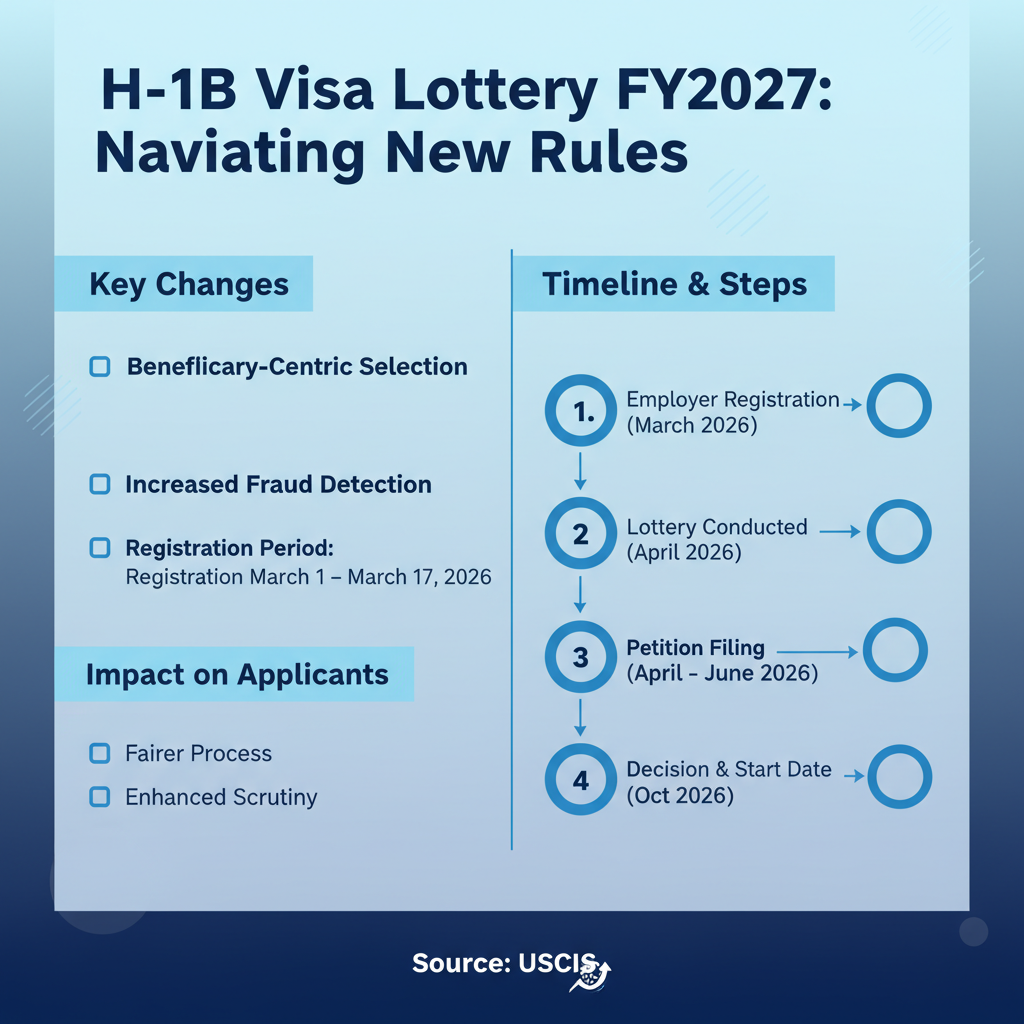
The landscape of U.S. immigration is constantly evolving, and few areas see as much change and demand as the H-1B visa program. As we approach the registration period for the Fiscal Year 2027 (FY2027) H-1B lottery, United States Citizenship and Immigration Services (USCIS) has unveiled significant rule changes that will profoundly impact how petitions are selected. For individuals in Orlando, Central Florida, and indeed nationwide, understanding these updates is not just beneficial—it's absolutely critical for anyone hoping to secure a coveted H-1B visa.
Why this news is showing up now
The H-1B visa program operates on a fiscal year basis, beginning October 1st. To allow sufficient time for processing, USCIS typically opens the H-1B lottery registration period in early March for the fiscal year starting six months later. The changes for FY2027 have been formally announced by USCIS well in advance of the upcoming registration period, giving petitioners and beneficiaries time to adapt. These changes are a direct response to concerns regarding widespread fraud in previous lottery cycles, where some beneficiaries had multiple employers submit registrations on their behalf, artificially inflating their chances of selection. The new rules aim to create a fairer, more transparent, and more efficient selection process by focusing on the individual beneficiary.
How it can affect Florida residents
Florida is a vibrant hub of innovation, tourism, healthcare, and technology. Cities like Orlando, Tampa, and Miami are home to burgeoning tech parks, world-renowned research institutions, and large multinational corporations that heavily rely on skilled foreign workers. For professionals in fields such as IT, engineering, healthcare, finance, and education across Florida, the H-1B visa is often the primary pathway to long-term employment in the U.S.
- Increased Fairness: For legitimate beneficiaries in Florida, the new rules are designed to level the playing field. If you are a highly skilled professional with a genuine job offer from a Florida employer, your chances of selection should now be based purely on the lottery, without being disadvantaged by fraudulent multiple entries.
- Employer Responsibility: Florida employers, particularly those in Orange County and along the I-4 corridor, must now be acutely aware of their responsibilities to ensure compliance with the new beneficiary-centric registration system. This means verifying beneficiary information meticulously and understanding that submitting multiple registrations for the same individual will lead to disqualification.
- Strategic Planning: For students graduating from Florida universities (like UCF, UF, FIU) on F-1 visas, or those on Optional Practical Training (OPT) looking to transition to H-1B status, understanding these changes is paramount. It influences how you plan your job search and collaborate with prospective employers.
- Reduced Fraud Impact: By deterring fraudulent registrations, the new system aims to make the lottery more equitable, potentially increasing the odds for truly qualified candidates and their sponsoring Florida businesses.
At Imigrar, we understand that these changes can seem daunting. Our Orlando-based team is dedicated to helping individuals and employers navigate these complexities, ensuring that Florida's talent pool can continue to thrive under the new regulations. We believe that by providing clear, actionable guidance, we can help "Keep Families Together" and support the growth of our community.
Need Help Navigating the H-1B Changes? Our Orlando immigration team is ready to assist. Call +1 786-791-3106 for a free consultation, or message us online. Se Habla Español.
What H-1B Visa Lottery Changes for FY2027 Is (and Why It Matters)
The H-1B visa program is a nonimmigrant visa that allows U.S. employers to temporarily employ foreign workers in specialty occupations. These occupations generally require a bachelor's degree or higher in a specific field. Due to overwhelming demand, USCIS utilizes a lottery system to allocate the limited number of H-1B visas available each fiscal year. The changes introduced for FY2027 fundamentally alter how this lottery works.
A plain-English definition
Imagine the H-1B visa as a special permit for skilled foreign professionals to work in the U.S. for specific jobs that need a college degree. Each year, the government only issues a certain number of these permits (the "cap"). Because far more people want these permits than are available, USCIS holds a lottery to decide who gets to apply. Historically, if multiple companies wanted to hire the same person, each company could enter that person's name into the lottery, increasing their chances. The big change for FY2027 is that now, no matter how many companies want to hire you, your name can only be entered into the lottery ONCE. This is called a beneficiary-centric selection process. It means the lottery focuses on the individual foreign worker (the beneficiary) rather than the employer (the petitioner).
Key terms you need to know
- H-1B Visa: A nonimmigrant visa category that permits U.S. employers to temporarily employ foreign workers in specialty occupations.
- Specialty Occupation: An occupation that requires theoretical and practical application of a body of highly specialized knowledge, and a bachelor's or higher degree in the specific specialty (or its equivalent) as a minimum for entry into the occupation in the United States.
- H-1B Cap: The annual numerical limit on the number of H-1B visas issued. Congress currently sets the regular cap at 65,000 visas each fiscal year.
- Advanced Degree Exemption (Master's Cap): An additional 20,000 visas are reserved for beneficiaries who have earned a U.S. master's degree or higher.
- Cap-Subject: Refers to H-1B petitions that are counted against the annual cap. Certain H-1B petitions (e.g., those for employment at universities or non-profit research organizations) are "cap-exempt" and do not go through the lottery.
- H-1B Lottery (or Selection Process): The computer-generated random selection process used by USCIS when the number of eligible registrations exceeds the annual H-1B cap.
- Beneficiary: The foreign worker for whom the H-1B visa petition is filed.
- Petitioner: The U.S. employer filing the H-1B visa petition on behalf of the foreign worker.
- Beneficiary-Centric Selection: The new method for the FY2027 H-1B lottery where selection is based on unique beneficiaries, not on the number of registrations submitted on their behalf. If a beneficiary has multiple registrations submitted by different employers, only one will be considered for selection.
- Labor Condition Application (LCA) (Form ETA-9035): A form certified by the U.S. Department of Labor (DOL) that attests to the employer's compliance with wage and working condition requirements for H-1B workers. This must be certified before filing Form I-129.
- Form I-129 (Petition for a Nonimmigrant Worker): The primary form filed by a U.S. employer to petition for an H-1B worker.
These changes matter because they represent a fundamental shift in strategy for both employers and prospective H-1B workers. For years, the system was criticized for allowing gaming through multiple registrations. The new beneficiary-centric approach aims to restore integrity to the lottery, ensuring that each qualified individual has an equal and fair shot at selection, regardless of how many job offers they might have received.
Current Immigration Law: The Foundation
The H-1B visa program is governed primarily by the Immigration and Nationality Act (INA), specifically Section 101(a)(15)(H)(i)(b) which defines the H-1B nonimmigrant classification, and Section 214(g) which establishes the annual numerical limitations (the cap). USCIS regulations further detail the requirements and procedures.
Federal requirements
To qualify for an H-1B visa, both the employer and the beneficiary must meet specific criteria:
-
For the Beneficiary:
- Hold a bachelor's degree or its equivalent, or a license in a specialty occupation field, or have work experience equivalent to a bachelor's degree.
- Be offered a job in a specialty occupation.
- Possess the necessary qualifications for the position.
-
For the Employer (Petitioner):
- Offer a job that qualifies as a specialty occupation.
- Pay at least the prevailing wage for the occupation in the area of employment, or the actual wage paid by the employer to other employees with similar experience and qualifications, whichever is higher. This is attested to in the Labor Condition Application (LCA).
- File the LCA (Form ETA-9035) with the U.S. Department of Labor (DOL) and receive certification before filing Form I-129.
- Demonstrate an employer-employee relationship with the beneficiary.
The annual cap for H-1B visas is 65,000 for the regular category, plus an additional 20,000 for those with a U.S. master's degree or higher (the advanced degree exemption). USCIS conducts the lottery when the number of registrations exceeds these caps. The new beneficiary-centric selection process for FY2027 is a crucial procedural change, but the underlying eligibility requirements remain rooted in these federal statutes and regulations.
You can find comprehensive details and official forms on the USCIS official website.
Florida-specific considerations
While the H-1B visa is a federal program, its impact and application are deeply felt at the state level. Florida's economy is highly diversified, with significant demand for H-1B workers in sectors such as:
- Technology: Orlando's "Silicon Swamp," Tampa's growing tech scene, and Miami's burgeoning startup ecosystem create high demand for software engineers, data scientists, IT specialists, and cybersecurity experts. Many local companies actively sponsor H-1B visas.
- Healthcare: Florida's large and aging population drives demand for doctors, nurses, and medical researchers, particularly in specialized fields.
- Aerospace and Aviation: With NASA's Kennedy Space Center and numerous aerospace companies, Florida is a hub for engineers and scientists.
- Hospitality and Tourism (Specialized Roles): While many tourism jobs don't qualify, highly specialized roles in management, finance, or IT within large hotel chains or theme parks (like those in Orlando) may qualify.
- Education and Research: Florida's extensive university system (e.g., University of Central Florida, University of Florida) and research institutions often sponsor H-1B visas for professors, researchers, and post-doctoral fellows. These positions are often cap-exempt.
For Central Florida residents, the Orlando USCIS Field Office may handle certain aspects of immigration cases, though H-1B petitions are typically processed at regional service centers. However, understanding local labor market conditions and employer needs is vital for H-1B beneficiaries and petitioners alike. Employers in Orange County, for instance, must ensure their prevailing wage calculations are accurate for the specific metropolitan statistical area.
Confused by the Legal Jargon? Our team at Imigrar simplifies complex immigration laws. Get personalized advice. Call +1 786-791-3106 for a free consultation. Se Habla Español.
How to Navigate the New H-1B Visa Lottery Rules: A Complete Step-by-Step Guide
The process of obtaining an H-1B visa, especially through the lottery, is intricate and requires meticulous attention to detail. With the new beneficiary-centric rules for FY2027, understanding each step is more critical than ever. This guide outlines the essential stages, incorporating the latest changes.
1) Understand the New Beneficiary-Centric Selection Process and Confirm Eligibility
This is the foundational shift for FY2027. USCIS will now select registrations based on unique beneficiaries. If multiple registrants submit a registration for the same beneficiary, that beneficiary will only be entered into the lottery once. All eligible registrations submitted on behalf of a unique beneficiary will have an equal chance of selection. If selected, each employer who submitted a registration for that beneficiary will receive a selection notice, and any one of those employers can then proceed to file a petition. This aims to prevent fraud and give every qualified individual a fair chance.
- Action for Beneficiary: Ensure you have a genuine job offer from a U.S. employer for a specialty occupation. Verify your educational qualifications meet the H-1B requirements (bachelor's degree or equivalent). If you have multiple job offers, communicate clearly with all prospective employers about the new rule.
- Action for Employer: Confirm the offered position meets the definition of a specialty occupation. Verify the beneficiary's qualifications. Understand that your registration contributes to a single entry for the beneficiary, not an additional entry for your company.
-
Required Documents (Initial Review):
- Beneficiary's academic transcripts and diplomas (translated and evaluated if from outside the U.S.).
- Beneficiary's resume/CV.
- Detailed job description from the employer.
- Any professional licenses or certifications.
2) Employer Files Labor Condition Application (LCA) with the Department of Labor (DOL)
Before an employer can file an H-1B petition with USCIS, they must obtain a certified Labor Condition Application (LCA), Form ETA-9035, from the U.S. Department of Labor (DOL). The LCA attests that the employer will pay the H-1B worker at least the prevailing wage for the occupation in the intended area of employment, or the actual wage paid to other similarly employed workers, whichever is higher. It also confirms that working conditions will not adversely affect other employees.
- Action for Employer: Determine the correct prevailing wage for the occupation and geographic area (e.g., Orlando, FL). File Form ETA-9035 electronically with the DOL. This step can take several days to a week or more for certification.
- Important: The LCA must be certified by the DOL *before* the H-1B petition (Form I-129) can be filed with USCIS. However, the LCA is generally *not* required for the initial H-1B lottery registration itself. It is crucial for the petition filing stage.
-
Required Documents for LCA:
- Employer's Federal Employer Identification Number (FEIN).
- Job title and duties.
- Work location(s).
- Proposed wage.
- Prevailing wage determination (often from DOL's Foreign Labor Certification Data Center).
3) H-1B Registration Period and Fee Payment
This is the first critical window for the FY2027 lottery. Employers must electronically register each prospective H-1B beneficiary with USCIS. The new beneficiary-centric rule is enforced at this stage. Each unique beneficiary can only be associated with one entry in the lottery, regardless of how many employers register them.
- Action for Employer: Create or access a USCIS online account. For each beneficiary, input their biographical information and pay the non-refundable H-1B registration fee (currently $10 for FY2027, though USCIS has proposed increasing it in future cycles). Warning: Ensure all information is accurate, as errors can lead to disqualification.
- Action for Beneficiary: Provide accurate personal information to your employer(s) and communicate any other employers who might be registering you.
- Timeline: The registration period typically opens in early March and lasts for approximately two to three weeks. For FY2027, expect a similar window in March 2026.
-
Required Information for Registration:
- Employer's legal name, FEIN, and mailing address.
- Employer's authorized signatory information.
- Beneficiary's full legal name, date of birth, country of birth, country of citizenship, passport number.
- Beneficiary's gender.
- Whether the beneficiary has a U.S. master's or higher degree (for the advanced degree exemption).
4) Lottery Selection and Notification
After the registration period closes, USCIS conducts the electronic lottery. Under the new beneficiary-centric system, the selections are made from the pool of unique beneficiaries. USCIS first selects enough registrations to meet the advanced degree exemption cap, then selects from the remaining pool to meet the regular cap.
- Action for Employer: Monitor your USCIS online account for selection notices. If your beneficiary is selected, USCIS will update the status in your account to "Selected."
- Action for Beneficiary: Stay in close communication with your employer(s) regarding selection status.
- Timeline: Selection results are usually announced by the end of March or early April.
- Important: A selection notice only grants the employer the eligibility to file an H-1B petition, not an approved visa.
5) Filing the H-1B Petition (Form I-129)
If a beneficiary is selected, the petitioning employer must then prepare and file a comprehensive Form I-129, Petition for a Nonimmigrant Worker, along with all required supporting documentation and fees, within the designated filing window specified in the selection notice (typically 90 days).
- Action for Employer: Work closely with an immigration attorney to prepare the detailed Form I-129 package. This includes the certified LCA, evidence of the beneficiary's qualifications, evidence of a specialty occupation, and the employer's ability to pay the required wage.
- Action for Beneficiary: Provide all requested personal and academic documents, employment history, and any other supporting evidence promptly to your employer/attorney.
-
Required Documents for Form I-129 (if selected):
- Certified LCA (Form ETA-9035).
- Form I-129 and H-1B Supplement.
- Employer's support letter detailing the job offer, specialty occupation, and salary.
- Beneficiary's educational degrees, transcripts, and evaluations (if applicable).
- Beneficiary's resume/CV.
- Copies of beneficiary's passport, visa, I-94 record, and previous U.S. immigration documents (if applicable).
- Evidence of the employer's financial stability and ability to pay the wage.
- Organizational charts, company brochures, and other business documentation.
- Filing fees (Form I-129 fee, ACWIA fee, fraud prevention and detection fee, public law 114-113 fee if applicable).
6) Adjudication and Visa Stamping/Change of Status
USCIS reviews the filed Form I-129 petition. They may issue a Request for Evidence (RFE) if more information is needed. If approved, the beneficiary can either undergo consular processing (applying for the H-1B visa stamp at a U.S. embassy or consulate abroad) or, if already in the U.S. in a valid nonimmigrant status, apply for a change of status to H-1B.
- Action for Employer/Attorney: Respond promptly and thoroughly to any RFEs.
- Action for Beneficiary: If changing status, maintain your current legal status until the H-1B effective date (typically October 1st). If consular processing, schedule an appointment at the appropriate embassy/consulate and prepare for the interview.
- Reminder: H-1B status typically begins on October 1st of the fiscal year.
7) Maintaining H-1B Status and Future Considerations
Once H-1B status is approved and activated, the beneficiary must maintain compliance with all immigration laws. This includes working only for the petitioning employer (or an approved H-1B transfer employer) in the approved occupation and receiving the specified wage. H-1B visas are typically granted for an initial period of three years and can be extended for a total maximum of six years, with certain exceptions.
- Action for Beneficiary: Understand your rights and responsibilities as an H-1B worker. Keep all immigration documents safe.
- Action for Employer: Continue to comply with LCA terms, including wage requirements. Inform USCIS of any material changes in employment.
-
Key Considerations:
- H-1B Transfers: If you change employers, your new employer must file a new H-1B petition.
- H-1B Extensions: If you wish to continue working beyond the initial approval period, your employer must file an extension petition.
- Green Card Process: Many H-1B holders eventually seek permanent residency (a "Green Card"). The H-1B is a "dual intent" visa, meaning you can pursue permanent residency while holding H-1B status.

Practical Steps You Can Take Today
Preparing for the H-1B visa lottery, especially with new rules, requires foresight and diligent action. Here’s a checklist of practical steps you can initiate right away to increase your chances of success and minimize stress.
- Understand the New Rules Thoroughly: Don't just skim the headlines. Read USCIS's official announcements regarding the beneficiary-centric selection process for FY2027. Understand what it means for you if you have multiple job offers.
- Secure a Sponsoring Employer: The H-1B is employer-


