


The landscape of U.S. skilled worker visas is constantly evolving, and for those aspiring to work in the United States, staying informed is paramount. As we approach the fiscal year 2027 (FY2027) H-1B visa lottery cycle, significant changes are once again on the horizon, promising to reshape how employers and beneficiaries approach this highly competitive process.
At Imigrar, an immigration law firm based in Orlando, Florida, our mission is to "Keep Families Together" by providing expert, compassionate legal guidance. We understand the anxieties and complexities that come with navigating U.S. immigration law, especially when critical opportunities like the H-1B visa are at stake. This comprehensive guide will break down the latest H-1B visa lottery changes for FY2027, offering practical advice and actionable steps for individuals and employers across Florida and the nation.
Se Habla Español. Our team is ready to assist you in both English and Spanish, ensuring clear communication every step of the way.
Need Help? Our Orlando immigration team is ready to assist. Call +1 786-791-3106 for a free consultation, or message us online. Se Habla Español.
The reporting that sparked this guide: H-1B Visa Lottery Changes for FY2027 (Legal News)
What This News Means for Immigrants in Orlando and Across Florida
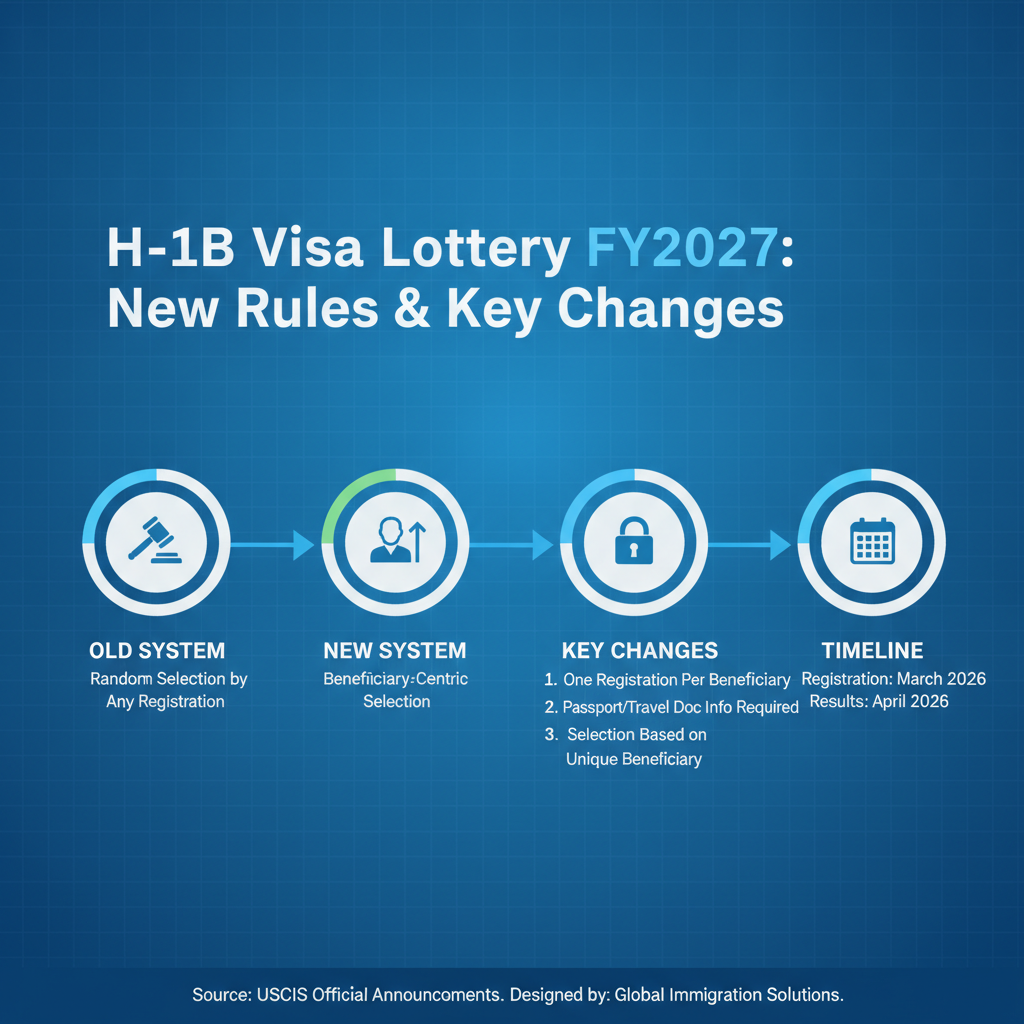
The H-1B visa program is a lifeline for many skilled foreign professionals seeking to contribute their talents to the U.S. economy, particularly in high-demand sectors like technology, healthcare, and engineering. Florida, with its burgeoning tech industry, world-class universities, and growing economy, is a major hub for H-1B beneficiaries. Changes to this vital program have widespread implications, affecting individuals, families, and businesses alike.
Why this news is showing up now
The H-1B visa program operates on a fiscal year cycle, with the lottery registration typically opening in March for the fiscal year that begins the following October 1st. For FY2027, this means the registration period will likely be in March 2026. However, discussions and formal announcements regarding changes often precede this period, sometimes by a year or more, giving stakeholders time to prepare. The U.S. Citizenship and Immigration Services (USCIS) continuously evaluates the H-1B program for efficiency, integrity, and to combat fraud. Following recent challenges, including high fraud rates related to multiple lottery registrations for the same beneficiary, USCIS has been proactive in implementing reforms. The most significant of these, the beneficiary-centric selection process, was put into effect for the FY2025 lottery and is expected to be refined and strictly enforced for FY2027 and beyond. This proactive approach by USCIS is why we are seeing news and discussions about upcoming changes well in advance of the actual FY2027 registration period.
Reminder: The H-1B cap is statutorily set at 65,000 visas annually, with an additional 20,000 reserved for those with a U.S. master's degree or higher (the "Master's Cap"). The demand for these visas consistently far outstrips the supply, making the lottery highly competitive.
How it can affect Florida residents
For immigrants living, studying, or working in Florida, these H-1B changes carry specific weight:
- Increased Competition (and Fairness): While the new beneficiary-centric selection aims to make the lottery fairer by preventing multiple registrations for the same individual, the underlying demand for H-1B visas remains incredibly high. This means that individuals in Florida, whether recent graduates from UCF or UF, or professionals working for tech companies in Orlando or Tampa, will still face intense competition.
- Employer Preparedness: Florida employers, from small startups to large corporations along the I-4 corridor, must adapt quickly to the new registration requirements. Understanding the shift to beneficiary-centric selection and ensuring their internal processes are compliant will be crucial to avoid errors and potential disqualification.
- Focus on Qualification: The changes underscore the importance of having a strong educational background and specialized skills that align with the H-1B requirements. Graduates from Florida universities with relevant degrees will be highly sought after by employers.
- Legal Guidance is More Critical: With increased scrutiny and new procedural requirements, the role of an experienced immigration attorney becomes even more vital. Errors in registration or petition filing can lead to denial, making expert assistance from firms like Imigrar in Orlando indispensable for Florida residents.
- Impact on Tech and Healthcare Sectors: Florida's growing technology sector, particularly in cities like Orlando and Miami, relies heavily on H-1B workers. Changes could impact the talent pipeline for these industries, necessitating careful planning by employers. Similarly, healthcare professionals also utilize the H-1B, and these changes will affect their opportunities.
Understanding these impacts early allows prospective H-1B beneficiaries and their employers in Florida to strategize effectively for the upcoming FY2027 lottery.
What H-1B Visa Lottery Changes for FY2027 Is (and Why It Matters)
The "H-1B Visa Lottery Changes for FY2027" refers to the modifications and new rules that USCIS has implemented or is expected to refine for the H-1B cap-subject petition process for the fiscal year starting October 1, 2026. These changes are primarily aimed at improving the integrity of the H-1B registration process and reducing fraud.
A plain-English definition
Imagine the H-1B visa as a special pass for skilled foreign workers to come and work in the U.S. in specific jobs (like IT, engineering, medicine, etc.). Because there are far more people who want this pass than there are available each year, USCIS uses a lottery system to decide who gets a chance to apply. Historically, some individuals tried to game the system by having multiple companies register them in the lottery, increasing their chances unfairly. The "changes for FY2027" are essentially new rules designed to stop this type of fraud by making the lottery fairer. Instead of counting each registration (which could be many for one person), USCIS now counts each *person* (beneficiary) only once, regardless of how many employers register them. This gives every eligible individual an equal shot in the lottery.
Important: These changes primarily affect the *registration* phase of the H-1B lottery, not the fundamental eligibility requirements for the H-1B visa itself, which remain largely the same.
Key terms you need to know
Navigating the H-1B process requires understanding specific terminology:
- H-1B Visa: A nonimmigrant visa that allows U.S. employers to temporarily employ foreign workers in specialty occupations.
- Specialty Occupation: An occupation that generally requires a bachelor's degree or higher in a specific specialty, or its equivalent, as a minimum for entry into the occupation.
- Cap-Subject H-1B: H-1B petitions that are subject to the annual numerical limits (cap) set by Congress (65,000 regular cap + 20,000 Master's Cap).
- Cap-Exempt H-1B: H-1B petitions filed by certain employers (e.g., higher education institutions, non-profit research organizations) that are not subject to the annual cap.
- Beneficiary: The foreign national worker whom the employer wishes to sponsor for an H-1B visa.
- Petitioner: The U.S. employer filing the H-1B petition on behalf of the beneficiary.
- H-1B Lottery (or Selection Process): The randomized process USCIS uses to select registrations when the number of eligible registrations exceeds the annual cap.
- H-1B Registration Period: The specific window of time (usually in March) when prospective petitioners must electronically register beneficiaries for the H-1B lottery.
- H-1B Petition Filing Period: The window of time during which selected petitioners can file their full Form I-129 petitions with USCIS.
- Master's Cap (or U.S. Master's Exemption): The additional 20,000 H-1B visas reserved for beneficiaries who have earned a U.S. master's degree or higher.
- Labor Condition Application (LCA): Form ETA-9035, certified by the U.S. Department of Labor (DOL), which attests that the employer will pay the H-1B worker at least the prevailing wage or the actual wage, whichever is higher, and provide working conditions that will not adversely affect other workers. This must be certified before filing the H-1B petition.
- Fiscal Year (FY): The U.S. government's fiscal year runs from October 1st to September 30th. FY2027 begins on October 1, 2026.
- Beneficiary-Centric Selection: The new lottery process where each unique beneficiary is entered into the lottery only once, regardless of the number of registrations submitted on their behalf by different employers. If a beneficiary is selected, all employers who registered for that beneficiary are notified, and only one can proceed to file a petition. This is the core of the FY2027 changes.
The shift to beneficiary-centric selection is a game-changer. It fundamentally alters the strategy for both employers and beneficiaries, emphasizing integrity and fair opportunity over sheer volume of registrations. It matters because it aims to level the playing field, making the lottery more equitable for all qualified applicants.
Navigating the new H-1B rules can be complex. Don't risk your future. Contact Imigrar today for expert guidance tailored to your unique situation. Call +1 786-791-3106 for a free consultation. Se Habla Español.
Current Immigration Law: The Foundation
The H-1B visa program is governed primarily by the Immigration and Nationality Act (INA), specifically sections related to nonimmigrant visas. Understanding these foundational laws is crucial for comprehending the recent changes.
The authority for the H-1B visa program is found in the Immigration and Nationality Act (INA) § 101(a)(15)(H)(i)(b), which defines the H-1B nonimmigrant classification. The annual numerical limitations (the cap) are established under INA § 214(g)(1)(A), which sets the general cap, and INA § 214(g)(5)(C), which provides for the Master's Cap exemption. Regulations governing the H-1B program are found in 8 Code of Federal Regulations (CFR) § 214.2(h).
Federal requirements
To qualify for an H-1B visa, both the employer (petitioner) and the foreign worker (beneficiary) must meet specific federal requirements:
- For the Beneficiary:
- Hold a bachelor's degree or its equivalent, or possess a license in a specialty occupation field, or have work experience equivalent to a bachelor's degree.
- Possess the specific degree required by the specialty occupation position, or extensive experience in the field.
- Have a job offer from a U.S. employer in a specialty occupation.
- For the Petitioner (Employer):
- Offer a job in a "specialty occupation" (as defined above).
- Pay the H-1B worker at least the prevailing wage for the occupation in the geographic area of employment or the actual wage paid to other employees with similar experience and qualifications, whichever is higher. This is attested to in the Labor Condition Application (LCA) Form ETA-9035, which must be certified by the Department of Labor before filing the H-1B petition.
- Maintain an employer-employee relationship with the beneficiary.
- File Form I-129, Petition for a Nonimmigrant Worker, on behalf of the beneficiary.
These core requirements remain unchanged, even with the new lottery system. The changes primarily impact *how* one enters the lottery, not *who* is eligible to enter.
For official information and forms, always refer to the USCIS official website.
Florida-specific considerations
While federal law governs the H-1B program, its application has specific nuances in Florida:
- Demand in Specialty Fields: Florida's economy is diverse, with high demand for H-1B workers in IT, aerospace, healthcare, hospitality management, and finance. Cities like Orlando, Miami, Tampa, and Jacksonville are growing tech hubs, attracting talent from around the globe.
- Educational Institutions: Universities like the University of Central Florida (UCF) in Orlando, the University of Florida (UF), Florida State University (FSU), and the University of Miami produce thousands of graduates annually, many of whom seek H-1B sponsorship after completing Optional Practical Training (OPT).
- Local USCIS Offices: While H-1B petitions are processed at regional service centers, Florida residents may interact with local USCIS field offices, such as the Orlando USCIS Field Office, for certain services like biometrics appointments or interviews (though rare for initial H-1B filings).
- Prevalence of Consultancies: Florida, like other states, has a significant presence of IT consulting firms that sponsor H-1B visas. The new beneficiary-centric lottery system is particularly impactful for these types of employers, as it aims to prevent the practice of multiple related entities registering the same individual.
Understanding the interplay between federal law and local dynamics is key for a successful H-1B strategy in Florida. Imigrar is deeply familiar with these local conditions and can provide tailored advice for clients in Orlando and throughout Central Florida.
How to Navigate the H-1B Lottery Changes: A Complete Step-by-Step Guide
The H-1B cap-subject process, particularly with the new beneficiary-centric selection, demands meticulous planning and execution. Here’s a step-by-step guide for FY2027:
1) Understand the New Rules and Eligibility
Before anything else, both the prospective beneficiary and the employer must fully grasp the implications of the beneficiary-centric lottery. For FY2027, this means:
- Each unique beneficiary can only be selected once, regardless of how many registrations are submitted on their behalf by different employers.
- If a beneficiary is selected, all employers who registered that beneficiary will receive a selection notification. However, only one employer can then proceed to file an H-1B petition for that selected beneficiary.
- The beneficiary's passport or valid travel document information is now a critical identifier during registration to ensure uniqueness.
- Employers must attest that the registration is based on a legitimate job offer and that they intend to file an H-1B petition if selected. USCIS has increased its scrutiny of these attestations and may conduct site visits.
Required Documents for this step (for understanding and internal assessment):
- Beneficiary's valid passport or travel document (to confirm unique identifier).
- Beneficiary's educational degrees and transcripts (to confirm specialty occupation eligibility).
- Employer's job description for the proposed H-1B position.
2) Employer Registration Process (March 2026 for FY2027)
This is the first critical phase for cap-subject H-1B visas. The employer (or their authorized representative) must create a USCIS online account and electronically register the beneficiary.
- Account Creation: If the employer doesn't have one, they must create a "registrant" account on the USCIS online portal.
- Beneficiary Information: For each beneficiary, the employer must provide specific details, including full legal name, date of birth, country of birth, country of citizenship, passport number (or other valid travel document number for beneficiaries without a passport), and gender.
- Employer Information: The employer must provide their legal name, EIN, address, and contact information.
- Attorney/Representative Information: If represented by an attorney (highly recommended), their details must be linked to the registration.
- Fee Payment: A non-refundable registration fee (currently $10, though subject to change for FY2027) must be paid for each registration.
Required Documents for this step:
- Beneficiary's valid passport details.
- Employer's EIN (Employer Identification Number).
- Payment method for the registration fee.
- Job offer letter details.
3) Lottery Selection and Notification (Late March/Early April 2026)
Once the registration period closes, USCIS conducts the lottery. Under the new rules:
- USCIS first runs the lottery for the Master's Cap.
- All unselected Master's Cap registrations, along with all regular cap registrations, are then entered into the regular cap lottery.
- A random selection process occurs based on the unique beneficiary. If a beneficiary has multiple registrations, they are only selected once.
- USCIS notifies selected registrants (and their legal representatives) through their online accounts. The status will change from "Submitted" to "Selected."
Timeline Expectations: Notifications are typically sent out by the end of March or early April. Keep a close eye on your USCIS online account.
4) Preparing and Filing the H-1B Petition (Form I-129)
If a beneficiary is selected, the employer has a specific window (usually 90 days) to prepare and file the full H-1B petition package with USCIS. This is the most labor-intensive part of the process.
- LCA Certification: The employer must first file and obtain a certified Labor Condition Application (Form ETA-9035) from the U.S. Department of Labor. This process can take 7-10 business days.
- Gathering Supporting Documents: This includes extensive documentation from both the employer and the beneficiary.
- Completing Form I-129: The core petition form. This form is complex and requires detailed information about the employer, the beneficiary, the proposed employment, and the specialty occupation.
- Writing a Support Letter: A detailed letter from the employer explaining the job, why it qualifies as a specialty occupation, the beneficiary's qualifications, and the employer's need for the beneficiary.
- Filing the Petition: The complete package, including the certified LCA, Form I-129, all supporting documents, and filing fees, must be mailed to the appropriate USCIS service center within the designated filing window.
Required Documents for this step (examples):
- Certified Form ETA-9035 (LCA).
- Form I-129, Petition for a Nonimmigrant Worker.
- Employer's Federal Employer Identification Number (EIN).
- Employer's financial statements, tax returns, and business licenses to prove ability to pay and legitimate business operations.
- Beneficiary's educational diplomas, transcripts, and evaluations of foreign degrees.
- Beneficiary's resume/CV and professional licenses/certifications.
- Beneficiary's passport, visa, I-94 arrival record, and previous I-797 approval notices (if applicable).
- Job offer letter and detailed job description.
- Organizational chart of the employer.
- Detailed support letter from the employer.
- Filing fees (check or money order).
5) Responding to RFEs (Request for Evidence) and Approval
It's common for USCIS to issue a Request for Evidence (RFE) if they need more information or clarification on certain aspects of the petition. Responding comprehensively and timely is crucial.
- RFE Analysis: Carefully review the RFE with your attorney to understand exactly what USCIS is asking for.
- Gathering Additional Evidence: This might involve getting expert opinion letters, more detailed job descriptions, additional financial records, or further educational evaluations.
- Timely Submission: RFEs typically have a response deadline (e.g., 60-90 days). Missing this deadline can lead to denial.
- Premium Processing: Employers can opt for premium processing (Form I-907) for an additional fee, which guarantees USCIS action (approval, RFE, or denial) within 15 calendar days once the petition is filed. This is often available once a petition is filed, though availability can vary.
Required Documents for this step:
- RFE letter from USCIS.
- Any additional documents specifically requested by USCIS.
- Expert opinion letters (if applicable).
- Form I-907, Request for Premium Processing Service (if electing premium processing).
6) Visa Interview (for Consular Processing) or Change of Status
Once the H-1B petition is approved, the next step depends on the beneficiary's current location and status:
- Consular Processing (Outside U.S.): If the beneficiary is outside the U.S., they will attend a visa interview at a U.S. embassy or consulate in their home country. They will need their H-1B approval notice (Form I-797) and other supporting documents.
- Change of Status (Inside U.S.): If the beneficiary is already in the U.S. in a valid nonimmigrant status (e.g., F-1 OPT, L-1, H-4) and the H-1B petition requested a "change of status," their status will automatically change to H-1B on October 1st (or the petition's effective date), provided the petition was approved.
Required Documents for this step (Consular Processing):
- Valid passport.
- Form I-797 (H-1B Approval Notice).
- DS-160 confirmation page.
- Visa interview appointment confirmation.
- Supporting documents similar to those filed with the I-129 (educational, employment proof).
7) Maintaining H-1B Status
Once H-1B status is acquired, beneficiaries must adhere to strict rules to maintain it.
- Working Only for Sponsoring Employer: H-1B workers can only work for the employer who sponsored their visa, and only in the position described in the petition.
- Reporting Changes: Any material changes to employment (e.g., job duties, work location, salary significant reduction) require an amended H-1B petition.
- Extensions: H-1B visas are initially granted for up to three years and can be extended for another three years, for a maximum total stay of six years. Further extensions beyond six years are possible under certain circumstances (e.g., if a green card process has been initiated).
Warning: Failure to comply with H-1B regulations can lead to loss of status and potential removal from the U.S.

Practical Steps You Can Take Today
Even though the FY2027 lottery registration is months away, proactive preparation is key, especially with the new beneficiary-centric rules. Here’s what you can do:
Actionable Checklist:
- Consult an Experienced Immigration Attorney: This is the most crucial step. Engage an attorney at Imigrar in Orlando early to understand the new rules, assess eligibility, and develop a strategy.
- Verify Beneficiary Information: Ensure the beneficiary's passport or travel document is valid and that all personal information (name, DOB, etc.) is consistent across all documents. This is vital for the unique identifier requirement.
- Identify Potential Employers: If you are a beneficiary, proactively network and seek job offers from legitimate employers who are willing to sponsor H-1B visas. Focus on quality offers, not just quantity of registrations.
- Employers: Review Internal Processes: Ensure your HR and legal teams understand the beneficiary-centric selection process. Implement internal controls to prevent duplicate registrations for the same beneficiary.
- Gather Educational and Professional Documents: Start compiling all diplomas, transcripts, academic evaluations, resumes, and professional licenses. Ensure foreign degrees are properly evaluated by a credential evaluation service.
- Understand Prevailing Wage Requirements: Employers should research prevailing wage data for the proposed position and location (e.g., Orlando, Florida) to ensure compliance.
- Financial Preparedness: Understand all potential costs, including USCIS filing fees, attorney fees, and premium processing fees.
- Stay Informed: Regularly check official USCIS announcements and reliable legal news sources. Imigrar will also provide updates as they become available.
Document Preparation Guidance:
- Organize Digitally: Scan all documents and save them in clearly labeled folders. This makes sharing with your attorney and preparing the petition much easier.
- Translation: Ensure all non-English documents are accompanied by certified English translations.
- Accuracy is Key: Double-check every piece of information. Even minor discrepancies can lead to RFEs or denials.
Timeline Expectations:
- Late 2025 – Early 2026: Employers and beneficiaries should be actively preparing, consulting with attorneys, and gathering documents.
- March 2026: H-1B electronic registration period for FY2027 is expected to open and close (typically a 2-3 week window).
- Late March – Early April 2026: USCIS conducts the lottery and announces selection results.
- April 1, 2026 – June 30, 2026 (Approx.): Petition filing period for selected registrants (usually a 90-day window).
- October 1, 202


