

The landscape of U.S. immigration is constantly evolving, and for skilled foreign workers and their employers, few topics are as critical as the H-1B visa program. As we approach the registration period for Fiscal Year 2027 (FY2027), significant changes to the H-1B lottery system are taking effect, profoundly impacting how beneficiaries are selected. These modifications, designed to enhance fairness and reduce fraud, require careful attention and strategic planning from anyone hoping to secure an H-1B visa.
At Imigrar, your trusted immigration law firm in Orlando, Florida, we understand the anxieties and complexities these changes can bring. Our mission is to "Keep Families Together" by providing expert, compassionate legal guidance. This comprehensive guide will break down the new H-1B lottery rules, explain what they mean for you, and offer actionable steps to navigate the process successfully, whether you’re in Central Florida, Orlando, or anywhere across the nation. Se Habla Español.
The reporting that sparked this guide:
H-1B Visa Lottery Changes for FY2027 (Legal News)
What This News Means for Immigrants in Orlando and Across Florida
The recent announcements regarding the H-1B visa lottery changes for Fiscal Year 2027 are not just technical updates; they represent a fundamental shift in how one of the most sought-after nonimmigrant visas will be allocated. For foreign nationals aspiring to work in specialty occupations in the U.S., and for U.S. employers seeking to hire top global talent, understanding these changes is paramount.
Why this news is showing up now
As of today, May 28, 2026, the immigration community is buzzing with discussions about the upcoming H-1B cap season. While the H-1B fiscal year begins on October 1st, the registration period for the FY2027 lottery typically occurs in March of the calendar year that precedes the fiscal year. This means the registration period for the H-1B FY2027 lottery will likely open in March 2026. USCIS often announces the specific dates and details of any new rules well in advance to allow petitioners and beneficiaries to prepare. The legal news sources are reporting on the finalization and implementation of these new rules, which were often proposed and debated in the preceding years, now becoming concrete policy for the next lottery cycle.
These changes stem from a continuous effort by U.S. Citizenship and Immigration Services (USCIS) to modernize the H-1B program, enhance its integrity, and curb fraudulent practices that have plagued the lottery system in previous years. The goal is to ensure that the lottery process is fairer and more equitable, giving genuine candidates a better chance at selection.
How it can affect Florida residents
Florida, particularly the Orlando and Central Florida region, is a vibrant hub for technology, tourism, healthcare, and aerospace industries. These sectors frequently rely on H-1B visas to bring in specialized talent that fills critical skill gaps. For immigrants living in Orlando, Tampa, Miami, or anywhere along the I-4 corridor, these changes have direct implications:
- Increased Fairness for Beneficiaries: If you are a prospective H-1B beneficiary, the new "beneficiary-centric" selection process means your chances of selection are no longer diluted by multiple employers submitting registrations on your behalf. This is a significant positive development for legitimate candidates.
- Employer Strategy Adjustments: Florida employers, from large corporations to burgeoning tech startups in Orange County, must adjust their H-1B sponsorship strategies. The focus shifts from mass registrations to ensuring each registration is meticulously prepared and legitimate for a specific job offer.
- Timelines for OPT/STEM OPT: Many H-1B hopefuls in Florida are currently on F-1 Optional Practical Training (OPT) or STEM OPT. The changes affect the cap-gap extension eligibility and require careful planning to maintain legal status if not selected in the lottery.
- Local Economic Impact: A more streamlined and fair H-1B process could attract more high-skilled talent to Florida, boosting innovation and economic growth in key industries.
Understanding these impacts is the first step toward successful navigation. Imigrar, with its Orlando base, is uniquely positioned to assist individuals and businesses across Florida in adapting to these critical changes.
Need Help? Our Orlando immigration team is ready to assist. Call +1 786-791-3106 for a free consultation, or message us online. Se Habla Español.
What H-1B Visa Lottery Changes for FY2027 Is (and Why It Matters)
The H-1B visa program is a nonimmigrant visa that allows U.S. employers to temporarily employ foreign workers in specialty occupations. These occupations generally require a bachelor's degree or higher in a specific field. The demand for H-1B visas consistently far exceeds the annual supply, necessitating a lottery system to allocate the limited number of visas available each fiscal year. The changes for FY2027 directly address the mechanics of this lottery.
A plain-English definition
Think of the H-1B visa as a special work permit for highly skilled individuals, often in fields like technology, engineering, medicine, and research. Each year, the U.S. government sets a limit, or "cap," on how many new H-1B visas can be issued. This cap is currently 65,000 for the regular category and an additional 20,000 for those with a U.S. master's degree or higher (the "master's cap"). Because many more people apply than there are visas, USCIS uses a computer-generated random selection process – a lottery – to decide who gets a chance to apply for the visa. The "changes" for FY2027 primarily alter *how* this lottery is conducted, moving from a system where multiple employers could register the same person to one where each person (beneficiary) gets only one chance, regardless of how many employers want to sponsor them.
The core reason these changes matter is fairness. In past lotteries, some individuals had multiple entries because several companies registered them, increasing their statistical odds of selection but diminishing the odds for others with only one registration. This new system aims to level the playing field for every unique individual seeking an H-1B visa.
Key terms you need to know
Navigating the H-1B process requires understanding specific terminology. Here are some essential terms, especially relevant to the new lottery rules:
- H-1B Cap: The annual numerical limit on the number of H-1B visas issued. Currently 65,000 for the regular cap and 20,000 for the U.S. master's cap. Some employers (e.g., universities, non-profits) are "cap-exempt."
- Beneficiary: The foreign national worker who is the subject of the H-1B petition. Under the new rules, the lottery selection is now "beneficiary-centric."
- Petitioner: The U.S. employer who files the H-1B petition on behalf of the beneficiary.
- H-1B Registration: An electronic process where employers submit basic information about the prospective H-1B beneficiary and the job offer to USCIS during a designated period. This is the "entry" into the lottery.
- Selection Notice: A notification from USCIS informing a petitioner that their registration for a specific beneficiary has been selected in the lottery, allowing them to file an H-1B petition.
- Specialty Occupation: An occupation that requires a theoretical and practical application of a body of highly specialized knowledge, and a bachelor's or higher degree in the specific specialty (or its equivalent) as a minimum for entry into the occupation in the United States.
- LCA (Labor Condition Application): Form ETA-9035. An application filed by the employer with the Department of Labor, attesting that they will pay the H-1B worker at least the prevailing wage for the occupation in the area of employment and will provide working conditions that will not adversely affect other workers. This must be certified before filing the H-1B petition.
- Prevailing Wage: The average wage paid to similarly employed workers in a specific occupation in the area of intended employment. Employers must pay at least the prevailing wage or the actual wage paid to other employees with similar experience and qualifications, whichever is higher.
- Cap-Gap Extension: A regulatory provision that allows certain F-1 students to extend their period of authorized stay and employment authorization until the start date of their H-1B employment (October 1st), provided an H-1B petition was timely filed on their behalf and they were selected in the lottery.
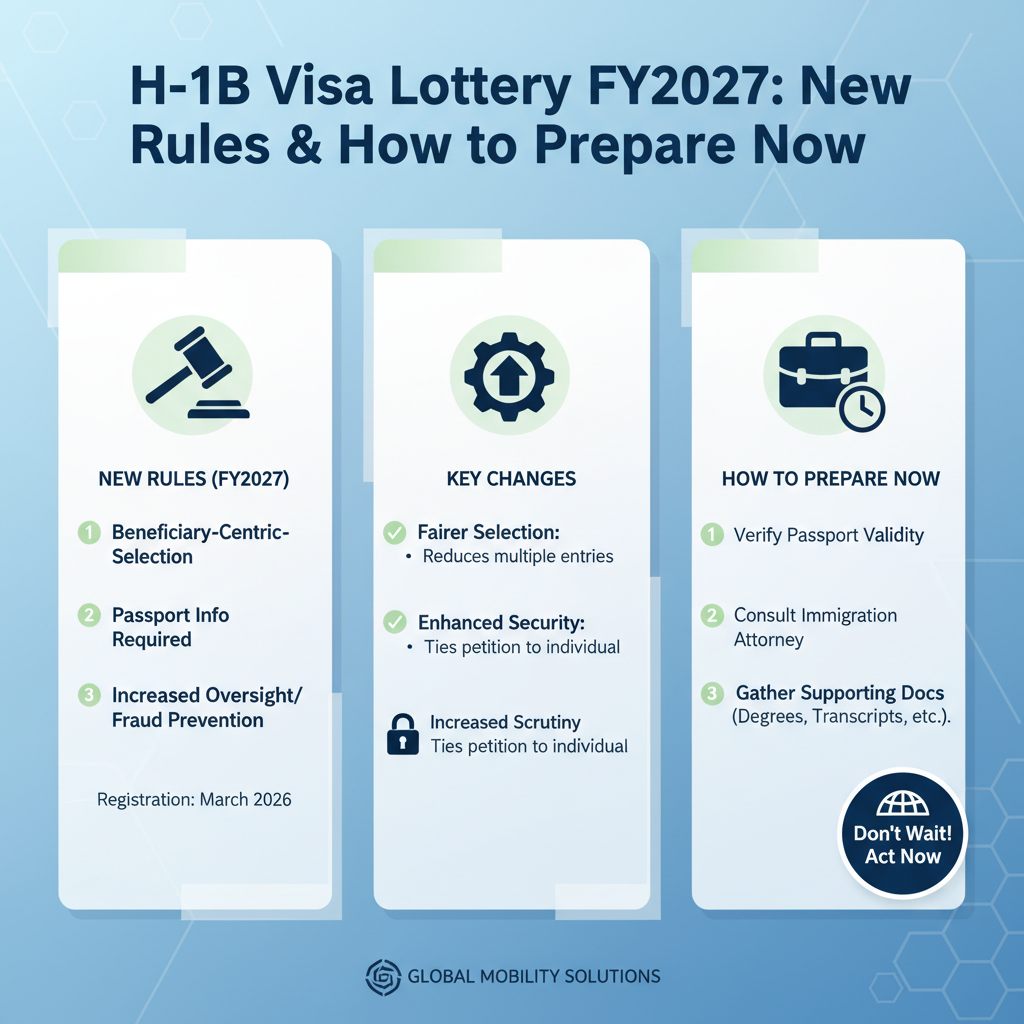
The shift to a "beneficiary-centric" selection model for FY2027 is the most significant change. Instead of selecting registrations, USCIS will select unique beneficiaries from the pool of all submitted registrations. If a beneficiary has multiple registrations submitted by different employers, they will still only be entered into the lottery once. This aims to prevent fraud and give every individual an equal chance.
USCIS official websiteCurrent Immigration Law: The Foundation
The H-1B visa program is authorized by the Immigration and Nationality Act (INA), specifically Section 101(a)(15)(H)(i)(b), which defines the H-1B nonimmigrant classification. The regulations governing its implementation are found in Title 8 of the Code of Federal Regulations (8 CFR). Understanding these foundational laws is crucial for comprehending the recent changes and ensuring compliance.
Federal requirements
To be eligible for an H-1B visa, both the employer (petitioner) and the foreign worker (beneficiary) must meet specific federal criteria:
For the Employer (Petitioner):
- Bona Fide Job Offer: The employer must offer a genuine job in a specialty occupation.
- Employer-Employee Relationship: A valid employer-employee relationship must exist between the petitioner and the beneficiary.
- Prevailing Wage: The employer must pay the H-1B worker at least the prevailing wage for the occupation in the geographic area of employment, or the actual wage paid to other employees with similar experience and qualifications, whichever is higher. This is attested to in the Form ETA-9035 (LCA).
- Tax ID: The employer must have a valid U.S. federal Employer Identification Number (EIN).
- No Adverse Impact: The employment of the H-1B worker must not adversely affect the working conditions of similarly employed U.S. workers.
For the Foreign Worker (Beneficiary):
- Specialty Occupation Qualification: The beneficiary must meet the minimum requirements for the specialty occupation, which typically means holding a U.S. bachelor's degree or its foreign equivalent, or possessing a license, or specialized training plus experience equivalent to a bachelor's degree.
- Professional License: If the occupation requires a state license to practice (e.g., doctors, nurses, architects), the beneficiary must possess that license. For those applying to work in Florida, this would mean a Florida state license.
- Educational Equivalency: Foreign degrees must be evaluated to determine their equivalency to a U.S. bachelor's or master's degree.
The H-1B visa is typically granted for an initial period of up to three years and can be extended for a total of six years. In some circumstances, extensions beyond six years are possible, particularly if the beneficiary has an approved employment-based immigrant petition or an adjustment of status application pending.
Required USCIS Forms: The primary form for an H-1B petition is Form I-129, Petition for a Nonimmigrant Worker. If an attorney represents the petitioner or beneficiary, Form G-28, Notice of Entry of Appearance as Attorney or Accredited Representative, must also be filed.
Florida-specific considerations
While immigration law is federal, certain aspects touch upon state-level realities. Florida does not have its own H-1B visa laws; however, the economic landscape and specific industry needs within the state heavily influence H-1B demand and employment opportunities. For those working in Orlando and surrounding areas:
- High Demand Industries: Central Florida's growing tech sector, theme park and hospitality management, healthcare, and advanced manufacturing industries frequently sponsor H-1B visas. This means a strong local job market for specialty occupations.
- Prevailing Wage Data: The prevailing wage for an occupation in Orlando, Florida, will differ from, say, Silicon Valley or New York City. Employers must use accurate local wage data, typically obtained from the Department of Labor's Foreign Labor Certification Data Center.
- Professional Licensing: For occupations requiring state licensure (e.g., engineering, architecture, certain medical professions), obtaining a Florida license is a prerequisite for H-1B employment in the state.
- Orlando USCIS Field Office: While H-1B petitions are processed centrally, individuals seeking to adjust their status or attend interviews for other immigration benefits may interact with the Orlando USCIS Field Office.
Important: The H-1B program is complex, and even minor errors can lead to denials or delays. Professional legal guidance is highly recommended to ensure all federal and practical requirements are met.
Need Help? Our Orlando immigration team is ready to assist. Call +1 786-791-3106 for a free consultation, or message us online. Se Habla Español.
How to Navigate the New H-1B Lottery Rules: A Complete Step-by-Step Guide
The H-1B process, especially with the new beneficiary-centric lottery system for FY2027, demands meticulous planning and execution. This step-by-step guide outlines the journey from employer sponsorship to visa approval.
1) Employer Assessment & Labor Condition Application (LCA) Preparation
Before any lottery registration can occur, a U.S. employer must identify a need for a foreign worker in a specialty occupation and commit to sponsoring them. This initial phase involves critical internal assessments and compliance steps.
Detailed Explanation: The employer first determines if the position qualifies as a "specialty occupation" and if the prospective employee meets the educational and experiential requirements. They must also confirm their ability to pay the required prevailing wage. This typically involves researching wage data for the specific occupation and geographic location (e.g., Orlando, FL). Once these initial checks are complete, the employer must file a Labor Condition Application (Form ETA-9035) with the U.S. Department of Labor (DOL). The LCA attests to the employer's compliance with wage and working condition requirements for H-1B workers. This form must be certified by the DOL before an H-1B petition can be filed with USCIS.
Required Documents/Information for this Step:
- Detailed job description, including duties and minimum requirements.
- Beneficiary's resume, academic transcripts, and degree certificates.
- Prevailing wage determination for the specific occupation and location.
- Employer's Federal Employer Identification Number (EIN).
- Employer's contact information and business details.
Timeline Expectation: LCA processing by the DOL typically takes 7-10 calendar days. It's crucial to start this process well in advance of the H-1B registration window.
2) H-1B Registration Under New Beneficiary-Centric Rules
This is the gateway to the H-1B lottery. For FY2027, USCIS has implemented a significant change: the selection process will be based on unique beneficiaries, not on registrations.
Detailed Explanation: During the designated H-1B registration period (typically in March, for FY2027 this will be March 2026), the employer (or their authorized legal representative) must electronically submit a registration for each prospective H-1B beneficiary they wish to sponsor. Each registration requires a $10 fee. Under the new rules, if multiple employers register the same beneficiary, that beneficiary will only be entered into the lottery once. USCIS will identify unique beneficiaries using valid passport information or other acceptable travel documents. If selected, USCIS will notify *all* employers who registered that specific beneficiary, and *any* of those employers can then file a petition on behalf of the selected beneficiary. This change aims to prevent a single individual from gaining an unfair advantage through multiple entries from different employers. It emphasizes the beneficiary's unique identity as the basis for selection.
Required Documents/Information for this Step:
- Beneficiary's full legal name, date of birth, country of birth, country of citizenship.
- Beneficiary's valid passport number (Important: This is critical for identifying unique beneficiaries).
- Beneficiary's gender.
- Employer's legal name, Federal Employer Identification Number (EIN), and mailing address.
- Employer's authorized signatory information.
- Attorney's G-28 information, if applicable.
Timeline Expectation: The registration window is typically open for a 15-day period in March. Selection notices are usually issued by late March or early April.
3) Lottery Selection & Petition Filing
Once the registration period closes, USCIS conducts the lottery. If selected, the employer can proceed with filing the full H-1B petition.
Detailed Explanation: USCIS first conducts the lottery for the master's cap, then for the regular cap, selecting unique beneficiaries until the annual limits are met. If a beneficiary is selected, USCIS sends a "selection notice" to the registering employer(s). This notice grants a specific window (usually 90 days) within which the employer must file the complete Form I-129, Petition for a Nonimmigrant Worker, with all supporting documentation. This is where the certified LCA from Step 1 becomes essential. The petition must prove that the job is a specialty occupation and that the beneficiary is qualified for it.
Required Documents for this Step (if selected):
- Certified Form ETA-9035 (LCA).
- Completed Form I-129 and H-1B Supplement.
- Copy of the H-1B selection notice.
- Beneficiary's educational documents (degrees, transcripts, evaluations).
- Beneficiary's resume and work experience letters.
- Employer's support letter detailing the job offer, wages, and need for the H-1B worker.
- Employer's financial statements, tax returns, and business licenses to prove ability to pay and legitimate business operations.
- Copies of beneficiary's passport, visa, I-94 record, and current immigration documents (e.g., EAD for OPT).
- If applicable, Form G-28.
- Applicable filing fees (Form I-129 fee, ACWIA fee, fraud prevention and detection fee, public law 114-113 fee if applicable, premium processing fee if requested).
Timeline Expectation: The filing window is typically 90 days from the selection notice date. USCIS processing times for Form I-129 can vary significantly; check USCIS Processing Times for current estimates. Premium processing (an additional fee of $2,805 as of late 2024, subject to change) guarantees a decision within 15 calendar days.
4) USCIS Processing & Request for Evidence (RFE)
After filing, USCIS reviews the petition. This stage can involve requests for additional information.
Detailed Explanation: USCIS adjudicators examine the filed petition and supporting documents. They verify that the employer and beneficiary meet all eligibility requirements, that the job is a specialty occupation, and that the employer-employee relationship is valid. During this review, USCIS may issue a Request for Evidence (RFE) if they need more information or clarification on any aspect of the petition. Responding to an RFE requires careful attention and often legal expertise to provide compelling additional evidence. Failure to adequately respond to an RFE can lead to a denial.
Reminder: For those in Orlando or elsewhere in Florida on F-1 OPT, a timely filed H-1B petition (and selection) allows for a "cap-gap" extension of your F-1 status and work authorization until October 1st, the start of the H-1B fiscal year. This is critical for maintaining legal status and employment.
Required Documents for RFE Response (if applicable):
- Specific documents requested by USCIS, such as detailed project plans, contracts, organizational charts, expert opinion letters, additional educational or experience documentation, etc.
Timeline Expectation: RFE responses typically have a deadline of 60-90 days. USCIS then takes additional time to review the RFE response.
5) Approval & Visa Stamping / Change of Status
Upon approval, the beneficiary can begin H-1B employment.
Detailed Explanation: If the petition is approved, USCIS will issue an I-797 Approval Notice. If the beneficiary is already in the U.S. and opted for a "Change of Status" (COS) (e.g., from F-1 to H-1B), their status automatically changes to H-1B on October 1st (or the approval date if later). If the beneficiary is outside the U.S., or if they opted for "Consular Processing," they must attend an H-1B visa interview at a U.S. embassy or consulate in their home country. They will receive an H-1B visa stamp in their passport to enter the U.S. in H-1B status. This step involves a separate application (Form DS-160) and interview.
Required Documents for Visa Stamping (Consular Processing):
- Valid passport.
- Form DS-160 confirmation page.
- Appointment confirmation page.
- Original Form I-797 Approval Notice.
- Employer letter confirming employment.
- LCA (Form ETA-9035).
- Original educational documents and transcripts.
- Resume and proof of work experience.
- Recent passport-style photographs.
- Payment of visa reciprocity fees, if applicable.
Timeline Expectation: Consular processing times vary by embassy/consulate; check the U.S. Department of State website for current wait times.
6) Maintaining H-1B Status & Compliance
Approval is not the end; maintaining H-1B status requires ongoing compliance.
Detailed Explanation: Once in H-1B status, the beneficiary must only work for the sponsoring employer in the approved specialty occupation and location. Any material changes to employment (e.g., job duties, work location, salary reductions below LCA minimums) may require an amended H-1B petition to be filed with USCIS. Both the employer and employee have responsibilities to ensure compliance with H-1B regulations. Violations can lead to loss of status or future immigration difficulties.
Warning: Unauthorized employment or failure to maintain status can have severe consequences, including deportation or bars to future immigration benefits.
Need Help? Our Orlando immigration team is ready to assist. Call +1 786-791-3106 for a free consultation, or message us online. Se Habla Español.

Practical Steps You Can Take Today
The H-1B lottery for FY2027 may seem far off, but early preparation is key to success, especially with the new rules. Don't wait until the last minute!
Actionable Checklist:
- Consult an Experienced Immigration Attorney: This is the most crucial step. An attorney can assess your eligibility, guide your employer, and ensure compliance with all new rules. At Imigrar, we offer free consultations to help you understand your options.
- Secure a Bona Fide Job Offer: Ensure your prospective employer is aware of the H-1B process and the new lottery rules. Focus on positions that clearly qualify as specialty occupations.
- Verify Your Passport Information: Since the lottery is now beneficiary-centric and relies on passport data, ensure your passport is valid and all information (especially your passport number) is accurate and consistent across all potential registrations.
- Gather Educational Documents: Collect all official transcripts, degree certificates, and any foreign degree evaluations. If you don't have an evaluation, start the process with a reputable credential evaluation service.
- Update Your Resume and Professional Portfolio: Clearly articulate your skills and experience to demonstrate your qualification for a specialty occupation.
- Understand the Timelines: Mark your


