

The landscape of U.S. immigration is constantly evolving, and for skilled foreign workers and the employers who rely on their talent, few changes are as impactful as those affecting the H-1B visa program. As an immigration law firm rooted in Orlando, Florida, Imigrar is dedicated to keeping families together by providing timely, accurate, and actionable guidance.
Today, we delve into the significant H-1B visa lottery changes implemented for Fiscal Year 2027 (FY2027), a topic generating considerable discussion across the legal and business communities. These new rules fundamentally alter how beneficiaries are selected and aim to strengthen the integrity of the lottery process. Understanding these shifts is paramount for anyone considering an H-1B visa.
Navigating the New H-1B Landscape? Don't face the complexities alone. Our Orlando immigration team is ready to assist. Call +1 786-791-3106 for a free consultation, or message us online. Se Habla Español.
The reporting that sparked this guide
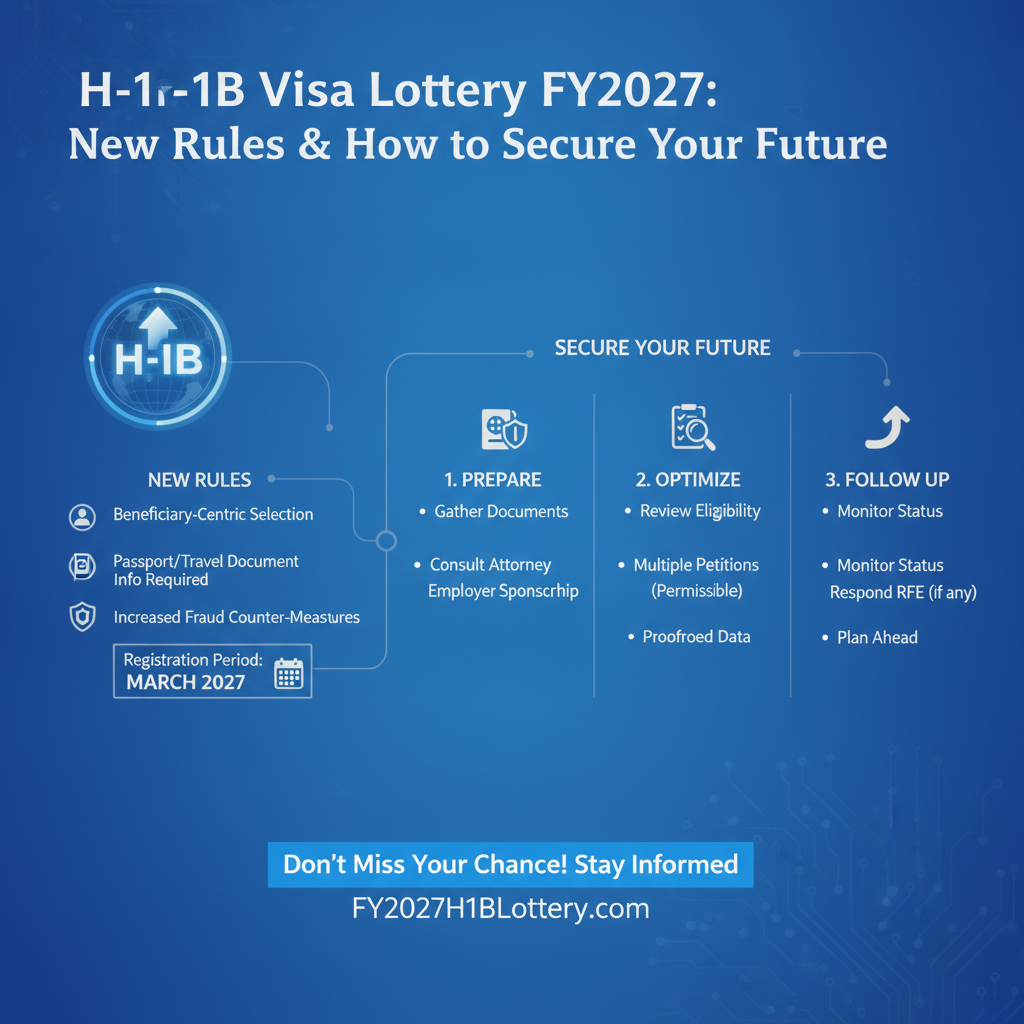
This comprehensive guide is prompted by recent H-1B Visa Lottery Changes for FY2027 (Legal News), highlighting the critical updates to the H-1B cap registration process. These changes represent a significant shift from previous years, impacting how employers register potential beneficiaries and how USCIS conducts the lottery selection.
What This News Means for Immigrants in Orlando and Across Florida
For individuals and businesses in Orlando and across the Sunshine State, these H-1B visa lottery changes are more than just legal updates; they are critical factors that could shape careers, business growth, and family futures. Florida, with its booming tech sector, robust tourism industry, and leading educational institutions, is a major hub for skilled foreign talent. Understanding these changes is not just beneficial—it's essential.
Why this news is showing up now
The U.S. government, through U.S. Citizenship and Immigration Services (USCIS), regularly reviews and updates immigration policies to address evolving economic needs, national security concerns, and program integrity. The H-1B visa program, designed for specialty occupation workers, has long been oversubscribed, leading to a lottery system for cap-subject petitions. In recent years, USCIS identified a significant increase in fraudulent registrations, where multiple employers would register the same beneficiary to increase their chances of selection. To combat this, new rules were proposed and finalized, specifically targeting the integrity of the lottery process for FY2027 and beyond.
The regulatory changes, formally known as the "H-1B Cap Registration Final Rule," shifted the selection process from an employer-centric model to a beneficiary-centric selection process. This means that instead of multiple registrations for one individual being allowed, each unique beneficiary is entered into the lottery only once, regardless of how many employers register them. This change was implemented to reduce fraud and provide a more equitable chance of selection for all eligible individuals.
How it can affect Florida residents
Florida's economy is diverse and growing, with significant demand for skilled professionals in various sectors. The I-4 corridor, stretching from Tampa Bay through Orlando to Daytona Beach, is a critical economic artery, home to numerous tech companies, healthcare providers, and major theme parks that rely on H-1B talent. Central Florida, in particular, benefits from a strong pipeline of graduates from universities like the University of Central Florida (UCF) and the University of Florida (UF), many of whom seek H-1B sponsorship.
- For H-1B Beneficiaries in Florida: If you are a prospective H-1B worker currently residing in Orlando, Kissimmee, Tampa, or anywhere in Florida—perhaps on an F-1 OPT visa or another nonimmigrant status—these changes directly impact your path to an H-1B. The beneficiary-centric selection process means you can now be registered by multiple employers, but you will only have one chance in the lottery. This simplifies the process for you by removing the incentive for fraudulent multiple entries, potentially increasing the overall fairness. However, it also means that your odds of selection are now truly based on the lottery itself, not on the number of employers willing to register you.
- For Florida Employers: Businesses in Orlando and across Florida that sponsor H-1B visas—from tech startups to engineering firms, hospitals, and educational institutions—must adapt their strategies. The new rules mean employers must focus on legitimate job offers and strong candidate profiles, rather than attempting to game the system with multiple registrations. This fosters a more competitive and ethical environment. Employers must ensure they have a genuine need for the H-1B worker and are prepared to file a robust petition if selected. The Orlando USCIS Field Office processes various immigration applications, and while H-1B petitions are typically handled by service centers, local compliance and understanding of state-specific labor laws remain crucial.
- Increased Scrutiny: USCIS has also stated its commitment to increasing fraud detection and investigation. This means that any H-1B petition, especially those from Florida employers, could face higher scrutiny, requiring meticulous documentation and adherence to all regulations.
At Imigrar, we understand these nuances. Our team is equipped to guide both individuals and employers in Florida through these changes, ensuring compliance and maximizing the chances of a successful H-1B outcome.
What H-1B Visa Lottery Changes for FY2027 Is (and Why It Matters)
The H-1B visa program is a cornerstone of U.S. immigration for skilled professionals. The recent changes for FY2027 are designed to reinforce its integrity and fairness.
A plain-English definition
The H-1B visa is a nonimmigrant visa that allows U.S. employers to temporarily employ foreign workers in specialty occupations. These occupations generally require a bachelor's degree or higher in a specific field. Examples include IT professionals, engineers, doctors, architects, and certain types of teachers. The U.S. Congress sets an annual cap on the number of H-1B visas issued each fiscal year. For most years, this cap is 65,000, with an additional 20,000 visas reserved for those with a U.S. master's degree or higher (the "Master's Cap"). Because demand far exceeds supply, USCIS conducts an annual lottery to select registrations for petition filing.
The "H-1B Visa Lottery Changes for FY2027" refer to new regulations that USCIS implemented to reform the lottery process, primarily shifting from an employer-centric selection model to a beneficiary-centric selection model. This means that the lottery selection is now based on each unique individual (the beneficiary), rather than on each registration submitted by an employer. If a beneficiary has multiple employers register them, they are still only entered into the lottery once. This change aims to prevent a single individual from having multiple entries through different employers, which previously inflated selection odds and contributed to fraud.
Key terms you need to know
Understanding the following terms is crucial for navigating the H-1B process, especially with the new rules:
- Beneficiary: The foreign national worker who is seeking the H-1B visa. Under the new rules, the lottery selection is now centered around the beneficiary.
- Petitioner: The U.S. employer who files the H-1B petition on behalf of the beneficiary.
- Specialty Occupation: An occupation that requires theoretical and practical application of a body of highly specialized knowledge, and a bachelor's or higher degree in the specific specialty (or its equivalent) as a minimum for entry into the occupation in the United States.
- Cap-Subject H-1B: H-1B petitions that are subject to the annual statutory cap of 65,000 visas, plus the 20,000 Master's Cap. Exemptions exist for certain employers (e.g., universities, non-profits affiliated with universities, government research organizations).
- H-1B Registration Period: The designated window, typically in March, during which prospective petitioners (employers) must electronically register beneficiaries for the lottery. For FY2027, this period already occurred in March 2026.
- H-1B Lottery: The random selection process conducted by USCIS when the number of registrations exceeds the annual cap.
- Selection Notice: A notification from USCIS indicating that an H-1B registration has been selected in the lottery, allowing the employer to proceed with filing the full H-1B petition.
- Form I-129, Petition for a Nonimmigrant Worker: The primary form filed by the employer once a beneficiary's registration is selected.
- Form I-797, Notice of Action: Various notices issued by USCIS, including selection notices for the lottery and approval notices for petitions.
- Prevailing Wage: The average wage paid to similarly employed workers in a specific occupation in the area of intended employment. Employers must pay the H-1B worker at least the prevailing wage or the actual wage paid to other employees with similar experience and qualifications, whichever is higher.
- Request for Evidence (RFE): A formal request from USCIS for additional documentation or information to support an H-1B petition.
- Beneficiary-Centric Selection: The core of the FY2027 changes. Instead of each registration being entered into the lottery, only unique beneficiaries are entered. If multiple employers register the same beneficiary, that beneficiary still only gets one entry. If selected, any of the registering employers can file the petition.
Current Immigration Law: The Foundation
The H-1B visa program is authorized under the Immigration and Nationality Act (INA), specifically Section 101(a)(15)(H)(i)(b), which defines the H-1B nonimmigrant classification, and Section 214(g), which establishes the annual numerical limitations (the "cap"). These statutes are codified in federal law at 8 U.S.C. § 1101(a)(15)(H)(i)(b) and 8 U.S.C. § 1184(g).
USCIS implements these laws through regulations found in the Code of Federal Regulations (CFR), primarily at 8 CFR Part 214.2(h). These regulations govern everything from eligibility requirements to the application process, fees, and the lottery system. The recent changes for FY2027 were enacted through amendments to these regulations, specifically modifying the lottery selection process to address fraud concerns.
For official information, always refer to the USCIS official website.
Federal requirements
To qualify for an H-1B visa, both the employer (petitioner) and the foreign worker (beneficiary) must meet specific federal requirements:
-
For the Beneficiary:
- Hold a bachelor's degree or its equivalent, or a license in a specialty occupation field, or work experience equivalent to a bachelor's degree.
- Possess the specific qualifications required for the specialty occupation position.
- If applying under the Master's Cap, hold a U.S. master's or higher degree from an accredited institution.
-
For the Petitioner (Employer):
- Offer a job in a specialty occupation that requires theoretical and practical application of a body of highly specialized knowledge, and a bachelor's or higher degree in the specific specialty.
- Demonstrate that the beneficiary meets the minimum educational and experience requirements for the specialty occupation.
- Pay the H-1B worker at least the prevailing wage for the occupation in the area of intended employment or the actual wage paid to other employees with similar experience and qualifications, whichever is higher. This is often determined through a certified Labor Condition Application (LCA) from the U.S. Department of Labor.
- Have a valid Employer Identification Number (EIN).
- Maintain an employer-employee relationship with the beneficiary.
- The H-1B Cap: The statutory annual cap of 65,000 H-1B visas, with an additional 20,000 for those with a U.S. master's degree or higher, remains in effect. The lottery is used to select registrations within these caps.
Important: The new beneficiary-centric selection method does not change the underlying eligibility requirements for the H-1B visa itself, but rather *how* individuals are selected to apply for it.
Florida-specific considerations
While H-1B laws are federal, their application has practical implications for Florida residents and businesses:
- Key Industries: Florida's robust sectors in information technology, aerospace and aviation (especially near Cape Canaveral), healthcare, engineering, and advanced manufacturing frequently utilize the H-1B program. Companies along the I-4 corridor, in cities like Orlando, Tampa, and Melbourne, are major H-1B employers.
- Educational Institutions: Florida is home to many world-class universities, including the University of Central Florida (UCF), University of Florida (UF), Florida State University (FSU), and the University of Miami. Graduates from these institutions, particularly those on F-1 visas with Optional Practical Training (OPT), are prime candidates for H-1B sponsorship. Many of these universities are also H-1B cap-exempt employers.
- Orlando USCIS Field Office: While H-1B petitions are generally processed at USCIS Service Centers, individuals in Orlando may interact with the Orlando Field Office for other immigration matters or in specific situations related to their status. Having local legal counsel who understands the regional context is invaluable.
- State-Specific Labor Laws: While federal law governs the H-1B, employers must also ensure compliance with Florida's state labor laws, which might impact aspects like employment contracts or workplace conditions.
Concerned about H-1B compliance in Florida? Imigrar has the local knowledge and national expertise. Call +1 786-791-3106 for a free consultation, or message us online. Se Habla Español.
How to Navigate the H-1B Visa Lottery Under New FY2027 Rules: A Complete Step-by-Step Guide
Navigating the H-1B lottery process under the new FY2027 rules requires careful planning and meticulous execution. Here’s a detailed step-by-step guide for both employers and beneficiaries.
1) Employer Assessment, Planning, and LCA Filing
Before any registration, the employer must assess the need for an H-1B worker and confirm the position qualifies as a specialty occupation. This initial phase involves significant internal planning.
- Internal Review: The employer identifies a need for a foreign worker, ensures the job duties meet specialty occupation criteria, and confirms the beneficiary possesses the required qualifications.
- Wage Determination: The employer must determine the appropriate prevailing wage for the position based on the occupation, industry, and geographical location (e.g., Orlando, Orange County, Florida).
-
Labor Condition Application (LCA) Filing: The employer must file Form ETA-9035, Labor Condition Application, with the U.S. Department of Labor (DOL). This form attests to compliance with wage and working condition requirements. The LCA must be certified by the DOL before the H-1B petition can be filed with USCIS.
- Required Documents (for LCA):
- Employer's EIN.
- Job title and duties.
- Work location(s).
- Required education and experience.
- Proposed wage.
- Prevailing wage determination source.
- Required Documents (for LCA):
Timeline Expectation: LCA certification can take 7-10 business days. This must be done *before* the H-1B petition filing, but not necessarily before registration.
2) H-1B Registration Submission (Beneficiary-Centric)
This is the critical phase for the lottery. Employers submit electronic registrations for each prospective H-1B beneficiary.
- Registration Window: USCIS typically opens the electronic registration period in March each year. For FY2027, this window already passed in March 2026.
- Beneficiary-Centric Approach: This is where the new rules are most evident. Each unique beneficiary can only be selected once, regardless of how many employers submit registrations on their behalf. If a beneficiary is registered by multiple employers, USCIS will still treat them as a single entry in the lottery.
-
Employer Action: Each employer wishing to sponsor an H-1B worker must create a USCIS online account and submit a separate registration for each beneficiary they intend to sponsor. Each registration requires a $10 fee.
- Required Information (for Registration):
- Employer's name, EIN, and mailing address.
- Beneficiary's full name, date of birth, country of birth, country of citizenship.
- Beneficiary's passport number.
- Beneficiary's highest degree attained.
- Whether the beneficiary holds a U.S. master's or higher degree.
- Attorney or representative information (if applicable).
- Required Information (for Registration):
Warning: Any attempt by multiple related entities to register the same beneficiary to gain an unfair advantage could result in denial of all petitions filed for that beneficiary and potential fraud investigations.
3) Lottery Selection and Notification
After the registration period closes, USCIS conducts the lottery.
- Random Selection: USCIS conducts a random selection from the submitted registrations. First, selections are made for the 20,000 Master's Cap. Then, unselected Master's Cap registrations are pooled with regular cap registrations for the remaining 65,000 slots.
- Notification: USCIS typically notifies selected registrants (employers) through their online accounts by the end of March or early April.
- Selection Notice (Form I-797C, Notice of Action): If selected, the employer will receive a Form I-797C confirming the selection and providing instructions for filing the H-1B petition. This notice will include a unique receipt number.
Timeline Expectation: Selection notices are usually issued within a few weeks after the registration period closes. For FY2027, these would have been issued in March/April 2026.
4) Petition Filing with USCIS (Form I-129)
Once a registration is selected, the employer can proceed with filing the full H-1B petition.
- Filing Period: Employers have a specific window (typically 90 days, starting April 1st) to file Form I-129, Petition for a Nonimmigrant Worker, along with all supporting documentation. This petition must be filed only by one of the employers who legitimately registered the beneficiary and received a selection notice.
-
Comprehensive Documentation: The petition package must be meticulously prepared and include extensive evidence supporting the specialty occupation, the beneficiary's qualifications, and the employer's ability to pay the required wage.
- Required Documents (for Form I-129 petition):
- Certified LCA (Form ETA-9035).
- Copies of beneficiary's educational degrees, transcripts, and evaluations of foreign degrees.
- Beneficiary's resume/CV.
- Letters of experience from previous employers.
- Copy of beneficiary's passport, visa, I-94 record, and previous I-797 approval notices (if applicable).
- Employer's business license, tax returns, financial statements (to prove ability to pay).
- Detailed job description, organizational charts, and evidence of specialty occupation nature.
- Employer-employee contract or offer letter.
- H-1B Data Collection and Filing Fee Exemption Supplement (if applicable).
- All required filing fees (e.g., base fee, ACWIA fee, fraud prevention and detection fee, public law 114-113 fee if applicable).
- Required Documents (for Form I-129 petition):
Reminder: The petition must be filed at the correct USCIS Service Center based on the employer's address or the beneficiary's work location. For many Florida-based companies, this might be the Vermont or California Service Center.
5) Premium Processing (Optional)
For an additional fee, employers can opt for Premium Processing to expedite the adjudication of their H-1B petition.
- Expedited Processing: USCIS guarantees processing within 15 calendar days for petitions filed with Form I-907, Request for Premium Processing Service.
- Fee: The fee for Premium Processing is substantial (e.g., $2,805 as of early 2026, subject to change).
- Availability: USCIS may temporarily suspend Premium Processing for H-1B petitions during high-volume periods, so check the latest updates on the USCIS official website.
6) Responding to Requests for Evidence (RFEs) or Notices of Intent to Deny (NOIDs)
It is common for USCIS to issue an RFE if they require more information or clarification on any aspect of the petition. A NOID indicates an intent to deny the petition unless compelling evidence is provided.
- Timely Response: It is crucial to respond to RFEs or NOIDs accurately and within the specified deadline (typically 60-90 days).
- Comprehensive Evidence: The response must directly address all points raised by USCIS and provide robust supporting documentation.
Warning: Inadequate or untimely responses to RFEs are a leading cause of petition denials. Legal counsel is highly recommended for RFE responses.
7) Visa Interview or Adjustment of Status
Upon approval of the H-1B petition, the beneficiary takes the final steps to obtain H-1B status.
- Consular Processing: If the beneficiary is outside the U.S., they will attend a visa interview at a U.S. embassy or consulate in their home country. Upon approval, an H-1B visa stamp will be placed in their passport, allowing them to enter the U.S.
-
Adjustment of Status: If the beneficiary is already in the U.S. in a valid nonimmigrant status (e.g., F-1 OPT) and the H-1B petition requested a "change of status," their status will automatically change to H-1B on October 1st (the start of the fiscal year). No separate interview is typically required for a change of status, though a visa stamp would be needed for future international travel.
- Required Documents (for Consular Processing):
- Passport valid for at least six months beyond the period of stay.
- DS-160 confirmation page.
- Appointment confirmation page.
- MRV fee payment receipt.
- Original Form I-797 Approval Notice.
- LCA.
- Offer letter and employment verification.
- Educational documents.
- Photographs.
- Required Documents (for Consular Processing):
Important: H-1B status typically begins on October 1st of the fiscal year for which the petition was filed, regardless of when the petition was approved.

Practical Steps You Can Take Today
Even if the FY2027 lottery registration has passed, there are crucial steps prospective H-1B beneficiaries and employers in Orlando and beyond can take to prepare for future cycles or address current situations.
Actionable Checklist:
- Engage with Potential Employers Early: If you are a beneficiary, start networking and securing job offers well in advance of the next H-1B registration period (which will be March 2027 for FY2028). Employers need time to prepare.
- Verify Employer Legitimacy: With the increased focus on fraud, ensure any potential sponsoring employer is legitimate and has a genuine need for your services. Be wary of offers that seem too good to be true or require you to pay excessive fees directly.
- Gather and Organize Your Documents: Proactively collect all educational documents (degrees, transcripts, evaluations), professional licenses, resumes, and passport/visa copies. Having these ready saves critical time.
- Consult with an Experienced Immigration Attorney: This is perhaps the most critical step. An attorney can assess your eligibility, advise employers on compliance, and guide you through the complex process.
- Understand the Timelines: Familiarize yourself with


