The reporting that sparked this guide: H-1B Visa Lottery Changes for FY2027 (Legal News)
What This News Means for Immigrants in Orlando and Across Florida
Why this news is showing up now
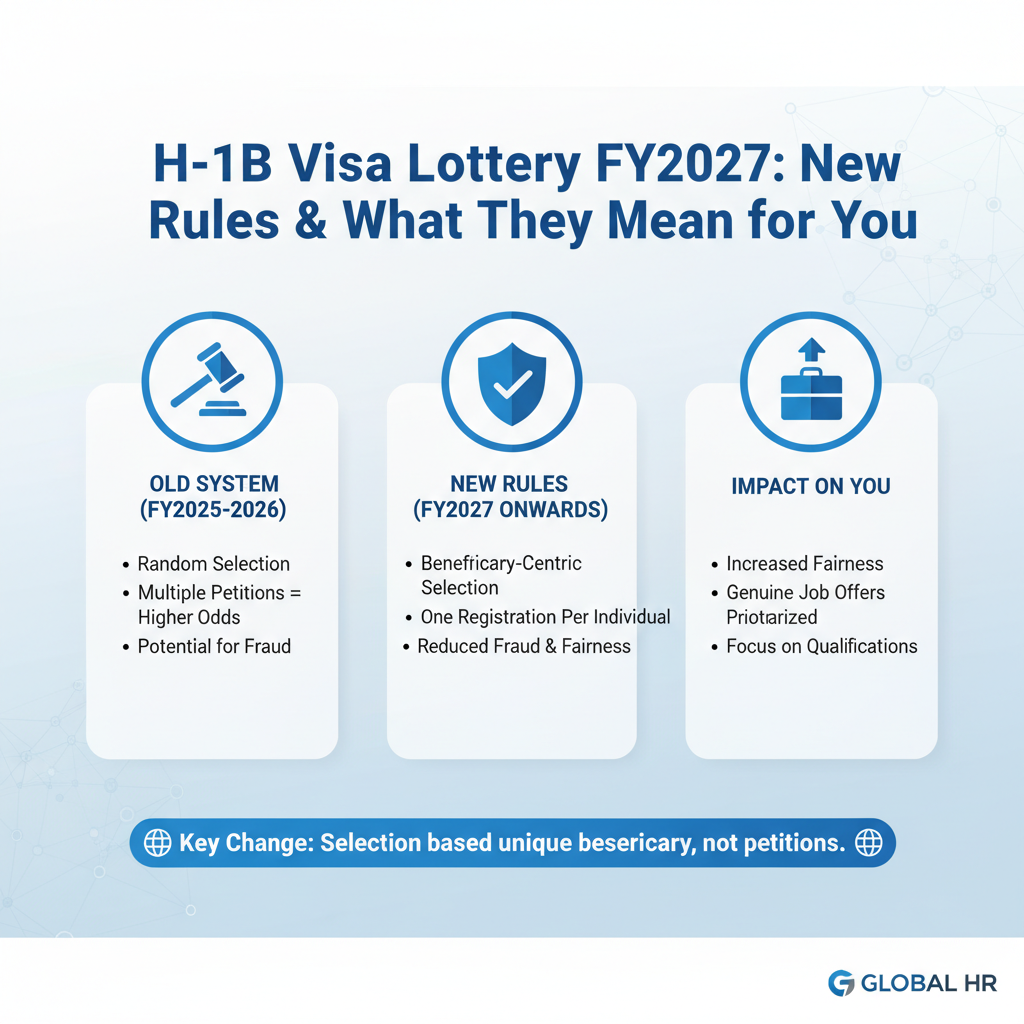
The news about H-1B visa lottery changes for FY2027 is surfacing now because the United States Citizenship and Immigration Services (USCIS) typically announces final rules and policy updates well in advance of the registration period. The H-1B cap-subject petition filing season for FY2027 will begin with the electronic registration period in March 2026. To provide ample time for potential petitioners (employers) and beneficiaries (foreign workers) to understand and adapt to the new regulations, USCIS publishes these changes months ahead. This allows employers to adjust their recruitment and sponsorship strategies, and it enables beneficiaries to prepare their credentials and seek appropriate legal counsel. The goal is to ensure transparency and a fair opportunity for all participants under the new framework. This proactive dissemination of information is crucial, especially given the profound impact these changes will have on the lottery's mechanics and integrity.How it can affect Florida residents
Florida, particularly Central Florida with its booming tech industry, theme park engineering needs, healthcare sector, and numerous universities, is a significant hub for H-1B visa holders. Orlando, known for its innovation districts and expanding business landscape along the I-4 corridor, attracts a diverse pool of highly skilled foreign professionals. The new H-1B lottery rules will have several key effects on Florida residents: * **For Aspiring H-1B Beneficiaries in Florida:** If you are a foreign national living in Orlando or anywhere in Florida, perhaps on an F-1 OPT visa, or you are abroad hoping to come to Florida for a specialty occupation, these changes are paramount. The shift to a **beneficiary-centric selection process** means that your chances are no longer amplified by multiple employers submitting registrations on your behalf. Each unique beneficiary will be entered into the lottery only once, regardless of how many job offers or employers they have. This levels the playing field, potentially reducing the overall number of lottery entries and increasing the statistical chance for each *individual* beneficiary's selection. However, it also means that you must ensure any employer registering on your behalf is legitimate and serious about your employment. * **For Florida Employers:** Companies in Orlando, Tampa, Miami, or across Florida that rely on the H-1B program to fill highly specialized roles will need to adapt their internal processes. They can no longer encourage or participate in the practice of submitting multiple registrations for the same individual. This change underscores the need for employers to be more strategic and focused on identifying the best candidates and ensuring their own compliance. It also means that if an employer registers a beneficiary, they must genuinely intend to employ that person in an H-1B specialty occupation. * **Increased Scrutiny:** USCIS has explicitly stated these changes are to combat fraud. This means that both employers and beneficiaries in Florida can expect increased scrutiny during the registration and petition filing phases. Misrepresentations or fraudulent submissions could lead to severe penalties, including denial of petitions, revocation of approvals, and even criminal prosecution. * **Importance of Legal Counsel:** For individuals and businesses in the Orlando area, navigating these complex changes without expert legal guidance can be risky. An experienced immigration attorney can help ensure compliance, strategize the best approach, and prepare robust petitions that meet the new, stricter requirements.Need Help? Our Orlando immigration team is ready to assist. Call +1 786-791-3106 for a free consultation, or message us online. Se Habla Español.
What H-1B Visa Lottery Changes for FY2027 Is (and Why It Matters)
The H-1B visa program is a nonimmigrant visa that allows U.S. employers to temporarily employ foreign workers in specialty occupations. These occupations generally require a bachelor's degree or higher in a specific field. The program is crucial for many U.S. industries, particularly tech, engineering, medicine, and research, enabling them to attract top global talent. However, demand for H-1B visas consistently far outstrips the annual supply, necessitating a lottery system to select eligible petitions. The recent H-1B Visa Lottery changes for FY2027, announced by USCIS, are a direct response to concerns about widespread abuse of the previous lottery system, specifically the practice of multiple registrations submitted by different employers for the same individual beneficiary. This practice artificially inflated selection rates and gave an unfair advantage to certain beneficiaries and employers. The new rules aim to restore integrity and fairness to the lottery process.A plain-English definition
Simply put, the H-1B visa is for skilled foreign workers to fill jobs in the U.S. that require a specific college degree. Because there are many more applicants than available visas each year, USCIS uses a lottery. For FY2027, the big change is *how* the lottery works: instead of picking registrations, USCIS will now pick *people*. If you, as the foreign worker (the **beneficiary**), are registered by multiple employers, you still only get one "ticket" in the lottery. This makes it fairer, as no one person can have their chances boosted by having many employers register for them. It ensures that each individual has an equal chance of being selected, regardless of how many employers are interested in sponsoring them.Key terms you need to know
Navigating the H-1B process requires familiarity with specific terminology. Here are the key terms, especially those relevant to the new FY2027 changes: * **H-1B Visa:** A nonimmigrant visa that permits U.S. employers to temporarily employ foreign workers in specialty occupations. * **Specialty Occupation:** An occupation that generally requires a bachelor's degree or higher in a specific specialty as a minimum for entry into the occupation. * **Beneficiary:** The foreign national individual who is the subject of the H-1B petition, seeking to work in the U.S. * **Petitioner:** The U.S. employer filing the H-1B petition on behalf of the beneficiary. * **H-1B Cap:** The annual limit on the number of H-1B visas issued each fiscal year. Currently, it's 65,000 for the regular cap and an additional 20,000 for the **Master's Cap** (for those with a U.S. master's degree or higher). * **Cap-Subject:** Refers to H-1B petitions that are subject to the annual numerical limits. Most H-1B petitions fall into this category. * **Cap-Exempt:** Certain employers are exempt from the H-1B cap, such as institutions of higher education, non-profit organizations affiliated with higher education, and government research organizations. * **H-1B Lottery (or Selection Process):** The system USCIS uses when the number of electronic registrations exceeds the annual H-1B cap. * **H-1B Registration Period:** A designated window (usually in March) during which prospective petitioners (employers) electronically submit registrations for the H-1B lottery. * **Beneficiary-Centric Selection:** This is the core new rule for FY2027. Instead of selecting registrations, USCIS will now select unique **beneficiaries** from the pool of submitted registrations. This means each eligible beneficiary will be entered into the lottery *only once*, regardless of how many employers submit registrations on their behalf. If a beneficiary is selected, all employers who registered for them will be notified, and any of those employers can then file a petition. * **Final Rule:** The official published regulation by USCIS outlining these new changes, which carries the force of law. * **Form I-129, Petition for a Nonimmigrant Worker:** The primary form used by employers to petition for nonimmigrant workers, including H-1B. * **Labor Condition Application (LCA) (Form ETA-9035):** A prerequisite to filing Form I-129 for H-1B. Employers must file this with the Department of Labor, attesting to paying prevailing wages and providing working conditions that will not adversely affect other workers. * **Cap-Gap Extension:** A provision that allows certain F-1 students with pending H-1B petitions to extend their status and employment authorization until October 1st (the start of the new fiscal year) if their OPT/status would otherwise expire. * **USCIS Online Account:** The portal used by employers (and their attorneys) to submit H-1B electronic registrations. These terms are vital for understanding the H-1B process, and the shift to **beneficiary-centric selection** is the most impactful change for FY2027. It fundamentally alters the strategy for both employers and beneficiaries.Need Help? Our Orlando immigration team is ready to assist. Call +1 786-791-3106 for a free consultation, or message us online. Se Habla Español.
Current Immigration Law: The Foundation
The H-1B visa program is authorized under the Immigration and Nationality Act (INA), specifically Section 101(a)(15)(H)(i)(b), which defines the H-1B nonimmigrant classification. The annual numerical limits, or "caps," are established under **INA § 214(g)**. This section sets the regular annual cap at 65,000, with an additional 20,000 visas reserved for beneficiaries who have earned a U.S. master's degree or higher. These statutory provisions are the backbone of the H-1B program, and all regulations, including the new FY2027 lottery rules, operate within this legal framework. The Department of Homeland Security (DHS) and USCIS are granted authority by Congress to administer these immigration laws and to issue regulations for their implementation. The new H-1B lottery rules for FY2027 were published as a **Final Rule** by DHS, amending 8 CFR Part 214, which governs nonimmigrant classes. This rule specifically revises the H-1B cap lottery procedures to shift from a registration-centric selection to a **beneficiary-centric selection process**.Federal requirements
To qualify for an H-1B visa, both the petitioner (employer) and the beneficiary (foreign worker) must meet specific federal requirements: * **For the Employer (Petitioner):** * **Bona Fide Job Offer:** The employer must have a genuine offer of employment in a specialty occupation. * **Employer-Employee Relationship:** A valid employer-employee relationship must exist between the petitioner and the beneficiary. * **Labor Condition Application (LCA):** The employer must file and obtain certification for a **Form ETA-9035, Labor Condition Application**, from the U.S. Department of Labor (DOL). This form attests that the employer will pay the H-1B worker at least the prevailing wage for the occupation in the area of employment, or the actual wage paid to other employees with similar experience and qualifications, whichever is higher. It also attests to providing working conditions that will not adversely affect other workers. * **Financial Viability:** The employer must demonstrate the ability to pay the proffered wage. * **Federal Employer Identification Number (FEIN):** Required for all registrations and petitions. * **For the Employee (Beneficiary):** * **Specialty Occupation Qualifications:** The beneficiary must possess the theoretical and practical application of a body of highly specialized knowledge, and have at least a bachelor's degree or its equivalent, or a license, or experience equivalent to a bachelor's degree. * **Educational Credentials:** Typically, this means a U.S. bachelor's or master's degree, or a foreign degree evaluated as equivalent to a U.S. bachelor's or master's degree. * **Professional License (if applicable):** For certain occupations (e.g., doctors, nurses, architects), a state license is required. * **No Grounds of Inadmissibility:** The beneficiary must not have any criminal record, previous immigration violations, or other issues that would make them inadmissible to the U.S. The H-1B petition itself is filed using **Form I-129, Petition for a Nonimmigrant Worker**. This form, along with extensive supporting documentation, is submitted to USCIS after a successful lottery selection.Florida-specific considerations
While H-1B laws are federal, their impact is felt locally. For Florida residents and businesses, several considerations are particularly relevant: * **Growing Industries:** Florida's economy is diversifying rapidly beyond tourism. The tech sector in Orlando and Tampa, aerospace and aviation in Brevard County, healthcare across the state, and finance in Miami all represent industries with a high demand for specialty occupation workers. This means many Florida-based companies are regular participants in the H-1B program. * **Educational Institutions:** Florida is home to numerous large universities (e.g., University of Central Florida, University of Florida, Florida State University) that produce a significant number of international graduates, many of whom seek H-1B sponsorship. These institutions themselves also employ H-1B workers and are often **cap-exempt**. * **Orlando USCIS Field Office:** While H-1B petitions are processed by specific USCIS service centers, individuals seeking a change of status to H-1B while residing in Orlando might interact with the Orlando USCIS Field Office for certain aspects of their immigration journey, although not directly for H-1B petition adjudication. * **Local Economic Impact:** The ability of Florida businesses to attract and retain skilled foreign talent through the H-1B program directly contributes to the state's economic growth and innovation. The new lottery changes aim to ensure that this talent acquisition process is fair and transparent. For current information on forms and policies, always refer to the USCIS official website.How to Navigate the New H-1B Lottery Process: A Complete Step-by-Step Guide
Navigating the H-1B lottery process has always been complex, but with the new FY2027 changes, a precise and compliant approach is more critical than ever. The shift to **beneficiary-centric selection** fundamentally alters the strategy for both employers and foreign workers. Here’s a detailed, step-by-step guide to help you prepare and successfully navigate this updated process.1) Understand the New Rule and Confirm Eligibility
Before anything else, it’s imperative to fully grasp the implications of the **beneficiary-centric selection** rule. This is the cornerstone of the FY2027 changes. * **What it means:** Each unique beneficiary will be entered into the lottery only once, regardless of how many employers submit registrations on their behalf. If a beneficiary is selected, *any* of the employers who registered for them can then proceed to file an H-1B petition. * **Actionable Advice:** If you are a beneficiary, communicate clearly with all potential employers. Ensure they understand this new rule. If multiple employers want to register for you, that's fine, but know it does not increase your personal odds of selection. It only means if you are selected, you'll have options for which employer to proceed with. * **Eligibility Check:** * **Beneficiary:** Do you have a bachelor's degree or higher, or its equivalent, in a specialty occupation field? Do you have the required licensure for your profession in the U.S. (if applicable)? * **Employer:** Does the job offered qualify as a specialty occupation? Is the employer a legitimate U.S. entity with a valid FEIN? Can they pay the prevailing wage? * **Important:** Start early. Begin gathering your educational documents, professional licenses, and work experience letters now.2) Employer-Sponsor Identification and LCA Filing
The H-1B process is employer-driven. You, as the beneficiary, cannot self-petition. * **Identify a Sponsoring Employer:** Secure a job offer from a U.S. employer willing to sponsor your H-1B visa. This employer must demonstrate that the position is a **specialty occupation**. * **Labor Condition Application (LCA) (Form ETA-9035):** Before an H-1B registration can be submitted, the employer must file an LCA with the U.S. Department of Labor (DOL). * **Purpose:** The LCA attests that the employer will pay the H-1B worker at least the prevailing wage for the occupation in the area of intended employment (e.g., Orlando, FL) or the actual wage paid to other employees with similar experience, whichever is higher. It also attests to providing working conditions that will not adversely affect other workers. * **Timeline:** LCA certification typically takes 7 business days, but can be longer if there are issues. This must be completed *before* registration. * **Required Documents for LCA:** * Employer's FEIN * Job title and duties * Worksite address(es) * Proposed annual wage * Prevailing wage determination (often from DOL's FLCDataCenter) * Job requirements (education, experience)3) H-1B Registration Process (March 2026 for FY2027)
This is where the new rules are most impactful. * **Registration Window:** USCIS typically opens the electronic registration period in early March (e.g., March 1-17, 2026, for FY2027). * **Electronic Submission:** The employer (or their authorized representative, like Imigrar) must create an online account with USCIS and submit the electronic registration. * **Beneficiary-Centric Data:** For FY2027, the registration must include specific, unique identifying information for the beneficiary, such as passport number, country of birth, and date of birth. This is how USCIS identifies and deduplicates entries for the beneficiary-centric selection. * **Registration Fee:** A non-refundable fee (e.g., $10 for FY2027) must be paid for each registration. * **Multiple Registrations for the Same Beneficiary:** If multiple employers genuinely offer you a job and wish to sponsor you, each employer can submit a registration. However, USCIS will consolidate these registrations and only enter *your name* into the lottery once. * **Warning:** Any attempt to submit multiple registrations for the *same employer* for the same beneficiary, or any fraudulent submissions, will lead to disqualification and potential penalties. USCIS is specifically targeting such practices. * **Required Information for Registration:** * Employer's Name, Address, FEIN * Employer's Authorized Signatory Information * Beneficiary's Full Name, Date of Birth, Country of Birth, Country of Citizenship * Beneficiary's Passport Number (or other travel document number used for entry) * Whether the beneficiary is eligible for the Master's Cap (U.S. master's degree or higher)4) If Selected: Petition Preparation and Filing (Form I-129)
If your name is selected in the lottery, USCIS will notify the registering employers. * **Selection Notification:** USCIS will notify petitioners of selections via their online accounts. This typically happens by the end of March or early April. * **Filing Window:** Selected petitioners will be given a specific 90-day window to file the full H-1B petition (Form I-129) with USCIS. * **Choose Your Sponsoring Employer:** If you were registered by multiple employers and selected, you must decide which employer you want to proceed with. * **Petition Assembly:** This is the most extensive step, requiring meticulous documentation. * **Required Documents for Form I-129 Petition:** * Certified LCA (Form ETA-9035) * **Form I-129, Petition for a Nonimmigrant Worker** * **Form I-129 H Supplement** * **Form G-28, Notice of Entry of Appearance as Attorney or Accredited Representative** (if represented by Imigrar) * Letter of Support from the employer detailing the job, specialty occupation requirements, and beneficiary's qualifications. * Beneficiary's educational credentials (degrees, transcripts, foreign evaluations) * Beneficiary's resume/CV * Copies of beneficiary's passport, visa, I-94 record, and previous U.S. immigration documents (if applicable) * Employer's financial documents (tax returns, annual reports) to prove ability to pay * Evidence of employer's business operations (brochures, website printouts) * Job offer letter * Any contracts between the employer and the beneficiary or end-client letters (if applicable for third-party placements) * Photographs (for beneficiaries filing for change of status) * Applicable filing fees (Base fee, ACWIA fee, Fraud Detection and Prevention fee, Public Law 114-113 fee, premium processing fee if requested).5) Petition Adjudication and Decision
After filing, USCIS reviews the petition. * **Processing Times:** Standard processing can take several months. You can check current processing times on the USCIS Processing Times website. * **Premium Processing:** For an additional fee, employers can opt for premium processing, guaranteeing a decision or Request for Evidence (RFE) within 15 calendar days. * **Requests for Evidence (RFEs):** USCIS may issue an RFE if they need more information or clarification. Prompt and thorough responses are crucial. * **Decision:** USCIS will issue an approval (Form I-797, Notice of Action) or a denial.6) Visa Interview (if abroad) or Change of Status (if in U.S.)
The final step before commencing H-1B employment. * **For Beneficiaries Outside the U.S.:** If approved, you will receive a Form I-797 approval notice. You must then schedule an interview at a U.S. Embassy or Consulate in your home country to obtain the H-1B visa stamp in your passport. * **Required Documents for Visa Interview:** * Valid passport * DS-160 confirmation page * Appointment confirmation page * Original Form I-797 approval notice * LCA (Form ETA-9035) * Letter from employer * Educational and professional documents * Proof of financial ties to home country (optional but helpful) * **For Beneficiaries in the U.S. (e.g., F-1 OPT):** If you applied for a "Change of Status" within the U.S. and it was approved, your status will automatically change to H-1B on October 1st (the start of the federal fiscal year). You will receive an I-797 with an attached I-94 showing H-1B status. * **Cap-Gap Extension:** If your F-1 OPT or other status expires before October 1st and your H-1B Change of Status petition is pending, you may be eligible for a Cap-Gap extension of your F-1 status and work authorization.7) Commencing Employment
Once your H-1B status is active (October 1st or date of entry with H-1B visa), you can begin working for the sponsoring employer in the approved specialty occupation. * **Reporting Requirements:** Be aware of any changes in employment (e.g., new worksite, significant change in duties), as these may require filing an amended H-1B petition. * **Maintaining Status:** Adhere to all H-1B visa conditions to maintain your legal status in the U.S.Need Help? Our Orlando immigration team is ready to assist. Call +1 786-791-3106 for a free consultation, or message us online. Se Habla Español.