


The landscape of U.S. immigration law is constantly evolving, and for those aspiring to work in a specialty occupation, the H-1B visa program is often the primary pathway. As we approach the registration period for Fiscal Year 2027 (FY2027), significant changes to the H-1B visa lottery system are taking effect, profoundly impacting how beneficiaries are selected. Understanding these new rules is not just helpful—it's essential for anyone hoping to secure an H-1B visa.
At Imigrar, your trusted immigration law firm in Orlando, Florida, we are dedicated to helping individuals and families navigate these complex changes. Our mission is to "Keep Families Together," and that includes ensuring you have the most accurate, up-to-date information and expert legal guidance.
Navigating the H-1B Lottery? The FY2027 changes are complex. Our Orlando immigration team is ready to assist you and your employer. Call +1 786-791-3106 for a free consultation, or message us online. Se Habla Español.
The reporting that sparked this guide:
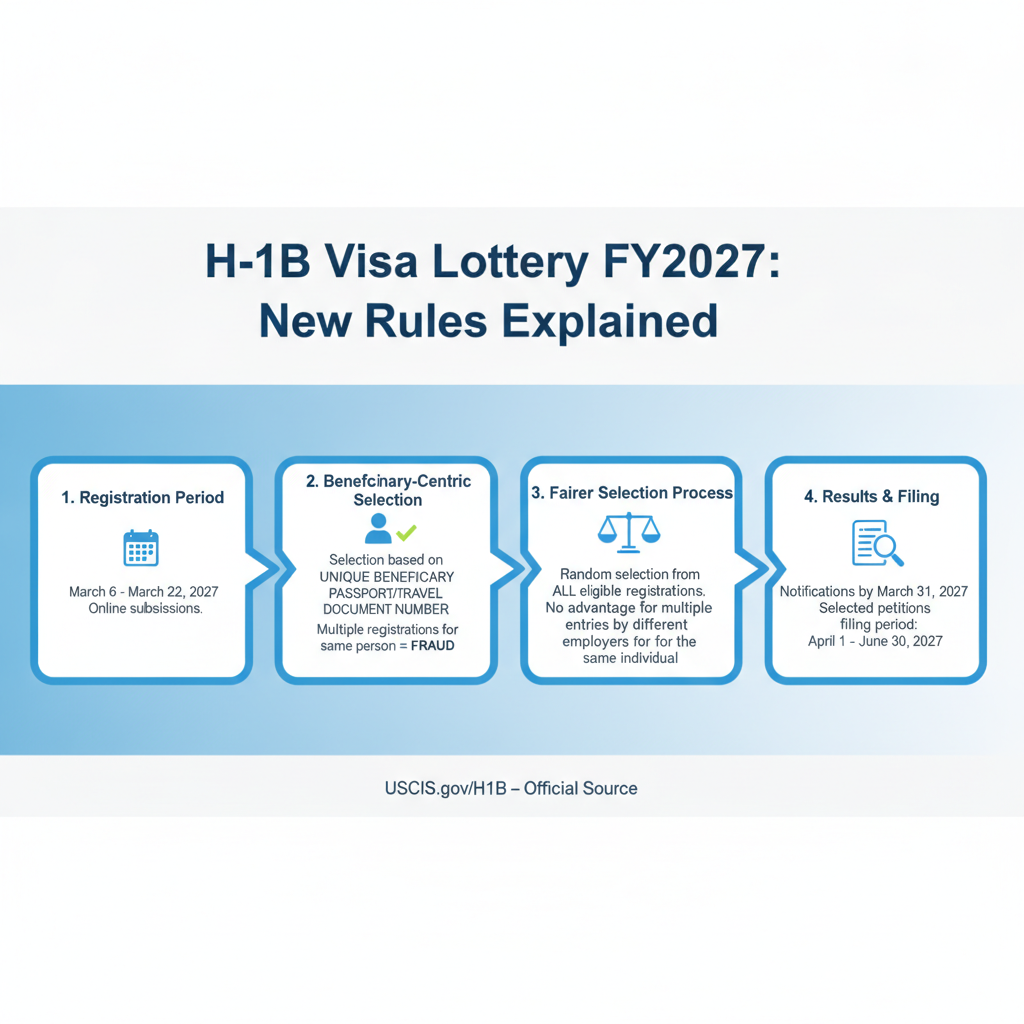
H-1B Visa Lottery Changes for FY2027 (Legal News)
What This News Means for Immigrants in Orlando and Across Florida
The H-1B visa program is a cornerstone for many skilled professionals seeking to work in the United States, particularly in the tech, healthcare, and engineering sectors. For Florida, a state experiencing rapid economic growth and a burgeoning demand for specialized talent, these changes are especially pertinent. The modifications to the H-1B lottery system for FY2027 aim to streamline the process, reduce fraud, and potentially offer a fairer chance to qualified beneficiaries.
Why this news is showing up now
The U.S. Citizenship and Immigration Services (USCIS) consistently reviews and refines its immigration processes to combat fraud, enhance efficiency, and adapt to the ever-changing demands of the U.S. labor market. The changes for FY2027, building upon recent regulatory updates, are a direct response to past challenges, including concerns over multiple registrations submitted on behalf of the same beneficiary by various employers, which inflated selection odds unfairly. These new rules, formally outlined in the "H-1B Registration Fee Final Rule" and "H-1B Modernization Rule," became effective for the FY2025 lottery and are now fully implemented for subsequent cycles, including FY2027. USCIS announced these changes well in advance to give employers and prospective H-1B beneficiaries ample time to understand and prepare for the updated procedures. The focus is now squarely on the individual beneficiary, aiming for a more equitable selection process.
How it can affect Florida residents
For individuals residing in Florida, whether they are international students graduating from universities like the University of Central Florida (UCF), University of Florida (UF), or Florida International University (FIU), or experienced professionals seeking new opportunities, these changes carry significant implications:
- Increased Fairness for Beneficiaries: The shift to a beneficiary-centric selection process means that each unique beneficiary will have only one chance in the lottery, regardless of how many employers register them. This levels the playing field, potentially increasing the odds for genuinely qualified candidates who previously competed against individuals with multiple, sometimes fraudulent, registrations.
- Impact on Florida's Industries: Florida's growing sectors, particularly technology, aerospace, healthcare, and engineering, heavily rely on H-1B talent. Companies in Orlando, Tampa, Miami, and other metropolitan areas will need to adapt their recruitment strategies to align with the new lottery rules. Employers must ensure their registrations are accurate and legitimate, focusing on securing talent rather than leveraging loopholes.
- Students and Recent Graduates: For Florida's large population of international students on F-1 visas, especially those on Optional Practical Training (OPT), understanding these changes is crucial. Your employer's compliance with the new rules will directly affect your H-1B prospects. It reinforces the importance of working with reputable employers and knowledgeable legal counsel.
- Reduced Fraud: By targeting duplicate registrations, USCIS aims to reduce overall H-1B fraud. This protects the integrity of the program, benefiting legitimate employers and beneficiaries in Florida and nationwide.
- Potential for Higher Registration Fees: While the core selection mechanism is the major change, USCIS also adjusts fees periodically. For FY2027, the H-1B registration fee has increased from $10 to $215 per beneficiary. This is a significant increase for employers, particularly those registering many candidates, and is a key financial consideration for Florida businesses.
The landscape for H-1B hopefuls in Florida is now more transparent but also requires diligent preparation and adherence to the updated guidelines. Imigrar is here to guide you through every step, ensuring you understand how these changes specifically impact your situation.
Concerned about the new H-1B rules? Let our experienced Orlando immigration lawyers clarify the process for you. Call +1 786-791-3106 for a free consultation. We speak English and Spanish! Se Habla Español.
What H-1B Visa Lottery Changes for FY2027 Is (and Why It Matters)
The H-1B visa program allows U.S. employers to temporarily employ foreign workers in specialty occupations. These occupations generally require a bachelor's degree or higher in a specific field. Due to high demand and an annual cap of 85,000 visas (including 20,000 for those with a U.S. Master's degree or higher), USCIS conducts a lottery to select eligible registrations when the number of registrations exceeds the available visas. The "H-1B Visa Lottery Changes for FY2027" refers to the new rules governing this selection process, which are designed to make it more equitable and less susceptible to abuse.
A plain-English definition
Imagine a highly sought-after concert ticket lottery. In the past, some people might have tried to enter the lottery multiple times using different names or accounts to increase their chances. The H-1B lottery changes for FY2027 are like a new rule for that concert ticket lottery: now, no matter how many times someone tries to enter, if it's traced back to the same person, they only get one entry. This means everyone has a fairer chance, and it prevents a few individuals from monopolizing the spots by having multiple employers register them. Specifically, USCIS will now select registrations based on the unique beneficiary, not the number of registrations submitted on their behalf. If a beneficiary has multiple registrations submitted by different employers, they still only get one chance in the lottery. If selected, all employers who registered that beneficiary will be notified, and any one of them can then file a petition.
Key terms you need to know
- H-1B Visa: A non-immigrant visa that allows U.S. employers to temporarily employ foreign workers in specialty occupations.
- Specialty Occupation: An occupation that requires a theoretical and practical application of a body of highly specialized knowledge, and a bachelor's or higher degree in the specific specialty (or its equivalent) for entry into the occupation in the U.S.
- Cap-Subject H-1B: H-1B petitions that are subject to the annual numerical limit (cap). Most H-1B visas fall into this category.
- Cap-Exempt H-1B: H-1B petitions filed by certain employers (like universities, non-profit research organizations, or government research organizations) that are not subject to the annual cap.
- Beneficiary: The foreign national worker who will be employed in the specialty occupation.
- Petitioner: The U.S. employer filing the H-1B petition on behalf of the beneficiary.
- Labor Condition Application (LCA): Form ETA-9035. An application filed by the employer with the U.S. Department of Labor (DOL) attesting that they will pay the H-1B worker the prevailing wage or the actual wage paid to other employees with similar experience and qualifications, whichever is higher, and provide working conditions that will not adversely affect other workers. This must be certified before filing the H-1B petition.
- H-1B Lottery: The random selection process conducted by USCIS when the number of H-1B registrations exceeds the annual cap.
- Fiscal Year (FY): The U.S. government's fiscal year runs from October 1 to September 30. H-1B visas selected for a given FY (e.g., FY2027) become effective on October 1st of the preceding calendar year (October 1, 2026, for FY2027).
- Premium Processing: An optional service offered by USCIS that guarantees processing of certain petitions (including H-1B) within 15 calendar days for an additional fee.
- Registration Period: The designated timeframe (typically in March) during which employers must submit electronic registrations for potential H-1B beneficiaries.
- Beneficiary-Centric Selection: The new lottery method where selection is based on unique beneficiaries, rather than the number of registrations submitted. This is the core of the FY2027 changes.
Current Immigration Law: The Foundation
The H-1B visa program is governed by specific provisions of the Immigration and Nationality Act (INA), primarily found in INA §101(a)(15)(H)(i)(b), which defines the H-1B nonimmigrant classification, and INA §214(g), which establishes the annual numerical cap and other requirements. Regulatory changes are published in the Code of Federal Regulations (CFR), specifically 8 CFR Part 214.
These laws and regulations outline the strict criteria that both the employer and the prospective H-1B worker must meet. Understanding this legal framework is critical before embarking on the H-1B journey.
Federal requirements
The H-1B visa is designed for temporary employment in specialty occupations. Both the employer (petitioner) and the foreign worker (beneficiary) must meet specific federal requirements:
For the Employer (Petitioner):
- Bona Fide Job Offer: The employer must have a legitimate job offer in a specialty occupation.
- Employer-Employee Relationship: A valid employer-employee relationship must exist, meaning the employer has the right to control the work of the H-1B employee.
- Labor Condition Application (LCA): The employer must file and have certified by the U.S. Department of Labor (DOL) a Form ETA-9035. This form attests to compliance with wage and working condition requirements, ensuring that the H-1B worker will be paid at least the prevailing wage for the occupation in the area of intended employment or the actual wage paid to other employees with similar experience and qualifications, whichever is higher.
- Ability to Pay: The employer must demonstrate the financial ability to pay the proffered wage.
- FEIN: Must have a valid Federal Employer Identification Number.
For the Employee (Beneficiary):
- Specialty Occupation Qualification: The beneficiary must possess the theoretical and practical application of a body of highly specialized knowledge. This is typically demonstrated by:
- A bachelor's or higher degree (or its equivalent) directly related to the specialty occupation from an accredited college or university.
- A state license, if required, to practice the specialty occupation.
- Specialized training, or progressively responsible experience in the specialty equivalent to a bachelor's degree. Generally, 3 years of progressive experience is considered equivalent to 1 year of college education.
- Job Match: The beneficiary's qualifications must match the requirements of the specialty occupation offered.
Important: All H-1B petitions must be filed using Form I-129, Petition for a Nonimmigrant Worker, along with all supporting documentation and the certified LCA. For an overview of forms and regulations, visit the USCIS official website.
Florida-specific considerations
While federal law governs the H-1B program, certain factors can be more pronounced in specific states like Florida:
- High Demand in Key Sectors: Florida's economy is diverse, with significant H-1B demand in technology (especially in Orlando's "Silicon Swamp" and Tampa's tech hubs), aerospace (Space Coast), healthcare (numerous hospitals and research facilities), tourism management, and engineering. This means competition for H-1B visas among employers and beneficiaries in these fields can be particularly intense.
- Prevailing Wage Levels: The prevailing wage for a specific occupation can vary significantly by geographic location. Employers in Orlando, for instance, must ensure they are meeting the prevailing wage for Orange County or the specific Metropolitan Statistical Area (MSA) where the job is located, as determined by the DOL.
- Educational Institutions: Florida is home to many large universities that attract international students. Many of these students aspire to work in Florida after graduation, often utilizing the H-1B program. The Orlando USCIS Field Office primarily handles adjustment of status applications, while H-1B petitions are processed at designated service centers (California or Vermont, depending on the employer's location). However, local support from firms like Imigrar is invaluable for navigating the overall process.
- Fraud Prevention: Given the state's growth and diverse population, Florida employers and beneficiaries must be extra vigilant against H-1B fraud schemes, especially in light of the new beneficiary-centric rules designed to curb such abuses. Ensuring your employer is legitimate and has a genuine need for your specialized skills is paramount.
How to Navigate the H-1B Lottery Changes: A Complete Step-by-Step Guide
The H-1B visa process, especially with the new lottery changes for FY2027, demands meticulous preparation and adherence to strict timelines. Here is a detailed step-by-step guide to help you and your employer navigate the process successfully.
1) Employer Registration & Lottery Selection (March 2026 for FY2027)
This is the crucial first step where the new beneficiary-centric selection method comes into play.
- Employer Action: Your prospective employer must create a USCIS online account (or use an existing one) and register each H-1B beneficiary for whom they wish to file a petition.
- Beneficiary Information: For each registration, the employer must provide accurate information about the beneficiary, including their full legal name, date of birth, country of birth, country of citizenship, passport number, and their master's degree eligibility (if applicable).
- Registration Fee: The employer must pay the required H-1B registration fee for each beneficiary. For FY2027, this fee is $215 per beneficiary.
- Registration Window: The electronic registration period typically opens in early March and lasts for approximately 2-3 weeks. For FY2027, expect this window to be in March 2026.
- Beneficiary-Centric Selection: Important: USCIS will group all registrations submitted for the same unique beneficiary. The lottery selection will then be conducted based on these unique beneficiaries, not on the number of registrations. If a beneficiary is selected, all employers who submitted a registration for that beneficiary will receive a selection notice. This means multiple employers can register you, but you still only get one "ticket" in the lottery.
- Lottery Results: USCIS typically announces the lottery results by the end of March. Employers will be notified electronically through their USCIS online accounts whether their beneficiary was selected.
Required Documents (for employer to complete registration):
- Beneficiary's full legal name, date of birth, country of birth, country of citizenship, passport number.
- Beneficiary's U.S. Master's degree information (if applicable).
- Employer's legal name, FEIN, and mailing address.
- Attorney or representative information (if applicable).
2) Lottery Results & Petition Preparation (April - June 2026)
Once selected, the real work of preparing the H-1B petition begins.
- Selection Notice: If your beneficiary is selected, the employer will receive a "Selection Notice" from USCIS, which includes a unique receipt number. This notice is crucial for filing the H-1B petition.
- Choosing an Employer: If multiple employers registered and you were selected, you (the beneficiary) will work with one chosen employer to proceed with the petition. This is a critical decision, as only one H-1B petition can be filed for you based on that selection.
- LCA Filing: The employer must immediately proceed with filing a Labor Condition Application (LCA) (Form ETA-9035) with the U.S. Department of Labor (DOL). This typically takes 7-10 business days for certification. The LCA must be certified before the H-1B petition can be filed with USCIS.
- Gathering Documents: Both the employer and the beneficiary must start gathering all necessary supporting documents.
Required Documents (for petition preparation, starting with LCA):
- Detailed job description, including duties, responsibilities, and minimum education/experience requirements.
- Employer's FEIN and business information.
- Information on the proposed H-1B wage and prevailing wage data for the job location.
3) Filing the H-1B Petition (Form I-129) (April 1, 2026 - June 30, 2026)
This is the core of the application process, where the full petition package is submitted to USCIS.
- Petition Filing Period: Employers whose registrations were selected typically have a 90-day window to file the H-1B petition (Form I-129) with USCIS. For FY2027, this window is expected to be from April 1, 2026, to June 30, 2026.
- Complete Package: The petition package must be comprehensive, including the certified LCA, Form I-129, all supporting documentation, and the correct filing fees.
- Filing Location: The petition is filed with the appropriate USCIS service center based on the employer's primary business address.
Required Documents (for Form I-129 petition):
- Certified Form ETA-9035 (LCA).
- Form I-129, Petition for a Nonimmigrant Worker, and relevant supplements (e.g., H-1B Data Collection and Filing Fee Exemption Supplement).
- Copy of the H-1B registration selection notice.
- Beneficiary's academic credentials: diplomas, transcripts, degree evaluations (if degree is from outside the U.S.).
- Beneficiary's resume/CV.
- Letters of experience from previous employers (if experience is used to qualify).
- Copy of beneficiary's passport, visa, I-94 record, and previous U.S. immigration documents (if applicable).
- Employer's business license, FEIN, financial statements, and tax returns.
- Detailed letter from the employer explaining the job offer, duties, salary, and why it qualifies as a specialty occupation.
- Organizational charts, photos of the workplace (if requested).
- Any agreements between the petitioner and beneficiary (e.g., employment contract).
4) USCIS Processing & RFE Responses (July 2026 onwards)
After filing, USCIS reviews the petition. This stage can involve requests for additional information.
- Regular Processing: Standard processing times can vary widely, often taking several months. You can check current processing times on the USCIS Processing Times page.
- Premium Processing: For an additional fee ($2,805 for FY2027, though subject to change), employers can file Form I-907, Request for Premium Processing Service, guaranteeing a response within 15 calendar days. This fee is separate from the base filing fee for Form I-129.
- Request for Evidence (RFE): USCIS may issue an RFE if they need more information or clarification. Responding to an RFE requires careful attention and often legal expertise. You typically have 60-90 days to respond.
- Approval/Denial: If approved, USCIS sends an approval notice (Form I-797). If denied, the notice will explain the reasons.
Required Documents (for RFE response, if issued):


