

The landscape of U.S. immigration is constantly evolving, and for those seeking to work in the United States, few changes are as impactful as those affecting the H-1B visa program. As an immigration law firm dedicated to keeping families together, Imigrar understands the immense pressure and hope tied to this crucial visa category. Today, we delve into the significant H-1B visa lottery changes for Fiscal Year 2027, rules that will profoundly shape the future for skilled workers and their sponsoring employers.
Staying informed is your first step towards success. This comprehensive guide, crafted by the expert legal team at Imigrar, will break down the new regulations, provide actionable advice, and help you prepare for the upcoming lottery season.
The reporting that sparked this guide: H-1B Visa Lottery Changes for FY2027 (Legal News)
What This News Means for Immigrants in Orlando and Across Florida
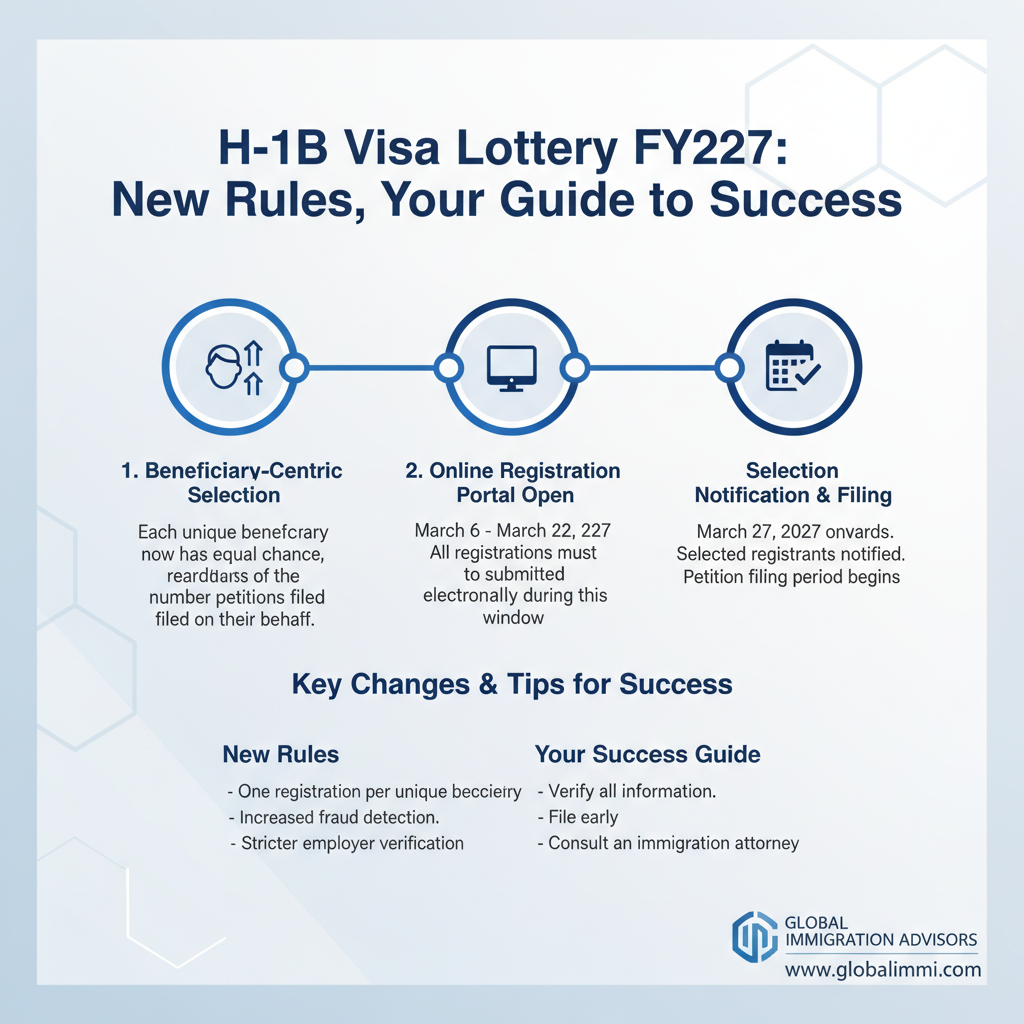
The recent announcements regarding the H-1B visa lottery for Fiscal Year 2027 mark a pivotal shift in how the U.S. Citizenship and Immigration Services (USCIS) will conduct its annual selection process. For countless skilled foreign nationals and their potential employers, these changes are not just procedural adjustments; they represent a fundamental rethinking of fairness and integrity within the H-1B system.
Why this news is showing up now
This news is circulating now because USCIS has finalized and implemented new rules designed to curb fraud and enhance the integrity of the H-1B cap registration process. While the H-1B lottery for FY2026 has already concluded under the previous rules, these new regulations will be in full effect for the upcoming FY2027 H-1B cap season, which typically begins with the registration period in March 2026 for petitions to be filed in April 2026. The agency often announces and finalizes such significant changes well in advance to give employers, beneficiaries, and legal professionals adequate time to prepare. The recent legal news reports highlight the finality and readiness of these new rules for the next cycle.
How it can affect Florida residents
Florida, particularly the Orlando metropolitan area, is a vibrant economic hub with growing sectors in technology, aerospace, healthcare, and hospitality. These industries heavily rely on the H-1B visa program to attract and retain top talent from around the globe. For Florida residents who are foreign nationals on F-1 OPT (Optional Practical Training) or other nonimmigrant statuses, or for those abroad hoping to come to Florida for work, these changes are critical:
- Increased Fairness: The most significant change is the shift to a beneficiary-centric selection process. This means that each unique beneficiary will only be entered into the lottery once, regardless of how many employers register them. This aims to reduce the unfair advantage previously held by individuals who submitted multiple registrations through various employers, thereby increasing the odds for all legitimate applicants.
- Reduced Fraud: In previous years, USCIS identified a surge in fraudulent registrations, where multiple companies (often related or shell companies) would register the same individual to inflate their chances. The new rules directly target this, making the lottery more equitable for legitimate employers and beneficiaries in Orlando and beyond.
- Employer Strategy Shift: Florida-based employers, from tech startups in Lake Nona to established hospitality groups near I-4, will need to adjust their H-1B recruitment strategies. While they can still register multiple beneficiaries, the focus will now be on sponsoring genuinely qualified candidates rather than attempting to game the system with multiple entries for a single person.
- Enhanced Scrutiny: USCIS has also announced increased site visits and investigations into companies that previously engaged in suspicious registration patterns. Florida businesses should ensure their H-1B practices are fully compliant and transparent.
For individuals and companies in Orlando and throughout Florida, these changes demand careful attention and proactive planning. The goal is to ensure that legitimate opportunities for skilled foreign workers continue to thrive, supporting Florida's economic growth while upholding the integrity of the immigration system.
Navigating these new H-1B rules can be complex. Our Orlando immigration team at Imigrar specializes in H-1B visas and is ready to assist. Call +1 786-791-3106 for a free consultation, or message us online. Se Habla Español.
What H-1B Visa Lottery Changes Are (and Why They Matter)
The H-1B visa is a nonimmigrant visa that allows U.S. employers to temporarily employ foreign workers in specialty occupations. These occupations generally require a bachelor's degree or higher in a specific field. The H-1B program is vital for U.S. companies to fill critical skill gaps, particularly in STEM (Science, Technology, Engineering, and Mathematics) fields.
However, demand for H-1B visas consistently outstrips supply. Congress sets an annual cap on the number of H-1B visas issued each fiscal year. Currently, this annual cap is 65,000 visas, with an additional 20,000 visas reserved for beneficiaries who have earned a U.S. master's degree or higher (the "master's cap"). Due to this limited number and overwhelming demand, USCIS employs a lottery system to select eligible registrations when the number of registrations exceeds the available visas, which has been the case for many years.
A plain-English definition
The H-1B visa lottery changes for FY2027 mean that USCIS has updated the rules for how it picks who gets a chance to apply for an H-1B visa. Before, multiple companies could register the same person, effectively giving that person several "tickets" in the lottery. Now, no matter how many companies want to sponsor you, you only get one "ticket" in the lottery. USCIS will select based on each unique individual (the "beneficiary") rather than on each registration submitted by an employer (the "petitioner"). This change is meant to make the lottery fairer for everyone and prevent fraud.
Key terms you need to know
Understanding the following terms is crucial for anyone involved in the H-1B process:
- H-1B Visa: A nonimmigrant visa that allows U.S. employers to temporarily employ foreign workers in specialty occupations.
- Specialty Occupation: An occupation that generally requires a bachelor's degree or higher in a specific specialty, or its equivalent, as a minimum for entry into the occupation.
- Annual Cap: The congressionally mandated limit on the number of H-1B visas issued each fiscal year (currently 65,000).
- Master's Cap: An additional 20,000 visas reserved for beneficiaries who possess a U.S. master's degree or higher. These are drawn first from the pool of registrations that qualify for this exemption.
- H-1B Lottery (or Cap Lottery): The random selection process conducted by USCIS when the number of eligible H-1B registrations exceeds the annual cap.
- Fiscal Year (FY): The U.S. government's accounting year, which runs from October 1 to September 30. H-1B visas are typically for the fiscal year starting October 1 following the lottery. For example, FY2027 visas become available on October 1, 2026.
- Beneficiary: The foreign national worker who is seeking the H-1B visa.
- Petitioner: The U.S. employer who is sponsoring the foreign national for the H-1B visa.
- H-1B Registration Period: The designated window (typically in March) during which prospective petitioners electronically submit registrations for the H-1B cap lottery.
- Selection Notice: The notification issued by USCIS to petitioners whose registrations have been selected in the lottery, allowing them to file an H-1B petition.
- Form I-129: The Petition for a Nonimmigrant Worker, the primary form used by employers to petition for H-1B workers.
- Labor Condition Application (LCA): Form ETA-9035, certified by the U.S. Department of Labor (DOL), which attests that the employer will pay the H-1B worker the prevailing wage or actual wage (whichever is higher) and provide working conditions that will not adversely affect other workers. This must be certified before filing Form I-129.
- Beneficiary-Centric Selection: The new selection process where each unique beneficiary is entered into the lottery only once, regardless of how many employers submit registrations on their behalf. This is the core of the FY2027 changes.
Current Immigration Law: The Foundation for H-1B Visas
The H-1B visa program is governed by the Immigration and Nationality Act (INA), specifically Section 101(a)(15)(H)(i)(b) and Section 214(g), which sets the annual cap. Regulations found in 8 CFR Part 214 further detail the requirements and procedures. These laws and regulations establish the framework within which USCIS operates the H-1B program, including the cap, eligibility criteria, and the lottery process.
Federal requirements
To qualify for an H-1B visa, both the employer (petitioner) and the foreign national (beneficiary) must meet specific federal requirements:
- For the Beneficiary:
- Must hold a bachelor's degree or its equivalent, or possess a license in a specialty occupation field, or have work experience equivalent to a bachelor's degree.
- The job offered must be in a specialty occupation, meaning it requires theoretical and practical application of a body of highly specialized knowledge and a bachelor's degree or higher in the specific specialty.
- For the Petitioner (Employer):
- Must offer a job that qualifies as a specialty occupation.
- Must file a Labor Condition Application (LCA), Form ETA-9035, with the Department of Labor (DOL) and receive certification before filing the H-1B petition. The LCA ensures that the employer is paying the H-1B worker at least the prevailing wage for the occupation in the area of intended employment.
- Must agree to pay the H-1B worker at least the prevailing wage or the actual wage paid to other employees with similar experience and qualifications, whichever is higher.
- Must file Form I-129, Petition for a Nonimmigrant Worker, along with all required supporting documentation, within the designated filing window if the registration is selected in the lottery.
- Annual Cap and Lottery:
- The annual cap of 65,000 regular H-1B visas and an additional 20,000 for the master's cap applies to most H-1B petitions.
- Certain employers are cap-exempt, including institutions of higher education, non-profit organizations affiliated with institutions of higher education, and non-profit research organizations or governmental research organizations.
- The lottery is conducted electronically based on registrations submitted during the designated period. For FY2027, the key change is the beneficiary-centric selection, meaning USCIS will select registrations based on unique beneficiaries, not on the number of registrations submitted for them.
For official information and detailed regulations, always refer to the USCIS official website.
Florida-specific considerations
While H-1B laws are federal, their impact is felt locally. Florida's economy is diverse, and many industries benefit from H-1B talent:
- Technology Hubs: Cities like Orlando, Tampa, and Miami are growing tech hubs, attracting IT professionals, software developers, and engineers. The demand for H-1B workers in these fields is consistently high.
- Healthcare: Florida's large and aging population drives significant demand for healthcare professionals, including doctors, nurses, and medical researchers, many of whom come on H-1B visas.
- Tourism & Hospitality: While less common for the H-1B (which focuses on specialty occupations), certain roles in management, finance, or specialized IT within large tourism companies in Orlando could qualify.
- Education & Research: Florida boasts numerous universities and research institutions, such as the University of Central Florida in Orlando, which are often cap-exempt for H-1B purposes, allowing them to hire foreign faculty and researchers outside the lottery.
Employers in Central Florida, particularly in counties like Orange County, must be acutely aware of prevailing wage requirements and local labor market conditions when filing LCAs. The Orlando USCIS Field Office primarily handles interviews for petitions that require them (e.g., Adjustment of Status), but the initial H-1B petition processing is done at USCIS service centers. Nevertheless, local insights and connections can be invaluable.
Need expert guidance on H-1B compliance in Florida? Imigrar serves clients nationwide from our Orlando office. Let us help you navigate the new H-1B lottery rules. Call us today: +1 786-791-3106. Se Habla Español.
Navigating the H-1B Visa Lottery Changes: A Complete Step-by-Step Guide
The FY2027 H-1B lottery process introduces critical changes, primarily the beneficiary-centric selection. This guide outlines the steps, incorporating these new rules, to help both prospective beneficiaries and petitioners prepare effectively.
1) Understanding the New Rules & Eligibility (Beneficiary-Centric Selection)
Before anything else, grasp the fundamental shift: USCIS will now select registrations based on each unique beneficiary, not per registration submitted. This means if three different employers register the same person, that person still only has one chance in the lottery. This aims to level the playing field and reduce fraud.
- Beneficiary Eligibility:
- Ensure the foreign national has at least a U.S. bachelor's degree (or foreign equivalent) or a license in a specialty occupation, or work experience equivalent to a bachelor's degree.
- Confirm the proposed job qualifies as a specialty occupation.
- If applicable, verify eligibility for the master's cap (U.S. master's degree or higher).
- Employer Eligibility:
- The employer must be a legitimate U.S. entity with a valid Employer Identification Number (EIN).
- They must genuinely intend to employ the H-1B beneficiary in a specialty occupation.
- Important: Fraudulent multiple registrations for a single beneficiary will now result in disqualification of *all* registrations for that beneficiary and potential legal consequences for the employers.
2) Employer Requirements & LCA Filing
The employer must initiate the process by determining the prevailing wage for the position and filing a Labor Condition Application (LCA) with the Department of Labor (DOL).
- Gathering Information:
- Detailed job description, including duties, responsibilities, and minimum educational/experience requirements.
- Proposed salary and benefits.
- Worksite location(s).
- Prevailing Wage Determination:
- The employer must obtain a prevailing wage determination from the DOL or use an independent authoritative source. This ensures the H-1B worker is paid fairly compared to U.S. workers in the same occupation and location.
- Filing LCA (Form ETA-9035):
- The employer submits Form ETA-9035 electronically to the DOL.
- This form attests that the employer will pay the H-1B worker at least the prevailing wage or the actual wage paid to other employees with similar experience and qualifications, whichever is higher.
- It also certifies that working conditions will not adversely affect other workers and that there is no strike or lockout in the occupation.
- Timeline Expectation: LCA certification typically takes 7-10 business days, but can vary. It *must* be certified before the H-1B petition (Form I-129) can be filed.
3) H-1B Registration Process (New System)
This is where the new beneficiary-centric selection method comes into play. The employer (or their authorized representative) creates a USCIS online account and registers the beneficiary.
- Required Documents/Information for Registration:
- Employer's legal name, mailing address, and EIN.
- Employer's authorized signatory information.
- Beneficiary's full legal name, date of birth, country of birth, country of citizenship, passport number.
- Beneficiary's gender.
- Beneficiary's highest level of education (U.S. master's or higher for master's cap eligibility).
- Whether the beneficiary has previously been selected in an H-1B lottery.
- A unique identifying number for the beneficiary (e.g., passport number).
- Each registration costs $10 (subject to change, always verify current fees).
- Important: Only one registration per unique beneficiary will be considered. If multiple registrations are filed for the same beneficiary, all registrations for that beneficiary will be denied. This is a critical change for FY2027.
- Timeline Expectation: The registration window typically opens in early March and lasts for approximately 2-3 weeks.
4) Waiting for Lottery Selection & Petition Preparation
After the registration period closes, USCIS conducts the lottery. Once selections are made, USCIS notifies petitioners of their selection status.
- Selection Notification:
- USCIS typically announces selection results by the end of March. Petitioners will receive a "selection notice" through their online USCIS account.
- If not selected, the status will show "Not Selected."
- Petition Preparation (for selected registrations):
- If selected, the employer must immediately begin preparing the comprehensive H-1B petition (Form I-129).
- This includes compiling extensive documentation to prove employer eligibility, beneficiary qualifications, and the specialty occupation nature of the job.
- Reminder: Selection in the lottery only grants the employer permission to file the Form I-129. It does not guarantee H-1B approval.
5) Filing the H-1B Petition (Form I-129)
Upon selection, the employer must file the complete Form I-129 package within the designated filing window, which is usually 90 days from the selection date.
- Required Documents for I-129 Petition:
- Certified LCA (Form ETA-9035).
- Form I-129, Petition for a Nonimmigrant Worker.
- Form I-129 H Classification Supplement and H-1B Data Collection and Filing Fee Exemption Supplement.
- Copy of the H-1B selection notice.
- Beneficiary's educational documents (degrees, transcripts, evaluations of foreign degrees).
- Beneficiary's resumes, experience letters, professional licenses.
- Beneficiary's passport biographical page, visa stamps, I-94 records.
- Employer's support letter detailing the job offer, specialty occupation duties, and beneficiary qualifications.
- Evidence of employer's ability to pay the proffered wage (e.g., financial statements, tax returns).
- Evidence of employer's business operations (e.g., articles of incorporation, business licenses, office lease).
- Photographs of the beneficiary (if required for change of status).
- Applicable filing fees (Base Filing Fee, American Competitiveness and Workforce Improvement Act (ACWIA) fee, Fraud Prevention and Detection Fee, Public Law 114-113 fee if applicable, and optional Premium Processing fee).
- Important: The petition must be filed at the correct USCIS service center based on the employer's address. Ensure all forms are current versions and fees are correct.
6) Responding to RFEs & Interview Preparation
USCIS may issue a Request for Evidence (RFE) if they need more information or clarification. In some cases, an interview may be required.
- Responding to RFEs:
- Carefully review the RFE and provide all requested documents and explanations within the specified deadline (typically 60-90 days).
- Warning: RFEs are common. A strong, well-organized response is critical.
- Interview Preparation:
- While H-1B petitions are generally decided without an interview, some beneficiaries may require an interview at a U.S. consulate abroad for visa stamping or at a USCIS field office (like the Orlando USCIS Field Office) for a change of status.
- Prepare to discuss your job duties, qualifications, and the employer's business.
7) Visa Stamping or Change of Status
Once the H-1B petition is approved, the final step depends on the beneficiary's current location and status.
- For Beneficiaries Outside the U.S.:
- They must attend a visa interview at a U.S. embassy or consulate in their home country to obtain an H-1B visa stamp in their passport.
- Required documents for visa stamping include the H-1B approval notice (Form I-797), passport, DS-160 confirmation, visa fee receipts, and supporting documents provided in the I-129 petition.
- U.S. Department of State website provides consulate-specific requirements.
- For Beneficiaries Inside the U.S. (Change of Status):
- If the beneficiary is already in the U.S. on a valid nonimmigrant status (e.g., F-1 OPT) and the H-1B petition requested a "change of status," they will automatically transition to H-1B status on October 1 (the start of the fiscal year) if the petition is approved.
- No separate visa stamping is required unless they travel outside the U.S. and need to re-enter in H-1B status.

Practical Steps You Can Take Today for the H-1B Lottery
The H-1B lottery is highly competitive, and the new rules mean preparation is more critical than ever. Here's what you can do now to maximize your chances for FY2027, especially if you're in Orlando or elsewhere in Florida:
- Actionable Checklist:
- Verify Your Eligibility: Double-check your educational background and work experience against H-1B requirements. Is your degree from a U.S. institution or evaluated as equivalent? Does your job truly qualify as a specialty occupation?
- Secure a Sponsoring Employer: Begin networking and applying for jobs that align with your qualifications and H-1B criteria. Many companies in Orlando's tech corridor or medical cities actively sponsor H-1B visas.
- Gather Essential Documents: Even if you don't have a sponsor yet, start compiling your educational transcripts, degree certificates, detailed resume, and passport information. Ensure all foreign documents are translated and certified.
- Understand the New Rules: Familiarize yourself with the beneficiary-centric selection process. Do not encourage multiple employers to register you, as this will lead to disqualification.
- Consult with an Immigration Attorney: This is perhaps the most crucial step. An experienced attorney can assess your eligibility, advise potential employers, and guide you through the complex process, ensuring compliance with the new rules.
- Monitor USCIS Updates: Keep an eye on the USCIS official website for the latest announcements regarding the FY2027 registration period and any further clarifications.
- Document Preparation Guidance:
- Accuracy is Key: Ensure all information on your resume, applications, and future H-1B registration/petition is consistent and accurate. Discrepancies can lead to RFEs or denials.
- Foreign Degree Evaluations: If your degree is from outside the U.S., obtain an official educational credential evaluation from a reputable service that confirms its U.S. equivalency.
- Translations: Any document not in English must be accompanied by a certified English translation.
- Copies vs. Originals: Generally, USCIS prefers copies of documents, but be prepared to provide originals if requested.
- Timeline Expectations:
- October 2025 - February 2026: Ideal time to secure a sponsoring employer and begin initial consultations with an attorney.
- Early March


