


The landscape of U.S. immigration is constantly evolving, and few changes impact skilled foreign workers and their employers as significantly as those affecting the H-1B visa program. For Fiscal Year 2027 (FY2027), the United States Citizenship and Immigration Services (USCIS) implemented critical updates to the H-1B visa lottery, aiming to enhance integrity and fairness in the selection process. These changes, which impacted the registration period earlier this year, are now shaping the petition filing and approval stages, demanding a thorough understanding from all involved parties.
At Imigrar, your trusted immigration law firm in Orlando, Florida, we are dedicated to keeping you informed and prepared. Our mission is to "Keep Families Together," and that includes helping skilled professionals navigate complex visa processes to build their futures in the U.S. This comprehensive guide breaks down the FY2027 H-1B visa lottery changes, what they mean for you, and how to successfully navigate the path ahead.
Is your H-1B future uncertain after the FY2027 changes? Don't leave your American dream to chance. Our expert Orlando immigration team is ready to assist. Call +1 786-791-3106 for a free consultation, or message us online. Se Habla Español.
The reporting that sparked this guide:
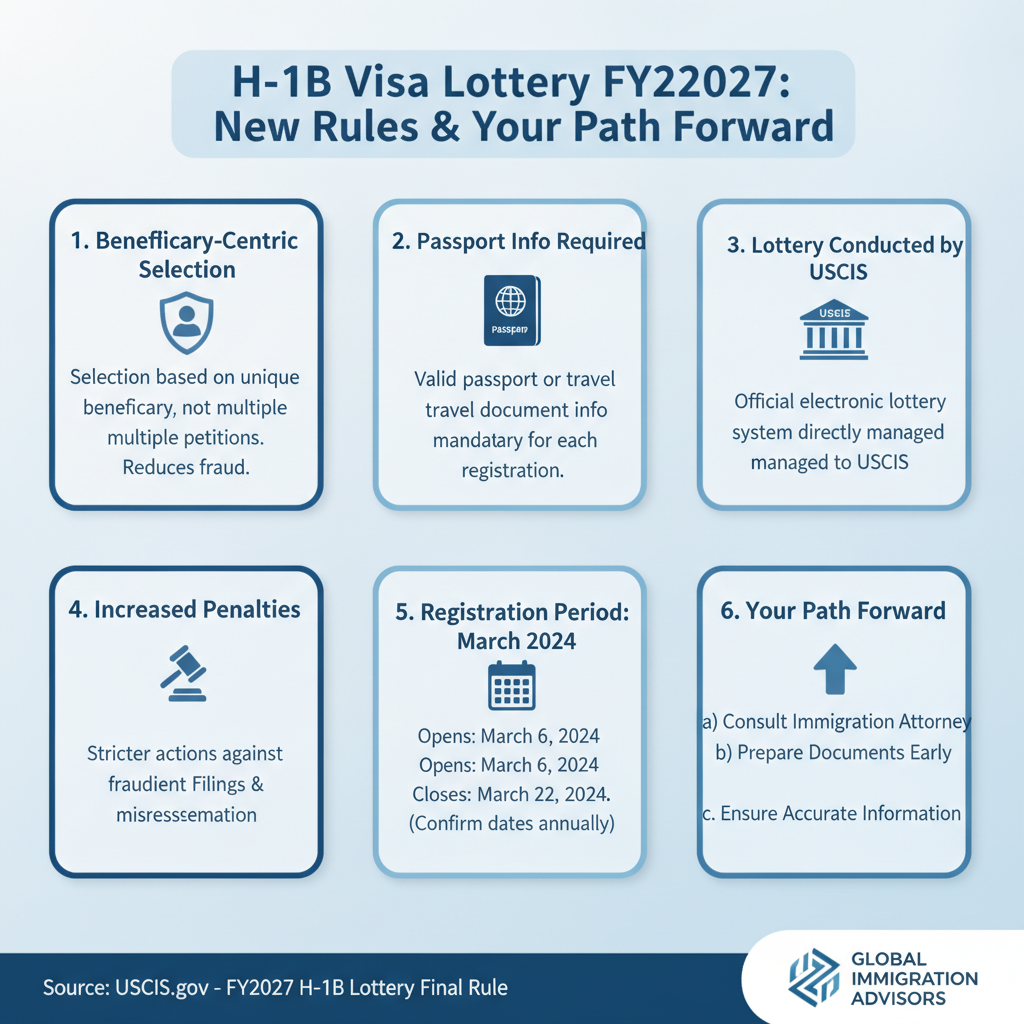
H-1B Visa Lottery Changes for FY2027 (Legal News)
What This News Means for Immigrants in Orlando and Across Florida
The H-1B visa program is a cornerstone for U.S. companies seeking to employ foreign workers in specialty occupations, particularly in technology, engineering, medicine, and other high-demand fields. Given the annual cap on new H-1B visas, a lottery system has become necessary for many years to select eligible registrations. The latest changes for FY2027 represent a significant shift designed to address long-standing concerns about fraud and ensure a more equitable distribution of opportunities.
Why this news is showing up now
Immigration law is dynamic, with USCIS regularly proposing and finalizing rules to adapt to current challenges and policy goals. The changes impacting the H-1B lottery for FY2027 were a direct response to a surge in multiple registrations for the same beneficiary by different employers, a practice that inflated lottery odds and undermined the program's integrity. USCIS had observed a dramatic increase in registrations in previous years, far outpacing the actual number of unique individuals seeking H-1B visas. This prompted the agency to finalize new regulations to curb these abuses. The rule change was published in the Federal Register earlier in 2024, specifically addressing the beneficiary selection process, and took effect for the FY2027 registration period which concluded in March 2026.
While the registration period for FY2027 has already passed, the implications of these changes are still very much present. Selected petitions are currently being filed and adjudicated. Understanding these rules is crucial for those whose petitions are in process, those considering future H-1B applications, and employers who rely on this vital program.
How it can affect Florida residents
Florida, and particularly Central Florida, is a hub for innovation, tourism, healthcare, and technology. Cities like Orlando, Tampa, and Miami attract a diverse array of businesses that frequently seek to hire skilled foreign talent. Many companies along the I-4 corridor, from startups to major corporations, depend on the H-1B program to fill critical roles that require specialized knowledge and skills.
- For H-1B Beneficiaries in Florida: If you are a foreign national working or studying in Florida, or aspiring to work here, these changes directly impact your chances of securing an H-1B visa. The new beneficiary-centric selection model means that while multiple employers can still register you, your name will only be entered into the lottery once. This aims to level the playing field, ensuring that each individual has a fair, equal chance.
- For Florida Employers: Businesses in Orlando and across the state sponsoring H-1B workers must fully understand the updated registration process and their responsibilities. Ensuring compliance is paramount to avoid delays, denials, or even accusations of fraud. Companies in the tech sector, medical device manufacturing, and hospitality management, all prominent in Florida, are particularly reliant on the H-1B program.
- Increased Integrity: The changes are designed to reduce fraud, meaning that legitimate petitions from Florida employers and beneficiaries have a better chance of being selected, as the system is less susceptible to manipulation by those submitting multiple registrations for the same individual.
Given Orlando's robust economy and diverse industries, the impact of these changes resonates deeply within our community. From the theme park engineers to the cutting-edge tech developers, many depend on the H-1B program to contribute their talents to Florida's growth.
What H-1B Visa Lottery Changes for FY2027 Is (and Why It Matters)
The H-1B visa program is a nonimmigrant visa that allows U.S. employers to temporarily employ foreign workers in specialty occupations. These occupations generally require a bachelor's degree or higher in a specific specialty, and the foreign worker must possess the equivalent credentials. The "lottery" comes into play because Congress sets an annual cap on the number of H-1B visas available each fiscal year: 65,000 regular cap visas and an additional 20,000 for those with a U.S. master's degree or higher (the "master's cap"). Demand consistently far exceeds supply, necessitating a random selection process.
A plain-English definition
Think of the H-1B visa as a special work permit for highly skilled professionals. Companies in the U.S. can sponsor these visas for jobs that require specific expertise, like a software engineer, a doctor, or an architect. Because so many people want these visas, and there's a limit to how many are given out each year, USCIS uses a lottery system. For FY2027, the big change is that instead of counting how many times an employer registered a person, USCIS now counts each person only ONCE, no matter how many employers registered them. This makes the lottery fairer, giving everyone an equal shot, and makes it harder for fraudulent registrations to take up spots.
Key terms you need to know
- USCIS (United States Citizenship and Immigration Services): The government agency responsible for administering immigration and naturalization benefits. This is your primary point of contact for H-1B applications. USCIS official website
- H-1B Cap: The annual statutory limit on the number of H-1B visas issued. This is 65,000 for the regular cap and an additional 20,000 for the U.S. Master's Cap.
- Cap-Exempt: Certain employers (e.g., institutions of higher education, non-profit research organizations) are exempt from the annual H-1B cap, meaning they can file H-1B petitions at any time.
- Lottery Registration: The electronic process where prospective H-1B petitioners (employers) submit basic information about the company and the prospective H-1B worker (beneficiary) to USCIS. This happens before the full petition is filed.
- Beneficiary: The foreign national who will be employed in the specialty occupation position.
- Petitioner: The U.S. employer who files the H-1B petition on behalf of the beneficiary.
- LCA (Labor Condition Application): Form ETA-9035. An application filed by the employer with the U.S. Department of Labor (DOL) attesting that they will pay the H-1B worker the prevailing wage or actual wage, whichever is higher, and provide working conditions that will not adversely affect other workers. This must be certified by the DOL before the H-1B petition can be filed. Department of Labor (LCA)
- Specialty Occupation: An occupation that requires theoretical and practical application of a body of highly specialized knowledge, and a bachelor's or higher degree in the specific specialty (or its equivalent) for entry into the occupation.
- Selected Registration: A registration chosen in the H-1B lottery, allowing the employer to proceed with filing a full H-1B petition.
The core of the FY2027 changes lies in the selection process. Previously, if multiple employers registered the same beneficiary, each registration was entered into the lottery separately, increasing that beneficiary's overall chance of selection. This led to concerns about "fraudulent" registrations designed solely to boost a beneficiary's odds without a genuine job offer from each registering employer. For FY2027, USCIS implemented a "beneficiary-centric" selection process. This means that if a beneficiary is registered by multiple employers, their name is entered into the lottery only once. If that unique beneficiary is selected, then any of the employers who registered them can file a petition on their behalf. This significantly reduces the advantage of multiple registrations and aims to ensure that each eligible beneficiary has an equal chance.
Confused by the H-1B changes? Get clarity from our experienced legal team. Imigrar offers free consultations for H-1B visa concerns. Call +1 786-791-3106 or contact us online. Se Habla Español.
Current Immigration Law: The Foundation
The H-1B visa program is governed primarily by the Immigration and Nationality Act (INA), specifically Section 101(a)(15)(H)(i)(b), which defines the H-1B nonimmigrant classification. Further regulations are found in Title 8 of the Code of Federal Regulations (CFR), particularly 8 CFR Part 214.2(h).
Federal requirements
To qualify for an H-1B visa, both the employer (petitioner) and the foreign worker (beneficiary) must meet specific federal criteria:
- For the Employer (Petitioner):
- Must offer a job in a "specialty occupation."
- Must agree to pay the H-1B worker at least the prevailing wage for the occupation in the geographic area of employment, or the actual wage paid to other employees with similar experience and qualifications, whichever is higher.
- Must file and receive certification of a Labor Condition Application (LCA) from the Department of Labor (DOL) before filing the H-1B petition.
- Must comply with all H-1B program requirements, including maintaining public access files and not displacing U.S. workers.
- For the Foreign Worker (Beneficiary):
- Must hold a bachelor's degree or its equivalent, or a higher degree required by the specialty occupation, from an accredited college or university.
- Alternatively, must possess a license, certification, or experience equivalent to a bachelor's degree.
- Must be qualified to perform services in the specialty occupation.
- If applying under the U.S. Master's Cap, must have earned a U.S. master's or higher degree from a qualifying institution.
The primary form used for an H-1B petition is Form I-129, Petition for a Nonimmigrant Worker. Employers often also file Form G-28, Notice of Entry of Appearance as Attorney or Accredited Representative, if they are represented by legal counsel.
Florida-specific considerations
While the H-1B visa program is a federal one, its practical application has unique considerations in Florida. The state's diverse economy means H-1B workers are found across numerous sectors. Orlando, for instance, has a thriving technology scene, a vast tourism and hospitality industry, and a growing healthcare sector. These industries frequently seek H-1B talent. The processing of H-1B petitions is handled by USCIS service centers, not specific state offices, but the local economy and job market influence the types of H-1B positions available and the prevailing wage determinations for different areas, including Central Florida and Orange County.
Employers in Florida must ensure their job offers meet the "specialty occupation" definition and that prevailing wage requirements are accurately met for the specific geographic location within the state. For Central Florida residents, understanding the local job market and employer needs is key to aligning with H-1B opportunities.
Important: The H-1B cap for FY2027 was already met, and registrations were selected. The current focus is on filing and adjudicating the selected petitions. If your registration was selected, adhering to all legal requirements is critical.

How to Navigate the New H-1B Lottery System: A Complete Step-by-Step Guide
Successfully obtaining an H-1B visa, especially with the new FY2027 lottery changes, requires meticulous preparation and strict adherence to USCIS guidelines. This guide outlines the typical steps involved, assuming an employer-sponsored petition.
1) Employer and Beneficiary Eligibility Assessment
Before any registration or petition filing, both the U.S. employer and the foreign national beneficiary must confirm their eligibility.
- Employer Actions:
- Verify the offered position qualifies as a specialty occupation. Does it require a bachelor's degree or higher in a specific field?
- Confirm financial ability to pay the required H-1B wage.
- Ensure the company has a valid Employer Identification Number (EIN).
- Beneficiary Actions:
- Gather all academic credentials, including diplomas, transcripts, and any professional licenses.
- If degrees are from outside the U.S., obtain an educational equivalency evaluation from a recognized credential evaluation service.
- Prepare a detailed resume or CV outlining work experience relevant to the specialty occupation.
- Ensure passport is valid and current.
- Required Documents (for assessment):
- Job description for the offered position.
- Beneficiary's resume/CV.
- Copies of beneficiary's academic degrees, transcripts, and professional licenses.
- Foreign degree evaluations (if applicable).
- Beneficiary's passport copy.
2) Employer Registration with USCIS (Completed for FY2027)
This critical step, which concluded in March 2026 for FY2027, is where employers submit an electronic registration for each unique beneficiary they wish to sponsor. The FY2027 changes were paramount here.
- Employer Actions:
- Create or log in to a USCIS online account.
- Provide accurate information about the petitioner (employer) and the beneficiary.
- Pay the non-refundable H-1B registration fee (which was $215 for FY2027 registrations, effective for the FY2026 cap season onwards).
- Crucial FY2027 Change: While multiple employers can still register the same beneficiary, USCIS selects registrations based on unique beneficiaries. Each unique beneficiary receives only one entry in the lottery, regardless of the number of registrations submitted on their behalf. This ensures fairness and reduces the incentive for fraudulent multiple registrations.
- Required Documents (for registration):
- Employer's legal name, FEIN, and mailing address.
- Authorized signatory's name and title.
- Beneficiary's full legal name, date of birth, country of birth, country of citizenship, passport number, and gender.
- Whether the beneficiary holds a U.S. master's or higher degree.
- Payment for the $215 registration fee.
3) Lottery Selection Notification
After the registration period closes, USCIS conducts the lottery. For FY2027, this process was completed in March 2026.
- Employer Actions:
- Monitor the USCIS online account for selection notifications.
- If selected, USCIS will issue a selection notice with a specific filing period during which the full H-1B petition must be submitted.
- Beneficiary Actions:
- Maintain open communication with the sponsoring employer and their legal counsel.
- Required Documents (after selection):
- USCIS H-1B selection notice.
4) Filing the H-1B Petition (Form I-129)
This is the most extensive step, involving the preparation and submission of a comprehensive petition package to USCIS within the designated filing window.
- Employer Actions:
- File and obtain certification for the Labor Condition Application (LCA) (Form ETA-9035) from the Department of Labor. This must be certified before the Form I-129 can be filed.
- Prepare Form I-129, Petition for a Nonimmigrant Worker, along with all required supplements.
- Draft a robust employer support letter detailing the job, the beneficiary's qualifications, and why the position requires a specialty occupation worker.
- Gather all supporting documentation as listed below.
- Pay the required USCIS filing fees (base fee, ACWIA fee, fraud prevention and detection fee, public law 114-113 fee, and premium processing fee if opted for).
- Mail the complete petition package to the appropriate USCIS Service Center.
- Required Documents (for I-129 petition):
- Certified LCA (Form ETA-9035).
- Original H-1B selection notice.
- Completed and signed Form I-129 and relevant supplements (e.g., H Classification Supplement, H-1B Data Collection and Filing Fee Exemption Supplement).
- Employer support letter.
- Beneficiary's academic credentials (diplomas, transcripts, evaluations).
- Beneficiary's resume/CV.
- Copies of beneficiary's passport, visa, and I-94 (if already in the U.S.).
- Employer's financial statements, tax returns, and business licenses to demonstrate ability to pay.
- Evidence of employer-employee relationship (e.g., offer letter, employment agreement).
- If applicable, copies of any previous USCIS approvals (e.g., I-797 for OPT, L-1, etc.).
- Checks for all applicable USCIS filing fees.
5) Responding to RFEs (if applicable)
It's common for USCIS to issue a Request for Evidence (RFE) if they require additional information or clarification on aspects of the petition. An RFE is not a denial, but it requires a prompt and thorough response.
- Employer/Counsel Actions:
- Carefully review the RFE and understand exactly what information USCIS is requesting.
- Gather all requested documents and prepare a detailed, clear response addressing each point raised in the RFE.
- Submit the RFE response by the specified deadline.
- Required Documents (for RFE):
- The RFE notice itself.
- All documents specifically requested by USCIS, often including more detailed evidence of specialty occupation, beneficiary qualifications, employer-employee relationship, or availability of work.
6) Petition Approval and Visa Stamping/Change of Status
If the petition is approved, USCIS will send an approval notice (Form I-797).
- For Beneficiaries Outside the U.S.:
- Attend a visa interview at a U.S. embassy or consulate in their home country.
- Required documents: Passport, Form I-797 approval notice, DS-160 confirmation, interview appointment confirmation, photos, and any documents demonstrating ties to the home country.
- Upon successful interview, the H-1B visa stamp will be placed in the passport.
- For Beneficiaries Inside the U.S. (Change of Status):
- If the petition included a request for a change of status (e.g., from F-1 OPT to H-1B),


