


The landscape of U.S. immigration is constantly evolving, and for many skilled professionals seeking to work in the United States, the H-1B specialty occupation visa represents a critical pathway. With the annual H-1B cap lottery drawing immense competition, any changes to its rules are of paramount importance. As we approach the registration period for Fiscal Year 2027 (FY2027), new regulations are poised to significantly impact how individuals and employers navigate this complex process.
Navigating the H-1B visa process, especially with new rules, can be daunting. Our experienced immigration attorneys at Imigrar in Orlando are here to guide you. Call us today for a free consultation at +1 786-791-3106, or message us online. Se Habla Español.
The reporting that sparked this guide
The information and insights presented in this comprehensive guide are informed by recent developments and discussions in immigration legal news, particularly regarding the H-1B Visa Lottery Changes for FY2027 (Legal News). These reports highlight the ongoing efforts by U.S. Citizenship and Immigration Services (USCIS) to refine the H-1B program, enhance its integrity, and adapt to current needs, ensuring a more equitable and efficient process for all stakeholders.
What This News Means for Immigrants in Orlando and Across Florida
The H-1B visa program is a cornerstone for many businesses and skilled professionals in the United States, allowing employers to temporarily employ foreign workers in specialty occupations. Florida, with its booming tech sector, diverse economy, and growing demand for highly skilled talent, is a significant hub for H-1B beneficiaries and petitioners. From the innovation centers of Orlando to the medical research facilities in Gainesville and the financial districts of Miami, companies across the state rely on the H-1B program to fill critical talent gaps.
Why this news is showing up now
The H-1B visa program operates on a fiscal year basis, running from October 1st to September 30th. Each year, USCIS conducts a lottery for cap-subject H-1B petitions, typically in March, for the fiscal year starting six months later. For FY2027, the registration period is anticipated to occur in March 2026. Discussions and formal announcements regarding rule changes often emerge in the months leading up to this critical registration window. USCIS continually reviews and updates its processes to combat fraud, improve efficiency, and respond to legislative directives or judicial decisions. The recent shift to a beneficiary-centric selection process for FY2025, alongside fee adjustments and stricter anti-fraud measures, signals a clear direction for the program's future. These changes are not isolated incidents but rather part of a continuous effort to strengthen the integrity of the H-1B system, making headlines and sparking conversations among immigration attorneys, employers, and prospective H-1B workers as they prepare for the upcoming FY2027 cycle.
How it can affect Florida residents
For individuals living in Orlando, across Central Florida, and throughout the state, these H-1B changes carry significant implications. Florida is home to a vibrant economy, with strong sectors in aerospace, defense, technology, healthcare, tourism, and advanced manufacturing. Companies along the I-4 corridor, from Tampa Bay through Orlando to Daytona Beach, frequently seek H-1B workers in fields like software development, engineering, data science, and specialized healthcare roles. The new rules, particularly those focused on the lottery selection process and anti-fraud measures, will directly impact:
- Job Prospects: For foreign nationals currently studying or working in Florida on other visa types (e.g., F-1 OPT, L-1, TN), understanding the new H-1B rules is crucial for their future career planning. The shift to a beneficiary-centric lottery, which prioritizes unique beneficiaries over multiple employer registrations for the same individual, aims to level the playing field and reduce unfair advantages.
- Employers: Florida-based companies, from large corporations to startups, must adapt their H-1B sponsorship strategies. They need to ensure compliance with updated registration procedures, prevailing wage determinations, and stringent documentation requirements.
- Competition: While the goal of some changes is to reduce fraud and enhance fairness, the overall demand for H-1B visas remains incredibly high. Florida's attractiveness as a business hub means competition for these visas will continue to be fierce.
- Processing Times and Costs: Anticipated fee adjustments and potential procedural changes could affect the overall cost and timeline of an H-1B application, impacting both employers and beneficiaries financially and logistically.
Understanding these changes is not just about compliance; it's about strategic planning to maximize your chances of success in a highly competitive program. Whether you are a student at the University of Central Florida (UCF), an engineer working in Melbourne, or a tech professional in Miami, these updates will directly influence your path to securing an H-1B visa and building a career in Florida.
Don't let H-1B changes overwhelm you. Imigrar has a proven track record of helping clients navigate complex immigration laws. We serve clients nationwide, with a strong presence in Orlando and Florida. Contact us at +1 786-791-3106 for expert guidance. Se Habla Español.
What H-1B Visa Lottery Changes for FY2027 Is (and Why It Matters)
The "H-1B Visa Lottery Changes for FY2027" refers to the modifications and updates that U.S. Citizenship and Immigration Services (USCIS) has made or is expected to make to the H-1B cap registration and selection process for the fiscal year beginning October 1, 2026. These changes are part of USCIS's ongoing efforts to modernize the H-1B program, increase fairness, and curb fraudulent practices that have plagued the lottery in previous years. Understanding these changes is critical for anyone hoping to secure an H-1B visa, as they fundamentally alter the strategic approach both employers and beneficiaries must take.
A plain-English definition
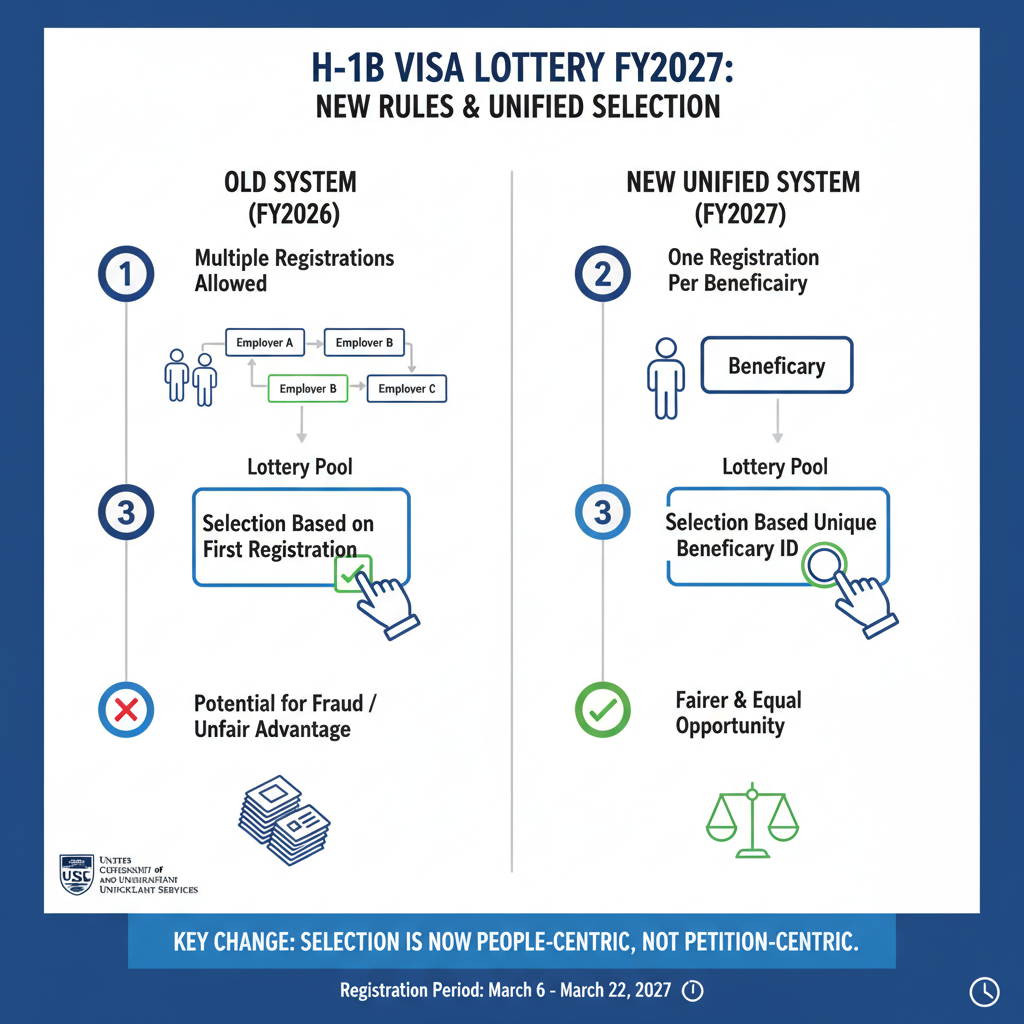
At its core, the H-1B visa allows U.S. employers to temporarily hire foreign workers in specialty occupations. These are jobs that require a bachelor's degree or higher in a specific field. Because there's a limit (or "cap") on how many H-1B visas can be issued each year (currently 85,000, including 20,000 for those with a U.S. master's degree or higher), USCIS uses a lottery system to select which registrations can proceed to a full petition. The "changes" for FY2027 primarily revolve around how this lottery is conducted, specifically shifting from an employer-centric to a beneficiary-centric selection process. This means that instead of each employer submitting multiple registrations for the same individual (which was previously allowed and led to inflated odds for some), each unique individual (beneficiary) can only be counted once in the lottery, regardless of how many employers register them. This aims to give every eligible individual an equal chance.
Key terms you need to know
Navigating the H-1B process requires familiarity with several key terms:
- USCIS (U.S. Citizenship and Immigration Services): The government agency responsible for administering immigration and naturalization benefits. This is the primary agency you'll interact with for H-1B petitions.
- Beneficiary: The foreign national who seeks the H-1B visa.
- Petitioner: The U.S. employer who sponsors the foreign national for the H-1B visa.
- Specialty Occupation: An occupation that generally requires a bachelor's degree or higher in a specific specialty, or its equivalent, as a minimum for entry into the occupation.
- H-1B Cap: The annual numerical limit on the number of H-1B visas issued. The general cap is 65,000, plus an additional 20,000 for those with a U.S. master's degree or higher (the "master's cap").
- Cap-Subject: An H-1B petition that is subject to the annual numerical limit. Most private sector H-1B petitions are cap-subject.
- Cap-Exempt: Certain employers, such as universities, non-profit research organizations, and government research organizations, are exempt from the annual cap.
- H-1B Registration Period: A specific window, typically in March, during which employers must electronically register prospective H-1B beneficiaries for the lottery. This is the first step for cap-subject petitions.
- Selection Notice: A notification from USCIS indicating that a registered beneficiary has been selected in the H-1B lottery, allowing their employer to file an H-1B petition on their behalf.
- LCA (Labor Condition Application): Form ETA-9035. An application filed with the U.S. Department of Labor (DOL) by the employer, attesting that they will pay the H-1B worker the prevailing wage or higher, and provide working conditions that will not adversely affect other workers. This must be certified before an H-1B petition can be filed with USCIS.
- Prevailing Wage: The average wage paid to similarly employed workers in a specific occupation in the geographic area of intended employment. Employers must pay H-1B workers at least the prevailing wage or the actual wage paid to other employees with similar experience and qualifications, whichever is higher.
- Form I-129: Petition for a Nonimmigrant Worker. This is the primary form filed by the employer with USCIS after a beneficiary is selected in the lottery.
- Premium Processing: An optional service offered by USCIS for an additional fee (Form I-907), which guarantees processing of certain petitions within a specific timeframe (currently 15 calendar days).
- Beneficiary-Centric Selection: The new lottery rule where each unique beneficiary is entered into the lottery only once, regardless of the number of registrations submitted on their behalf by different employers. This change aims to prevent multiple registrations from increasing an individual's odds unfairly.
- Fraud Detection and National Security (FDNS): USCIS unit focused on identifying and addressing fraud and security concerns within immigration benefit applications. The new rules often include measures to strengthen FDNS efforts.
The shift to beneficiary-centric selection is a significant change. Previously, an individual could have multiple registrations submitted by different employers, and each registration had an equal chance of being selected. This meant that individuals with multiple job offers, or those willing to accept multiple registrations, had a statistically higher chance of selection. Under the new rules for FY2027 (which build on the FY2025 changes), USCIS will consolidate all registrations for a single beneficiary into one entry for the lottery. If that entry is selected, any of the employers who registered that beneficiary can then file a petition. This move is designed to make the lottery fairer, reduce gaming of the system, and ensure that every eligible individual has an equal and legitimate shot at an H-1B visa.
Current Immigration Law: The Foundation
The H-1B visa program is rooted in federal immigration law, primarily the Immigration and Nationality Act (INA). Specifically, the H-1B category is established under INA § 101(a)(15)(H)(i)(b), which defines the nonimmigrant classification for specialty occupation workers. Further regulations governing the H-1B program, including eligibility, petition requirements, and the annual cap, are found in INA § 214(g) and Title 8 of the Code of Federal Regulations (8 CFR Part 214.2(h)).
Federal requirements
To qualify for an H-1B visa, both the employer (petitioner) and the foreign national (beneficiary) must meet specific federal requirements:
For the Employer (Petitioner):
- Bona Fide Job Offer: The employer must offer a legitimate job in a specialty occupation.
- EIN: The employer must have a valid IRS Employer Identification Number (EIN).
- LCA Certification: The employer must obtain a certified Labor Condition Application (Form ETA-9035) from the U.S. Department of Labor. This attests to several conditions, including:
- Paying the H-1B worker at least the prevailing wage for the occupation in the area of employment or the actual wage paid to similarly qualified workers, whichever is higher.
- Providing working conditions that will not adversely affect other workers.
- Notifying employees of the LCA filing.
- No strike or lockout in the occupational classification.
- Ability to Pay: The employer must demonstrate the financial ability to pay the proffered wage to the H-1B employee.
For the Employee (Beneficiary):
- Specialty Occupation Qualification: The beneficiary must meet one of the following criteria:
- Possess a U.S. bachelor's or higher degree required by the specialty occupation field.
- Hold a foreign degree equivalent to a U.S. bachelor's or higher degree in the specialty occupation field.
- Possess an unrestricted state license, registration, or certification that authorizes them to fully practice the specialty occupation and be engaged in that specialty in the state of intended employment.
- Have work experience equivalent to a bachelor's degree in the specialty, where three years of specialized training and/or work experience may be considered equivalent to one year of college education.
- Job Match: The beneficiary's qualifications must directly relate to the specialty occupation offered by the employer.
All H-1B petitions are filed with USCIS. The official website, USCIS official website, is the authoritative source for forms, instructions, and policy updates.
Florida-specific considerations
While immigration law is federal, its application has local implications. Florida does not have its own state-specific H-1B visa laws, but residents and employers in the state are directly impacted by federal H-1B regulations and USCIS processing procedures. Key considerations for Florida residents and businesses include:
- Local USCIS Field Offices: While H-1B petitions are processed by USCIS service centers, local field offices like the Orlando USCIS Field Office (located at 6680 Corporate Centre Blvd, Orlando, FL 32822) handle other immigration matters, such as interviews for adjustment of status or naturalization, which might become relevant later in an immigrant's journey.
- Economic Landscape: Florida's diverse economy means H-1B opportunities span various industries. Tech companies in Orlando, medical facilities in South Florida, and engineering firms across the state are frequent H-1B petitioners. Understanding local industry demand can help beneficiaries target appropriate employers and employers understand their staffing needs.
- Educational Institutions: Florida is home to numerous universities (e.g., UCF, University of Florida, Florida State University) that produce a large number of international graduates, many of whom seek H-1B sponsorship after completing their Optional Practical Training (OPT). These institutions also serve as cap-exempt H-1B employers.
- Legal Support: Given the complexity of the H-1B program and the recent changes, securing legal counsel from an experienced immigration law firm in Florida, like Imigrar, is crucial for both employers and beneficiaries. Our Orlando team understands the local context and national regulations.
The federal requirements remain the foundation, but the practical application and strategic considerations for H-1B visas are very much shaped by the local economic and demographic realities of Florida.

How to Navigate the H-1B Lottery Changes for FY2027: A Complete Step-by-Step Guide
Successfully obtaining an H-1B visa, especially with the new lottery changes for FY2027, requires meticulous planning and adherence to strict procedures. This guide outlines the essential steps for both employers and prospective beneficiaries.
1) Employer Determines Eligibility and Sponsorship Readiness
Before any steps can be taken, the U.S. employer must confirm they meet the requirements to be an H-1B petitioner and that the position offered qualifies as a specialty occupation. This is the foundational step.
- Employer Eligibility: The employer must be a legitimate U.S. entity with a valid EIN. They must have a genuine need for a foreign worker in a specialty occupation.
- Job Qualification: The job duties must be complex enough to require a bachelor's degree or higher in a specific field. Common examples include software developers, engineers, financial analysts, and certain healthcare professionals.
- Proffered Wage: The employer must be prepared to pay at least the prevailing wage for the occupation in the geographic area of employment, or the actual wage paid to similarly qualified employees, whichever is higher. This often requires research into Department of Labor wage data.
- Beneficiary Qualification: The employer must verify that the prospective employee (beneficiary) meets the educational or experience requirements for a specialty occupation. This includes evaluating foreign degrees for U.S. equivalency.
Required Documents (Initial Assessment - Employer):
- Employer's IRS EIN.
- Detailed job description, including duties, responsibilities, and minimum educational/experience requirements.
- Beneficiary's resume/CV and academic transcripts/degree certificates (for initial assessment).
- Wage determination data for the specific occupation and location.
Important: Start this assessment early. Missteps here can invalidate the entire process later.
2) H-1B Cap Registration (The Lottery Phase)
This is the critical phase where the new rules for FY2027 come into play, primarily focusing on the beneficiary-centric selection process. The registration period is typically in March, preceding the fiscal year by six months.
- Create a USCIS Online Account: The employer (or their authorized representative, like Imigrar) must create a "registrant" account on the USCIS online portal.
- Submit H-1B Registration: During the designated registration period (e.g., March 2026 for FY2027), the employer electronically submits a registration for each prospective H-1B beneficiary. Under the new rules, each unique beneficiary should only have ONE entry in the lottery, even if multiple employers register them. USCIS will use the beneficiary's passport or travel document information to identify unique individuals.
- Pay Registration Fee: A non-refundable fee (historically $10, but subject to change for FY2027 based on recent fee rule updates) is required for each registration.
- Wait for Lottery Results: USCIS conducts the lottery after the registration period closes. Selection notices are typically issued by the end of March.
Required Information (H-1B Registration):
- Employer's legal name, EIN, and mailing address.
- Authorized signatory's name and title.
- Beneficiary's full legal name, date of birth, country of birth, country of citizenship, passport number, gender.
- Beneficiary's highest degree attained and the institution that awarded it.
- Whether the beneficiary is eligible for the U.S. master's cap.
Warning: Ensure all information is accurate. Errors can lead to rejection or denial later.
3) Labor Condition Application (LCA) Filing and Certification
If a beneficiary's registration is selected in the lottery, the next immediate step for the employer is to file and obtain certification for the Labor Condition Application (LCA) with the U.S. Department of Labor (DOL). This must be done *before* the H-1B petition (Form I-129) can be filed with USCIS.
- Prepare and File LCA: The employer, or their attorney, prepares and electronically files Form ETA-9035 with the DOL through the iCert portal. This form details the H-1B worker's occupation, wage, work location, and employer attestations.
- Internal Notice: The employer must provide notice of the LCA filing to U.S. workers at the place of employment. This is typically done by posting a notice in two conspicuous locations at the worksite or by electronic notification.
- DOL Review and Certification: The DOL reviews the LCA for completeness and compliance. This process typically takes 7 business days. Once certified, the employer receives the approved LCA.
Required Documents (LCA):
- Employer's legal name, address, and EIN.
- Occupation title and wage rate.
- Proposed dates of employment.
- Worksite location(s).
- Prevailing wage determination source and rate.
Reminder: A certified LCA is a prerequisite for filing the H-1B petition. Do not skip or rush this step.
4) H-1B Petition Filing (Form I-129)
Once the LCA is certified and a selection notice is received, the employer can proceed with filing the full H-1B petition with USCIS. There will be a specific filing window (e.g., typically from April 1st for 90 days) for selected registrations.
- Complete Form I-129: The employer prepares and signs Form I-129, Petition for a Nonimmigrant Worker, specifically for the H-1B classification.
- Gather Supporting Documentation: This is a comprehensive package including evidence of the employer's eligibility, beneficiary's qualifications, the specialty occupation nature of the job, and the certified LCA.
- Pay Filing Fees: Several fees are required, including the Form I-129 base filing fee, the American Competitiveness and Workforce Improvement Act (ACWIA) fee, Fraud Prevention and Detection Fee, and potentially a Public Law 114-113 fee (for employers with 50+ employees, where 50% or more are H-1B or L-1 workers). These fees are subject to change, so always check the latest USCIS filing fees.
- Mail Petition Package: The complete petition package is mailed to the correct USCIS service center, as indicated in the Form I-129 instructions.
Required Documents (Form I-129 Petition):
- Copy of the H-1B Registration Selection Notice.
- Certified Form ETA-9035 (LCA).
- Completed and signed Form I-129.
- Employer's federal EIN, business license, financial statements, and tax returns to prove ability to pay and legitimate business operations.
- Detailed letter from the employer describing the company, the specialty occupation, and why the beneficiary is qualified.
- Beneficiary's educational documents: degrees, transcripts, foreign degree evaluations.
- Beneficiary's professional licenses/certifications (if applicable).
- Beneficiary's resume/CV.
- Copies of beneficiary's passport, visa, Form I-94 (Arrival/Departure Record), and previous immigration documents (e.g., EAD for OPT).
- Marriage certificate and birth certificates for dependents (for H-4 visa applications, if applicable).
- Photographs of the beneficiary (if required for consular processing).
- Any other evidence proving the job is a specialty occupation and the beneficiary is qualified.
Important: Organize the petition meticulously. A well-organized petition minimizes RFE (Request for Evidence) risks.
5) Premium Processing (Optional)
For employers who need a faster decision, USCIS offers Premium Processing for H-1B petitions. This service significantly reduces the processing time for an additional fee.
- File Form I-907: The employer submits Form I-907, Request for Premium Processing Service, along with the required fee, either concurrently with Form I-129 or after the I-129 has been filed and received by USCIS.
- Guaranteed Processing Time: USCIS guarantees a decision (approval, denial, RFE, or Notice of Intent to Deny) within 15 calendar days from the date of receipt for premium processing cases.
Required Documents (Premium Processing):
- Completed and signed Form I-907.
- Additional Premium Processing fee (check current fees on USCIS official website).
Reminder: Premium processing only speeds up USCIS's review; it does not guarantee approval.
6) USCIS Decision and Status Change or Consular Processing
After USCIS reviews the petition, a decision will be issued. The outcome determines the next steps.
- Petition Approval: If approved, and the beneficiary is already in the U.S. and eligible for a Change of Status, their status will automatically change to H-1B as of October 1st (the start of the fiscal year). If the beneficiary is outside the U.S. or needs to depart and re-enter, they will undergo consular processing at a U.S. embassy or consulate abroad to obtain an H-1B visa stamp in their passport.
- Request for Evidence (RFE): USCIS may issue an RFE if they need more information or clarification. A prompt and comprehensive response is critical.
- Denial: If the petition is denied,


