


Date Published: 2026-03-03
The reporting that sparked this guide
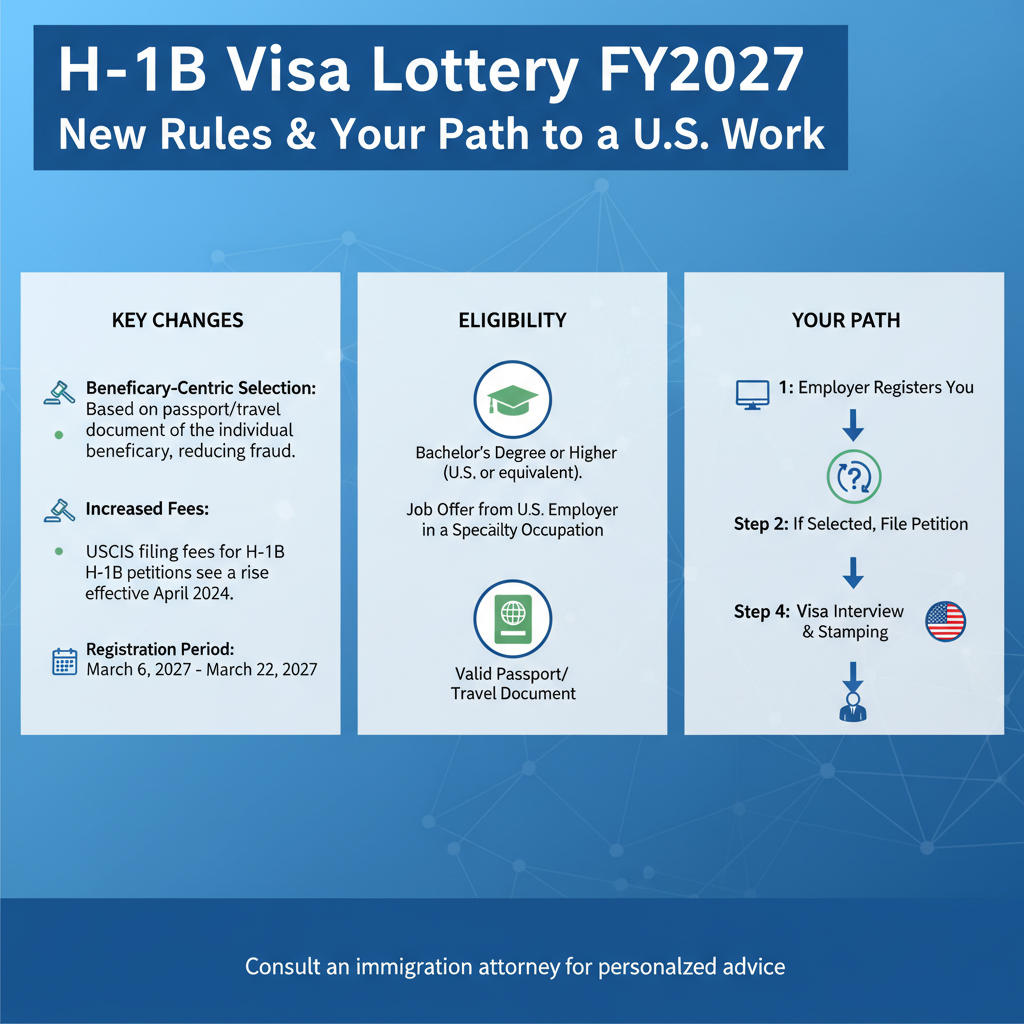
The landscape of U.S. immigration law is constantly evolving, and few areas garner as much attention and anxiety as the H-1B visa program. Recent legal news reports highlight significant changes to the H-1B visa lottery process for Fiscal Year 2027 (FY2027), which is crucial for employers and prospective employees alike. Imigrar is committed to keeping our community informed and prepared for these pivotal shifts.
You can find more details on the general immigration news landscape here: H-1B Visa Lottery Changes for FY2027 (Legal News)
What This News Means for Immigrants in Orlando and Across Florida
The H-1B visa program is a lifeline for many skilled foreign workers seeking opportunities in the U.S. and for American companies needing specialized talent. For those living in Orlando, across Florida, or planning to move here, these changes are not just bureaucratic adjustments; they directly impact your future and career trajectory.
Why this news is showing up now
The U.S. government, primarily through U.S. Citizenship and Immigration Services (USCIS), regularly reviews and updates its immigration policies to address program integrity concerns, respond to economic needs, and streamline processes. The H-1B visa program, in particular, has been a frequent target for reform due to its high demand and the annual lottery system. The changes for FY2027, which began its registration period in March 2026, are a direct response to ongoing efforts to combat fraud, improve the fairness of the lottery, and ensure that the program fulfills its intended purpose of bringing highly skilled workers to the U.S. to fill critical labor shortages.
Specifically, the adjustments build upon previous efforts to introduce a beneficiary-centric selection process, aiming to prevent multiple registrations by different employers for the same individual, a practice that previously inflated lottery odds and disadvantaged genuine applicants. These changes reflect a commitment to a more equitable and transparent system, which is why they are making headlines now, right as the FY2027 registration window opens.
How it can affect Florida residents
Florida, and particularly the Orlando area, is a hub for growing industries such as technology, aerospace, healthcare, and tourism. These sectors heavily rely on skilled foreign workers, many of whom come to the U.S. on H-1B visas. The changes to the H-1B lottery for FY2027 will have several direct impacts on Florida residents:
- Increased Fairness for Beneficiaries: If you are a prospective H-1B beneficiary in Florida, or hope to work for a Florida-based company, the new beneficiary-centric selection process means that each individual will have only one chance in the lottery, regardless of how many employers sponsor them. This significantly levels the playing field, potentially increasing the odds for individuals who previously faced competition from beneficiaries with multiple entries.
- Employer Strategy Shifts: Florida employers, especially those in the tech corridor around Orlando and Tampa, will need to adjust their H-1B recruitment and sponsorship strategies. They can no longer rely on submitting multiple registrations for a single candidate to boost their chances. This emphasizes the importance of identifying top talent early and ensuring robust petition preparation.
- Fraud Prevention: The enhanced measures against fraud mean that both employers and beneficiaries must be meticulously honest and accurate in their registrations. Any misrepresentation or attempt to game the system could result in severe penalties, including denials and future immigration bars. For those working in Central Florida, this means heightened scrutiny on all applications originating from or destined for the region.
- Planning and Timelines: The H-1B process is already time-sensitive. These changes underscore the need for early planning and professional legal guidance. Florida companies and individuals aiming for an H-1B must be proactive in preparing all necessary documentation well in advance of the March 2026 registration period for FY2027.
- Local Economic Impact: A more stable and predictable H-1B program, even with stricter rules, can benefit Florida's economy by ensuring that its growing industries continue to attract and retain the best global talent, fostering innovation and job creation across the state.
Navigating these H-1B changes can be complex. Our Orlando immigration team at Imigrar understands the local landscape and federal requirements. Don't go it alone. Call +1 786-791-3106 for a free consultation to discuss your specific situation, or message us online. Se Habla Español.
What H-1B Visa Lottery Changes Are (and Why It Matters)
The H-1B visa is a nonimmigrant visa that allows U.S. employers to temporarily employ foreign workers in specialty occupations. These occupations generally require a bachelor's degree or higher in a specific specialty. Due to overwhelming demand, USCIS operates an annual lottery to select petitions when the number of registrations exceeds the annual cap.
A plain-English definition
Think of the H-1B visa as a special pass for talented people from other countries to work in specific, highly skilled jobs in the U.S. These jobs are usually in fields like technology, engineering, medicine, or teaching, where you need at least a college degree in that specific area. Because so many people want these visas each year – far more than the government allows – USCIS holds a lottery. This lottery decides who gets a chance to apply for the visa. The "changes" for FY2027 mean that the rules for entering and winning this lottery have been updated to make the process fairer and prevent people from trying to get multiple chances.
The most significant change is that the lottery is now based on each individual person (the "beneficiary") rather than each job offer. This means that no matter how many companies want to hire you and register you for the lottery, your name only gets entered once. This makes it harder for some people to "game the system" by having multiple employers register them, and it gives everyone a more equal chance.
Key terms you need to know
- H-1B Cap: The annual limit on the number of H-1B visas issued each fiscal year. Currently, it's 85,000, which includes 20,000 reserved for those with a U.S. master's degree or higher (the "master's cap").
- Specialty Occupation: A job that requires a theoretical and practical application of a body of highly specialized knowledge, and a bachelor's or higher degree in the specific specialty (or its equivalent) as a minimum for entry into the occupation in the United States.
- Beneficiary: The foreign national worker who will be employed in the specialty occupation.
- Petitioner: The U.S. employer who is sponsoring the H-1B visa for the beneficiary.
- H-1B Registration: The electronic process where employers submit basic information about the company and the prospective H-1B worker to USCIS during a specific window (usually in March) to enter the lottery.
- Beneficiary-Centric Selection: The new lottery process where selections are based on unique beneficiaries, rather than unique registrations. This means each beneficiary, regardless of how many registrations are submitted on their behalf, will only be entered into the lottery once.
- LCA (Labor Condition Application): Form ETA-9035. An application filed with the Department of Labor by the employer, attesting that they will pay the H-1B worker at least the prevailing wage or the actual wage, whichever is higher, and provide working conditions that will not adversely affect other employees.
- Fiscal Year (FY): The U.S. government's fiscal year runs from October 1 to September 30. H-1B visas are allocated for a specific fiscal year, e.g., FY2027 visas become available starting October 1, 2026.
Current Immigration Law: The Foundation
The H-1B visa program is governed by the Immigration and Nationality Act (INA), specifically Section 101(a)(15)(H)(i)(b), and further codified in federal regulations (8 CFR Parts 214 and 274a). Understanding these foundational laws is crucial for anyone involved in the H-1B process.
Federal requirements
The core requirements for an H-1B visa are established at the federal level by USCIS, an agency of the Department of Homeland Security. These include:
- Specialty Occupation: The job offer must qualify as a specialty occupation, meaning it requires a bachelor's degree or higher in a specific field.
- Education/Experience: The beneficiary must possess the required bachelor's or higher degree (or its foreign equivalent) in the specialty occupation field, or hold an unrestricted state license, or possess work experience equivalent to a bachelor's degree.
- Employer-Employee Relationship: A valid employer-employee relationship must exist between the petitioner and the beneficiary.
- Wage Requirements: The employer must agree to pay the beneficiary at least the prevailing wage for the occupation in the area of intended employment or the actual wage paid by the employer to other employees with similar experience and qualifications, whichever is higher. This is attested to in the Labor Condition Application (LCA), Form ETA-9035, which must be certified by the U.S. Department of Labor before filing the H-1B petition.
- Cap-Subject vs. Cap-Exempt: Most H-1B petitions are subject to the annual cap. However, certain employers, such as institutions of higher education, non-profit organizations affiliated with higher education, and non-profit research organizations or government research organizations, are cap-exempt.
The new rules for FY2027, specifically the beneficiary-centric selection process, are implemented under the authority granted to USCIS to manage the H-1B cap and lottery. This change is designed to improve the integrity of the lottery system and ensure fairness.
For official information and forms, always refer to the USCIS official website.
Florida-specific considerations
While H-1B requirements are federal, their practical application often has state-level nuances. For Florida residents and businesses, specific considerations include:
- Prevailing Wage Areas: The prevailing wage determination for an H-1B position is location-specific. Wages for a software developer in Orlando's tech corridor (like areas near Research Park or Lake Nona) might differ from those in Miami or Jacksonville. Employers must ensure they are using the correct wage data for their specific Florida location.
- Industry Demand: Florida's growing industries, particularly in tech, aviation, and healthcare, have a high demand for H-1B talent. This means intense competition for H-1B visas among Florida-based companies.
- Local USCIS Presence: While H-1B petitions are processed nationally, having access to local immigration attorneys familiar with the Orlando USCIS Field Office and its procedures, even for general inquiries or other immigration matters, can be invaluable. The Orlando USCIS Field Office is located at 6680 Corporate Centre Blvd, Orlando, FL 32822.
- State Labor Laws: While federal law dictates H-1B wages and working conditions, Florida's state labor laws also apply to H-1B workers regarding general employment practices, though federal H-1B regulations often provide stricter standards in specific areas.
Important: Always consult with an experienced immigration attorney to ensure compliance with both federal and any relevant state-level requirements.
Key USCIS forms related to the H-1B process include:
- Form I-129, Petition for a Nonimmigrant Worker: This is the primary form filed by the employer on behalf of the beneficiary, requesting H-1B classification.
- Form I-907, Request for Premium Processing Service: Optional form for employers who wish to expedite the processing of their Form I-129 petition.
- Form I-797, Approval Notice: The notice issued by USCIS upon approval of the H-1B petition.
How to Navigate the FY2027 H-1B Lottery: A Complete Step-by-Step Guide
The H-1B lottery process, especially with the FY2027 changes, requires meticulous planning and execution. Here’s a comprehensive step-by-step guide for employers and beneficiaries.
1) Employer and Beneficiary Preparation (Months Before Registration)
This initial phase is critical for both the employer and the prospective H-1B worker. It typically begins several months before the March registration window.
- Employer Actions:
- Identify Need: Determine the specific specialty occupation role and confirm it meets H-1B requirements.
- Recruit Beneficiary: Identify a qualified foreign national for the position.
- Attorney Consultation: Engage an experienced immigration attorney (like Imigrar) to assess eligibility, discuss strategy, and manage the process.
- Wage Determination: Research the prevailing wage for the specific occupation and geographic area (e.g., Orlando, FL).
- Beneficiary Actions:
- Gather Credentials: Collect all academic transcripts, diplomas, and professional licenses.
- Foreign Degree Evaluation: If applicable, obtain an official evaluation of foreign degrees to determine their U.S. equivalency.
- Resume/CV: Ensure your resume accurately reflects your qualifications and experience for the specialty occupation.
Required Documents (Preparation Phase):
- Employer: Job description, company financial statements (if new employer), business license.
- Beneficiary: Academic transcripts, diplomas, degree evaluations, professional licenses, detailed resume/CV.
2) Labor Condition Application (LCA) Filing (Early 2026 for FY2027)
Before an H-1B petition can be filed, the employer must obtain a certified LCA from the U.S. Department of Labor (DOL).
- Attorney/Employer Actions:
- File Form ETA-9035: Submit the LCA to the DOL, attesting to wage and working conditions.
- Posting Notice: Post a notice of the LCA filing at the place of employment or provide it electronically to affected employees.
- Wait for Certification: The DOL typically processes LCAs within 7 business days.
Required Documents (LCA Phase):
- Form ETA-9035 (LCA) details.
- Employer identification number (EIN).
- Job title, duties, wage rate, work location.
Reminder: A certified LCA is a prerequisite for H-1B registration and petition filing.
3) H-1B Electronic Registration (March 2026 for FY2027)
This is the critical window for entering the lottery. For FY2027, the registration period will likely be in March 2026. USCIS typically announces the exact dates in advance.
- Attorney/Employer Actions:
- Create USCIS Online Account: If not already, the employer or their attorney must create an online account with USCIS.
- Submit Registrations: For each prospective H-1B beneficiary, submit an electronic registration providing basic information about the employer and the beneficiary.
- Pay Fee: Pay the non-refundable $10 H-1B registration fee for each registration.
- Beneficiary Actions:
- Provide Information: Supply accurate personal details, including full legal name, date of birth, country of birth, country of citizenship, passport number, and highest level of education.
- Verify Data: Double-check all information provided to the employer/attorney for accuracy, as this is crucial for the beneficiary-centric selection process.
Required Information (Registration Phase):
- Employer: Legal name, EIN, mailing address, authorized signatory information.
- Beneficiary: Full legal name, date of birth, country of birth, country of citizenship, gender, passport number, highest level of education.
Important: Under the new rules, if multiple employers register the same beneficiary, USCIS will consider all registrations for that beneficiary valid but will only select the beneficiary once. If selected, any of the employers who registered that beneficiary may proceed with filing an H-1B petition.
4) Lottery Selection and Notification (Late March/Early April 2026)
After the registration period closes, USCIS conducts the lottery. Selected registrants are then notified.
- USCIS Actions:
- Conduct Lottery: USCIS runs the lottery, first for the master's cap, then for the regular cap.
- Notify Selections: USCIS updates the status of selected registrants in their online accounts.
- Employer/Attorney Actions:
- Monitor Account: Regularly check the USCIS online account for selection notifications.
- Notify Beneficiary: Inform the beneficiary immediately of the selection status.
Timeline Expectation: Selection notifications are typically issued by late March or early April. Petitions for selected registrations can usually be filed starting April 1st.
5) H-1B Petition Filing (April 1, 2026, onwards for FY2027)
Only after a registration is selected can the employer file the full H-1B petition with USCIS.
- Attorney/Employer Actions:
- Prepare Form I-129: Complete Form I-129, Petition for a Nonimmigrant Worker, along with all required supplements and supporting documentation.
- Assemble Petition Packet: Include the certified LCA, evidence of the beneficiary's qualifications, job offer letter, company information, and proof of lottery selection.
- Pay Filing Fees: Submit all applicable USCIS fees, which include the base filing fee, ACWIA fee, fraud prevention and detection fee, and (if applicable) the public law 114-113 fee.
- Mail Petition: File the complete petition packet to the correct USCIS service center within the designated filing window (usually 90 days from April 1st).
Required Documents (Petition Filing Phase - example list):
- Form I-129 and H-1B Data Collection and Filing Fee Exemption Supplement.
- Certified Form ETA-9035 (LCA).
- Copy of the H-1B selection notice.
- Beneficiary's educational documents (degrees, transcripts, evaluations).
- Beneficiary's resume/CV, passport copy, visa copies (if applicable).
- Employer's letter of support, job description, organizational charts.
- Company financial statements, tax returns, articles of incorporation.
- Any specialized licenses or certifications required for the occupation.
Warning: The filing window is strict. Missing this deadline will result in denial.
6) Petition Processing and Adjudication
USCIS reviews the petition, and a decision is made. Processing times can vary greatly.
- USCIS Actions:
- Review Petition: USCIS adjudicators examine the petition and supporting evidence.
- RFE (Request for Evidence): If more information is needed, USCIS may issue an RFE, requesting additional documents or clarification.
- Decision: USCIS issues an approval (Form I-797), denial, or notice of intent to deny.
- Attorney/Employer Actions:
- Respond to RFE: If an RFE is received, work with the attorney to gather and submit the requested evidence promptly.
- Monitor Status: Track the petition status online via the USCIS Processing Times tool.
Important: If the petition is approved, the H-1B status becomes effective on October 1, 2026, for FY2027 petitions, assuming the beneficiary is in the U.S. and applying for a Change of Status. If outside the U.S., they will need to apply for an H-1B visa stamp at a U.S. consulate abroad.
Confused about the H-1B process? Imigrar's experienced immigration lawyers in Orlando are here to guide you. From registration to petition filing, we ensure every step is handled accurately. Call +1 786-791-3106 today for your free consultation. Se Habla Español.
Practical Steps You Can Take Today
Proactivity is key in the H-1B process, especially with the FY2027 changes. Here’s how you can prepare now.
Actionable Checklist (5+ items):
- Consult an Immigration Attorney: This is the most crucial first step. Engage an attorney experienced in H-1B visas (like Imigrar) immediately to assess eligibility and strategize for the FY2027 lottery.
- Gather All Educational Documents: If you are a beneficiary, ensure all diplomas, transcripts, and foreign degree evaluations are ready and certified.
- Update Resume/CV: Make sure your resume clearly highlights your specialty occupation skills and qualifications.
- Verify Employer Commitment: Employers should confirm their commitment to sponsoring H-1B visas and allocating necessary resources.
- Understand the New Beneficiary-Centric System: Both employers and beneficiaries must fully grasp that multiple registrations for one individual will not increase lottery odds. Focus on one strong, legitimate sponsorship.
- Review Job Description: Ensure the job duties clearly demonstrate a specialty occupation requirement.
- Financial Preparedness: Employers should budget for all filing fees and legal costs associated with the H-1B petition.
Document preparation guidance
- Accuracy is Paramount: Every piece of information on forms and supporting documents must be accurate and consistent. Discrepancies can lead to RFEs or denials.
- Translations: Any document not in English must be accompanied by a certified English translation.
- Copies, Not Originals: Generally, USCIS requires copies of documents, not originals, unless specifically requested. Keep your originals safe.
- Organize Systematically: Create a well-organized file for all documents, categorized by type (educational, employment, personal identification). This saves time and reduces stress.
Timeline expectations
- Pre-Registration: Ideally, begin attorney consultations and document gathering 3-6 months before the March 2026 registration window (i.e., by late 2025).
- LCA Filing: LCAs should be filed in January-February 2026 to ensure certification before H-1B registration.
- H-1B Registration: Typically a short window in March (e.g., March 1-17, 2026).
- Lottery Results: Usually released by late March or early April 2026.
- Petition Filing: April 1, 2026, until approximately June 30, 2026 (the 90-day window).
- USCIS Processing: Can take anywhere from 2-6 months or more for regular processing. Premium processing (additional fee) guarantees a 15-day response.
- Effective Date: October 1, 2026 (for FY2027).
Reminder: These timelines are estimates and subject to change by USCIS. Stay informed via official channels or your legal counsel.
How Imigrar Helps Immigrants in Orlando
At Imigrar, our mission is to "Keep Families Together" by providing expert legal guidance through the complex U.S. immigration system. For the H-1B visa, especially with the new FY2027 changes, our expertise is invaluable.
Our experience and expertise
Our team of dedicated immigration attorneys has extensive experience navigating the H-1B visa process for individuals and businesses across various industries, including the thriving tech and healthcare sectors in Orlando and throughout Florida. We understand the nuances of specialty occupation requirements, prevailing wage determinations, and the intricacies of USCIS adjudication. We stay up-to-date with the latest policy changes, including the new beneficiary-centric selection rules for FY2027, to ensure our clients receive accurate, timely, and strategic advice.
We've successfully assisted countless H-1B petitioners and beneficiaries, from initial eligibility assessments to RFE responses and post-approval guidance. Our deep understanding of federal immigration law, combined with our familiarity with local economic drivers in Central Florida, allows us to provide tailored solutions that meet both legal requirements and client objectives.
Free consultation offer
The H-1B lottery is highly competitive, and even minor errors can lead to denial. That’s why we offer a free consultation to discuss your H-1B eligibility, answer your initial questions about the FY2027 changes, and outline the best path forward. Whether you are an employer in Orlando looking to sponsor a skilled worker or an individual seeking an H-1B visa, we are here to provide clarity and confidence.
During your free consultation, we will:
- Review your specific situation and educational/professional background.
- Explain the FY2027 H-1B lottery changes and how they impact you.
- Discuss the requirements for a specialty occupation.
- Outline the steps involved in the H-1B registration and petition process.
- Address your concerns about timelines, costs, and potential challenges.
Don't leave your immigration future to chance. Let Imigrar be your trusted guide.
Se Habla Español. Our bilingual team is ready to serve the diverse communities of Orlando and beyond. We understand the importance of clear communication in your native language to ensure you fully comprehend every aspect of your case.

Frequently Asked Questions
Q: What exactly is the "beneficiary-centric selection process" for FY2027?


