


What This News Means for Immigrants in Orlando and Across Florida
The H-1B visa program is a cornerstone for many skilled foreign professionals seeking to contribute their talents to the U.S. economy, particularly in high-growth sectors like technology, healthcare, and engineering. For those with aspirations in Florida, a state known for its burgeoning tech hubs, expanding medical facilities, and diverse industries, the H-1B visa represents a critical gateway. As we approach the registration period for Fiscal Year 2027 (FY2027), significant changes to the H-1B lottery system, initially introduced for FY2025, are now firmly in place, fundamentally altering how prospective beneficiaries and petitioning employers must prepare.
At Imigrar, an immigration law firm based in Orlando, Florida, we understand the profound impact these updates have on individuals and businesses alike. Our mission, "Keep Families Together," extends to ensuring that skilled professionals can pursue their careers in the U.S. and build stable lives. These new rules are designed to enhance the integrity of the H-1B program, prevent fraud, and ensure a fairer selection process. However, they also introduce new complexities that require careful attention and expert guidance.
Why this news is showing up now
The "trending news" surrounding H-1B visa lottery changes for FY2027 isn't about entirely new, last-minute regulations. Instead, it reflects the ongoing adaptation to and understanding of the H-1B Registration Final Rule published by U.S. Citizenship and Immigration Services (USCIS) in late January 2024. This comprehensive rule, which took effect on March 4, 2024, introduced several key reforms that directly impacted the FY2025 H-1B cap season and will continue to govern all subsequent lotteries, including the upcoming FY2027 cycle. The legal news and discussions you're seeing now are a continuation of the immigration community's efforts to fully grasp and operationalize these changes, preparing for the next round of registrations.
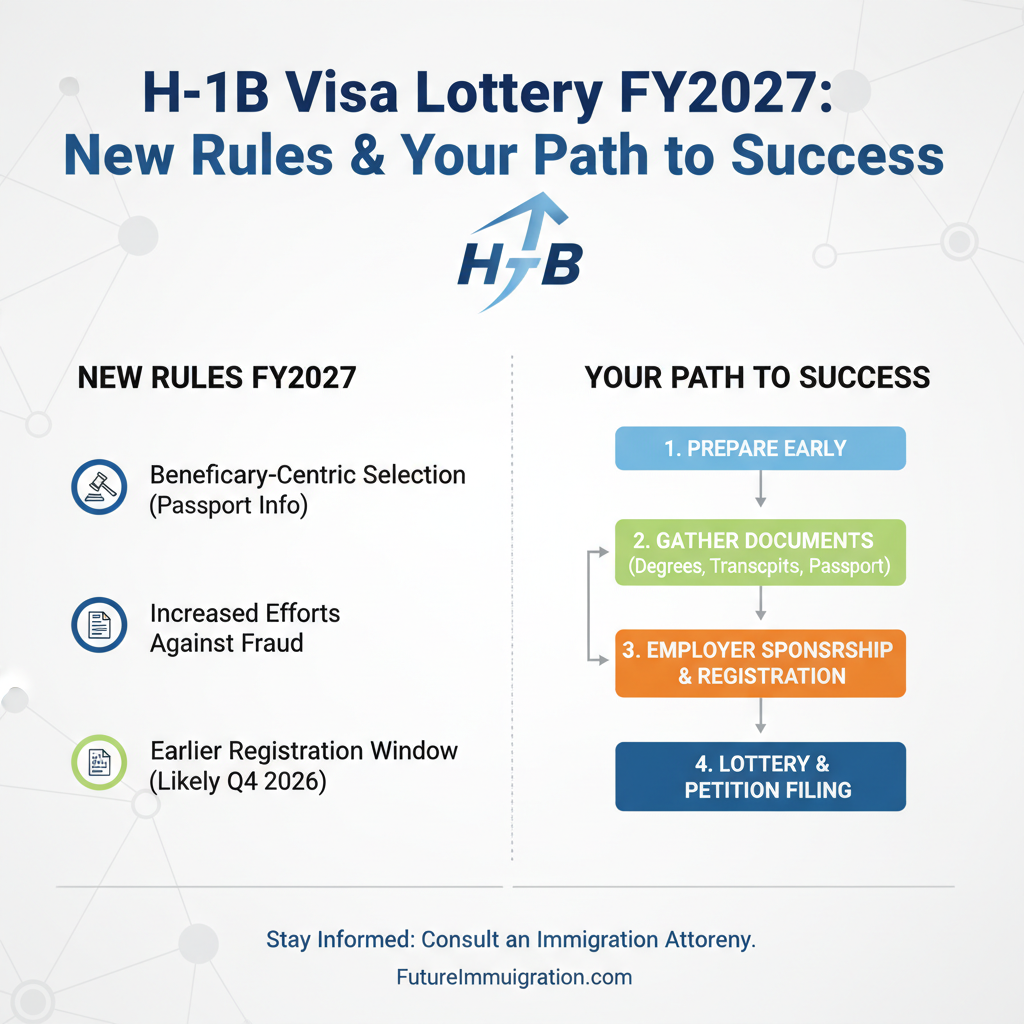
For FY2027, the focus remains on the "beneficiary-centric" selection process, increased registration fees, and enhanced program integrity measures. As the annual H-1B cap registration period typically opens in early March for the fiscal year starting October 1st, 2026, the discussion intensifies months prior, ensuring employers and potential employees are well-informed and prepared. Today, February 24, 2026, we are in a crucial preparatory window, making this information highly relevant and timely.
How it can affect Florida residents
Florida, particularly the Orlando and Central Florida region, is a magnet for talent in various H-1B-eligible fields. Major employers in technology, simulation, aerospace, hospitality management, and healthcare often rely on the H-1B program to fill specialized roles. These new rules will have specific implications for Florida residents:
- For Prospective H-1B Beneficiaries in Florida: If you are an international student graduating from a Florida university (like UCF, UF, or FIU) on an F-1 visa and seeking to transition to an H-1B, or if you are a professional already working in Florida on another visa and hoping to change status, these changes are paramount. The beneficiary-centric selection means your individual qualifications and the legitimacy of your job offer are scrutinized more closely, irrespective of how many employers might register you.
- For Florida Employers: Companies across the I-4 corridor, from Orlando to Tampa, that regularly sponsor H-1B visas must adapt their internal processes. They need to ensure strict compliance with the new registration rules, particularly regarding the prevention of multiple registrations for the same individual beneficiary by related entities. The increased registration fee also adds to administrative costs.
- Enhanced Scrutiny and Integrity: USCIS's emphasis on program integrity means a higher likelihood of site visits to Florida businesses and requests for additional evidence to confirm the bona fides of job offers and the employer-employee relationship, especially for smaller or newer companies. This impacts employers in Orlando, Miami, Jacksonville, and other major Florida cities.
Understanding these shifts is not merely academic; it's essential for strategizing your immigration pathway. Imigrar is here to provide the local expertise and nationwide reach needed to navigate these complex federal regulations effectively.
Need Help Navigating H-1B Changes? Our Orlando immigration team is ready to assist. Call +1 786-791-3106 for a free consultation, or message us online. Se Habla Español.
What H-1B Visa Lottery Changes for FY2027 Is (and Why It Matters)
The H-1B visa is a non-immigrant visa that allows U.S. employers to temporarily employ foreign workers in specialty occupations. These occupations generally require a bachelor's degree or higher in a specific field. The program is crucial for U.S. companies that need to hire skilled workers when qualified American workers are unavailable. However, demand for H-1B visas far exceeds the annual supply, leading to a lottery system.
A plain-English definition
Think of the H-1B visa as a special work permit for highly skilled professionals. If you have a college degree in a specialized field (like IT, engineering, medicine, or finance) and a U.S. employer wants to hire you for a job that specifically requires that degree, an H-1B visa might be your path. Because so many people want these visas, the U.S. government uses a lottery system to select who gets to apply each year. The "changes" for FY2027 mean that the rules for entering and winning this lottery have been updated to make the process fairer and to prevent people from trying to "game" the system.
Key terms you need to know
- H-1B Visa: A non-immigrant visa allowing U.S. employers to temporarily employ foreign workers in specialty occupations.
- Specialty Occupation: An occupation that requires theoretical and practical application of a body of highly specialized knowledge, and a bachelor's degree or higher in the specific specialty (or its equivalent) as a minimum for entry into the occupation in the United States.
- Cap-Subject H-1B: H-1B visas subject to the annual numerical cap set by Congress.
- Annual Cap: Congress limits the number of H-1B visas issued each fiscal year to 65,000 for the regular cap and an additional 20,000 for those with a U.S. master's degree or higher (the "master's cap"). Certain organizations (e.g., universities, non-profit research organizations) are "cap-exempt."
- Fiscal Year (FY): The U.S. government's fiscal year runs from October 1 to September 30. H-1B petitions approved for a given FY (e.g., FY2027) will have a start date of October 1st of that year or later.
- Beneficiary: The foreign worker who will be employed in the specialty occupation.
- Petitioner: The U.S. employer sponsoring the foreign worker for the H-1B visa.
- H-1B Registration Period: A designated period (typically in March) during which prospective petitioners electronically register beneficiaries for the lottery.
- Beneficiary-Centric Selection: The core of the new rules. Instead of each registration having an equal chance, the selection is now based on each unique beneficiary. If a beneficiary has multiple registrations submitted on their behalf by different employers, they are entered into the lottery only once. This prevents multiple entries for the same person from increasing their odds.
- Labor Condition Application (LCA): Form ETA-9035. A prerequisite for filing an H-1B petition, certified by the U.S. Department of Labor (DOL), attesting that the employer will pay the H-1B worker at least the prevailing wage or the actual wage, whichever is higher, and will provide working conditions that will not adversely affect other workers.
- Prevailing Wage: The average wage paid to similarly employed workers in a specific occupation in the area of intended employment.
- Premium Processing: An optional service offered by USCIS that guarantees processing of certain petitions (like H-1B) within 15 calendar days for an additional fee.
- Request for Evidence (RFE): A notice from USCIS asking for more documentation or information to support a petition.
Understanding these terms is crucial as you navigate the H-1B process, especially with the renewed emphasis on integrity and the beneficiary-centric approach for FY2027.
Current Immigration Law: The Foundation
The H-1B visa program is governed primarily by the Immigration and Nationality Act (INA), specifically Section 101(a)(15)(H)(i)(b) and Section 214(g). These statutes establish the framework for non-immigrant visas for specialty occupations and outline the annual numerical limitations. Further regulations are found in Title 8 of the Code of Federal Regulations (8 CFR), particularly Part 214.2(h), which details the requirements for H-1B non-immigrants.
The recent changes for FY2027 are implemented through amendments to these regulations, specifically the final rule that modernizes the H-1B program and enhances the H-1B cap registration process. This rule aims to curb fraud and abuse by altering the lottery selection process and strengthening USCIS's ability to ensure program integrity.
Federal requirements
To qualify for an H-1B visa, both the employer (petitioner) and the foreign worker (beneficiary) must meet specific federal requirements:
For the Beneficiary:
- Hold a bachelor's degree or its equivalent, or a higher degree, required by the specialty occupation.
- Possess a state license, if required, to practice the occupation.
- Have authorization to work in the U.S. (e.g., F-1 OPT, another visa status) if applying for a change of status.
- The job itself must qualify as a specialty occupation.
For the Petitioner (Employer):
- Offer a "specialty occupation" position.
- Pay the H-1B employee at least the prevailing wage for the occupation in the area of intended employment or the actual wage paid to other employees with similar experience and qualifications, whichever is higher. This is documented through the Labor Condition Application (Form ETA-9035).
- Maintain an employer-employee relationship with the beneficiary.
- Meet specific regulatory requirements related to working conditions and non-displacement of U.S. workers (for "H-1B dependent" employers).
The primary form used for an H-1B petition is Form I-129, Petition for a Nonimmigrant Worker. If the beneficiary is currently in the U.S. and seeking to change their status, the petition will also include a request for change of status. Upon approval, USCIS issues a Form I-797, Approval Notice.
For detailed information on forms, fees, and current regulations, always refer to the USCIS official website.
Florida-specific considerations
While H-1B visa requirements are federal, the practical implications and opportunities vary by location. In Florida, particularly the Orlando area, certain industries and types of employers are more prevalent:
- Tech and Simulation: Central Florida is a hub for modeling, simulation, and training (MS&T), with significant defense contractors and tech companies. H-1B visas are common for software engineers, data scientists, and specialized researchers in this sector.
- Healthcare: Orlando boasts a robust healthcare industry, with hospitals and research facilities that frequently sponsor H-1B visas for doctors, nurses (in specialty roles), medical researchers, and allied health professionals.
- Tourism and Hospitality (Management): While many roles in tourism are not H-1B eligible, specialized management positions in large resorts or theme parks requiring specific degrees (e.g., hospitality management, finance, marketing) can qualify.
- Higher Education: Florida universities and colleges, like the University of Central Florida in Orlando, are cap-exempt H-1B employers, meaning they can petition for H-1B workers at any time of the year, outside the lottery system.
For Central Florida residents, understanding these local industry trends can help in identifying potential employers. The Orlando USCIS Field Office primarily handles interviews for family-based petitions and naturalization, but the impact of federal H-1B policy changes will be deeply felt by employers and skilled workers throughout Orange County and beyond.
Confused by H-1B Regulations? Imigrar has the expertise to guide you. Contact our Orlando office at +1 786-791-3106 for a free consultation. Se Habla Español.

How to Navigate the H-1B Visa Lottery Changes for FY2027: A Complete Step-by-Step Guide
Successfully navigating the H-1B visa lottery, especially with the FY2027 changes, requires meticulous planning and adherence to strict deadlines. Here's a step-by-step guide for beneficiaries and employers:
1) Understand the New FY2027 Lottery Rules and Prepare Strategically
Before any action is taken, it's paramount to grasp the core changes that will govern the FY2027 H-1B lottery. The most significant shift is the beneficiary-centric selection process. This means:
- One Entry Per Beneficiary: Each unique beneficiary will be entered into the lottery only once, regardless of how many different employers submit registrations on their behalf. If multiple registrations are submitted for the same beneficiary, USCIS will consider all eligible registrations and select the beneficiary once.
- Employer Identification: Employers must now provide valid passport or travel document information for the beneficiary. This is a critical fraud prevention measure.
- Increased Registration Fee: The H-1B registration fee has increased from $10 to $215 per beneficiary. This applies to each registration submitted.
- Start Date Flexibility: Approved H-1B petitions can now request a start date *after* October 1st of the fiscal year, allowing for more operational flexibility for employers.
Actionable Advice: Employers should conduct thorough due diligence on their potential beneficiaries and ensure they are not submitting duplicate registrations for the same individual through related entities. Beneficiaries should communicate openly with all potential employers to avoid confusion. Consult an attorney early to understand how these changes specifically impact your situation.
2) Employer and Beneficiary Preparation: Eligibility and Documentation
This phase focuses on ensuring both the employer and the beneficiary meet the fundamental requirements for an H-1B visa.
Employer Preparation:
- Verify Eligibility: Ensure your company qualifies as a legitimate U.S. employer and can offer a genuine "specialty occupation" position. This includes having a valid Employer Identification Number (EIN).
- Determine Prevailing Wage: Research and determine the appropriate prevailing wage for the offered position in the specific geographic area (e.g., Orlando, Florida) using resources like the DOL's Foreign Labor Certification Data Center.
- Employer-Employee Relationship: Be prepared to demonstrate a valid employer-employee relationship, especially if the beneficiary will work at a third-party client site.
Beneficiary Preparation:
- Degree and Qualifications: Gather all educational documents (diplomas, transcripts). If your degree is from outside the U.S., you will need a foreign degree evaluation to prove its U.S. equivalency.
- Resume/CV: Update your professional resume to clearly highlight your specialized skills and experience relevant to the H-1B position.
- Passport/Travel Documents: Ensure your passport is valid and provide accurate details to your sponsoring employer. This information is now critical for the registration process.
Required Documents (Initial Prep):
- Beneficiary's valid passport details
- Beneficiary's educational degrees and transcripts (or evaluation)
- Detailed job description for the specialty occupation
- Employer's EIN
- Proof of employer's ability to pay the prevailing wage
3) The H-1B Registration Process for FY2027
This is the initial step for cap-subject H-1B visas. It's a critical, short window where employers submit electronic registrations for their prospective employees.
- Create/Access myUSCIS Account: The petitioning employer (or their authorized representative, like Imigrar) must have a myUSCIS online account to submit registrations.
- Submit Registration Electronically: During the designated registration period (typically the first two weeks of March, but specific dates for FY2027 will be announced by USCIS), the employer submits one electronic registration for each unique beneficiary. Each registration requires the $215 fee.
- Provide Beneficiary Information: Accurate beneficiary information, including full legal name, date of birth, country of birth, country of citizenship, passport/travel document number, and highest level of education, must be provided.
- No LCA Required at Registration: A certified Labor Condition Application (LCA) is *not* required at the registration stage, but it is a prerequisite for the full petition if selected.
Reminder: For FY2027, the beneficiary-centric selection method means that even if multiple employers register the same individual, that individual only gets one chance in the lottery. This aims to prevent fraud where employers might collude to increase an individual's odds.
Timeline Expectation: The H-1B registration period for FY2027 is expected to be in early March 2026. Lottery results are typically announced by the end of March.
4) If Selected: Petition Filing (Form I-129)
If your beneficiary is selected in the lottery, the employer will receive a "Selection Notice" via their myUSCIS account. This opens a specific window (usually 90 days, from April 1st to June 30th) to file the full H-1B petition.
- File LCA (Form ETA-9035): Immediately upon selection, if not done already, the employer must file and obtain certification for the Labor Condition Application (LCA) from the Department of Labor. This process can take several days to weeks.
- Prepare Form I-129: Complete Form I-129, Petition for a Nonimmigrant Worker, along with the H-1B Data Collection and Filing Fee Exemption Supplement.
- Gather Supporting Documents: Collect all necessary documents to support the petition.
- Pay Fees: Pay all required USCIS filing fees (base fee, ACWIA fee, fraud prevention and detection fee, public law 114-113 fee if applicable). The total can range from $1,710 to over $7,000, depending on company size and requested services (e.g., premium processing).
- File with USCIS: Mail the complete petition package to the correct USCIS Service Center within the designated filing window.
Required Documents (Petition Filing):
- Certified Form ETA-9035 (LCA)
- Completed and signed Form I-129 with all supplements
- Beneficiary's educational documents (diplomas, transcripts, evaluations)
- Beneficiary's resume/CV
- Offer letter detailing the specialty occupation position
- Employer's IRS documentation (EIN, tax returns)
- Business license and company brochures/website information
- Evidence of employer's ability to pay wage
- Evidence of employer-employee relationship (e.g., organizational charts, contracts)
- Any previous U.S. visa documents (e.g., F-1, OPT EAD)
- Copy of beneficiary's passport
- If requesting change of status: Copy of I-94 record
5) Awaiting Adjudication and Next Steps
After filing, USCIS will process the petition. This can take several months unless premium processing is used.
- Receipt Notice: USCIS will issue a Form I-797C, Notice of Action, acknowledging receipt of your petition.
- Possible RFE: USCIS may issue a Request for Evidence (RFE) if they need more information. Responding to an RFE accurately and promptly is crucial. Imigrar specializes in crafting robust RFE responses.
- Approval (Form I-797): If approved, USCIS will send a Form I-797, Approval Notice. If a change of status was requested and approved, the I-797 will include a new I-94 record reflecting H-1B status.
- Consular Processing (if outside U.S.): If the beneficiary is outside the U.S. or requested consular processing, they must attend a visa interview at a U.S. embassy or consulate in their home country to obtain the H-1B visa stamp. This typically involves submitting Form DS-160, Nonimmigrant Visa Application, and paying the visa application fee.
Important: The H-1B start date is typically October 1st of the fiscal year for which the cap was selected (e.g., October 1, 2026, for FY2027), though the new rules allow for later start dates.
6) Post-Approval Compliance and H-1B Portability
Once the H-1B visa is approved and active, there are ongoing responsibilities and possibilities.
- Maintain Status: The H-1B worker must commence employment with the petitioning employer as specified in the petition. Any significant changes in employment (e.g., job duties, location, salary) may require an amended petition.
- H-1B Portability: An H-1B worker can "port" their H-1B to a new employer once the new employer files a new H-1B petition on their behalf, even before the new petition is approved. This allows for seamless transition between H-1B employers.
- Amendments: If there are material changes to the H-1B employment (e.g., a new work location outside the metropolitan statistical area covered by the original LCA, significant changes in job duties), the employer must file an amended H-1B petition.


