What This News Means for Immigrants in Orlando and Across Florida
Why this news is showing up now
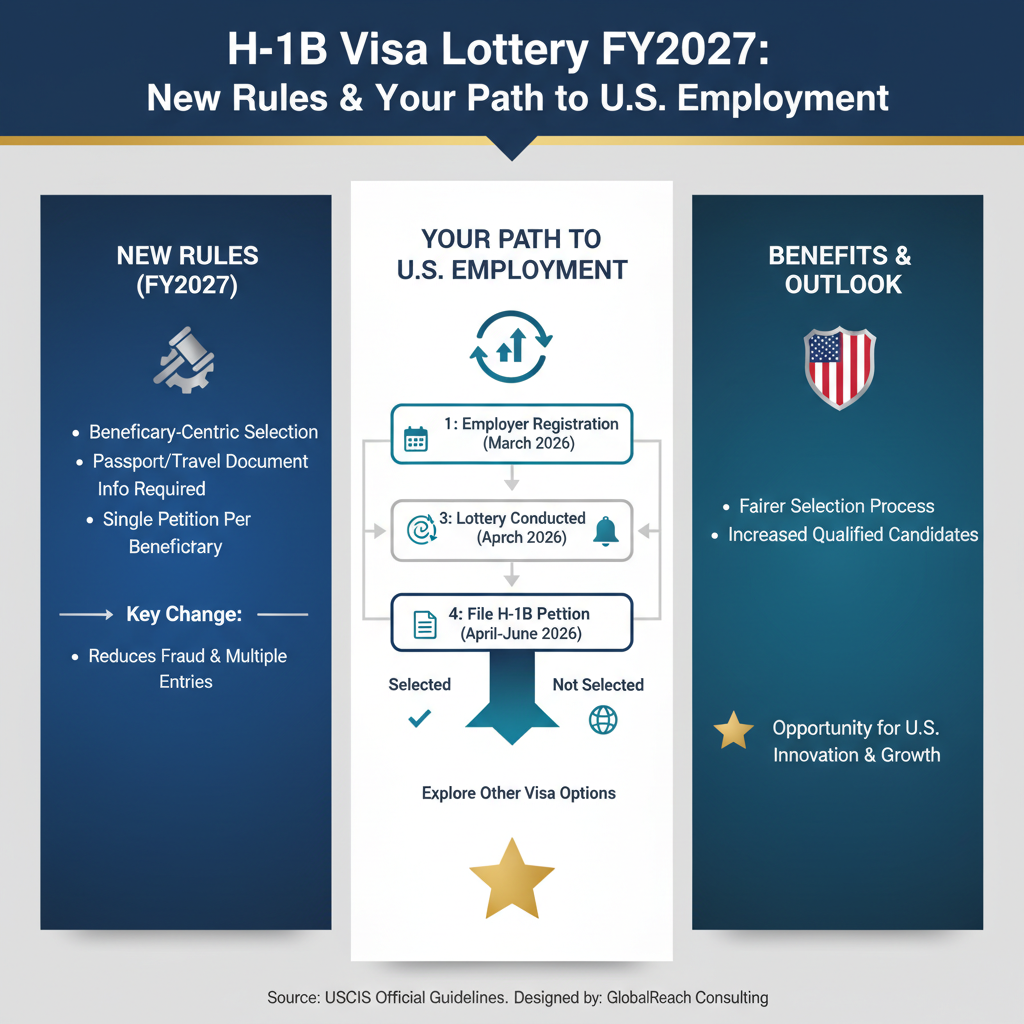
As of today, April 29, 2026, the H-1B cap for Fiscal Year 2027 (which commences on October 1, 2026) has already seen its electronic registration period conclude in March 2026, and the results of the lottery have recently been announced. USCIS typically opens the filing period for selected H-1B petitions on April 1st. The "new rules" referenced in the legal news source would have been formalized and announced by USCIS well in advance of the March 2026 registration window, allowing petitioners and beneficiaries time to prepare. These rules aim to enhance the integrity of the H-1B program, deter fraud, and ensure a more equitable selection process. Therefore, this news is highly relevant *now* for those who have been selected in the FY2207 lottery and are preparing their petitions, as well as for those planning for future H-1B applications who need to understand the updated landscape. It’s also crucial for employers who sponsor H-1B workers to be fully aware of their obligations under the revised system.How it can affect Florida residents
Florida, especially the Orlando metropolitan area, is a vibrant hub for technology, tourism, aerospace, healthcare, and engineering industries. Companies across the I-4 corridor, from startups to multinational corporations, frequently rely on the H-1B program to attract top talent. Graduates from institutions like the University of Central Florida (UCF), Florida Institute of Technology, and the University of Florida, both domestic and international, often seek H-1B sponsorship. For skilled foreign nationals living in Orlando or considering job opportunities here, these H-1B lottery changes have direct implications: * **Increased Fairness, Reduced Fraud:** The emphasis on beneficiary-centric selection aims to prevent multiple registrations for the same individual, which historically inflated selection odds for some and reduced them for others. This could mean a more level playing field for genuinely interested candidates in Florida. * **Employer Due Diligence:** Florida employers sponsoring H-1B candidates must now be even more meticulous in their registration and petition processes to comply with the new integrity measures, potentially requiring more robust documentation and internal checks. * **Strategic Planning:** Both individuals and employers need to understand the updated timeline, requirements, and potential pitfalls to effectively plan for the H-1B process, whether for FY2027 petitions currently being filed or for future fiscal years. * **Impact on Local Economy:** A more robust and fair H-1B program helps ensure that Florida businesses can continue to access the specialized talent needed to innovate and grow, contributing to the state's economic vitality. Understanding these changes is not just about compliance; it's about optimizing your chances of success in a highly competitive system.Navigating H-1B changes can be complex. Our Orlando immigration team at Imigrar specializes in H-1B visas and can help you understand the new rules and prepare your petition. Call +1 786-791-3106 for a free consultation, or message us online. Se Habla Español.
What H-1B Visa Lottery Changes for FY2027 Is (and Why It Matters)
The H-1B visa program allows U.S. employers to temporarily employ foreign workers in specialized occupations. These occupations generally require a bachelor's degree or higher in a specific specialty. Due to high demand, the number of H-1B petitions often exceeds the annual quota set by Congress, necessitating a lottery system. The "H-1B Visa Lottery Changes for FY2027" refers to the significant modifications implemented by U.S. Citizenship and Immigration Services (USCIS) to the electronic registration and selection process for the H-1B cap-subject visa.A plain-English definition
Simply put, the H-1B visa is for professional workers in fields like IT, engineering, medicine, and education. Because there are more applicants than available visas each year (the "cap"), USCIS runs a computer-generated lottery to select who gets to apply. The "changes" for FY2027 primarily involve *how* this lottery is conducted. Instead of multiple registrations being allowed for the same individual by different employers, the new system focuses on the *individual beneficiary*. This means each unique individual can only be selected once, regardless of how many employers registered them. This is a crucial shift designed to prevent fraud and ensure a fairer chance for all eligible beneficiaries.Key terms you need to know
To fully grasp the H-1B process and the impact of the new changes, it's essential to understand these terms: * **H-1B Visa:** A nonimmigrant visa that allows U.S. employers to temporarily employ foreign workers in specialty occupations. * **Specialty Occupation:** An occupation that requires theoretical and practical application of a body of highly specialized knowledge and a bachelor's degree or higher in the specific specialty (or its equivalent) as a minimum for entry into the occupation in the United States. * **Cap-Subject H-1B:** Refers to H-1B visas subject to the annual statutory limit. Congress sets an annual cap of 65,000 H-1B visas, with an additional 20,000 visas reserved for those with a U.S. master's degree or higher (the "master's cap"). * **H-1B Lottery:** The random selection process conducted by USCIS when the number of electronic registrations exceeds the annual H-1B cap. * **FY2027 (Fiscal Year 2027):** The U.S. government's fiscal year runs from October 1 to September 30. FY2027 begins on October 1, 2026, and ends on September 30, 2027. H-1B petitions approved for this fiscal year generally have a start date of October 1, 2026. * **Electronic Registration Period:** The window, typically in March, during which prospective H-1B petitioners (employers) submit electronic registrations for beneficiaries they intend to sponsor. * **Beneficiary:** The foreign national employee for whom the H-1B visa is sought. * **Petitioner:** The U.S. employer sponsoring the H-1B visa. * **LCA (Labor Condition Application):** Form ETA-9035, certified by the U.S. Department of Labor (DOL), attesting to wage and working conditions. Required before filing an H-1B petition. * **Prevailing Wage:** The average wage paid to similarly employed workers in a specific occupation in the area of intended employment. Employers must pay the H-1B worker at least the prevailing wage or the actual wage paid to employees with similar experience and qualifications, whichever is higher. * **Beneficiary-Centric Selection:** The core of the new H-1B lottery rules. Under this system, USCIS selects registrations based on unique beneficiaries, not on the number of registrations submitted on their behalf. If a beneficiary has multiple registrations, they will only be entered into the lottery once. If selected, all valid petitions filed on their behalf by different employers will be considered valid. This aims to eliminate the advantage of multiple registrations. * **Integrity Measures:** New rules introduced to combat fraud and abuse in the H-1B program, including strengthened verification processes and potential investigations into employers submitting numerous registrations for the same individual. These changes are significant because they directly impact the probability of selection and place a greater emphasis on the legitimate employer-employee relationship from the outset. For immigrants in Orlando and nationwide, understanding these terms is the first step toward a successful H-1B application.Current Immigration Law: The Foundation
The H-1B visa program is rooted deeply in the Immigration and Nationality Act (INA), specifically under INA § 101(a)(15)(H)(i)(b), which defines the H-1B nonimmigrant classification. Further regulations governing the program are found in INA § 214(g), which establishes the annual numerical limitations (the "cap") for H-1B visas. The Department of Homeland Security (DHS) and USCIS implement these laws through federal regulations outlined in the Code of Federal Regulations (CFR), particularly 8 CFR 214.2(h). These laws and regulations dictate everything from eligibility criteria for both the employer and the beneficiary to the application process, duration of stay, and permissible activities.Federal requirements
To qualify for an H-1B visa, both the employer (petitioner) and the foreign worker (beneficiary) must meet specific federal requirements: **For the Employer (Petitioner):** * **Bona Fide Job Offer:** Must offer a job in a specialty occupation. * **LCA Certification:** Must file and obtain a certified Labor Condition Application (Form ETA-9035) from the U.S. Department of Labor, attesting to paying the prevailing wage and providing working conditions that will not adversely affect other workers. * **Employer-Employee Relationship:** Must establish a valid employer-employee relationship with the beneficiary. * **Ability to Pay:** Must demonstrate the financial ability to pay the offered wage. **For the Employee (Beneficiary):** * **Specialty Occupation Qualifications:** Must hold a bachelor's degree or its equivalent, or possess a license in a specialty occupation field, or have work experience equivalent to a bachelor's degree. * **Job Match:** The degree or experience must be directly related to the specialty occupation job offered. * **Licensure (if applicable):** Must possess any state-specific license required to perform the job duties (e.g., for doctors, nurses, engineers). **Important:** The new FY2027 rules primarily impact the *selection* process, not the fundamental eligibility criteria. However, the increased scrutiny on multiple registrations and the legitimacy of job offers means that meeting these federal requirements rigorously is more critical than ever.Florida-specific considerations
While H-1B is a federal program, local factors can influence the application process and job prospects. In Florida, particularly in Orlando, the robust tech sector (e.g., simulation and training, digital media, cybersecurity), aerospace companies (e.g., on the Space Coast), and healthcare systems provide numerous opportunities for H-1B eligible professionals. * **Prevailing Wage Data:** The prevailing wage for a specific occupation can vary significantly based on the geographic location. Employers in Orlando and other Florida cities must ensure they are using accurate prevailing wage data for the specific Metropolitan Statistical Area (MSA) to avoid issues with the LCA. * **Local Industries:** Florida's diverse economy means a wide range of specialty occupations are in demand, from software developers in Orlando's tech parks to biomedical engineers in Gainesville or financial analysts in Miami. * **USCIS Field Office:** While H-1B petitions are processed by specific USCIS service centers, if a beneficiary living in Central Florida needs to attend an interview for a related process (e.g., a change of status, though less common for initial H-1B), the Orlando USCIS Field Office located at 5449 South Semoran Boulevard, Orlando, FL, would be the relevant local office. Understanding these legal foundations and how they apply locally is key to a successful H-1B application. For detailed information and forms, always refer to the USCIS official website.How to Navigate the New H-1B Visa Lottery System: A Complete Step-by-Step Guide
The H-1B process, especially with the FY2027 changes, requires careful planning and execution. This guide outlines the typical steps, incorporating the new beneficiary-centric lottery system.1) Employer Assessment & Labor Condition Application (LCA) Filing
Before any lottery registration can occur, the prospective employer must determine if the position qualifies as a specialty occupation and if the beneficiary meets the requirements. * **Specialty Occupation Analysis:** The employer and their legal counsel (like Imigrar) assess whether the job duties require a bachelor's degree in a specific field and if the beneficiary possesses such a degree or its equivalent. * **Prevailing Wage Determination:** The employer must research and determine the prevailing wage for the specific occupation in the area of intended employment. This ensures compliance with wage requirements. * **LCA Filing (Form ETA-9035):** The employer files an LCA with the U.S. Department of Labor (DOL). This form attests that the employer will pay the H-1B worker at least the prevailing wage or the actual wage paid to other employees with similar experience and qualifications, whichever is higher. It also ensures working conditions will not adversely affect U.S. workers. * **Required Documents (for LCA):** Employer’s EIN, job title, job duties, wage rate, work location, SOC code, prevailing wage source. * **Timeline:** LCA certification typically takes 7-10 business days. This must be certified *before* the H-1B petition can be filed.2) H-1B Electronic Registration & Lottery (Beneficiary-Centric Selection)
This is where the FY2027 changes are most prominent. * **Registration Period:** During the designated registration period (typically in March, for FY2027 it was March 2026), the employer submits an electronic registration for each prospective H-1B beneficiary they wish to sponsor. * **New Beneficiary-Centric Selection:** Under the new rules, each **unique beneficiary** is entered into the lottery only once, regardless of how many employers registered them. USCIS identifies duplicate registrations for the same individual. * **Important:** While multiple employers *can* still register the same beneficiary, this no longer increases the beneficiary’s odds of selection. It only means that if selected, *any* of the registering employers can file a petition on that beneficiary's behalf. * **Selection Notification:** USCIS notifies selected registrants (employers) electronically. For FY2027, these notifications were issued by late March/early April 2026. * **Required Information (for Registration):** Employer's legal name, EIN, mailing address, authorized signatory information; Beneficiary's full name, date of birth, country of birth, country of citizenship, passport number, gender, and whether they hold a U.S. master's degree or higher. * **Cost:** A non-refundable $10.00 registration fee per beneficiary.3) H-1B Petition Filing for Selected Beneficiaries
If a registration is selected, the employer can then proceed with filing the full H-1B petition. * **Petition Preparation:** The employer, with legal assistance, prepares Form I-129, Petition for a Nonimmigrant Worker, along with all supporting documentation. * **Required Documents (for I-129):** * Certified LCA (Form ETA-9035). * Copy of the H-1B registration selection notice. * Evidence of the beneficiary's educational qualifications (e.g., diplomas, transcripts, foreign degree evaluations). * Evidence of the beneficiary's professional experience (e.g., letters from previous employers, résumés). * Detailed job description and employer's support letter explaining the specialty occupation nature of the position. * Employer's financial statements or tax returns to prove ability to pay. * Beneficiary's passport, visa, I-94 record, and other immigration documents. * If applicable, Form G-28, Notice of Entry of Appearance as Attorney or Accredited Representative. * **Filing Window:** USCIS specifies a filing window, typically from April 1st for 90 days, during which selected petitions must be submitted. For FY2027, this window is currently open (April 2026 - June 2026). * **Fees:** Various filing fees apply, including the base filing fee, ACWIA fee, fraud prevention and detection fee, and if applicable, the Public Law 114-113 fee. Premium Processing (Form I-907) is an optional additional fee for expedited processing.4) USCIS Processing & Approval
Once filed, USCIS reviews the petition. * **Receipt Notice:** USCIS issues a Form I-797C, Notice of Action, acknowledging receipt of the petition. * **RFE/NOID:** USCIS may issue a Request for Evidence (RFE) if more information is needed, or a Notice of Intent to Deny (NOID). Responding accurately and promptly is crucial. * **Approval:** If approved, USCIS issues a Form I-797, Notice of Action, indicating the petition's approval. * **Timeline:** Regular processing can take several months. Premium Processing guarantees a response within 15 calendar days for an additional fee. You can check USCIS Processing Times for current estimates.5) Visa Interview (for those outside the U.S.) / Change of Status (for those inside)
This step depends on the beneficiary's current location. * **Consular Processing (Outside U.S.):** If the beneficiary is outside the U.S., they will attend an H-1B visa interview at a U.S. embassy or consulate in their home country. Upon approval, an H-1B visa stamp is placed in their passport. * **Required Documents:** Original Form I-797 Approval Notice, DS-160 confirmation, passport, visa interview appointment confirmation, photos, and supporting documents similar to the I-129 petition. * **Link:** U.S. Department of State for embassy/consulate information. * **Change of Status (Inside U.S.):** If the beneficiary is already in the U.S. in a valid nonimmigrant status (e.g., F-1 OPT, L-1, H-4), the H-1B petition can include a request for a Change of Status. If approved, the beneficiary's status automatically changes to H-1B as of October 1st (or the petition's start date). * **Important:** Maintaining valid nonimmigrant status until the H-1B start date is critical.6) Beginning H-1B Employment
* **Start Date:** H-1B employment typically begins on October 1st of the fiscal year for which the visa was approved. * **Portability:** If an H-1B worker wishes to change employers, a new H-1B petition must be filed by the new employer. The worker can begin working for the new employer upon the filing of the new petition, provided certain conditions are met (H-1B portability rules).7) Maintaining H-1B Status
* **Compliance:** Both employer and employee must continuously comply with H-1B regulations, including maintaining the required wage, job duties, and employment relationship. * **Amendments:** If there are significant changes to the job duties, work location, or employer, an amended H-1B petition (Form I-129) may be required. * **Extensions:** H-1B status is generally granted for an initial period of up to three years and can be extended for a total maximum of six years. Further extensions beyond six years are possible under specific circumstances (e.g., if a green card process has been initiated).Don't risk errors in your H-1B application! The new rules demand precision. Let Imigrar's experienced Orlando immigration attorneys guide you. Call +1 786-791-3106 for a free consultation. Se Habla Español.
Practical Steps You Can Take Today
Whether you're an employer or an aspiring H-1B beneficiary, proactive preparation is key, especially with the FY2027 changes. Here’s a checklist of practical steps: * **Engage with Potential Employers Early:** If you are a beneficiary, start networking and securing job offers well in advance. For employers, identify your talent needs and begin the internal process for H-1B sponsorship much earlier than you think. The earlier you start, the better prepared you'll be for the next registration cycle (for FY2028). * **Gather Essential Documents:** Compile all academic transcripts, diplomas, foreign degree evaluations, résumés, and employment letters. Ensure your passport is valid and up-to-date. Employers should prepare detailed job descriptions and organizational charts. * **Verify Educational Equivalency:** If your degree is from outside the U.S., obtain a professional evaluation to determine its U.S. equivalency. This is a critical step for specialty occupation determination. * **Understand the "Beneficiary-Centric" Rule:** Both employers and beneficiaries must fully grasp that multiple registrations for the same individual no longer increase selection odds. Focus on legitimate job offers and clean, accurate registrations. * **Consult with an Experienced Immigration Attorney:** This is perhaps the most crucial step. An attorney can assess eligibility, advise on strategy, ensure compliance with all new rules, and prepare all necessary documentation. * **Stay Informed on USCIS Updates:** Immigration policies and procedures can change. Regularly check the USCIS official website for the latest announcements and guidance. * **Review Your Immigration History:** Ensure all previous immigration records are accurate and consistent. Any discrepancies can cause delays or denials. **Document Preparation Guidance:** * **Organization:** Keep all documents well-organized, ideally in digital format, clearly labeled. * **Accuracy:** Double-check all personal details (names, dates of birth, passport numbers) for consistency across all documents. * **Translations:** Any document not in English must be accompanied by a certified English translation. * **Copies:** Provide copies of documents unless originals are specifically requested by USCIS. **Timeline Expectations (for future H-1B cycles, based on FY2027):** * **January-February (Calendar Year before FY):** Employers and beneficiaries prepare for registration, gather initial documents, and consult with attorneys. * **March (Calendar Year before FY):** H-1B electronic registration period opens and closes (e.g., March 2026 for FY2027). * **Late March/Early April (Calendar Year before FY):** USCIS announces lottery results and notifies selected registrants. * **April 1 - June 30 (Calendar Year before FY):** Filing window for H-1B cap-subject petitions for selected beneficiaries opens (e.g., April 1, 2026 - June 30, 2026 for FY2027). * **April - September (Calendar Year before FY):** USCIS processes petitions. Premium processing can expedite this. * **October 1 (Start of FY):** Approved H-1B petitions become effective. Beneficiaries can begin employment under H-1B status. **Warning:** Missing deadlines, providing incorrect information during registration, or failing to submit a complete petition during the filing window can lead to denial or loss of the H-1B opportunity.