


The reporting that sparked this guide: H-1B Visa Lottery Changes for FY2027 (Legal News)
What This News Means for Immigrants in Orlando and Across Florida
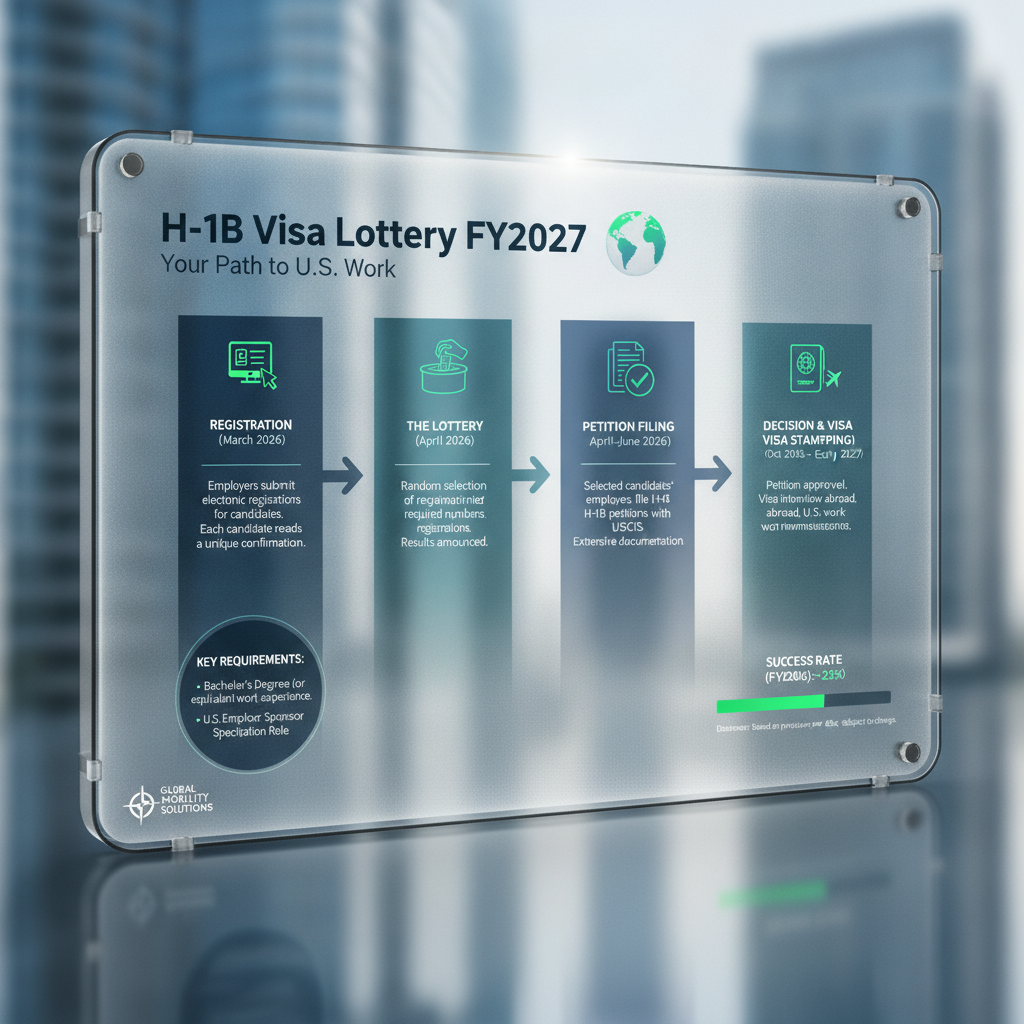
For skilled foreign workers and the employers who seek their talent, the H-1B visa program is a critical gateway to opportunity in the United States. Each year, the demand for these visas far outstrips the available supply, necessitating a lottery system. The U.S. Citizenship and Immigration Services (USCIS) has recently implemented significant changes to the H-1B visa lottery process, particularly impacting the Fiscal Year 2027 (FY2027) cycle. These aren't just minor adjustments; they represent a fundamental shift in how H-1B registrations are selected, with profound implications for individuals and businesses alike.
Why this news is showing up now
As of June 2026, the H-1B visa lottery for FY2027 has largely concluded its initial phases. The registration period, typically held in March, saw the implementation of the new beneficiary-centric selection process. Following this, selected registrants (or their sponsoring employers) would have proceeded with filing the full H-1B petition (Form I-129) during the filing window that typically begins April 1st. Many of these petitions are now in various stages of processing – some approved, some awaiting a decision, and others potentially facing Requests for Evidence (RFEs). The legal news and discussions are now focused on the initial outcomes of this new process, analyzing its effectiveness in curbing fraud, its impact on selection rates, and the challenges or successes faced by employers and beneficiaries under the new rules. This ongoing discourse is crucial for understanding how these changes will shape future H-1B cycles and for those whose petitions are still pending.
How it can affect Florida residents
Florida, with its booming tech sector, growing healthcare industry, and vibrant tourism and hospitality scene, relies heavily on skilled foreign workers. Major metropolitan areas like Orlando, Miami, Tampa, and Jacksonville are home to numerous companies that sponsor H-1B visas. The changes to the FY2027 H-1B lottery have direct and significant implications for Florida residents:
- For H-1B Beneficiaries in Florida: If you are an international student graduating from a Florida university (like UCF, UF, or FIU) on an F-1 visa with Optional Practical Training (OPT), or if you are already working in Florida on another non-immigrant visa and sought H-1B sponsorship, these changes directly impacted your chances of selection for FY2027. The beneficiary-centric approach aims to level the playing field, theoretically reducing the advantage gained by having multiple employers register you. This could mean a more equitable chance for all, but also removes a previous strategy for those with multiple job offers.
- For Florida Employers: Companies along the I-4 corridor, in Orlando's tech parks, or within the medical districts of Central Florida, often sponsor H-1B visas to fill specialized roles. These employers had to adapt their registration strategies for FY2027, focusing on submitting a single, legitimate registration for each unique beneficiary. This could streamline the process for honest employers but also requires strict adherence to the new rules to avoid potential penalties for fraudulent registrations.
- Impact on Local Economy: A stable and predictable H-1B program is vital for Florida's economic growth. The clarity and fairness of the new lottery system, if successful, could help Florida businesses attract and retain top global talent, fostering innovation and economic expansion in sectors like aerospace, simulation, advanced manufacturing, and IT that are strong in the Orlando and wider Florida region.
Navigating the H-1B changes can be complex. Our Orlando immigration team at Imigrar specializes in work visas and is ready to assist you. Call +1 786-791-3106 for a free consultation, or message us online. Se Habla Español.
What H-1B Visa Lottery Changes for FY2027 Is (and Why It Matters)
The H-1B visa is a non-immigrant visa that allows U.S. employers to temporarily employ foreign workers in specialty occupations. These occupations generally require a bachelor's degree or higher in a specific field. Examples include IT professionals, engineers, scientists, architects, accountants, and certain medical professionals. The "lottery" comes into play because Congress sets an annual cap on the number of H-1B visas issued each fiscal year.
A plain-English definition
Imagine a highly sought-after concert where only a limited number of tickets are available. Millions of fans want to go, but there aren't enough seats. So, the organizers decide to hold a lottery: everyone registers, and a random drawing determines who gets to buy a ticket. The H-1B visa lottery works similarly. Each year, far more employers want to hire foreign workers on H-1B visas than the law allows. For FY2027, the U.S. government (specifically USCIS) put new rules in place for this "drawing." The biggest change is that now, instead of counting each "ticket request" (employer registration), they count each "fan" (beneficiary). This means if five different employers want to hire the same person, that person only gets one "entry" in the lottery, not five. This change is designed to make the lottery fairer and reduce attempts to unfairly increase selection odds, ensuring that every individual has an equal chance, regardless of how many job offers they have.
Key terms you need to know
- H-1B Visa: A non-immigrant visa category that allows U.S. employers to temporarily employ foreign workers in specialty occupations.
- Specialty Occupation: An occupation that requires a theoretical and practical application of a body of highly specialized knowledge, and a bachelor's degree or higher in the specific specialty (or its equivalent) as a minimum for entry into the occupation in the U.S.
- USCIS (U.S. Citizenship and Immigration Services): The government agency that oversees lawful immigration to the United States. USCIS official website.
- H-1B Cap: The annual statutory limit on the number of H-1B visas issued. Currently, this is 65,000 for the regular cap and an additional 20,000 for the "master's cap" (for those with a U.S. master's degree or higher).
- Cap-Exempt: Certain H-1B petitions are not subject to the annual cap, such as those filed by institutions of higher education, non-profit organizations affiliated with higher education, or non-profit research organizations.
- Beneficiary: The foreign national worker who will be employed in the specialty occupation.
- Petitioner: The U.S. employer filing the H-1B petition on behalf of the beneficiary.
- Registrant: The U.S. employer who submits an H-1B registration on behalf of a beneficiary during the lottery registration period.
- FY (Fiscal Year): The U.S. government's fiscal year runs from October 1st to September 30th. H-1B visas selected in the lottery become available for employment starting October 1st of the relevant fiscal year (e.g., FY2027 H-1B visas are for employment starting October 1, 2026).
- Lottery/Selection Process: The random drawing conducted by USCIS when the number of eligible registrations exceeds the annual H-1B cap.
- Beneficiary-Centric Selection: The new rule for FY2027, where selection in the lottery is based on unique beneficiaries, not on the number of registrations submitted on their behalf. Each unique beneficiary is entered into the lottery only once, regardless of how many employers register them.
- LCA (Labor Condition Application): Form ETA-9035. An application filed with the Department of Labor by an employer seeking to hire an H-1B worker, attesting to certain wage and working conditions. This must be certified before filing the Form I-129.
- Form I-129, Petition for a Nonimmigrant Worker: The primary form filed by the employer with USCIS to request H-1B classification for a foreign worker.
- Form I-797C, Notice of Action: A receipt notice or selection notice issued by USCIS. For the lottery, this form informs registrants whether their registration was selected.
- Premium Processing: An optional service offered by USCIS for an additional fee, guaranteeing adjudication of certain petitions within 15 calendar days.
Current Immigration Law: The Foundation
The H-1B visa program operates under specific provisions of the Immigration and Nationality Act (INA), primarily found at 8 U.S.C. § 1101 et seq. The regulatory framework governing the H-1B program is outlined in 8 C.F.R. Part 214.2(h). These legal statutes and regulations dictate everything from eligibility criteria to the annual cap, the petition process, and the recent lottery changes.
Federal requirements
To be eligible for an H-1B visa, both the beneficiary and the petitioning employer must meet stringent federal requirements:
- For the Beneficiary:
- Must hold a bachelor's degree or its equivalent, or a license in a specialty occupation field, or have work experience equivalent to a bachelor's degree.
- Must be coming to the U.S. to perform services in a specialty occupation.
- Must meet any state licensure requirements for the occupation (e.g., for doctors, nurses, architects).
- For the Employer (Petitioner):
- Must demonstrate that the position qualifies as a specialty occupation.
- Must file a Labor Condition Application (LCA), Form ETA-9035, with the U.S. Department of Labor (DOL) and obtain certification before filing Form I-129. The LCA attests that the employer will pay the H-1B worker at least the prevailing wage or the actual wage, whichever is higher, and will provide working conditions that will not adversely affect other workers.
- Must pay the required filing fees.
- Must offer a bona fide job offer.
- The Annual Cap: The H-1B program is subject to an annual numerical cap of 65,000 visas, with an additional 20,000 visas reserved for those holding a U.S. master's degree or higher. When the number of registrations or petitions exceeds these caps, USCIS conducts a random lottery. The FY2027 lottery introduced the key change of selecting based on unique beneficiaries.
- Duration: An H-1B visa is initially granted for up to three years and can be extended for a maximum of six years. In certain circumstances, extensions beyond six years are possible, particularly if the beneficiary has a pending green card application.
Florida-specific considerations
While federal law governs the H-1B program, the specific economic and educational landscape of Florida creates unique considerations for H-1B applicants and employers:
- Demand in Key Sectors: Florida's robust technology sector (especially in Orlando, Tampa, and Miami), healthcare industry, and engineering firms frequently seek H-1B talent. This means a high volume of H-1B petitions originating from Florida, intensifying competition in the lottery.
- University Talent Pool: Florida is home to numerous top-tier universities, including the University of Central Florida (UCF) in Orlando, the University of Florida (UF), and Florida International University (FIU). These institutions produce a large pool of international graduates on F-1 visas, many of whom seek H-1B sponsorship for employment within the state. For those with U.S. master's degrees from these institutions, the master's cap provides a slightly higher chance of selection.
- Local USCIS Field Offices: While H-1B petitions are processed by USCIS service centers, residents of Florida might interact with local USCIS field offices for other immigration matters or in specific scenarios. The Orlando USCIS Field Office, for instance, handles interviews for certain adjustment of status applications, which might become relevant for H-1B holders transitioning to permanent residency.
- Prevailing Wage Determinations: Prevailing wages, determined by the Department of Labor based on occupation and geographic area, can vary significantly across Florida. Employers in high-cost-of-living areas like Miami or certain parts of Orlando may face higher prevailing wage requirements compared to other regions, impacting the cost of sponsorship.
For more detailed information on H-1B requirements and forms, always refer to the USCIS official website.
How to Navigate the H-1B Visa Lottery Changes for FY2027: A Complete Step-by-Step Guide
Understanding the H-1B process, especially with the FY2027 changes, is crucial. This guide outlines the typical steps involved, assuming the lottery has already concluded for FY2027 and focusing on what comes next for selected beneficiaries and their employers.
1) Understand the New Rules & Eligibility (Beneficiary and Employer)
Before any action, ensure both the beneficiary and the employer meet the fundamental H-1B eligibility criteria, especially in light of the new beneficiary-centric selection rule for FY2027. This rule dictates that each unique beneficiary can only be selected once in the lottery, regardless of how many employers registered them. USCIS aims to reduce fraud and provide a more equitable chance for all.
- For the Beneficiary: Confirm you possess the required bachelor's degree (or foreign equivalent), or a higher degree, or professional license, or work experience equivalent to a bachelor's degree in a specialty occupation.
- For the Employer: Ensure the job offered qualifies as a specialty occupation and that the company has a legitimate need for an H-1B worker. The employer must be prepared to pay the prevailing wage.
- Important: If multiple employers registered you for the FY2027 lottery, only one of those registrations could have been selected. You should be in communication with all sponsoring employers to understand the outcome.
2) Employer Registration with USCIS (Completed for FY2027)
For FY2027, this step would have occurred in March 2026. Employers (or their authorized representatives like Imigrar) would have submitted electronic registrations for each prospective H-1B beneficiary. Under the new rules, employers must ensure that each beneficiary is unique to prevent duplicate entries from the same employer and understand that if multiple employers registered one beneficiary, only one selection notice would be issued for that beneficiary.
- Required Information for Registration:
- Employer's legal name, address, and EIN.
- Employer's authorized signatory information.
- Beneficiary's full legal name, date of birth, country of birth, country of citizenship, passport number.
- Beneficiary's gender.
- Whether the beneficiary has a U.S. master's degree or higher (for the master's cap).
- Payment of the $10 H-1B registration fee per beneficiary.
- Reminder: For FY2027, the beneficiary-centric selection aimed to ensure that only unique beneficiaries were chosen, regardless of how many registrations were submitted on their behalf.
3) Lottery Selection & Notification (Completed for FY2027)
USCIS conducts the random lottery drawing if the number of eligible registrations exceeds the annual cap. For FY2027, this would have happened shortly after the registration period closed in March 2026. Selected registrants (employers) are then notified. If you were selected, your employer would have received a selection notice.
- Notification: USCIS sends an electronic Form I-797C, Notice of Action, to the online USCIS account of the registrant whose registration was selected. This notice confirms selection and authorizes the filing of the H-1B petition.
- Warning: Only selected registrants are eligible to file an H-1B cap-subject petition. Filing without a selection notice will lead to denial.
4) Petition Filing (Form I-129)
Once a registration is selected, the employer has a specific window (typically 90 days, starting April 1st for FY2027) to file the complete H-1B petition (Form I-129, Petition for a Nonimmigrant Worker) with USCIS. This is the most detailed and document-intensive step.
- Key Documents & Information for Form I-129:
- Certified Labor Condition Application (LCA), Form ETA-9035.
- Copy of the H-1B selection notice (Form I-797C).
- Employer's letter of support outlining the job duties, salary, and why the position qualifies as a specialty occupation.
- Beneficiary's educational documents (degrees, transcripts, evaluations of foreign degrees).
- Beneficiary's resume/CV.
- Beneficiary's passport copy, visa, and I-94 record.
- Copies of any previous U.S. immigration documents (e.g., EAD, I-20s for F-1 status).
- Organizational charts, company brochures, or other evidence demonstrating the employer's business and the bona fide nature of the job offer.
- Evidence of employer-employee relationship (if applicable, especially for third-party placements).
- Applicable USCIS filing fees (Form I-129 fee, ACWIA fee, Fraud Prevention and Detection fee, Public Law 114-113 fee for certain employers).
- Recommendation: This step is highly complex. Engage an experienced immigration attorney, like those at Imigrar, to prepare and file the petition to ensure accuracy and completeness, especially if your case involves specific challenges or if your case is handled through the Orlando USCIS Field Office for any related issues.
Don't risk a denial due to errors. Imigrar has a proven track record in H-1B petition filings. Contact our Orlando team at +1 786-791-3106 for expert guidance and support. Se Habla Español.
5) Premium Processing (Optional)
If speed is critical, employers can opt for Premium Processing by filing Form I-907, Request for Premium Processing Service, along with the H-1B petition or after it has been filed. This guarantees a decision (approval, denial, or Request for Evidence - RFE) within 15 calendar days for an additional fee. Important: USCIS increased the Premium Processing fee in early 2024.
- Required Documents for Premium Processing:
- Form I-907.
- Applicable Premium Processing fee.
6) Decision & Visa Stamping/Change of Status
After USCIS reviews the petition, a decision is issued. If approved, the outcome depends on whether the beneficiary is inside or outside the U.S.
- For Beneficiaries in the U.S. (Change of Status): If the beneficiary is already in the U.S. in a valid non-immigrant status (e.g., F-1 OPT, L-1, TN) and requested a change of status to H-1B, the approval notice (Form I-797A or Form I-797B) will indicate the change of status and new H-1B validity period, typically starting October 1st.
- For Beneficiaries Outside the U.S. (Consular Processing): If the beneficiary is outside the U.S., or if they requested consular processing, the approval notice (Form I-797B) will be sent to the employer. The beneficiary must then apply for an H-1B visa stamp at a U.S. embassy or consulate abroad. This involves scheduling an interview, completing Form DS-160, Online Nonimmigrant Visa Application, and attending the interview.
- Required Documents for Consular Processing:
- Passport valid for at least six months beyond the intended period of stay.
- DS-160 confirmation page.
- Appointment confirmation page.
- MRV fee payment receipt.
- Original Form I-797B approval notice.
- Employer's letter of support.
- LCA, Form ETA-9035.
- Educational and professional documents.
- Photos meeting U.S. visa requirements.
7) Maintaining H-1B Status
Once H-1B status is granted, it's crucial to maintain it. This includes working only for the petitioning employer in the approved specialty occupation, adhering to the terms of the LCA, and notifying USCIS of any material changes in employment (e.g., new work location, significant change in duties). Violating these terms can lead to loss of status.
- Key Considerations:
- Report any change of address to USCIS within 10 days using Form AR-11, Alien's Change of Address Card.
- If changing employers, a new H-1B petition must be filed by the new employer (this is generally "portable" under certain conditions).
- Keep all immigration documents safe and organized.
Practical Steps You Can Take Today
Whether you were selected in the FY2027 lottery, are waiting on a petition decision, or are planning for future H-1B cycles, proactive steps are essential. For those in Orlando and across Central Florida, understanding these steps can make a significant difference.
Here's an actionable checklist:
- Consult an Immigration Attorney: This is paramount. The H-1B process, particularly with the new rules, is intricate. An experienced attorney can assess your eligibility, guide your employer, prepare accurate documentation, respond to RFEs, and advise on post-selection strategies.
- Organize All Documents: Start gathering all personal and professional documents immediately. This includes passports, academic transcripts, diplomas, work experience letters, resumes, and any previous immigration forms (I-20s, EADs, I-797s). Having these ready will save valuable time.
- Communicate with Your Employer: Maintain open and clear communication with your sponsoring employer. Ensure they understand the new beneficiary-centric rules and are prepared to file a robust petition. If you had multiple registrations, confirm which employer received the selection notice.
- Understand Timelines: Familiarize yourself with the H-1B lifecycle. For FY2027, petitions were due to be filed by early summer. Approvals might start arriving, and RFEs could be issued throughout the summer. H-1B status typically begins October 1st. Missing any deadline can lead to denial.
- Prepare for Potential RFEs: USCIS often issues Requests for Evidence (RFEs) asking for more information or clarification. Discuss with your attorney and employer what potential RFEs might arise (e.g., specialty occupation, employer-employee relationship, wage issues) and gather preliminary evidence to address them.
- Review Job Duties and Qualifications: Ensure that your job duties clearly align with a specialty occupation and that your qualifications demonstrably meet the requirements. This is a common area for USCIS scrutiny.
- Explore Alternatives (If Not Selected): If you were not selected in the FY2027 lottery, or if your petition is denied, discuss alternative visa options with your attorney, such as O-1 (Extraordinary Ability), L-1 (Intracompany Transfer), TN (NAFTA Professionals), E-3 (Australian Specialty Occupation), or even exploring cap-exempt H-1B opportunities.
Document preparation guidance
Accuracy and completeness are critical. Here’s how to approach document preparation:
- Digital Copies: Scan all documents clearly and organize them into digital folders. Ensure file names are descriptive.
- Translations: Any document not in English must be accompanied by a certified English translation.
- Certifications: For academic credentials, have original transcripts ready. If using foreign degrees, obtain a professional educational equivalency evaluation.
- Employer Support: Work closely with your employer to ensure their support letter is comprehensive and addresses all aspects of the specialty occupation and the employer-employee relationship.
Timeline expectations (post-FY2027 lottery selection)
As of June 2026, for those selected in the FY2027 lottery:
- April 1, 2026 – June 30, 2026 (approx.): H-1B cap-subject petitions (Form I-129) filing window for selected registrants.
-
Have Questions About Your Case?
Schedule a free consultation with our attorney-reviewed team today


